-
-
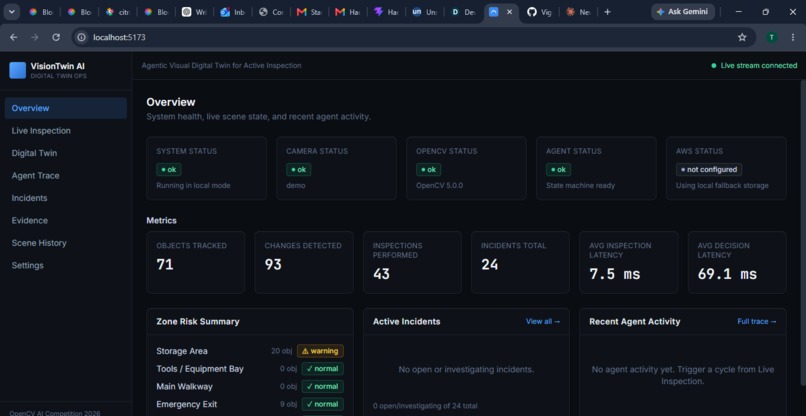
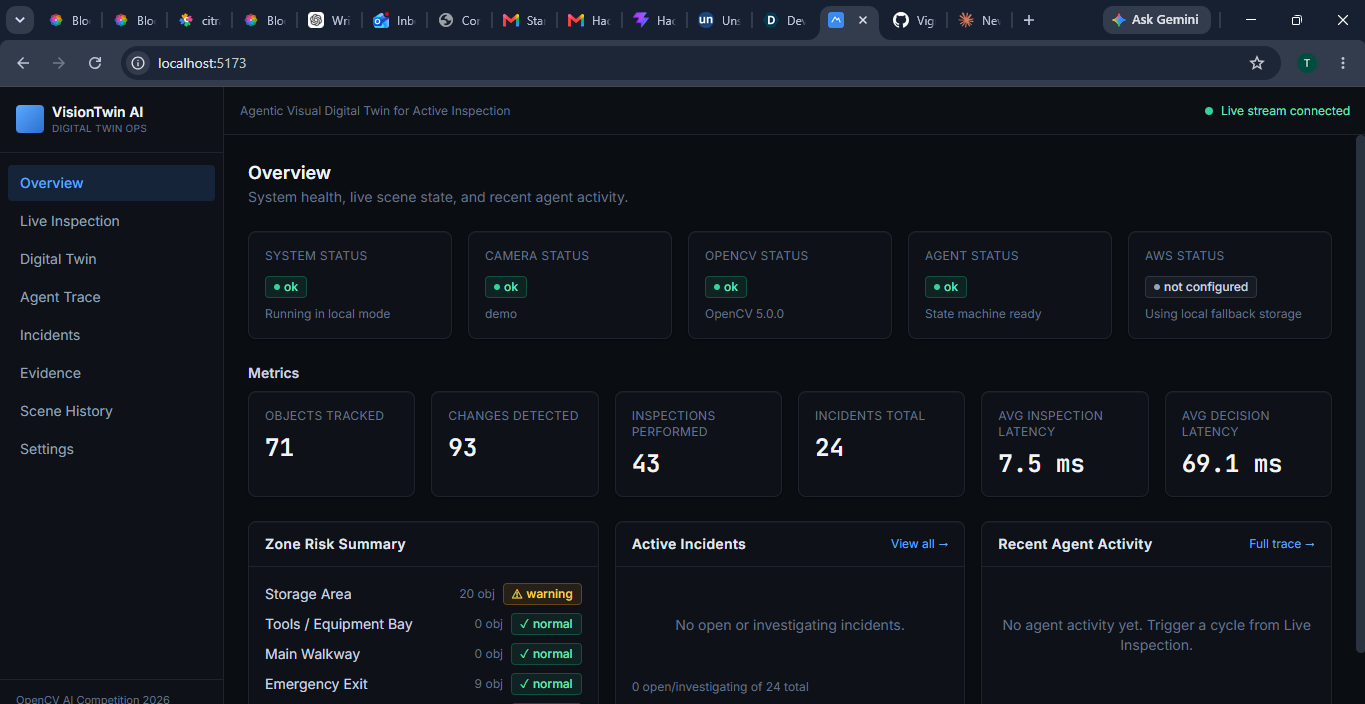
VisionTwin AI — an AI system that watches a warehouse and decides what's worth a closer look, built with OpenCV 5 and AWS.
-
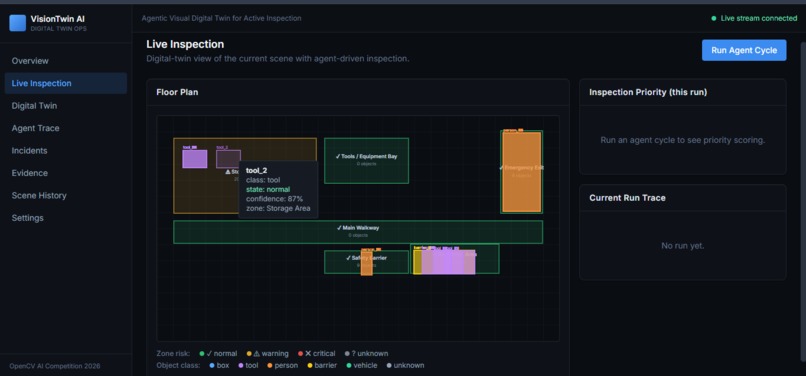
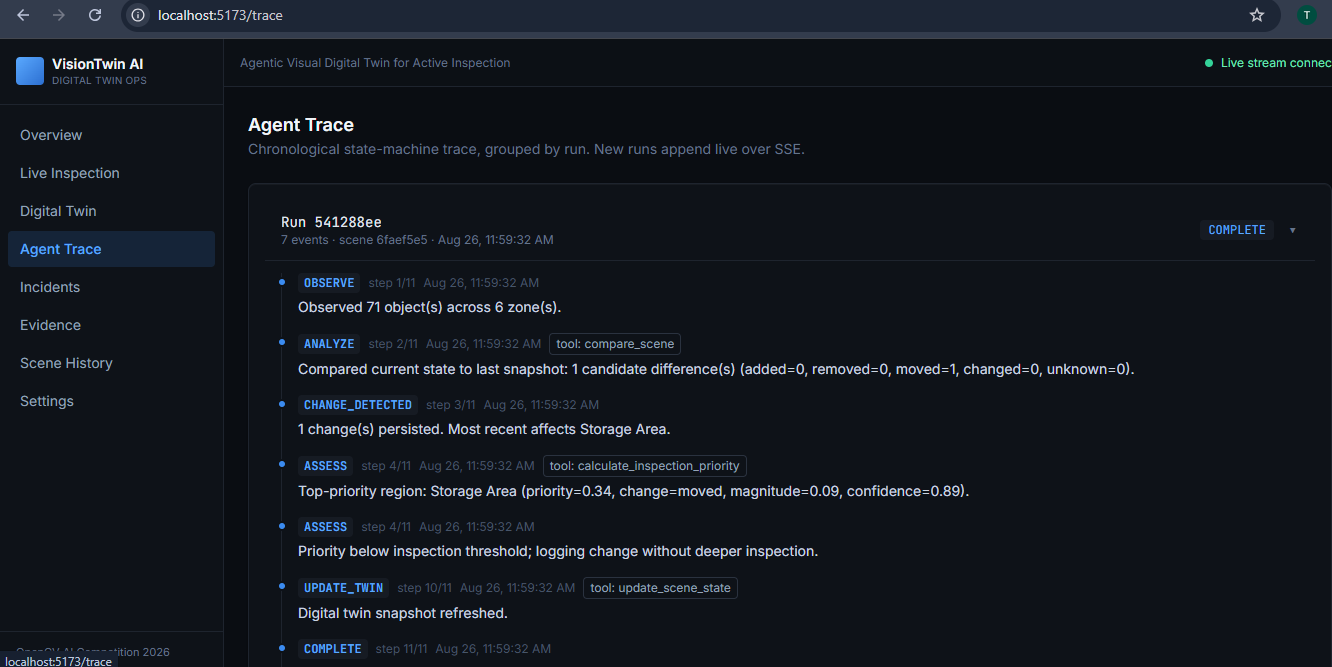
How the agent works: it watches, compares, picks what to check, inspects closer, then acts if needed.
-
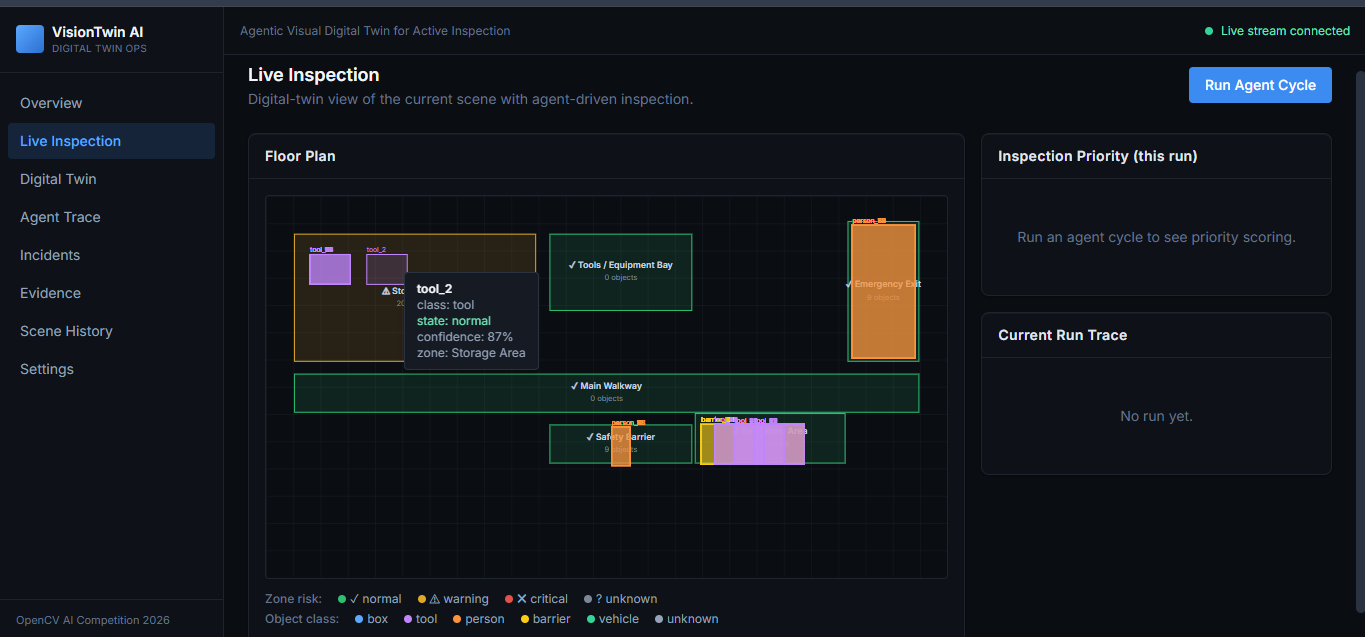
A real example: the system spots something in a restricted area and flags it.
-
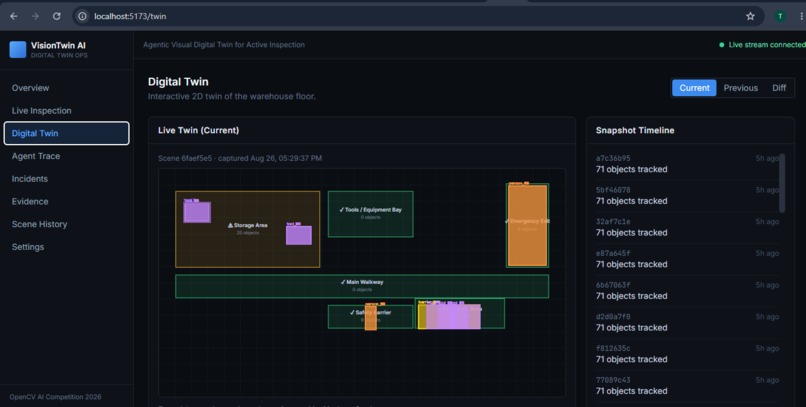
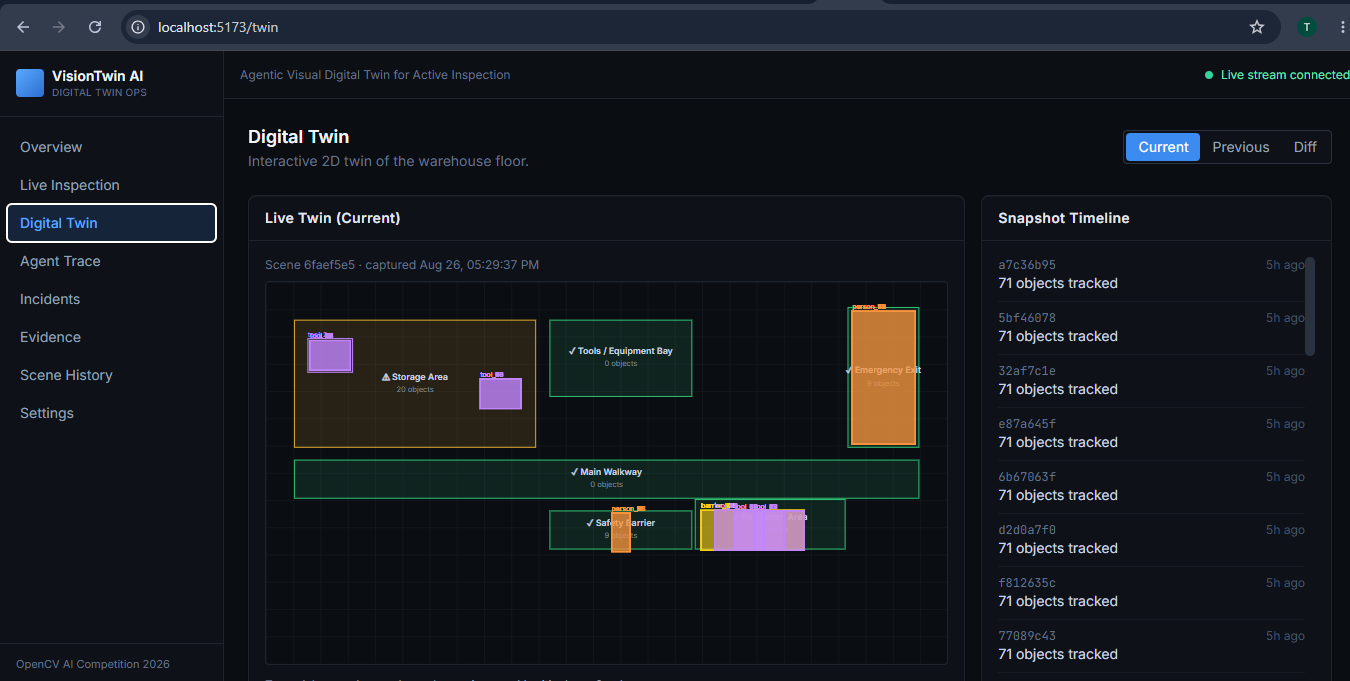
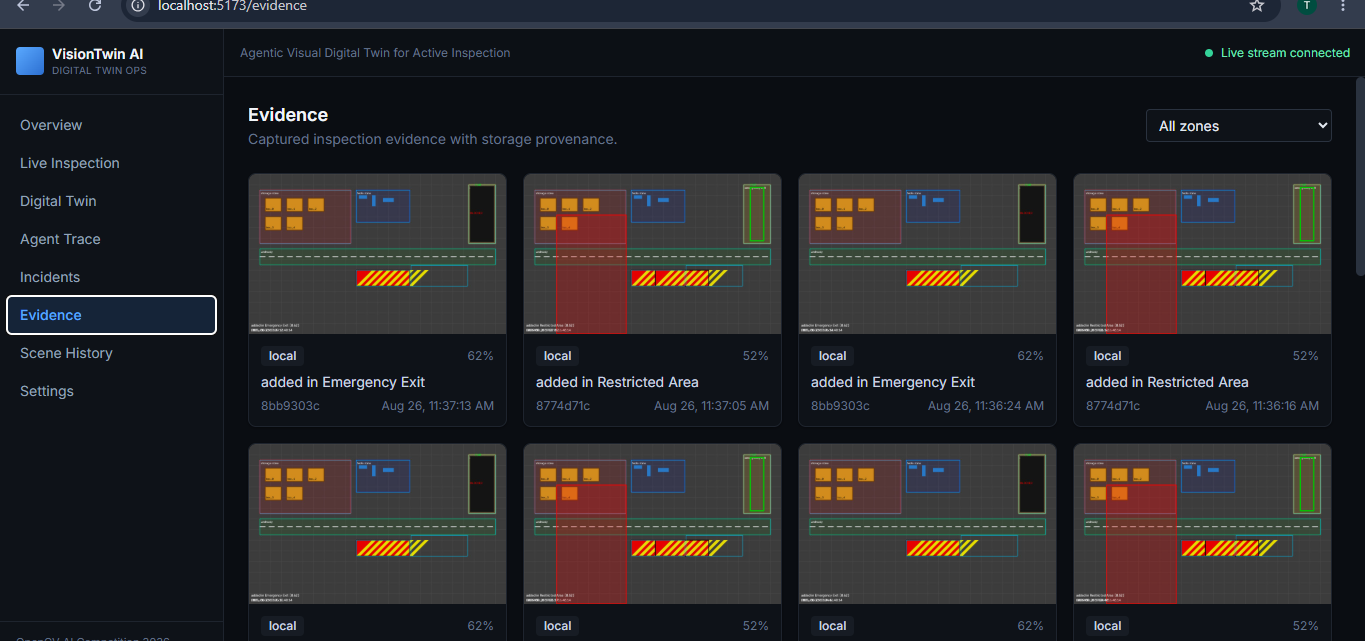
The system's map of the warehouse zones — storage, tools, walkway, and emergency exit.
-
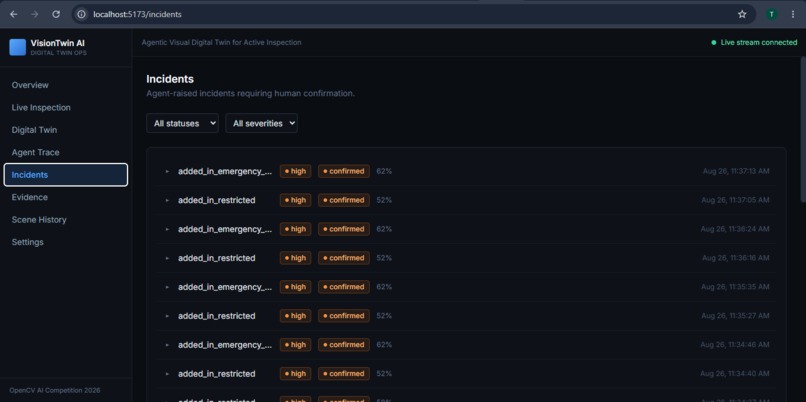
A closer inspection confirming something actually changed before creating an alert.
-
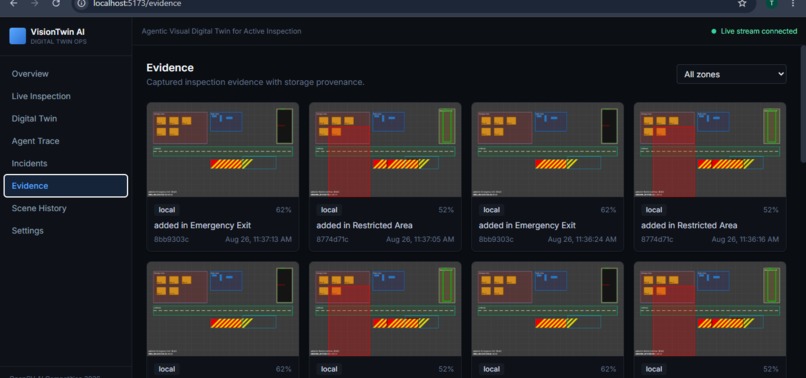
Another example of the system catching and scoring a change.
-
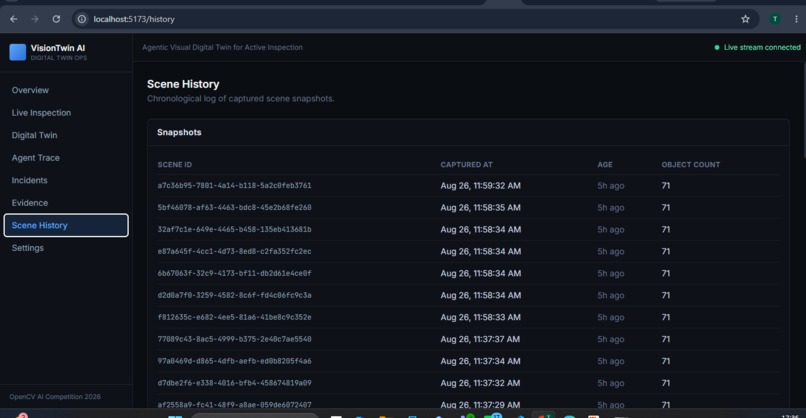
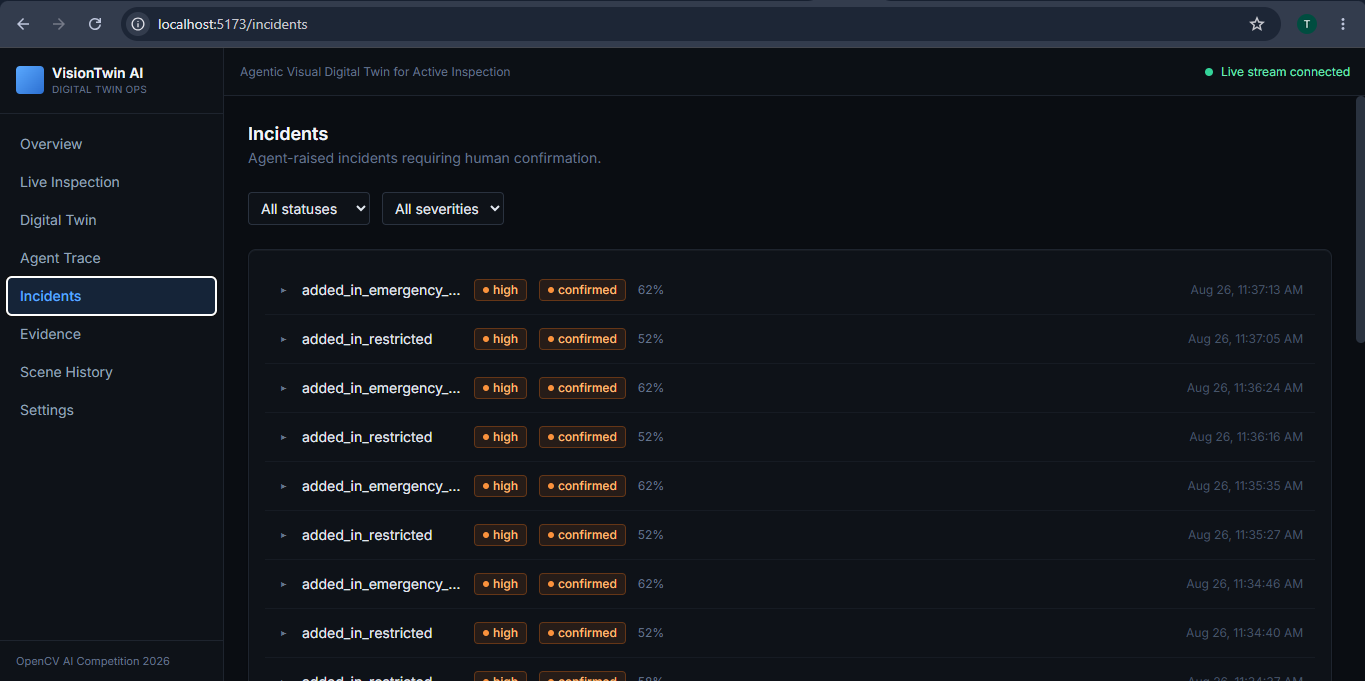
An alert with a timestamp, created automatically by the system.
-
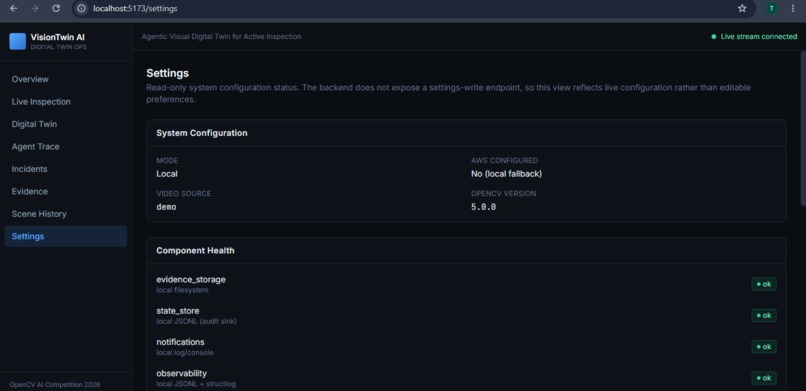
One more real result from the system — not a mockup, actual output.
Inspiration
Most "AI camera" products fall into one of two traps. Either they stream every frame through a detector and dump a wall of "person detected" / "box detected" alerts on an operator who eventually just tunes them out — or they hand the decision to a black-box model that silently auto-resolves things with no explanation and no human in the loop. A blocked emergency exit and a box nudged two inches on a shelf get the exact same treatment: a bounding box on a screen.
We wanted to build something closer to how a good human inspector actually works: glance at the whole floor, notice something's off in one corner, walk over, look closer, and only then decide whether it's worth raising an alarm — and be able to explain that decision afterward. That's the idea behind VisionTwin AI: an agentic visual digital twin that actively chooses where to look next, instead of treating every pixel as equally important.
What it does
VisionTwin AI watches a scene (warehouse-style, in this build) and maintains a live digital twin — objects, zones, risk state — that updates every cycle. On top of that twin runs a deterministic, fully-auditable agent loop:
- Perceive — classical OpenCV 5 vision (background subtraction, contour analysis, centroid tracking, zone mapping) builds a picture of what's in the scene and where.
- Compare — the live scene is diffed against the last persisted twin snapshot to find what changed.
- Decide where to look — a transparent, weighted priority score (magnitude, zone risk, detector confidence, object importance, incident history — no black box) ranks every candidate change.
- Inspect — only the top-priority region gets a deeper, more expensive OpenCV pass (Canny edge density + SSIM) to confirm or reject it.
- Act — confirmed events become an audited incident with a rendered evidence JPEG and an operator notification for high/critical severity, gated by a responsible-AI rule that never lets the agent auto-resolve a critical incident on its own.
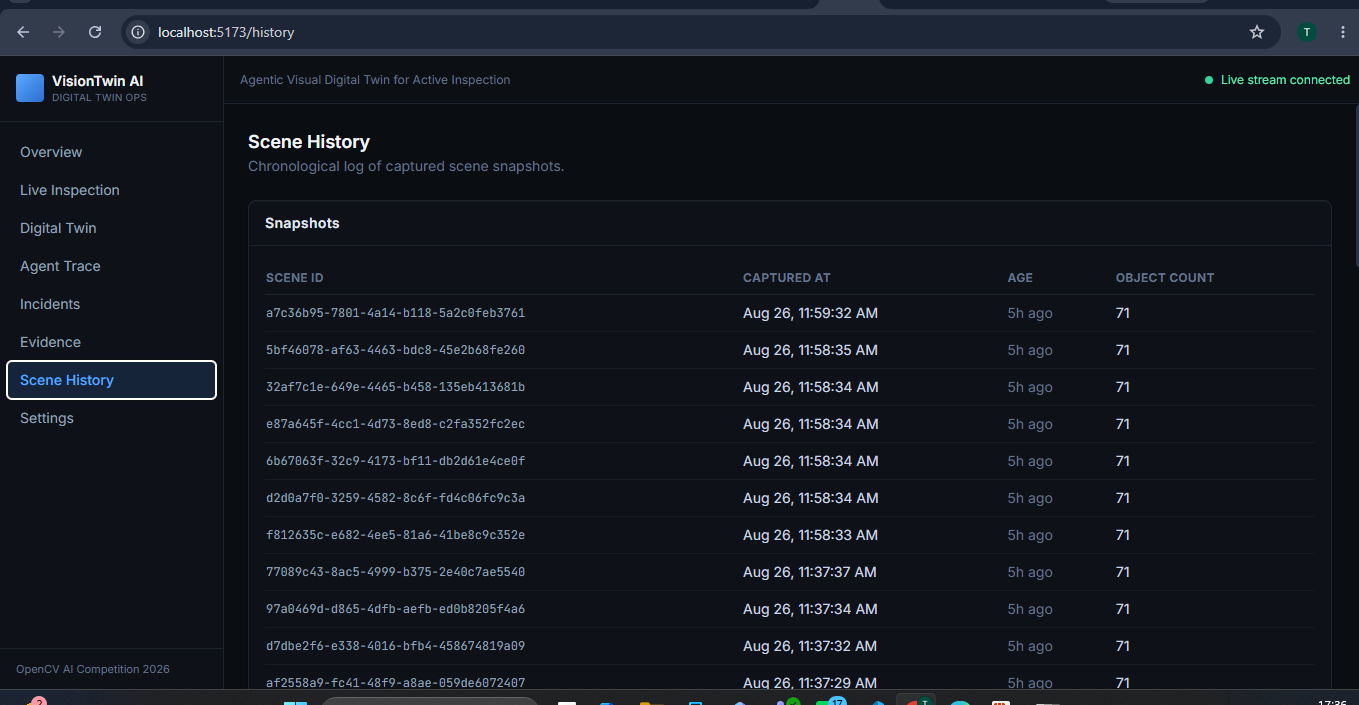
- Update the twin — the baseline snapshot refreshes every cycle, whether or not anything happened.
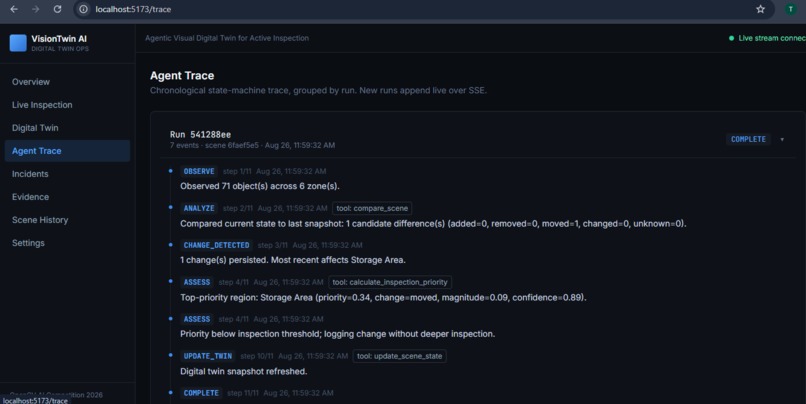
Every state transition is persisted as a replayable event — never raw model chain-of-thought — so a full run can be inspected end to end through GET /api/v1/agent/traces.
How we built it
- Vision layer — OpenCV 5, no shortcuts. Every stage is real, working classical CV: MOG2 background subtraction + contour analysis for detection, greedy nearest-centroid tracking, point-in-polygon zone mapping,
absdiff+ a from-scratch Gaussian-window SSIM (Wang et al. 2004) + dense Farneback optical flow for comparison, and Canny + SSIM for deep inspection. No trained deep-learning detector is used or claimed — that's a deliberate scope choice, documented rather than hidden. - Agent layer — a deterministic state machine, not a prompt loop:
OBSERVE → ANALYZE → CHANGE_DETECTED → ASSESS → SELECT_REGION → INSPECT → REASSESS → DECIDE → ACTION → UPDATE_TWIN → COMPLETE, driving 8 explicit, named tools (compare_scene,inspect_region,calculate_inspection_priority,capture_evidence,create_incident,notify_operator,update_scene_state,request_human_confirmation). - Priority formula, out in the open:
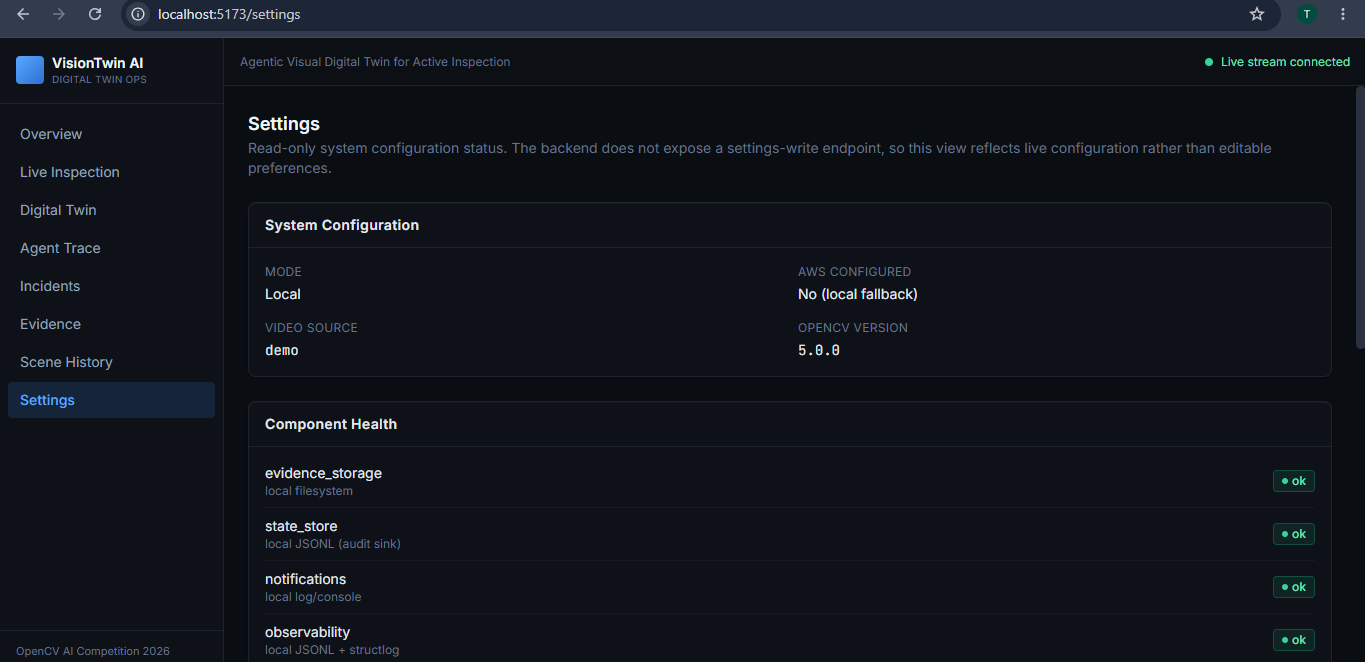
priority = 0.30·magnitude + 0.20·zone_risk + 0.20·confidence + 0.10·object_importance + 0.10·history_score, dampened for ambiguous change types — so the agent's next move is always traceable to concrete factors. - Cloud layer — AWS as an adapter, not a dependency. S3 stores evidence images (presigned URLs), DynamoDB mirrors incidents/events for durability (explicitly not the system of record — SQLite always is), SNS notifies operators on high/critical severity, CloudWatch carries metrics and logs. A single factory picks AWS or an honest local-mode fallback (files, JSONL, structlog) based on whether credentials are actually configured, so the whole system runs completely offline with zero AWS account required.
- Backend: FastAPI, 20 REST endpoints across 9 route modules, plus a live SSE event stream.
- Frontend: React + TypeScript + Vite, a typed API client covering the full backend contract, and 8 pages (Overview, Digital Twin, Agent Trace, Incidents, Evidence, Live Inspection, Scene History, Settings).
- Demo data: since we didn't have a physical camera or warehouse,
vision/samples/warehouse_scene_generator.pydeterministically draws synthetic scripted scenes from pure OpenCV primitives. It only manufactures pixels — every detection, track, comparison, and inspection result downstream is computed by the real vision pipeline running against those pixels, nothing is faked.
Challenges we ran into
- Keeping the "active perception" idea honest rather than cosmetic — it would have been easy to fake a priority score that didn't actually gate anything. Instead the priority formula genuinely determines which single region gets the expensive deep-inspection pass each cycle.
- Building a responsible-AI gate that's a real code path, not a policy statement:
request_human_confirmationhard-routes any critical-severity incident toinvestigating— there is no code path anywhere in the agent that lets a critical incident auto-confirm or auto-resolve. - Zone-localization wasn't perfect: our evaluation harness scores 1.0 precision/recall/F1 on synthetic ground truth, but zone-localization accuracy is 0.80 — the
barrier_movedscenario fails to localize to any zone at all three tested resolutions. We chose to report that honestly rather than quietly drop the metric. - Time-boxing meant AWS mode is implemented and unit-tested (adapter tests against local/mocked behavior) but wasn't exercised against a live AWS account, and
docker-compose.ymlwas reviewed but not run, in this build environment. We'd rather list those gaps plainly than overstate what's verified.
Accomplishments that we're proud of
- 51 backend tests passing across agent, integration (API + AWS adapters), unit, and vision suites.
- Perfect detection precision/recall/F1 (1.0) on our synthetic evaluation harness (18 labeled samples, 3 resolutions × 6 scripted change types) — reported alongside the 0.80 zone-localization gap, not instead of it.
- Measured, reproducible performance numbers (not estimates): ~150–210 ms/frame end-to-end on a dev machine with no GPU, dominated by dense Farneback optical flow in the coarse diff stage.
- A genuinely working end-to-end loop — synthetic scene → OpenCV detection → priority-scored inspection target → deep inspection → evidence JPEG → audited incident → notification — all traceable through a real, replayable agent trace.
- A documentation suite (10 docs, all grounded in actual file paths, line numbers, and re-run numbers) that says what's not done as clearly as what is.
What we learned
That "agentic" is easy to claim and hard to make real. The difference between a system that looks like it's making judgment calls and one that actually is comes down to whether the intermediate decisions (the priority score, the inspection gate, the human-confirmation threshold) are visible, numeric, and replayable — or just narrative dressing on top of a fixed pipeline. We also relearned that classical OpenCV, used deliberately, still gets you a long way before you need a trained model — and that saying so explicitly is more useful to a judge (or a future user) than dressing it up as deep learning.
What's next for VisionTwin AI
- Run AWS mode against a live account and a real Graviton/Compute Optimizer benchmark.
- Replace greedy nearest-centroid tracking with a Kalman filter / Hungarian-algorithm assignment for more robust identity across occlusions.
- Fix the
barrier_movedzone-localization gap identified in evaluation. - Independently verify the frontend end-to-end against a running backend (it currently aligns with the API contract by construction but hasn't been UI-tested by us).
- Validate the whole pipeline against real camera footage instead of the synthetic generator — lighting, noise, and ambiguous real-world scenes are the next real test.
Built With
- agentic-ai
- amazon-cloudwatch
- amazon-dynamodb
- amazon-sns
- amazon-web-services
- computer-vision
- digital-twin
- docker
- fastapi
- javascript
- numpy
- opencv
- opencv5
- pytest
- python
- react
- rest-api
- server-sent-events
- sqlite
- tailwindcss
- typescript
- uvicorn
- vite

Log in or sign up for Devpost to join the conversation.