-
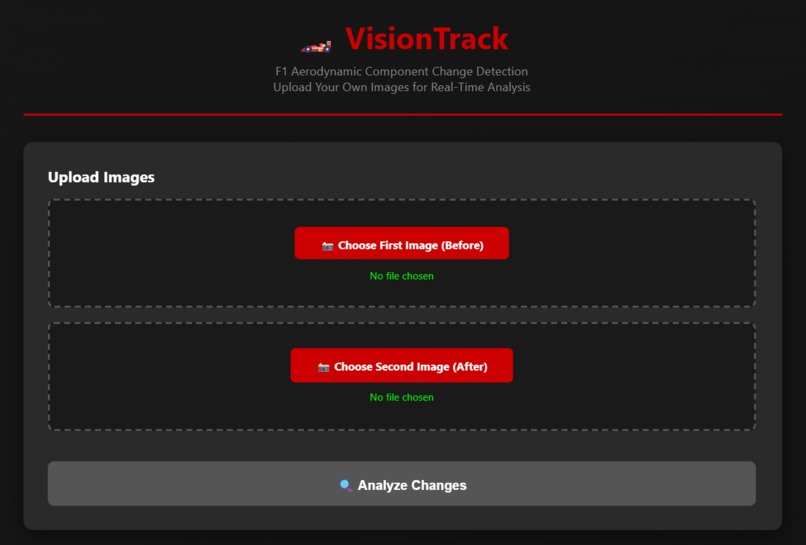
Upload Page
-
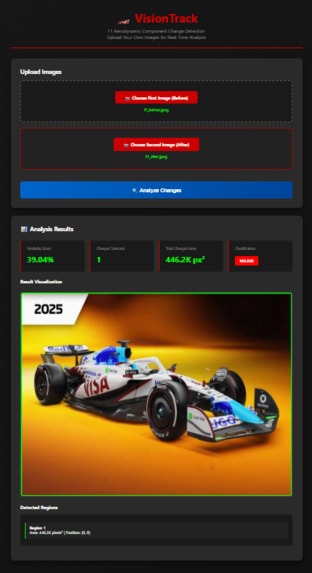
Analysis Page


Inspiration
In Formula 1, precision defines performance. Even the slightest visual change, a crack in the chassis, tire wear, or an aerodynamic tweak can impact results. Inspired by the fast-paced accuracy of F1 engineering, we built VisionTrack, a Visual Difference Engine that detects, classifies, and visualizes changes in time-series images. Our goal: to help machines see what humans might miss, with the speed and intelligence of an F1 pit crew.
What We Learned
Working on VisionTrack taught us how to apply computer vision and deep learning to real-world change detection problems. We learned how to:
- Preprocess and align time-series images under dynamic lighting and camera angles.
- Use CNNs and Siamese networks for feature-based image comparison.
- Generate heatmaps and bounding boxes to visualize detected changes.
- Build an interactive web dashboard for human-in-the-loop validation.
- Optimize model performance for high-speed F1 visual feeds in real time.
How We Built It
1. Preprocessing: Used OpenCV to align “before” and “after” frames, normalize brightness, and reduce noise.
2. Detection Engine: Combined pixel-level differencing with deep feature extraction using a Siamese CNN model.
3. Classification: Trained a model to classify detected changes into:
- Damage
- Wear
- New addition
- Visual anomaly
4. Visualization: Developed a React-based web interface to display before/after sliders and overlay AI-generated change maps.
5. Optimization: Deployed the model with GPU acceleration on AWS EC2 for ultra-fast inference.
Mathematical Representation
The visual change between two frames is defined as: $$ D = | f(x_t) - f(x_{t+1}) |_2 $$ where ( f(x_t) ) is the feature embedding of an image at time ( t ), and ( D ) measures the magnitude of visual change between two frames.
Challenges We Faced
- Lighting & Perspective Variations: F1 environments change rapidly; aligning frames precisely was tough.
- False Positives: Reflections and shadows triggered false alerts — solved using adaptive masking and shadow filtering.
- Computation Speed: Real-time processing of high-res frames required GPU optimization and frame batching.
- Data Scarcity: Real F1 datasets were limited, so we generated synthetic data with simulated defects and track conditions.

Log in or sign up for Devpost to join the conversation.