-
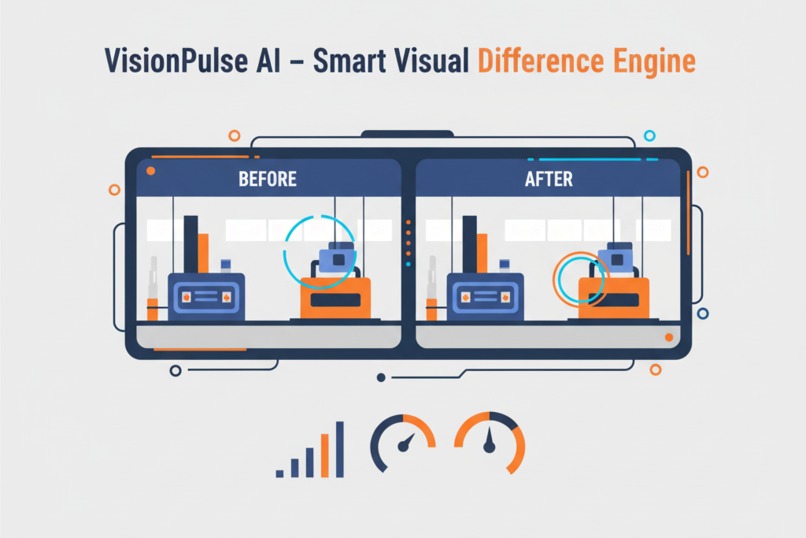
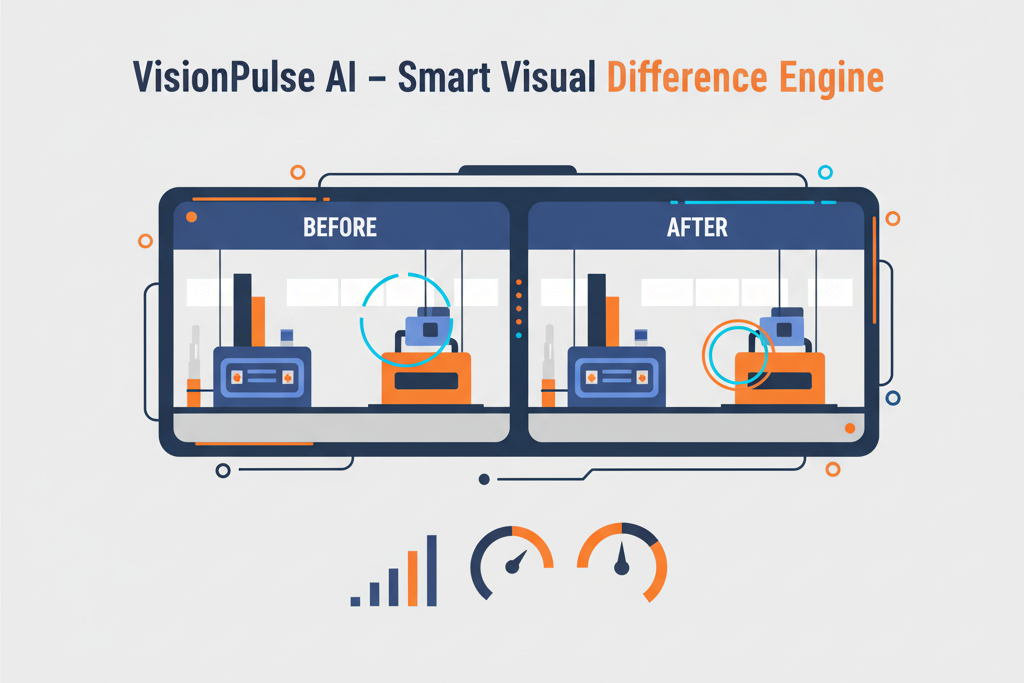
Spot the difference, instantly. Our system uses advanced AI to detect critical changes in industrial settings with glowing precision
Inspiration
We were inspired by how industries like manufacturing, infrastructure, and brand auditing rely heavily on visual inspections — yet most of these are done manually. Humans often miss subtle but crucial differences between images captured at different times, leading to quality issues, delayed maintenance, or compliance failures. We wanted to build an AI assistant that can see and reason about visual changes automatically, turning a tedious process into a data-driven insight engine.
What it does
VisionPulse AI is a general-purpose visual difference engine that compares two or more time-series images to automatically:
- Detect and highlight visual changes
- Classify the type of change (color shift, object displacement, surface defect, etc.)
- Generate a textual summary explaining what changed and by how much It helps in detecting manufacturing defects, infrastructure wear, or brand inconsistencies — all through AI-powered vision analysis.
How we built it
- Image Alignment : We used OpenCV feature matching (ORB + homography) to align images and eliminate camera angle or scale differences.
- Change Detection : Applied Structural Similarity Index (SSIM) and Optical Flow to compute pixel-level and motion-based differences.
- AI Classification : A lightweight Convolutional Neural Network (CNN) trained on synthetic image pairs classifies changes as structural, color, or object-based.
- Visualization : Generated a heatmap overlay to visualize changed regions and displayed a simple Flask web UI for uploading and comparing images.
- Reporting : Produced a short text summary describing detected changes and severity levels.
Challenges we ran into
- Handling lighting variations and reflections that caused false positives.
- Aligning slightly rotated or cropped images precisely.
- Running AI inference efficiently on limited hardware without GPUs.
- Designing a general model that works across multiple domains — from factory images to construction sites.
Accomplishments that we're proud of
- Built a fully functional prototype pipeline that performs alignment, detection, and difference visualization.
- Created a modular architecture that can adapt to any domain (manufacturing, infrastructure, etc.).
- Achieved stable and explainable outputs using a mix of classical vision + modern AI.
- Made a tool that’s genuinely useful — not just for research, but for real-world inspection automation.
What we learned
- How traditional image processing (OpenCV) and AI (CNNs) complement each other.
- The importance of data normalization and image registration before AI processing.
- How to generate explainable AI results that help humans make better decisions.
- Improved understanding of performance optimization for local and cloud-based image analysis.
What's next for VisionPulse AI
- Integrate drone or CCTV feeds for continuous infrastructure monitoring.
- Support video and 3D model comparisons to expand beyond static images.
- Train a domain-specific model for manufacturing or road quality analysis.
- Deploy as a cloud API that industries can integrate into their existing systems.
- Add a temporal tracking dashboard showing how things change over days, weeks, or months.


Log in or sign up for Devpost to join the conversation.