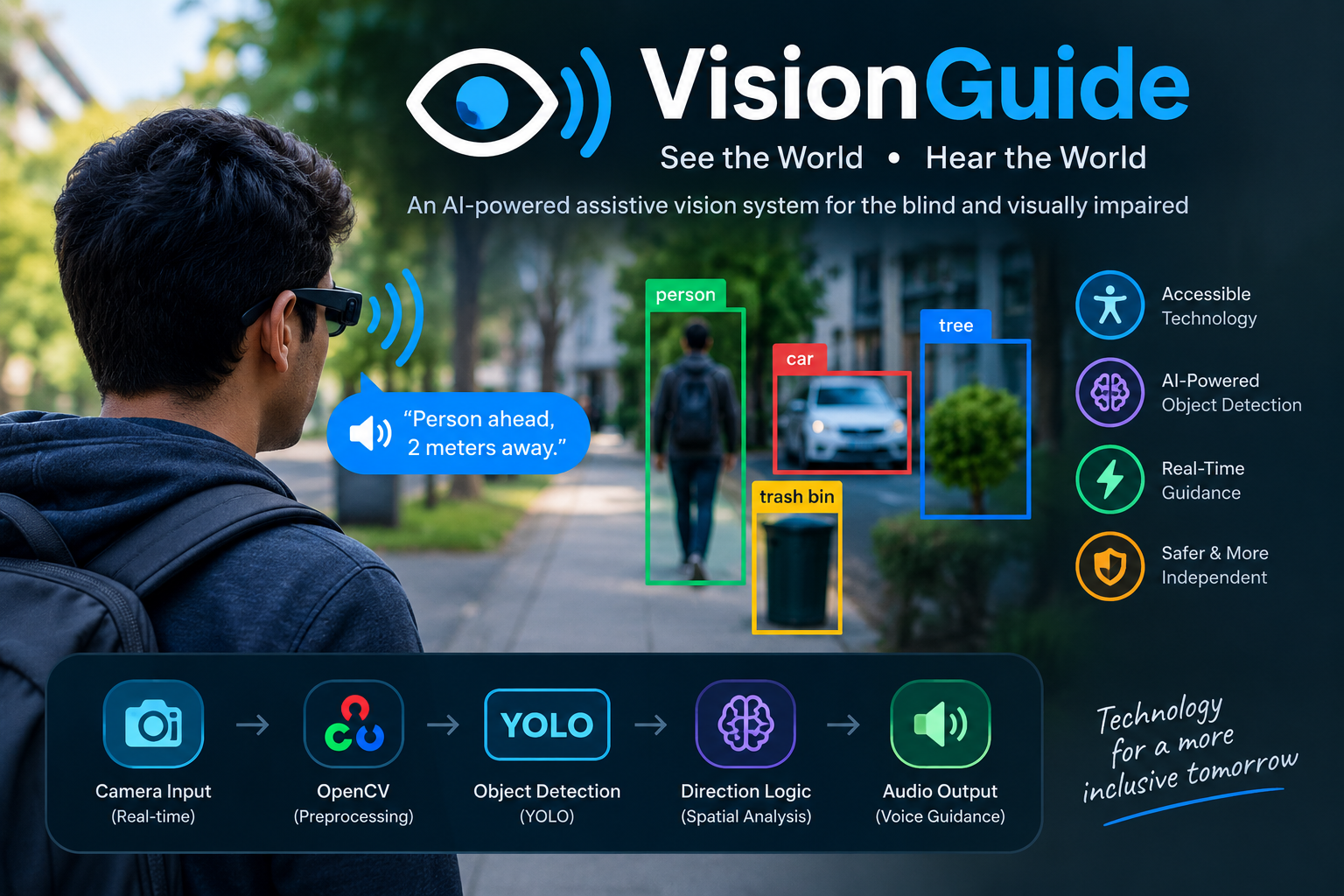
VisionGuide
Inspiration
VisionGuide was inspired by the idea of making everyday surroundings more accessible to people who are blind or visually impaired. Traditional computer vision can identify objects, but simply knowing that an object exists is not always enough. We wanted to build a system that could detect objects and communicate where they are located in a simple, actionable way.
This led us to VisionGuide — an AI-powered vision assistant designed to transform visual information into meaningful audio guidance.
What it does
VisionGuide uses a camera feed to understand the user's surroundings in real time.
The system:
- Captures frames using OpenCV.
- Detects objects using a pre-trained YOLO model.
- Identifies the object's bounding box and confidence.
- Determines whether an object is on the left, ahead, or right.
Converts the detected information into simple guidance such as:
- "Person on your left"
- "Chair ahead"
- "Car on your right"
Provides the foundation for real-time voice-based environmental awareness.
Our goal is to make the output simple and useful rather than overwhelming the user with unnecessary visual information.
How we built it
The current VisionGuide pipeline is built using Python and follows a modular computer-vision architecture:
Camera → OpenCV → YOLO → Direction Analysis → Voice Guidance
Technologies used
- Python — core application development
- OpenCV — image and video processing
- YOLO — real-time object detection
- NumPy — image/data processing
- Tensor/PyTorch ecosystem — YOLO inference
- AWS Graviton — ARM-based cloud deployment and benchmarking
- AWS Cloud-Optimized OpenCV Library (COOL) — planned optimization stage
We first developed and tested the application locally, then moved the workload to an AWS Graviton-based environment.
As part of our optimization work, we established a standard OpenCV baseline on a Graviton instance. For a 1080p-to-640×480 resize workload, the baseline measured approximately 0.588 ms average latency and 1701 operations/sec over 100 iterations.
The next optimization stage is to run the same workload through AWS COOL and compare the results under reproducible conditions.
Challenges we ran into
One of the biggest challenges was moving a computer-vision application from a loc
Built With
- amazon-web-services
- cool
- fastapi
- opencv
- python
- yolo

Log in or sign up for Devpost to join the conversation.