-
-
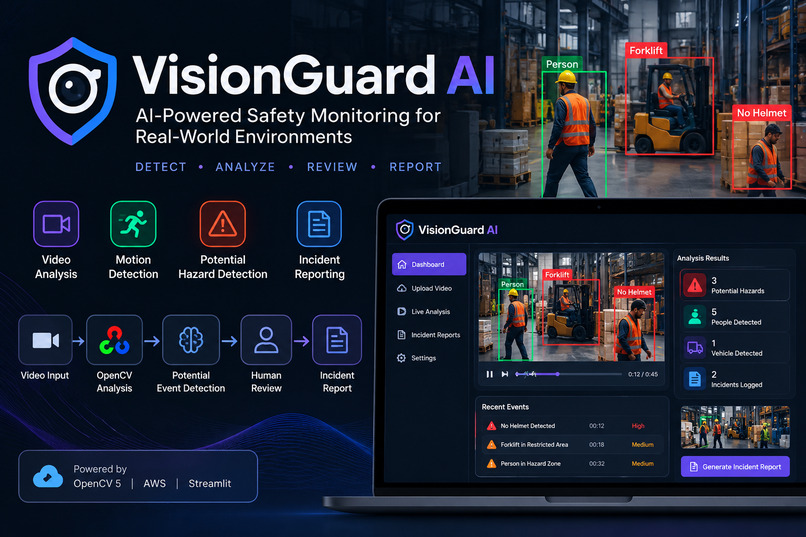
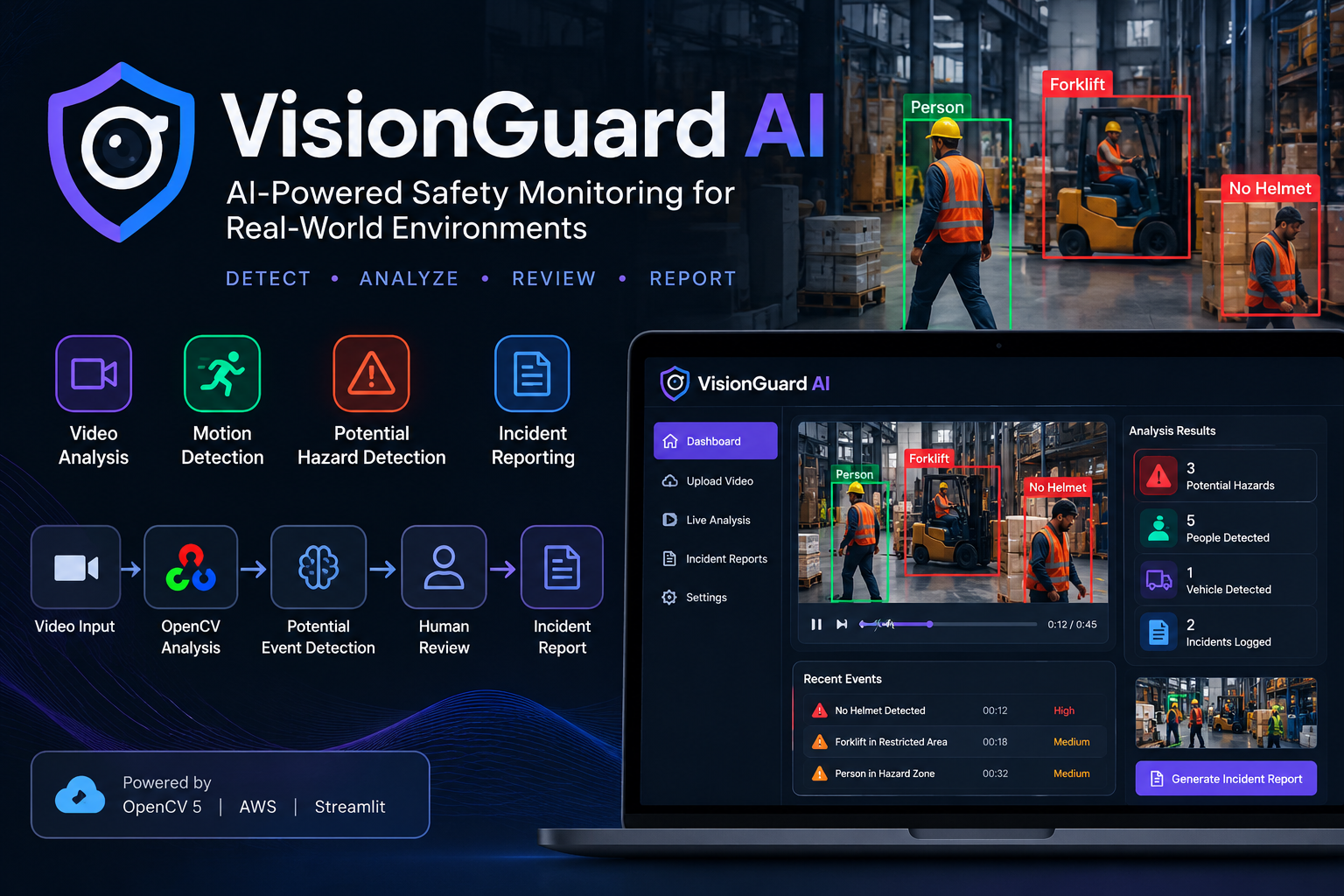
An OpenCV5 and AWSoriented safety monitoring prototype for video analysis, potential hazard detection, human review, and incident reporting.
About the Project
Inspiration
Workshops, laboratories, and warehouses can contain potential safety risks that are difficult to monitor continuously. We wanted to explore how computer vision and cloud technology could help analyze video, flag suspicious activity, and support faster human review. This inspired us to build VisionGuard AI: Agentic Safety Inspector using OpenCV 5 and AWS.
What It Does
VisionGuard AI analyzes video frames and monitors a designated region for sustained motion. When activity meets the configured detection criteria, the system can flag it for further inspection and help generate an incident report. The project is designed as a foundation for an agentic safety workflow, where visual observations can guide the next inspection step or request human review.
How We Built It
We structured the project into separate components for video analysis, application logic, and cloud storage. OpenCV handles frame processing and motion analysis, while AWS S3 is intended for storing relevant incident evidence. The application is packaged with Docker to support consistent deployment, and the documentation describes the architecture, setup, and testing process.
Challenges We Faced
One key challenge was designing a simple detection pipeline that could identify sustained motion without treating every movement as a confirmed safety violation. We also considered reproducibility, cloud configuration, and secure handling of AWS credentials. Another important challenge was distinguishing a potential event from a verified hazard, which is why human review and transparent limitations are important parts of the design.
What We Learned
Building VisionGuard AI helped us explore computer vision pipelines, video-frame analysis, cloud storage integration, containerized deployment, and responsible AI system design. We learned that useful safety tools need more than detection: they also need clear evidence, understandable reports, careful evaluation, and human oversight.
Future Scope
Future improvements could include detecting specific safety equipment and restricted-zone violations, supporting multiple camera feeds, adding configurable alert thresholds, and evaluating performance on a wider range of real-world footage.
Current limitation: This prototype focuses on motion in a designated region. Motion alone does not establish that a hazard or safety violation has occurred, and further testing and validation would be required before real-world safety use.
Built With
- agentic-ai
- amazon-web-services
- artificial-intelligence
- cloud-computing
- computer-vision
- docker
- flask
- machine-learning
- motion-detection
- opencv-5
- python
- safety-monitoring
- video-analysis

Log in or sign up for Devpost to join the conversation.