VisionForge — Agentic AI for Autonomous Industrial Inspection
See. Investigate. Reason. Re-inspect. Act.
🚨 The Problem
Modern manufacturing relies heavily on visual inspection to identify defects such as misaligned labels, damaged containers, missing components, surface anomalies, and geometric deviations.
Traditional computer-vision inspection systems are often built around a fixed pipeline:
Camera → Detection → PASS/FAIL
The problem is that real-world inspection is rarely that simple.
When visual evidence is ambiguous, a fixed pipeline may not know what to inspect next, which additional evidence is needed, or when a human should intervene.
We wanted to build something different.
💡 Our Solution
VisionForge is an agentic computer-vision platform for autonomous industrial inspection.
Instead of simply detecting a defect, VisionForge creates a continuous perception-and-investigation loop:
Camera / Video
↓
OpenCV 5 Perception
↓
Visual Evidence
↓
Vision Agent
↓
Plan Investigation
↓
Select CV Tool
↓
Re-inspect
↓
New Evidence
↓
Reason
↓
Decision
↓
Human Approval
↓
Action + Audit Trail
The key idea is simple:
The visual evidence determines what the agent does next.
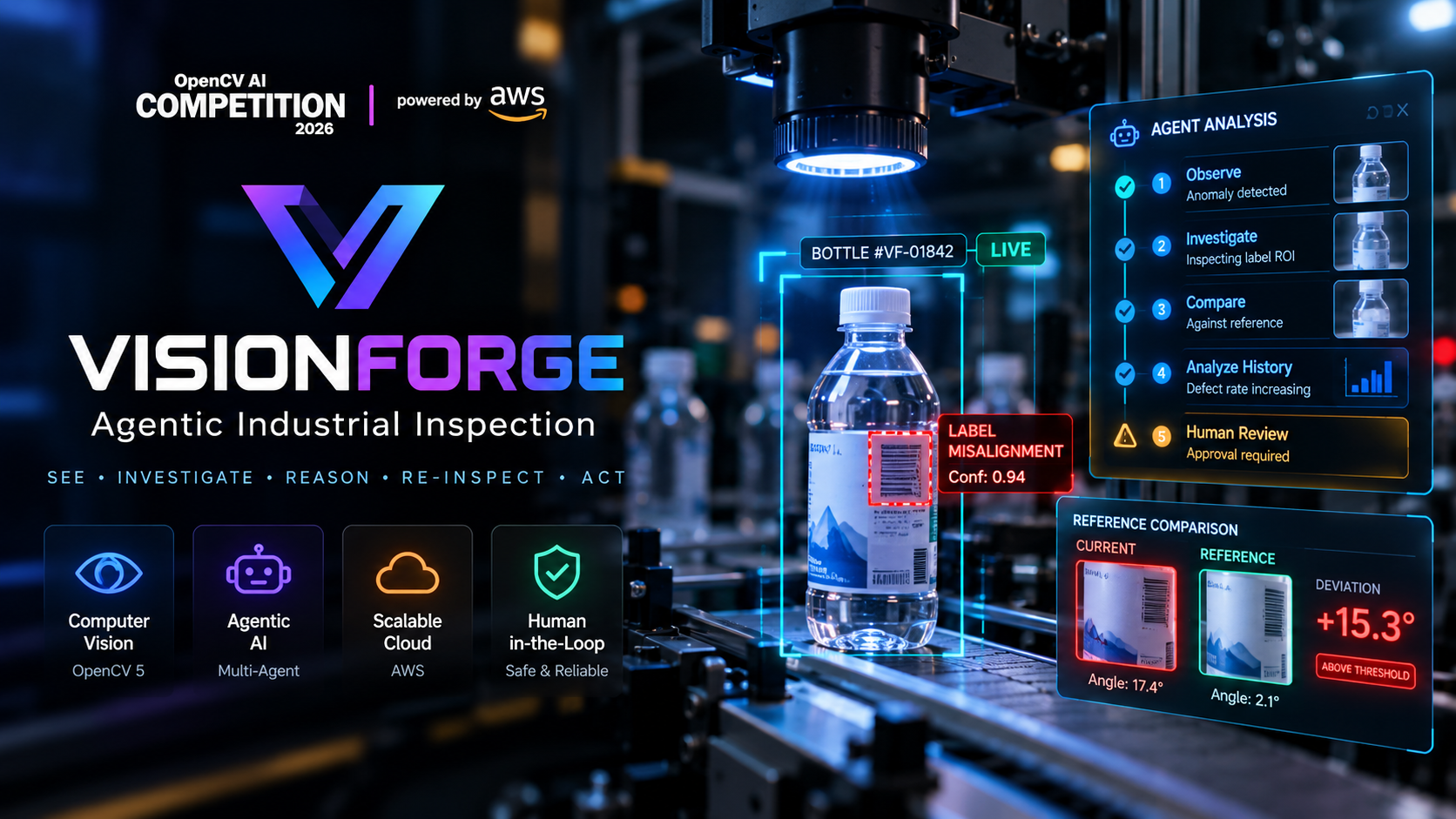
For example, if a bottle appears to have a potentially misaligned label, VisionForge doesn't immediately declare it defective.
The agent can:
Detect the suspicious region.
Extract the label ROI.
Perform edge and contour analysis.
Measure the label orientation.
Compare it with a reference.
Analyze recent inspection history.
Determine whether additional evidence is required.
Escalate the case to a human when appropriate.
👁️ OpenCV 5 at the Core
VisionForge is not an LLM wrapped around a camera.
OpenCV is a fundamental part of the inspection pipeline.
We use computer vision techniques for:
Image preprocessing
ROI extraction
Edge detection
Contour analysis
Geometric measurements
Shape analysis
Label alignment
Cap inspection
Surface anomaly analysis
Reference comparison
Image-quality analysis
Motion analysis
Object tracking
Evidence generation
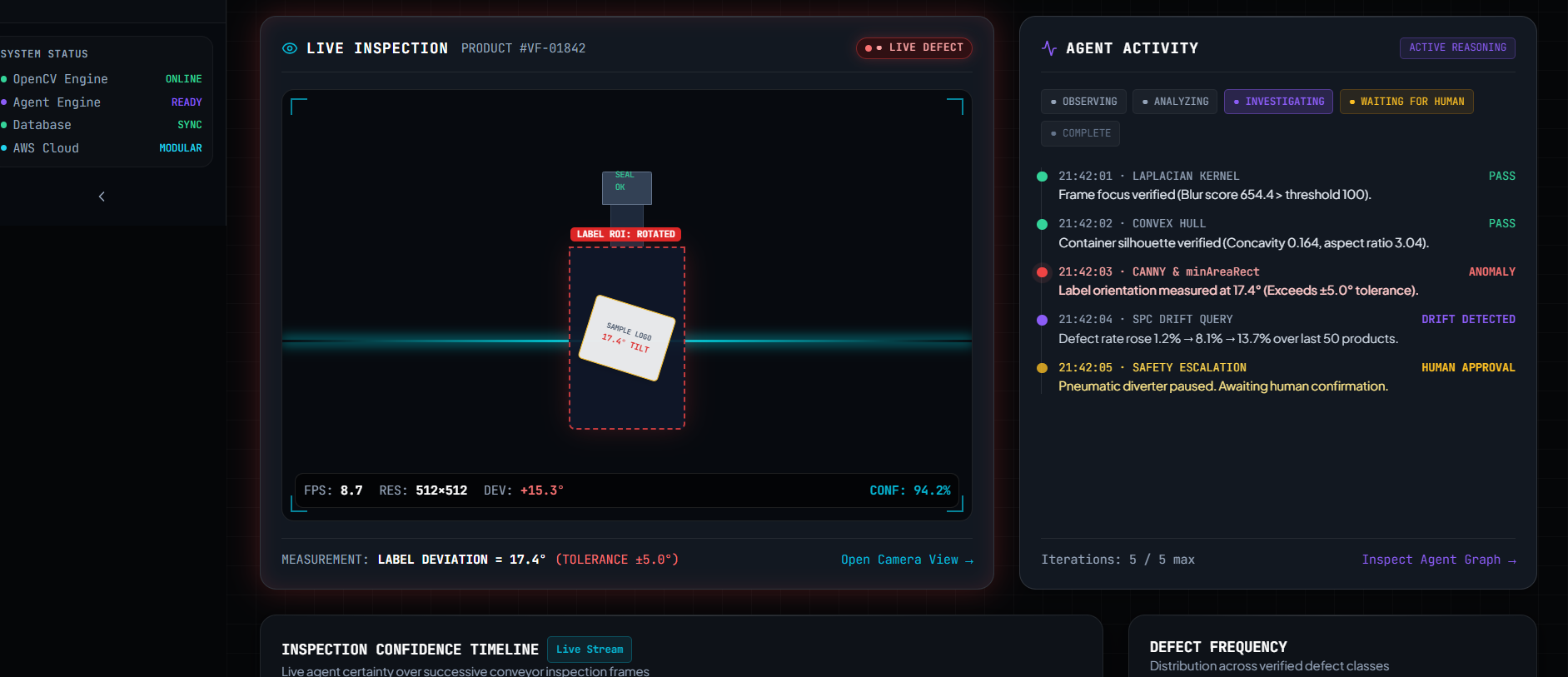
For example, label alignment can be converted into measurable visual evidence:
Current label angle = 17.4°
Reference label angle = 2.1°
Angular deviation = 15.3°
The agent can then use this evidence to decide whether another inspection step is necessary.
🤖 Agentic Vision
The most important part of VisionForge is the Agentic Vision Loop.
A conventional system might produce:
DEFECT DETECTED
Confidence: 94%
VisionForge instead produces an investigation trace:
OBSERVE
Potential label anomaly detected.
↓
PLAN
Additional evidence is required.
↓
TOOL
Extract high-resolution label ROI.
↓
EVIDENCE
Label angle = 17.4°.
↓
PLAN
Compare against reference.
↓
TOOL
Reference comparison.
↓
EVIDENCE
Deviation = +15.3°.
↓
PLAN
Check recent inspection history.
↓
EVIDENCE
Deviation is increasing across recent products.
↓
DECISION
Human review required.
This makes the system's behavior observable rather than hiding everything behind a single prediction.
🔬 Evidence-First AI
Every important decision in VisionForge is connected to visual evidence.
Evidence can include:
Original frame
Cropped ROI
Edge map
Contour visualization
Reference comparison
Difference image
Geometric measurements
Historical inspection data
Agent tool execution results
The platform is designed around a simple principle:
No evidence → no confident claim.
If the system does not have enough information, it can explicitly report:
"Insufficient evidence."
The system is also designed to distinguish between a measured observation and a hypothesis.
For example:
Measured observation: Label deviation is above the configured threshold.
versus:
Hypothesis: The increasing deviation may indicate label-applicator drift.
This distinction is important for trustworthy industrial AI.
🔄 Active Visual Investigation
VisionForge introduces an active perception approach.
The agent can determine:
"Where should I look next?"
If the complete frame is ambiguous, it can request a more focused inspection.
For example:
Full frame
↓
Possible anomaly
↓
Select ROI
↓
High-resolution inspection
↓
Measure geometry
↓
Compare reference
↓
Check history
This transforms computer vision from a passive detection pipeline into an interactive investigation system.
🧑💻 Human-in-the-Loop Safety
VisionForge does not blindly automate consequential decisions.
When an inspection reaches a critical or uncertain state, the system can request human approval.
Example:
┌─────────────────────────────────┐
│ HUMAN REVIEW REQUIRED │
│ │
│ Possible repeated anomaly │
│ Confidence: 94% │
│ │
│ Evidence: │
│ • 4 visual observations │
│ • Reference comparison │
│ • Historical trend │
│ │
│ Suggested action: │
│ Quarantine affected batch │
│ │
│ [ Re-inspect ] [ Reject ] │
│ [ Approve Action ] │
└─────────────────────────────────┘
For the prototype, operational actions are simulated and run in dry-run mode.
Every human decision is recorded in the audit trail.
☁️ AWS
VisionForge is designed with a cloud-ready architecture.
AWS can be used for:
Object/evidence storage
Scalable compute
Event processing
Monitoring
Production deployment
ARM/Graviton benchmarking
The architecture keeps cloud dependencies modular so the core computer-vision pipeline can also run locally.
This allows the project to remain reproducible while providing a path toward scalable deployment.
📊 Measurement Instead of Marketing
We wanted VisionForge to be measurable.
The system is designed to evaluate:
Computer Vision
Precision
Recall
F1 score
Accuracy
IoU where applicable
Measurement error
System Performance
Average latency
P95 latency
FPS
CPU utilization
Memory usage
Throughput
Agent Performance
Investigation success rate
Number of agent iterations
Tool calls
Human escalation rate
Time to decision
The benchmark system is designed to use actual measurements rather than fabricated performance numbers.
🧪 Reproducible Demo
VisionForge includes a demo environment designed around industrial bottle/container inspection.
The demo can simulate:
Normal products
Label misalignment
Missing labels
Cap abnormalities
Shape deformation
Surface anomalies
Blur
Lighting variation
Occlusion
Synthetic data can be generated for controlled testing and reproducible demonstrations.
Synthetic results are clearly distinguished from real-world manufacturing performance.
🏗️ Architecture
┌──────────────────┐
│ Camera / Video │
└────────┬─────────┘
↓
┌──────────────────┐
│ OpenCV 5 │
│ Perception │
└────────┬─────────┘
↓
┌──────────────────┐
│ Visual Evidence │
└────────┬─────────┘
↓
┌──────────────────┐
│ Vision Agent │
└────────┬─────────┘
↓
┌──────────────────┐
│ Tool Registry │
└────────┬─────────┘
↓
┌─────────────┴─────────────┐
↓ ↓
OpenCV Analysis Historical Data
↓ ↓
└─────────────┬─────────────┘
↓
┌──────────────────┐
│ Decision Engine │
└────────┬─────────┘
↓
┌──────────────────┐
│ Human Review │
└────────┬─────────┘
↓
┌──────────────────┐
│ Action + Audit │
└──────────────────┘
🛠️ Technology Stack
Computer Vision
OpenCV 5
Python
NumPy
Backend
FastAPI
Pydantic
SQLAlchemy
SQLite / PostgreSQL
Frontend
React
TypeScript
Vite
Tailwind CSS
Framer Motion
Recharts
Infrastructure
Docker
AWS
S3
CloudWatch
AWS compute / Graviton-compatible architecture
Testing
Pytest
API integration tests
Agent tests
End-to-end testing
Performance benchmarking
🎨 The Interface
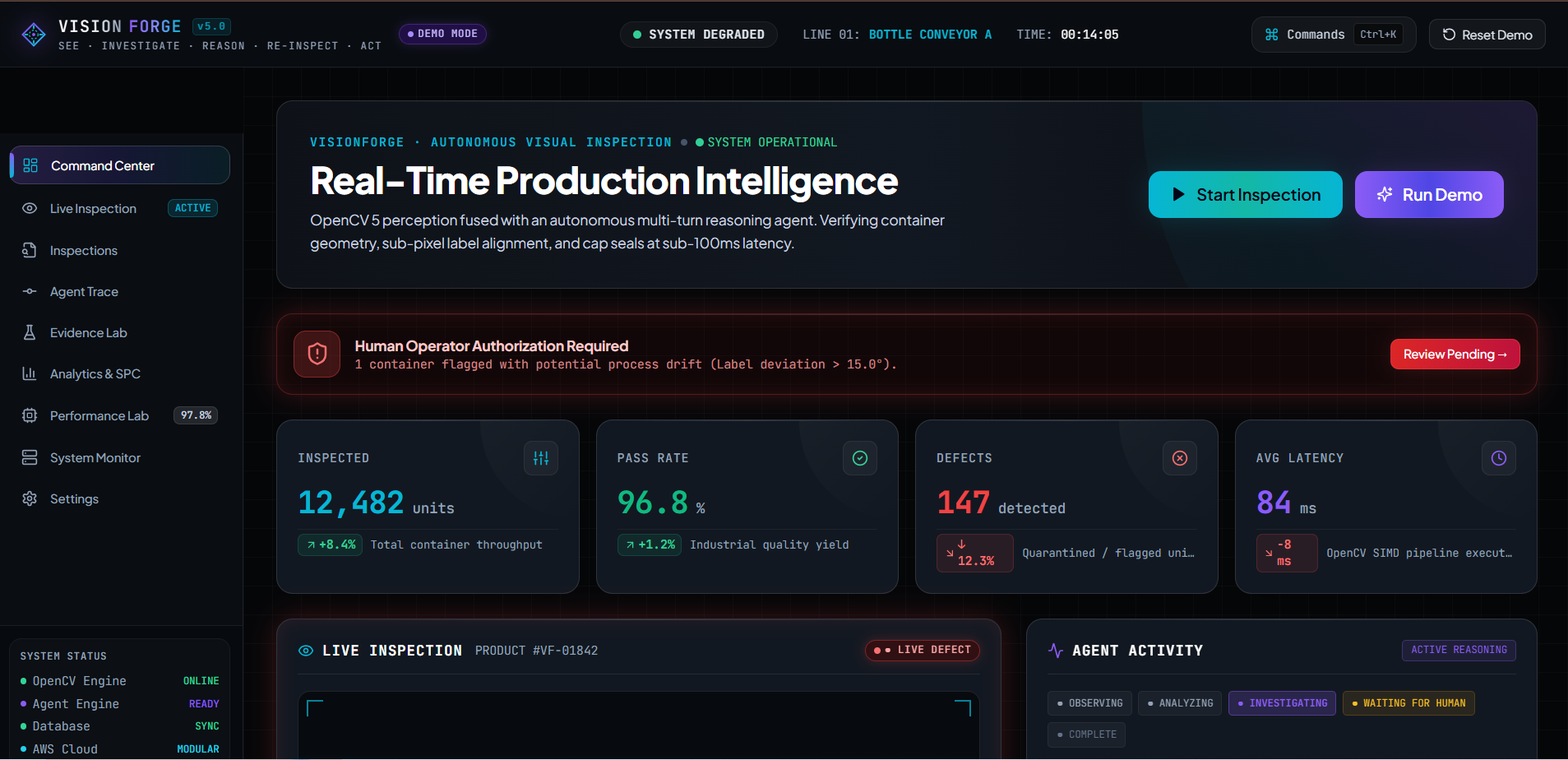
VisionForge was designed as an AI inspection command center rather than a conventional dashboard.
The interface provides dedicated views for:
Live Inspection
Agent Trace
Evidence Lab
Inspection History
Analytics
Benchmarking
Human Review
System Monitoring
The Agent Trace allows users to visually follow the system's investigation:
OBSERVE
↓
PLAN
↓
TOOL
↓
EVIDENCE
↓
REASON
↓
RE-INSPECT
↓
DECISION
The Evidence Lab lets users inspect the actual visual information behind a decision.
💭 What Inspired Us
We were inspired by a simple question:
What if computer vision could investigate instead of simply classify?
Industrial environments are messy.
Lighting changes.
Objects become partially occluded.
Cameras can produce imperfect frames.
Defects can be ambiguous.
A fixed pipeline cannot always know what information it needs next.
That led us to explore the combination of OpenCV + agentic reasoning + active visual inspection + human oversight.
📚 What We Learned
Building VisionForge required us to think beyond individual AI models.
We learned how to:
Design an agent around structured visual evidence.
Make computer vision measurements useful to an agent.
Build tool-based agent orchestration.
Separate deterministic CV measurements from AI reasoning.
Design human-in-the-loop safety mechanisms.
Track evidence provenance.
Build reproducible computer-vision benchmarks.
Design cloud-ready CV systems.
Build real-time visual interfaces.
Handle uncertainty instead of pretending AI is always correct.
One of the biggest lessons was:
A trustworthy AI system should be able to show why it reached a conclusion.
⚡ Challenges
Some of the hardest engineering challenges included:
1. Making the agent genuinely agentic
It was not enough to ask an AI model to describe an image.
We needed the visual evidence to influence the next tool call.
2. Combining deterministic vision with AI reasoning
Measurements such as angles, contours, and geometry should come from computer vision rather than being hallucinated by a language model.
3. Handling uncertainty
A real inspection system must know when it does not have enough evidence.
4. Designing reproducible evaluation
We separated demonstration data, synthetic data, and actual benchmark measurements to avoid misleading performance claims.
5. Human oversight
Automation is useful, but consequential operational decisions should remain controllable by authorized humans.
🚀 What's Next
Future versions of VisionForge could support:
Multiple industrial inspection domains
Multi-camera inspection
Edge deployment
Real-time production-line integration
More advanced anomaly detection
Digital twins
Predictive maintenance
Multi-agent inspection teams
Additional ARM/Graviton optimization
Continuous learning from verified human decisions
Our long-term vision is to make VisionForge a reusable agentic visual inspection engine rather than a single-purpose defect detector.
🏁 Final Thought
Traditional computer vision asks:
"What do I see?"
VisionForge asks:
"What do I see, what evidence am I missing, what should I inspect next, and when should a human decide?"
That is the idea behind VisionForge.
Built With
- agentic
- ai
- amazon
- amazon-web-services
- cloudwatch
- computer
- css
- docker
- ec2
- fastapi
- framer
- graviton
- motion
- numpy
- opencv
- postgresql
- python
- react
- s3
- sqlalchemy
- sqlite
- tailwind
- typescript
- vision
- vite


Log in or sign up for Devpost to join the conversation.