-
-
-
-
Ai vision
InspirationTechnology should not only be intelligent—it should be inclusive.
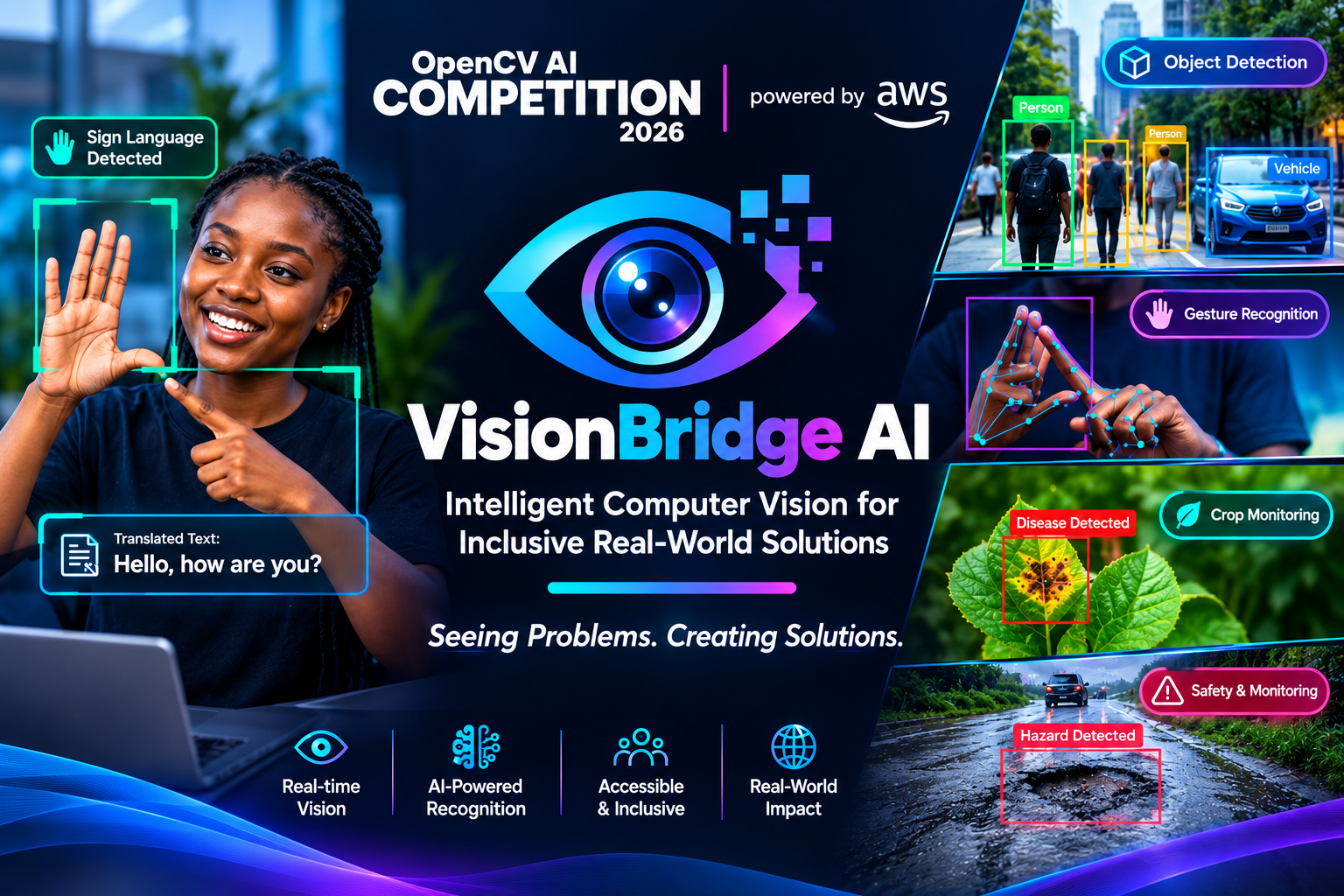
The idea for VisionBridge AI was inspired by the everyday communication and accessibility challenges faced by people with disabilities, especially people who use sign language. We imagined a world where a camera could understand visual information and help people communicate, interact, and respond to their environment more easily. This led us to explore how OpenCV, artificial intelligence, and computer vision could transform a simple camera into an intelligent assistant capable of understanding gestures, recognizing objects, and detecting important visual conditions. Our tagline captures the vision: “Seeing Problems. Creating Solutions.”
What it doesWhat We Built
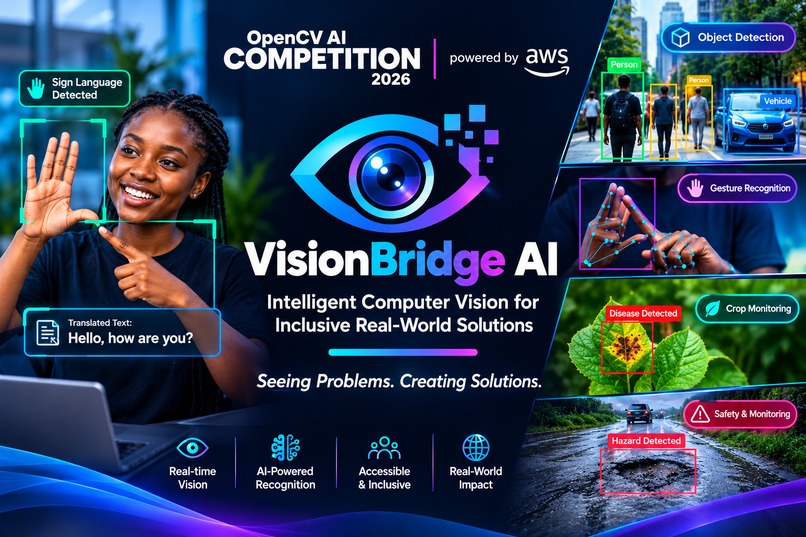
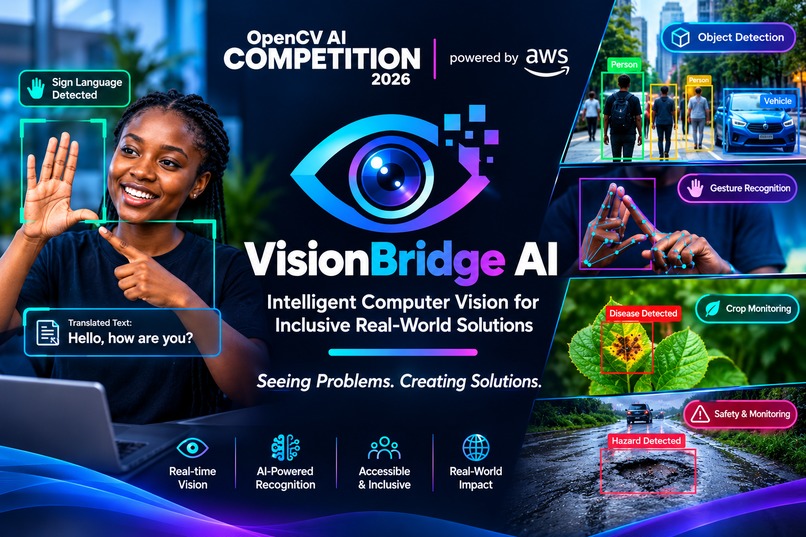
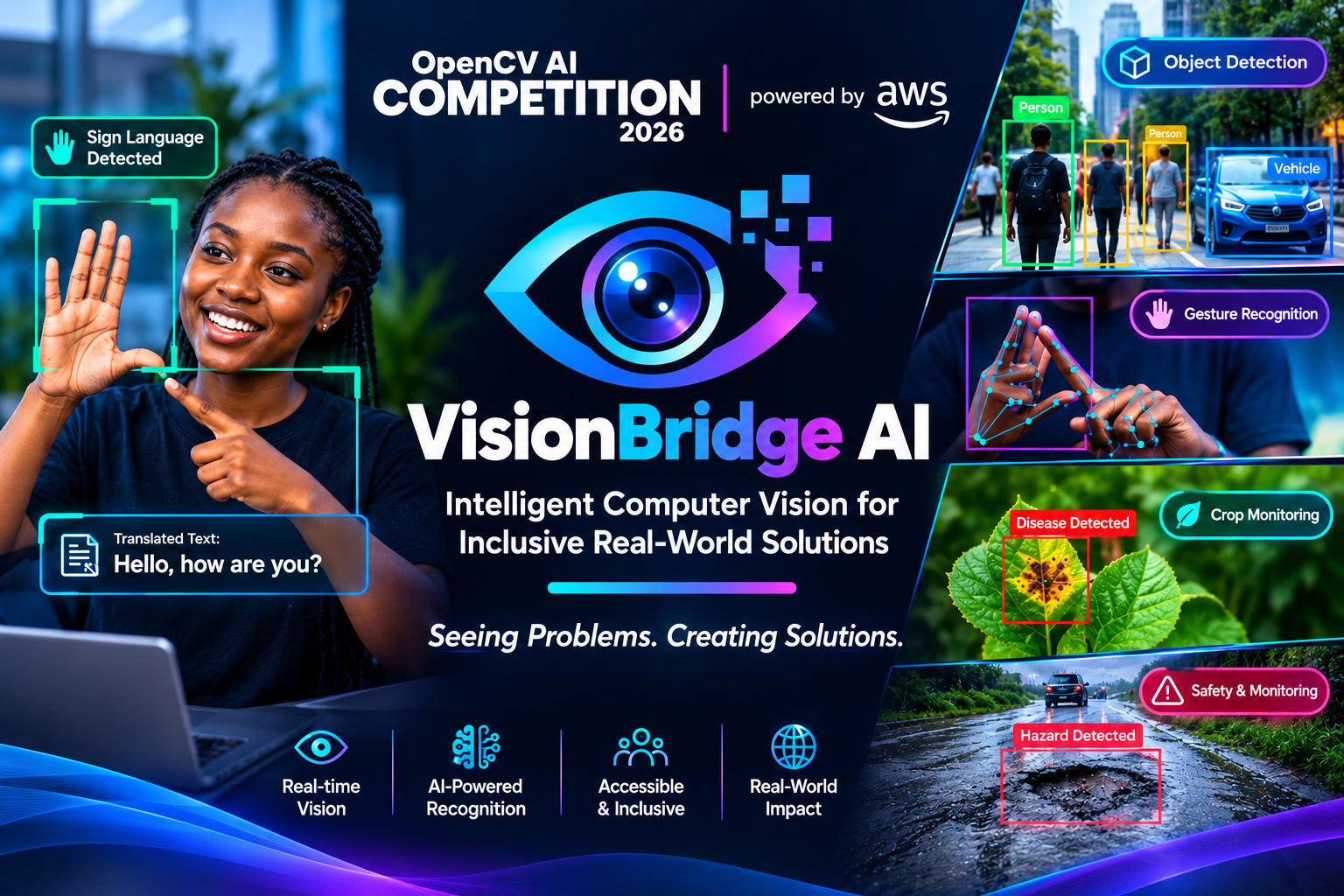
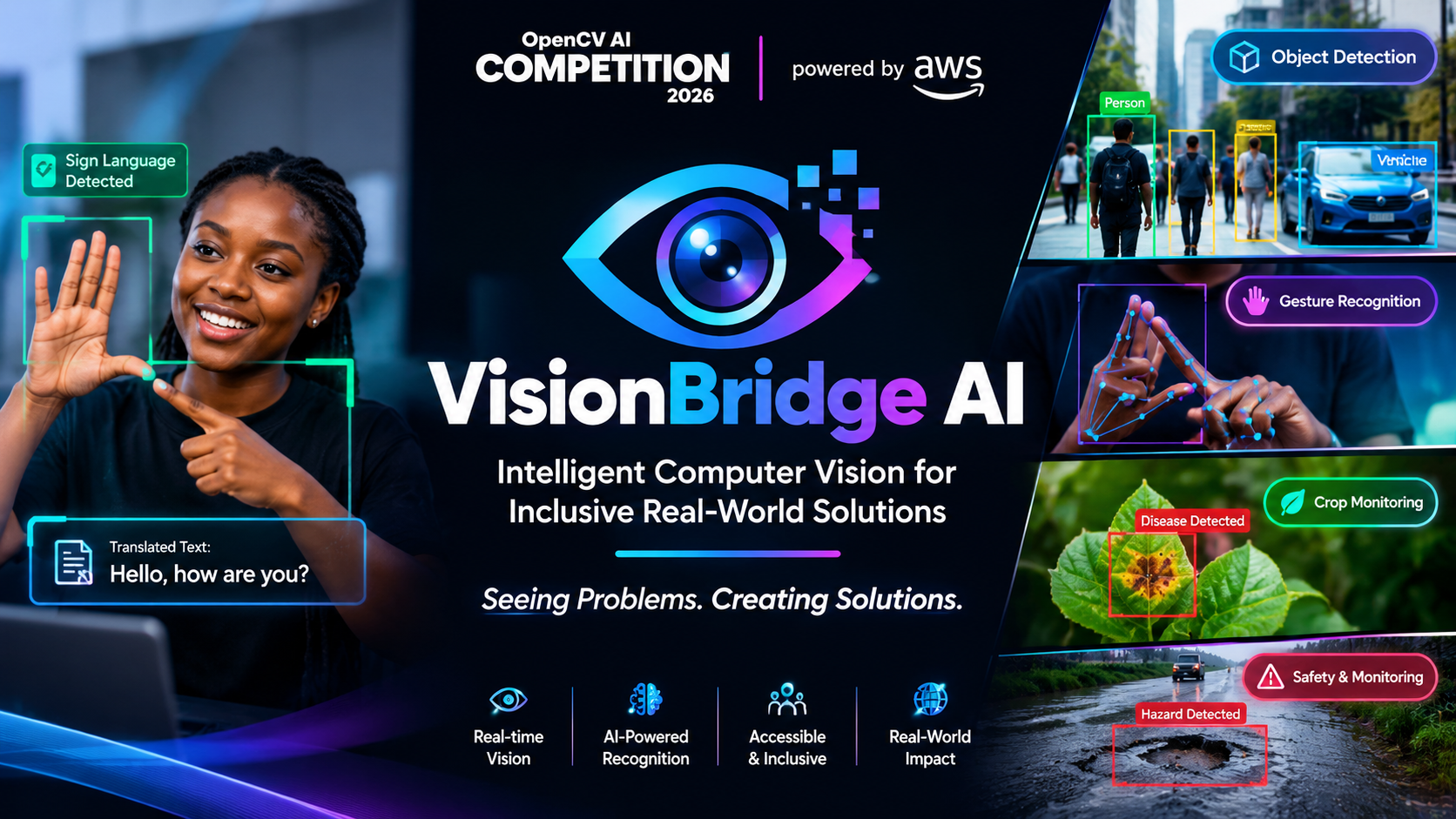
VisionBridge AI is an intelligent computer-vision platform designed to turn visual information into useful, accessible insights. Our prototype explores several applications of computer vision: 🤟 Sign Language Recognition — detects hand gestures and translates recognized signs into readable text. ✋ Gesture Recognition — uses hand and body movements as an intuitive form of interaction. 👁️ Object Detection — identifies people, vehicles, and other objects in real time. 🌱 Crop Monitoring — detects potential signs of disease or abnormal conditions on plants. 🛣️ Safety & Hazard Detection — identifies potentially dangerous objects or conditions in the environment. The goal is not to build separate AI systems for every problem, but to demonstrate how one computer-vision framework can be adapted to solve different real-world challenges.
How we built itHow We Built It
VisionBridge AI was designed around a computer-vision pipeline: Camera → Image Processing → Detection/Recognition → AI Interpretation → Useful Output OpenCV provides the foundation for processing camera frames and extracting visual information. AI/ML models can then interpret the processed data and produce meaningful results. For example, in the accessibility component: The architecture is designed to support real-time processing while keeping the interface simple enough for users without technical knowledge.
Challenges we ran into Challenges We Faced
One of our biggest challenges was designing a system capable of handling different environments and visual conditions. Lighting, camera quality, background noise, hand positioning, distance from the camera, and variations between users can all affect computer-vision performance. Another challenge was balancing accuracy, speed, and accessibility. A system that is highly accurate but too slow is not useful for real-time interaction. We therefore focused on creating a modular concept that can be improved over time with better datasets, optimized models, and additional testing.
Accomplishments that we're proud ofVisionBridge AI is more than a computer-vision project. It is an attempt to demonstrate how AI can bridge gaps between people, technology, and their environment.
Our long-term vision is to expand the platform into a scalable solution that can support accessibility, agriculture, public safety, education, healthcare, and other areas where visual intelligence can make a meaningful difference. VisionBridge AI sees the world—and helps turn what it sees into solutions.
What we learnedWhat We Learned
Building VisionBridge AI taught us that successful AI projects are not just about having an accurate model. The real challenge is connecting technology to a problem that genuinely matters to people. We learned more about: Computer-vision pipelines Real-time image processing Object and gesture recognition AI model integration Designing technology for accessibility Turning a broad idea into a practical prototype Thinking about AI performance in real-world environments Most importantly, we learned to think about AI from the user's perspective, rather than simply focusing on the technology.
What's next for VisionBridge AI: Intelligent Computer Vision
Built With
- accessibility
- amazon-web-services
- artificial
- assistive
- computer
- deep
- for
- gesture
- good
- image
- intelligence
- language
- learning
- machine
- object
- processing
- sign
- vision


Log in or sign up for Devpost to join the conversation.