-
-
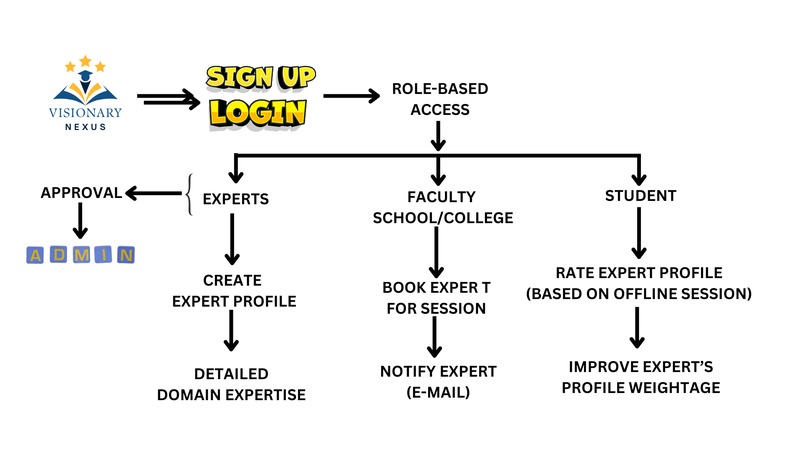
THE WORKFLOW OF VISIONARY NEXUS

📌 About the Project — Visionary Nexus
🌟 Inspiration
The inspiration for Visionary Nexus came from a real and persistent gap between students, academic institutions, and industry experts. While students struggle to access the right guidance at the right time, experts lack a structured platform to share knowledge at scale. I aimed to build an AI-driven ecosystem that democratizes mentorship and bridges education with real-world expertise through intelligent automation.
📚 What I Learned
Through this project, I gained hands-on experience in:
- Designing scalable, cloud-native and microservice-based architectures
- Building high-performance, asynchronous APIs using FastAPI
- Applying Machine Learning for intelligent expert–user matching
- Implementing secure authentication and role-based access control with Firebase
- Containerizing and deploying applications using Docker on Google Cloud
- Integrating data-driven decision systems and explainable AI concepts
- Thinking like a product builder and founder, balancing technology with usability
I also learned how architectural and model-level decisions directly influence system performance, scalability, interpretability, and user trust.
🛠️ How I Built It
The platform was developed using a full-stack, AI-first, cloud-native approach:
- Frontend: React for responsive, role-based dashboards
- Backend: FastAPI for scalable, low-latency REST services
- Machine Learning:
- Feature engineering on user profiles, expertise, experience, ratings, and availability
- ML-based recommendation and ranking models for expert matching
- Feedback-driven learning to improve match quality over time
- Feature engineering on user profiles, expertise, experience, ratings, and availability
- Authentication & Realtime Services: Firebase
- Cloud Infrastructure: Google Cloud Platform (compute, storage, IAM)
- Containerization: Docker for environment consistency and scalable deployment
The expert matching mechanism combines ML predictions with weighted feature scoring.
🚧 Challenges Faced
Key challenges encountered during development included:
- Designing an ML-powered yet interpretable matching system
- Ensuring secure, role-aware data access across multiple user types
- Managing model performance and scalability in a cloud environment
- Orchestrating containerized services efficiently on Google Cloud
- Aligning AI intelligence with real-world usability and fairness
These challenges strengthened my understanding of system design, MLOps thinking, and responsible AI deployment.
🚀 Outcome
Visionary Nexus evolved into a production-ready, AI-enabled mentorship and collaboration platform. It demonstrates how Machine Learning, cloud computing, and modern web technologies can work together to intelligently connect people, expertise, and opportunities—forming a strong foundation for a scalable EdTech and expert collaboration ecosystem.

Log in or sign up for Devpost to join the conversation.