-
-
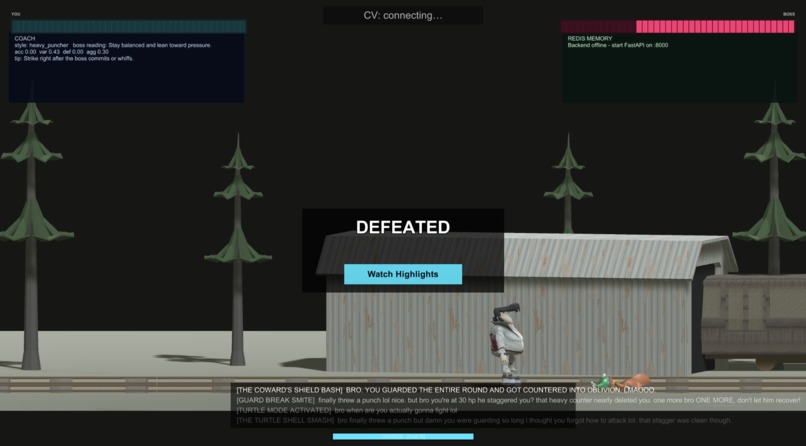
An image after the game is over.
-
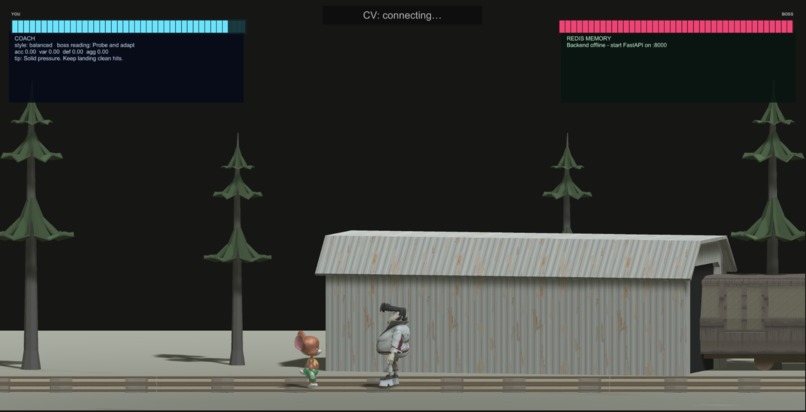
Image at the start of the game
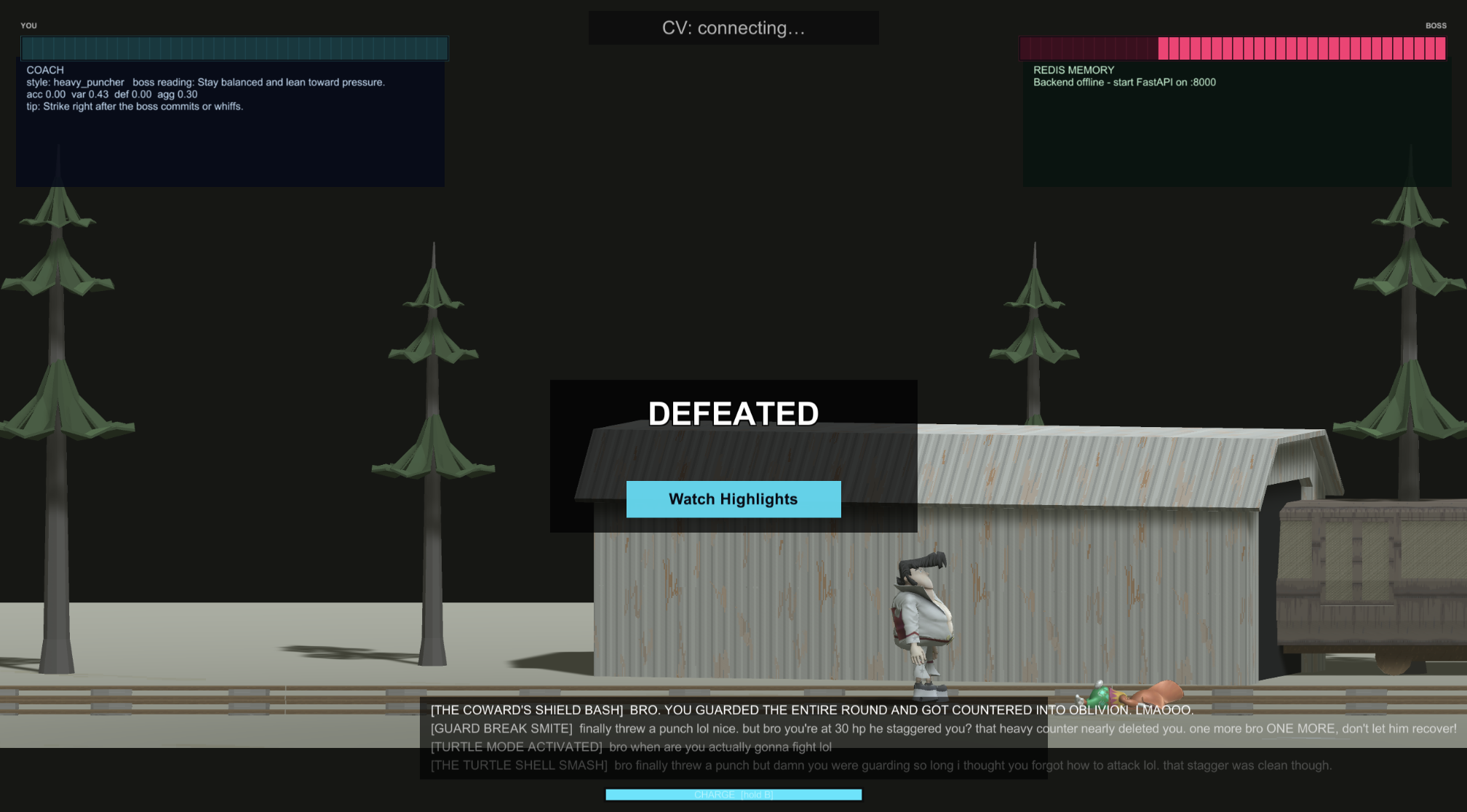
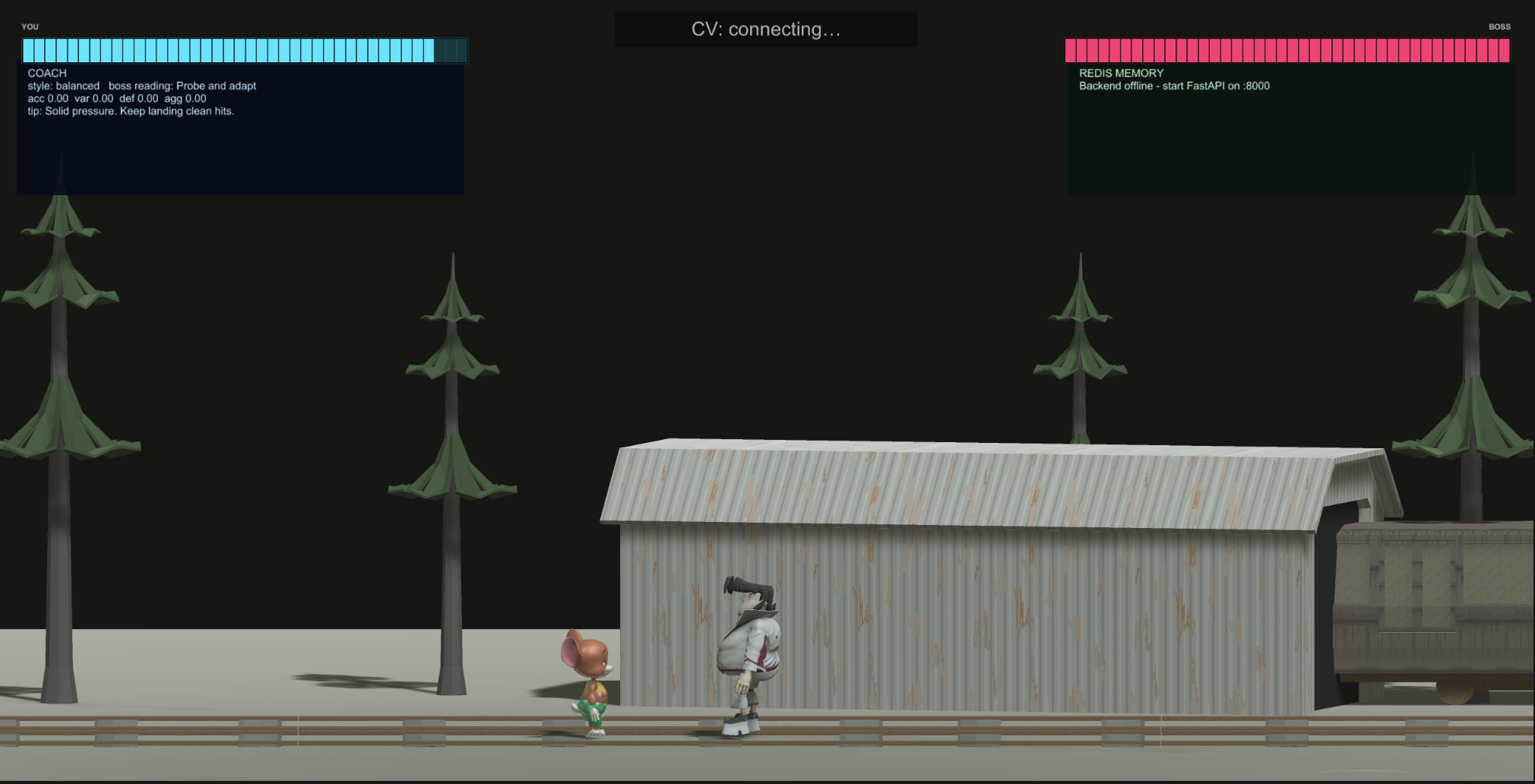
Vision Arena
Inspiration
AI is changing software, but most games still use it as a separate layer: scripted enemies, chatbots, or background tools. I wanted to build a game where AI was part of the core experience.
Vision Arena asks: what if the player’s body, the boss, the narration, and the match memory were all connected through AI?
The result is a 2.5D boss fight where the player punches, guards, and moves in front of a webcam while an AI-powered boss learns their habits and adapts.
What it does
Vision Arena is a real-time Unity boss fight controlled through computer vision.
A webcam maps body movement into combat actions:
- Extend one arm: punch
- Extend both arms: heavy punch
- Raise both wrists: guard
- Step left or right: move
The game also uses agents:
- GameMaster: coordinates the match
- Enemy Agent: adapts boss strategy
- Narrator Agent: names moves and gives live commentary
- Coach Agent: gives player feedback
- Recap Agent: creates a post-fight summary
The goal is to make the fight feel live: your body controls the action, and the AI reacts to how you play.
Tech stack
- Unity + C#: combat, animation, health, HUD, arena, and keyboard fallback
- Python + MediaPipe: webcam body tracking
- FastAPI + WebSockets: bridge between vision, Unity, and agents
- Redis: player memory, boss strategy, move history, and cooldowns
- Fetch.ai / Agentverse / ASI:One: battle and commentary agents
- Arize: tracing and fight evaluation
- Pika: post-fight recap generation
- Vapi: optional pre-fight boss phone call
How it works
MediaPipe reads pose landmarks from the webcam every frame. Punches are detected using wrist depth compared to shoulder depth, so the player must physically extend toward the camera.
Unity keeps the real-time combat local for low latency. The agents handle slower, higher-level tasks such as strategy, narration, coaching, memory, and recap generation.
The backend connects the system with FastAPI routes and WebSockets. Unity sends combat telemetry to the backend, agents respond, and Redis stores match memory so the boss can adapt across rounds.
Reliability and fallbacks
Because live demos can fail, Vision Arena includes fallback paths:
- Keyboard controls if computer vision is unavailable
- Mock pose events if the camera fails
- Deterministic agent responses if AI services are unavailable
- In-memory storage if Redis is unavailable
- Mock phone-call flow if Vapi is not configured
This keeps the core game playable even if hardware or external services fail.
Challenges
The hardest part was making webcam input feel physical. I had to tune depth thresholds, handle camera mirroring, and filter unreliable landmarks so punches did not trigger accidentally.
Another challenge was separating real-time gameplay from slower AI decisions. Combat had to stay fast, while agents handled strategy, narration, memory, and evaluation.
Since this was a solo project, I had to cut scope and focus on the core demo: body-controlled combat, an adaptive boss, and visible AI systems.
What I learned
I learned that computer vision controls depend on small details like coordinate systems, confidence scores, mirroring, and depth.
I also learned that multi-agent systems work best when each agent has a clear role. Vision Arena separates match flow, boss strategy, narration, coaching, and recap generation.
Most importantly, I learned that AI demos need graceful fallbacks. The project became stronger once the core experience could run without perfect hardware or network conditions.
What’s next
Next, I would add live MYO armband EMG input, expand boss memory across sessions, improve ASI:One commentary, and polish the arena and characters for a more cinematic fight.


Log in or sign up for Devpost to join the conversation.