Inspiration
Founders can spend months building a product only to discover that their customers have a different problem than the one they set out to solve.
The common advice is to always start with the problem, but plenty of successful companies didn't. Some start with a solution and go looking for where it fits. That's not inherently wrong. It fails when the founder falls in love with what they built and starts hunting for evidence a problem exists, rather than evidence it doesn't. A friend saying "neat, I'd use that" isn't validation. It's just an absence of pushback.
Most existing validation tools invite this mistake. They ask whether people like or would use a product, but liking an idea isn't the same as experiencing the problem it solves.
The second inspiration came from how investment decisions get made. A founder can have a strong idea but still struggle with a question they weren't prepared for, and a room that averages its opinions can bury a serious objection under general enthusiasm.
We built Vision, an AI-driven application, to help founders treat their idea as a hypothesis, not a foregone conclusion, and answer two questions early: Are we solving the right problem, and can we defend our idea when it's challenged?
What It Does
Vision takes founders through two stages that test both the problem they're solving and how well their idea stands up to scrutiny.
Part 1 - Market Validation
Founders start by describing their product. Vision breaks it down into 4-5 potential problems it could be solving, including the founder's original framing.
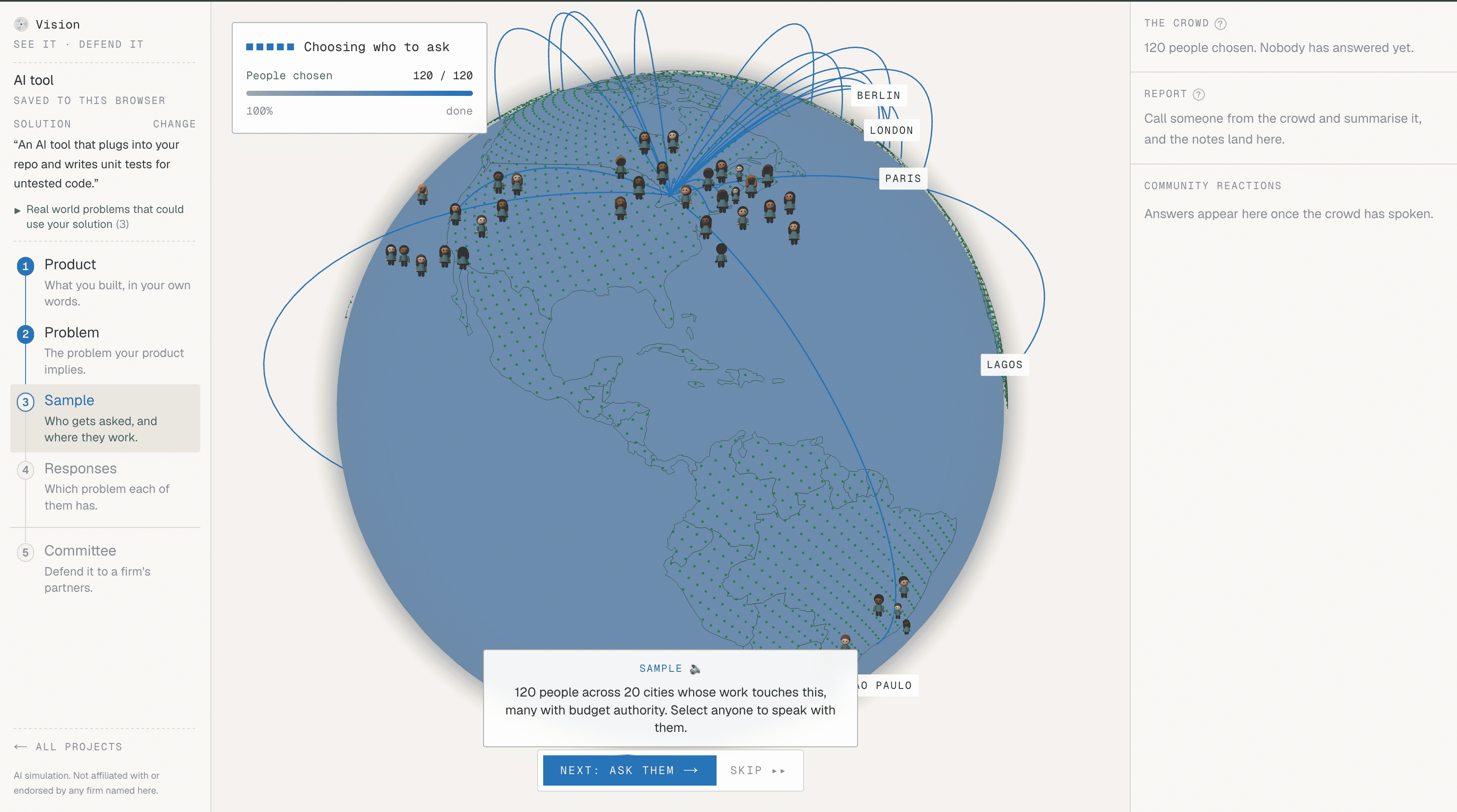
It then selects 120 simulated professionals from a library of 326 personas across 20 global hubs and places them on an interactive 3D globe. Instead of asking whether they like the product, each persona is asked which problems they actually experience.
Vision then:
- Compares the market's top problems with the founder's original assumption.
- Weighs responses by how strongly each problem is felt, rather than just counting responses.
- Lets founders adjust their framing and test it again.
- Uses a council of five AI agents and a Contrarian to debate whether the problem is worth solving.
- Produces a Problem Validation Score out of 100 based on problem severity, gaps in existing solutions, market fit, and evidence strength.
Part 2 - Investment Committee
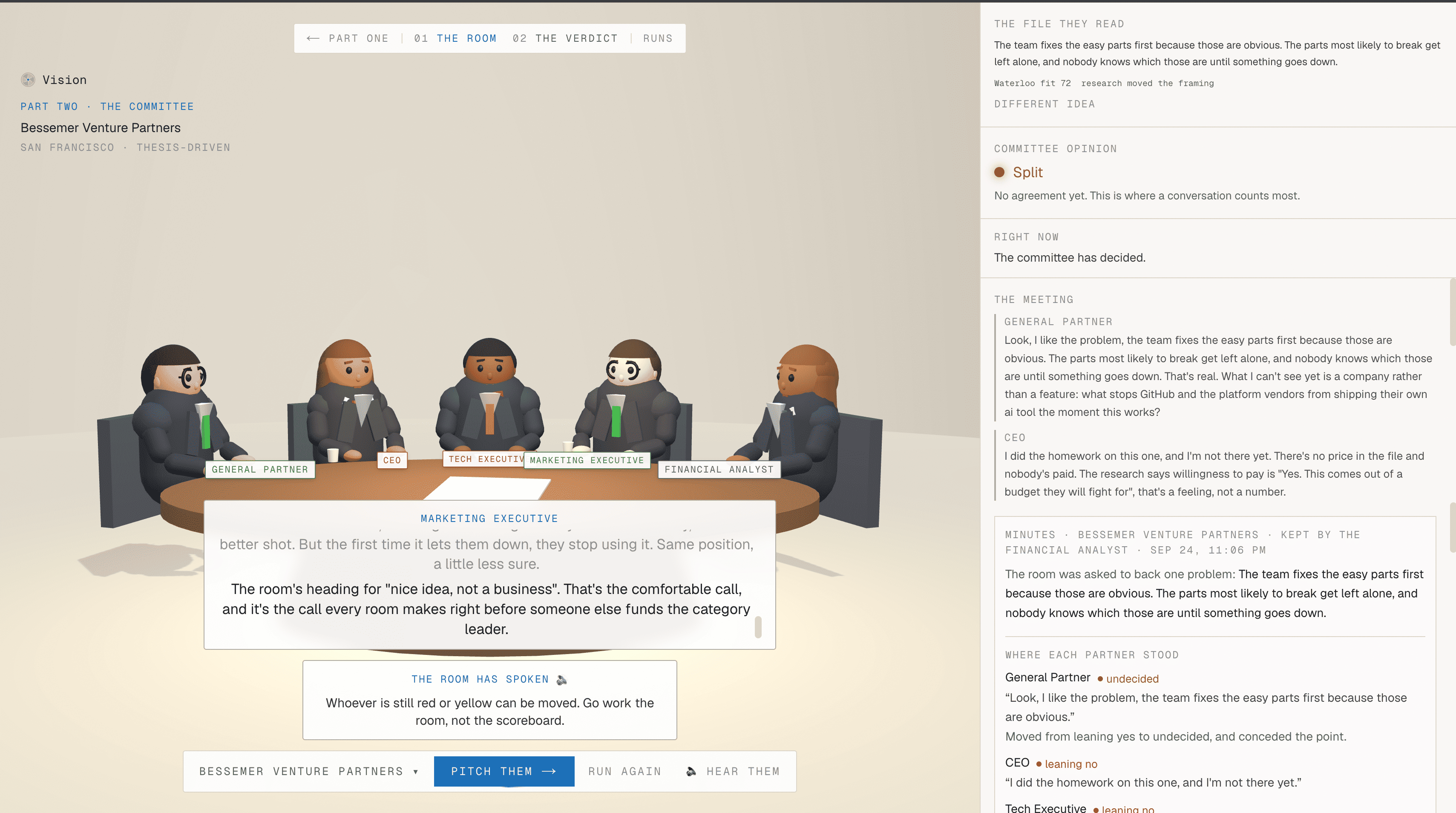
Founders then choose from 25 real VC firms and enter a simulated 3D investment committee room.
Three AI partner agents review the startup and deliberate for five rounds before the founder even begins pitching. Their discussion is visualized through a live graph showing which agents challenge each other and how their positions develop.
Once the pitch begins:
- Founders pitch their idea out loud while the committee asks questions and raises objections.
- An objection tracker keeps track of questions that weren't fully answered.
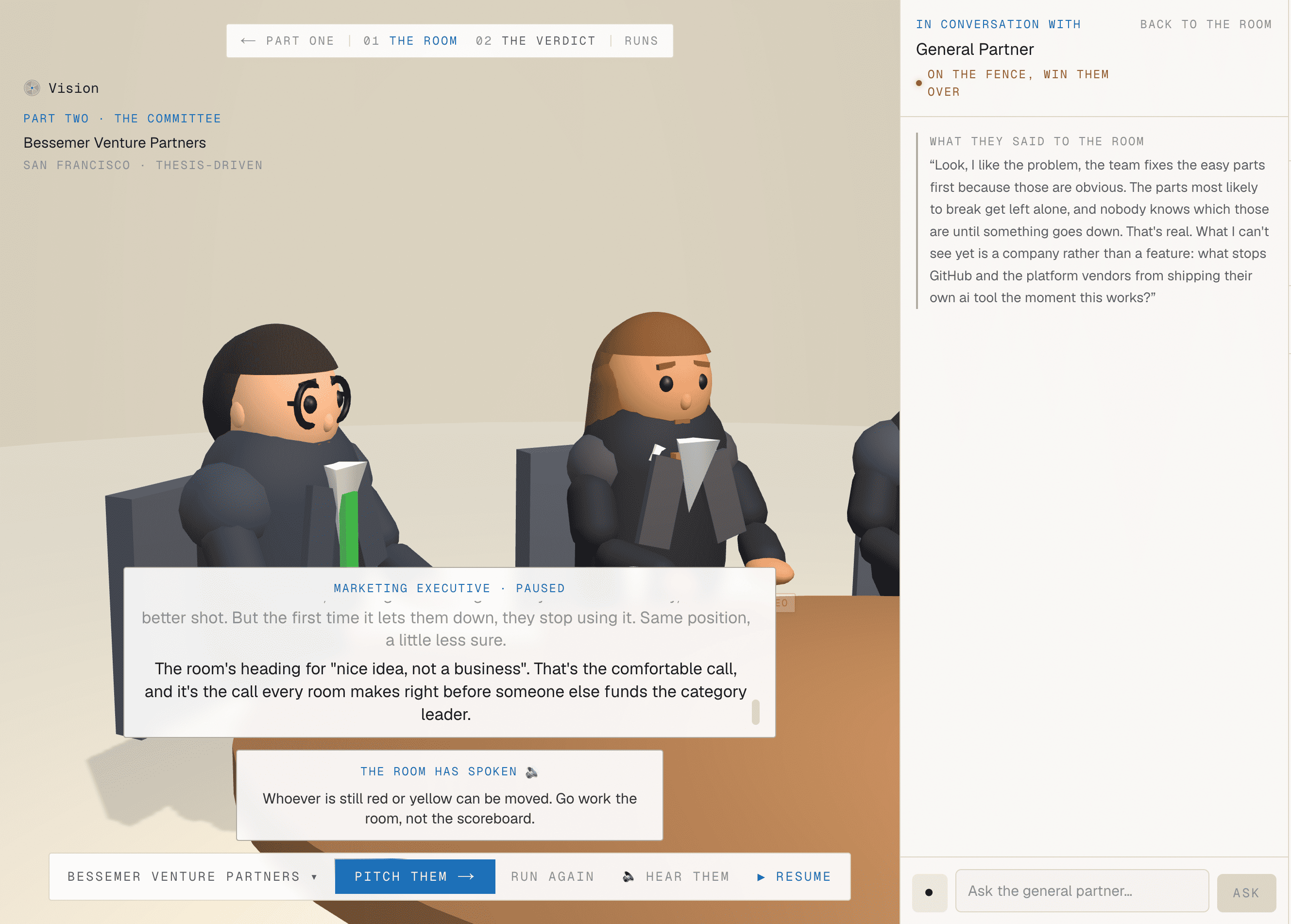
- Founders can pull individual partners aside for a private conversation.
- The committee votes at the end, while strong objections are surfaced rather than averaged away.
Finally, Vision generates a diligence report and meeting minutes showing where each partner stood, how their opinions changed, where they disagreed, which challenges went unanswered, and what the founder should work on next.
How we built it
Vision was built with Next.js, React, TypeScript, and Three.js, with Gemini, OpenAI, Claude, and ElevenLabs powering the AI and voice experiences.
At the core of Vision is a multi-agent deliberation system. Instead of having several AI agents independently answer the same question, our agents actually discuss and challenge each other's reasoning.
The deliberation follows five stages:
- Decompose - A chair divides the decision into questions for different agents.
- Independent reasoning - Agents form their initial opinions without seeing each other's answers.
- Cross-examine - Agents challenge specific arguments made by other agents.
- Rebut - Challenged agents respond and can revise their positions.
- Adversarial review - A Devil's Advocate challenges the direction the group reached.
This allows agents to disagree, defend their reasoning, concede points, and change their positions through discussion. The same deliberation engine powers both the market-validation council and the investment committee.
Challenges We Ran Into
- Keeping agents distinct: We needed to prevent agents from gradually converging into the same perspective, so we tracked stance variance, challenges, concessions, and changes in their positions.
- Silent failures: A formatting change once caused every simulated persona to return the same neutral response without throwing an error. We added tests to automatically detect this.
- Building the 3D experience: Our first boardroom characters looked like they hadn't rendered correctly, so we improved their models, shadows, positioning, and seating.
- Browser limitations: Animation testing and audio playback introduced challenges with browser throttling and autoplay restrictions.
Accomplishments We're Proud Of
One of our biggest accomplishments was seeing agents actually change their positions through deliberation. An agent could enter with one position, be challenged by another agent, and revise its stance based on the discussion.
We also built interactive 3D globe and boardroom experiences, added fallbacks for AI and voice services, and finished with 177 tests, including tests specifically designed to catch misleading or homogenized AI outputs.
What We Learned
The biggest lesson was that the question you ask determines what you can learn. No amount of engineering can compensate for asking the wrong question in the first place.
We also learned that averaging opinions can hide important disagreements, AI behavior needs to be tested rather than just checking whether the application runs, and silent failures can be much harder to catch than explicit errors.
What's Next
- Allow agents to continue debating until their positions stabilize.
- Detect groups of agents that consistently agree.
- Evaluate the quality of objections, not just how many are raised.
- Give agents memory across multiple pitches.
- Ground simulated personas in real market data.
Built With
next.js react typescript three.js tailwindcss zustand framer-motion
google-gemini openai anthropic-claude elevenlabs web-speech-api
server-sent-events vitest vercel
Try it out
- Live app, no sign up and no API key needed: https://vision-phi-lovat.vercel.app
- GitHub repository: https://github.com/jaineelmodi11/vision
- The architecture writeup, for the protocol in full: https://github.com/jaineelmodi11/vision/blob/main/ARCHITECTURE.md
- Health check, which probes underneath the fallback rather than reporting a degraded run as healthy: https://vision-phi-lovat.vercel.app/api/system/check
The deployment runs on Gemini's free tier, so the link costs nothing to keep up and nothing for a judge to use.
Built With
- claude
- claude-hussenet-anagram
- elevenlabs
- next.js
- react
- tailwindcss
- three.js
- typescript


Log in or sign up for Devpost to join the conversation.