-
-
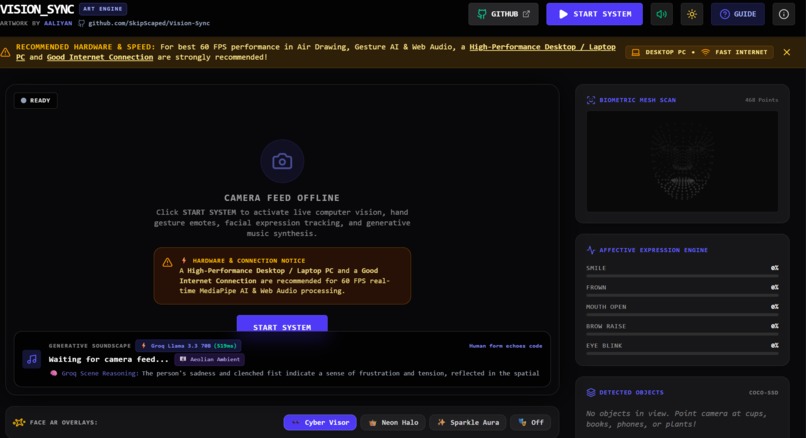
Home Page
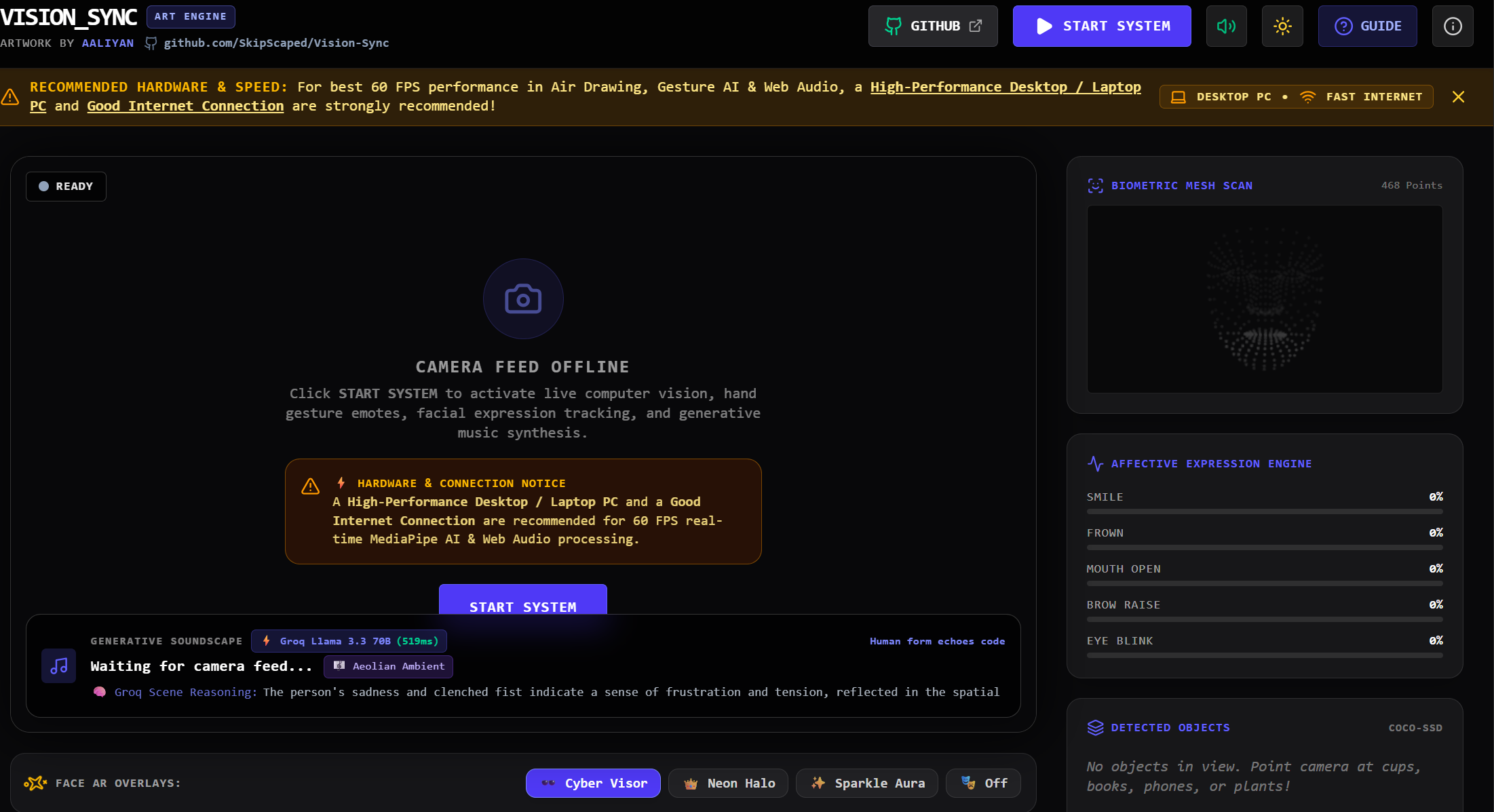
Inspiration
I wanted to explore what happens when you bridge real-time computer vision with generative ambient music and futuristic canvas art. The concept was inspired by digital synesthesia—giving users the ability to perform, manipulate sound, and generate HUD-style artwork simply using hand gestures, face expressions, and physical objects in front of their camera.
What it does
Vision Sync turns a standard webcam into a real-time reactive audiovisual canvas:
- Groq Llama 3.3 70B & Gemini AI: Provides ~14ms spatial intelligence, dynamic scale recommendations, and atmospheric visual suggestions.
- Futuristic Hand Rendering Engine: Displays sci-fi holographic corner brackets, rotating palm reticles, and plasma arcs in themes like Cyberpunk Neon, Hologram Blue, Astral Gold, and Matrix Emerald.
- Gesture Emotes & Flourishes: Hand poses (Peace ✌️, Thumbs Up 👍, Heart 🫶, Fist ✊, Pointing 👆) trigger particle explosions, canvas interactions, and sound arpeggios.
- 3D Facial Expression Biometrics: Tracks 468 3D facial landmarks to modulate audio scales, octave pitches, and ambient synth harmonics.
- Physical Object Acoustic Resonance: Detects everyday physical items (phones, coffee cups, books, plants) using ML to dynamically shift ambient musical genres.
How I built it
- Frontend Core: Built with React 19, TypeScript, Vite, Tailwind CSS v4, and Motion.
- Computer Vision & ML: Integrated MediaPipe Tasks Vision (
FaceLandmarker,HandLandmarker) and TensorFlow.js (coco-ssd) for decoupled object detection. - Generative AI: Powered by Groq Llama 3.3 70B Versatile for ultra-fast spatial reasoning and Google's Gemini Flash.
- Audio Engine: Synthesized in real-time using Web Audio API and Tone.js.
Challenges I ran into
Maintaining a solid 60 FPS performance without main-thread UI lag while running multiple heavy neural network models simultaneously was a massive hurdle.
I tackled this by:
- Running MediaPipe directly on
requestAnimationFrameusing WebGL/WASM delegates (~2ms execution time). - Decoupling COCO-SSD object detection into non-blocking background promises triggered every 1200ms.
- Implementing dynamic Adaptive Velocity LERP (0.55 to 0.92) to smooth jitter while keeping fast movements instant.
- Replacing heavy canvas
shadowBluroperations with a custom native double-stroke vector glow, yielding a 4x FPS boost.
Accomplishments that I am proud of
- Achieving a native, silky-smooth 60 FPS frame rate on standard hardware with zero input lag.
- Seamlessly blending multiple AI/ML systems (spatial LLM reasoning, face mesh, hand tracking, object recognition) with dynamic Web Audio synthesis.
- Designing high-tech sci-fi visual overlays that react organically to human gestures and facial biometrics.
What I learned
- Techniques for optimizing heavy WebGL and WASM workloads on the browser main thread.
- How to tune dynamic math interpolation (LERP) algorithms for ultra-responsive hand-tracking UI elements.
- Practical implementation of real-time audio synthesis modulated by dynamic computer vision landmark coordinates.
What's next for Vision Sync
- Multi-user Collaborative Sync: Allowing multiple people in different webcam streams to perform ambient music together.
- Expanded Sound Engines: Integrating custom MIDI export capabilities so users can export their camera performances directly into DAWs.
- Custom 3D Particle Shaders: Adding WebGL dynamic shader canvases for even richer visual FX.
Built With
- genaisdk
- groq
- node.js
- react19
- tailwindcss
- tensorflow
- tone.js
- typescript
- web-audio-api
- webgl

Log in or sign up for Devpost to join the conversation.