-
-
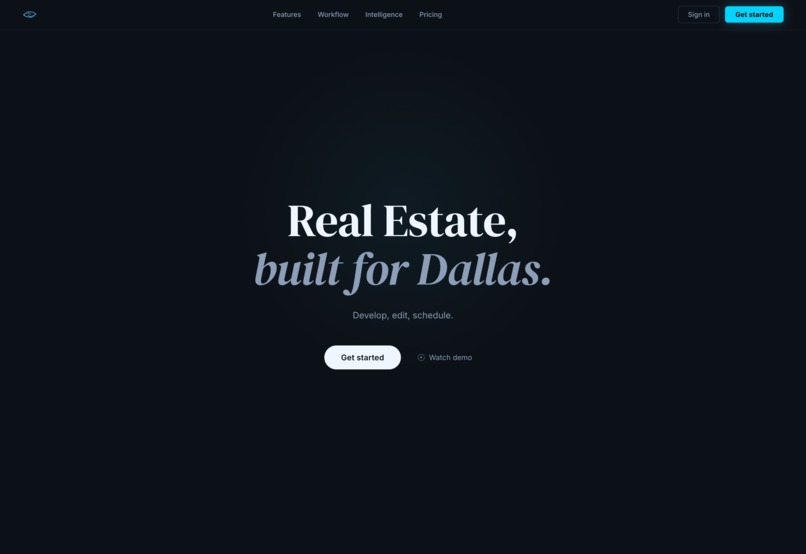
Landing
-
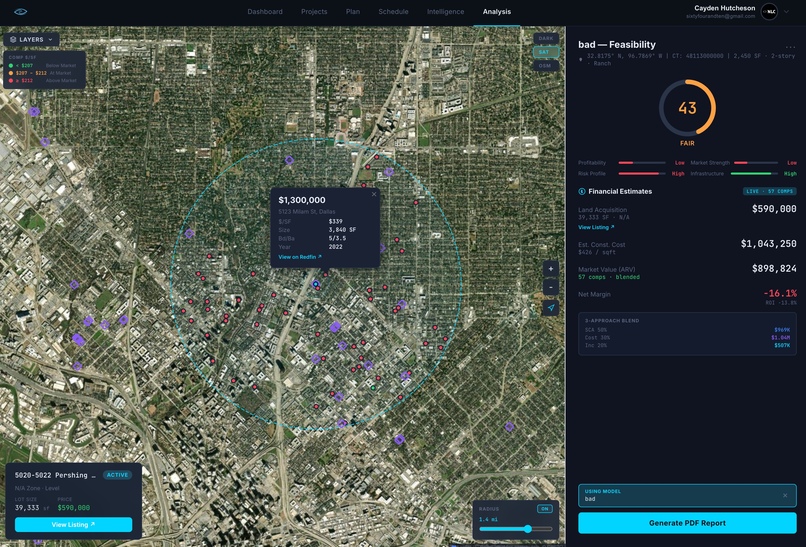
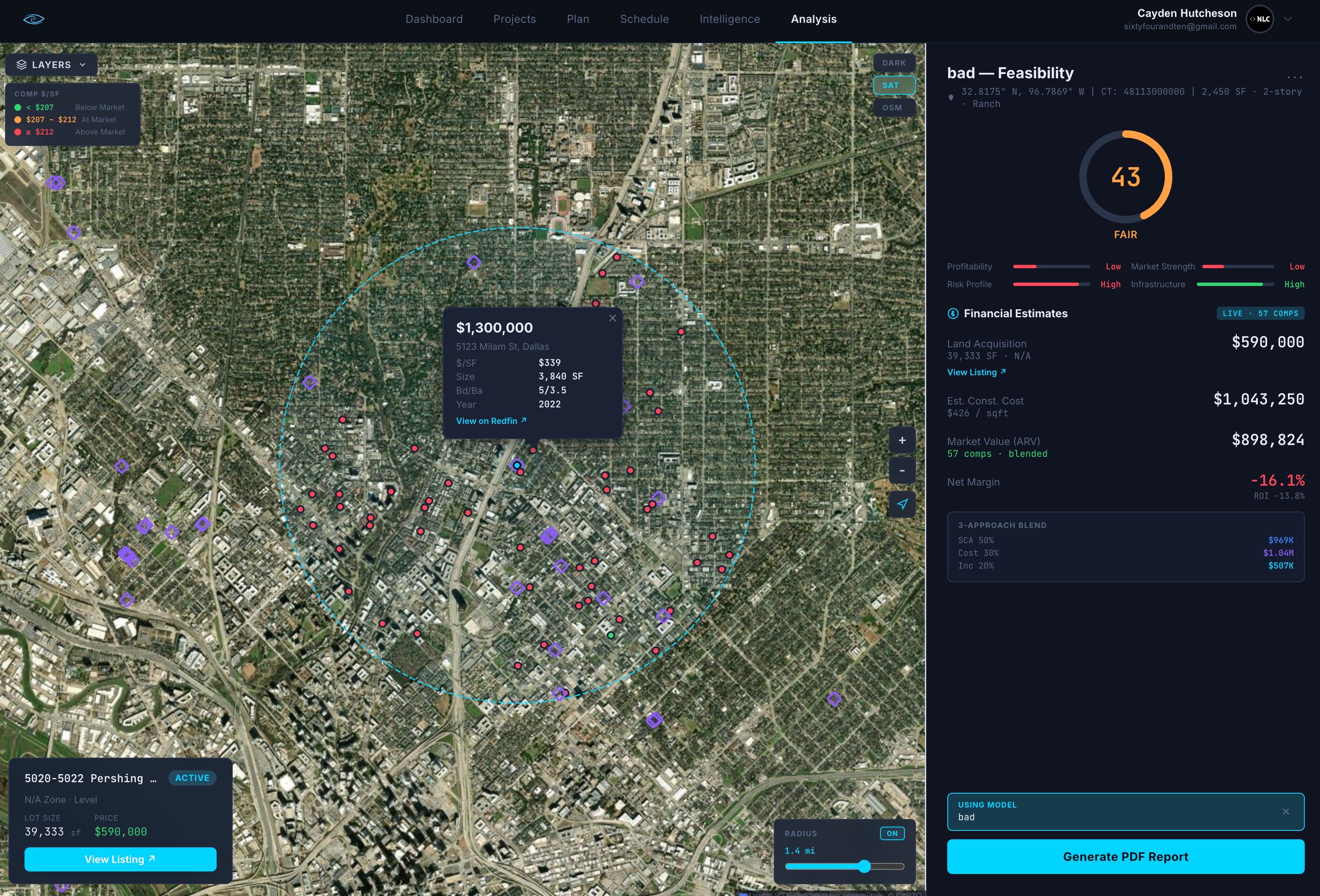
Map
-
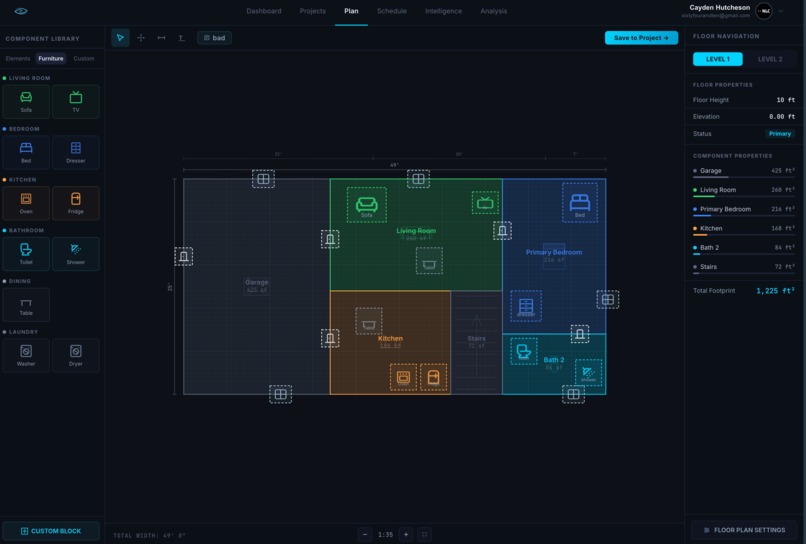
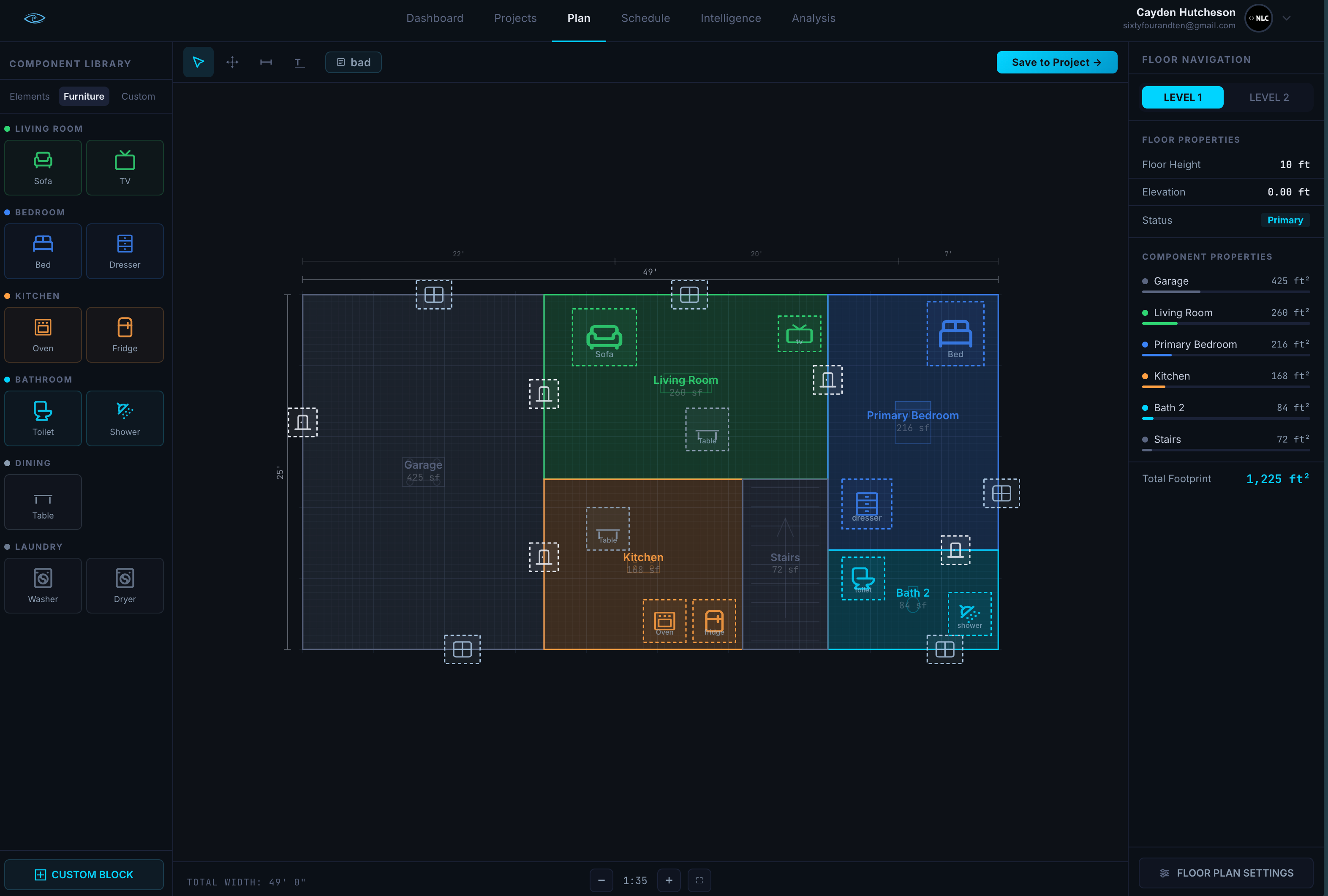
Floor Plan
-
-
Inspiration
Real estate developers in Dallas spend hours bouncing between a spreadsheet, a site-plan PDF, a structural consultant, and a zoning code PDF — just to answer one question: is this lot worth building on? We wanted to collapse that entire workflow into a single AI-powered platform that gives a developer a feasibility verdict in minutes, not days.
What it does
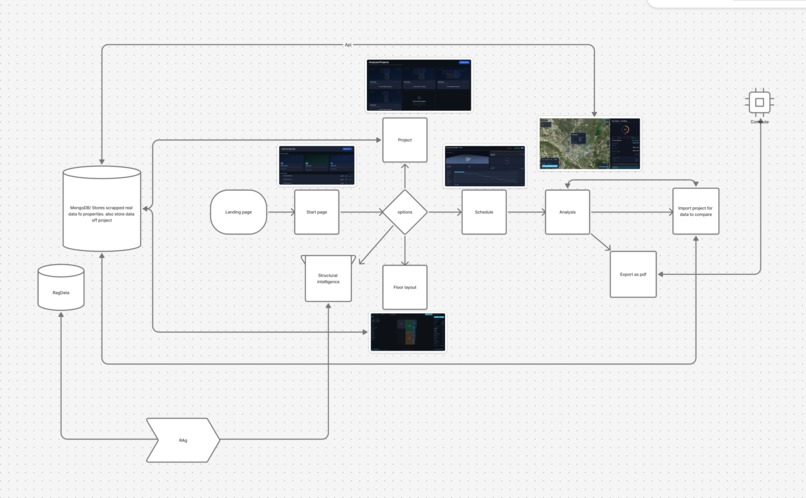
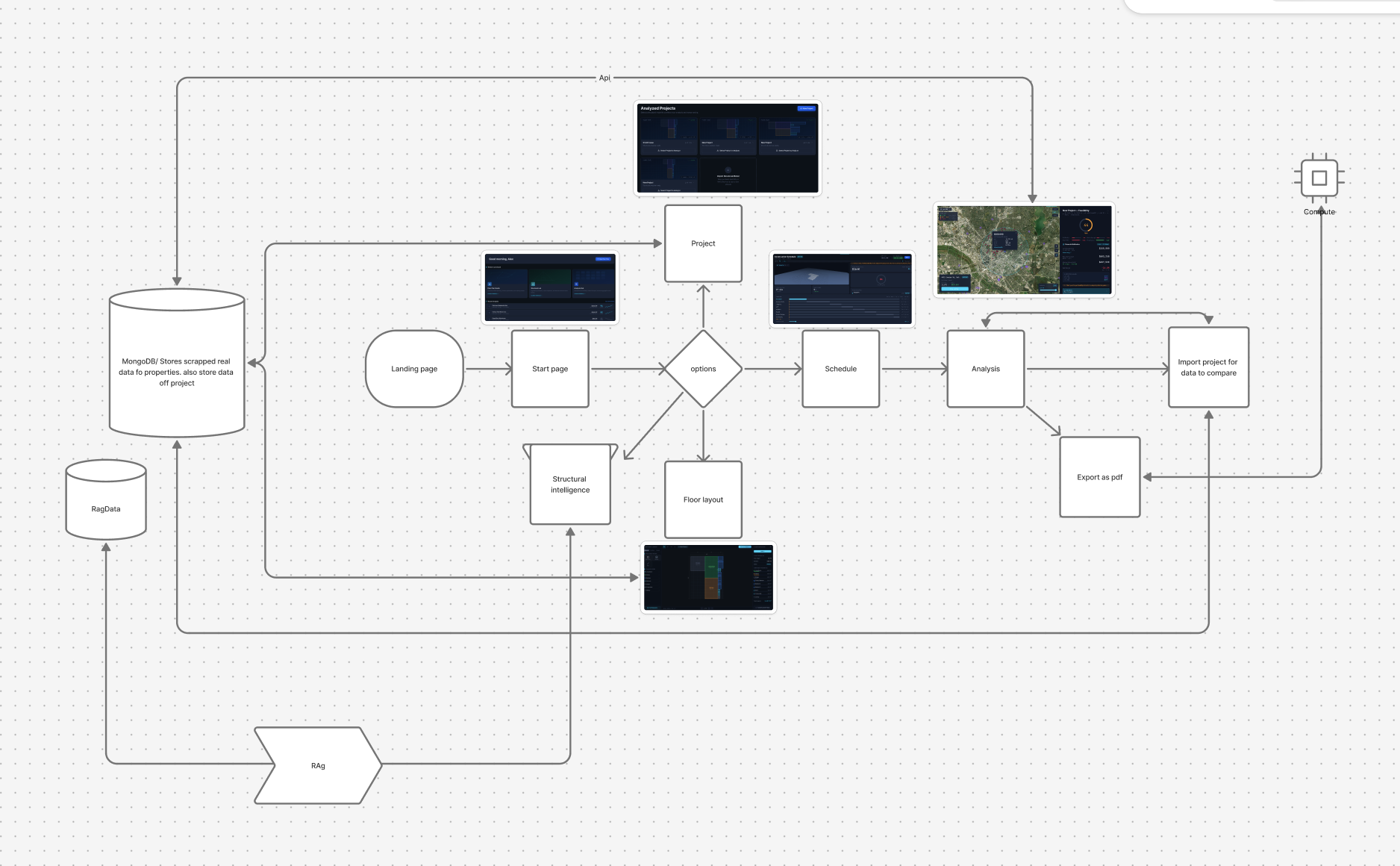
Vision is an end-to-end land feasibility intelligence platform targeting the Dallas, TX residential market. It guides a developer through three stages:
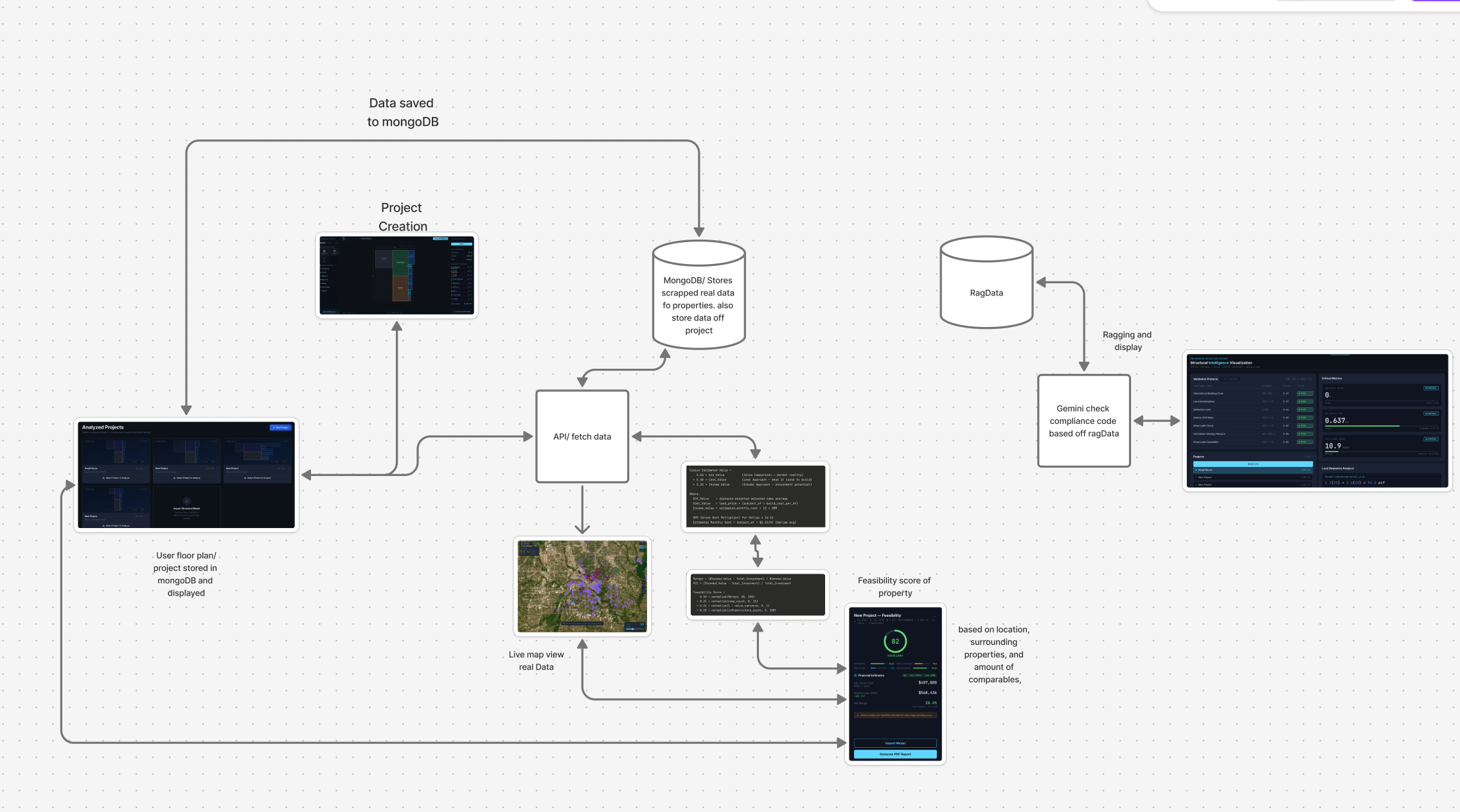
DEVELOP — Drop a parcel on an interactive Leaflet map or key in an address. Vision pulls zoning context (10 Dallas district templates), computes lot coverage, setbacks, max height, and FAR, then auto-generates a constraint-based floor plan across up to six rooms. A Feasibility Score (0–100) is shown immediately alongside ARV, cost-per-SF, projected margin, and year-over-year market trend.
EDIT — A 7-layer material editor lets the developer swap finishes across Foundation, Framing, Exterior, Roofing, Insulation, Interior, and MEP layers. Every slider change recalculates construction cost in real time. A trained Gradient Boosting ML model — fit on actual Dallas Redfin comparable sales — predicts the sale price per SF and neighborhood price tier. A Monte Carlo risk simulator runs up to 10,000 iterations over the pro-forma, returning IRR distributions, VaR at 95%, and a full 20-bin histogram.
SCHEDULE — A five-phase construction timeline is generated automatically (Site Prep → Foundation → Framing → MEP/Finish → Closeout) with durations derived from square footage and labor assumptions.
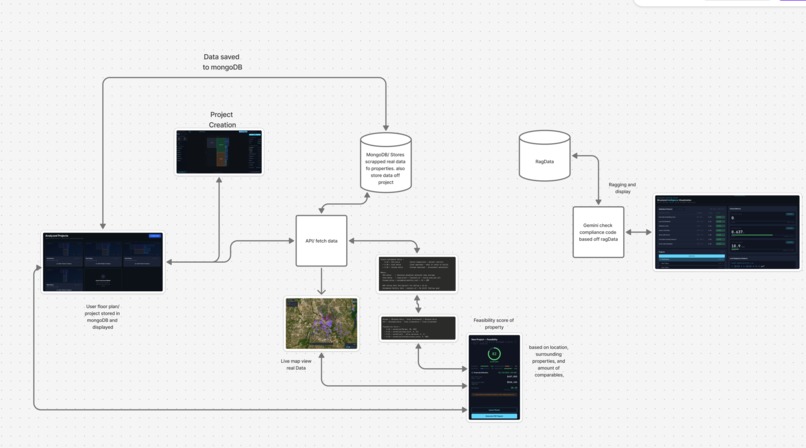
Underneath it all, a Structural Intelligence screen runs closed-form beam analysis per AISC 360-16 across seven W-shape sections (W14×22 through W24×84), checks six LRFD load combinations per ASCE 7-22, evaluates six code compliance checks (flexural, shear, L/360 deflection, soil bearing, seismic drift, wind uplift), and assigns a Structural Complexity Index (0–10). Compliance narratives are generated by a Retrieval-Augmented Generation pipeline powered by Google Gemini Pro against a structural knowledge base.
How we built it
Frontend: React 18 + Vite SPA with a strict dark design system (JetBrains Mono for data, Inter for labels, #0d1117 bg, #00d4ff accent). All styles are inline — no CSS files — for density and consistency. Leaflet handles the parcel map; Clerk handles auth. Backend: FastAPI (Python) with eight pure-computation service modules that share zero cross-dependencies. PostgreSQL via SQLAlchemy + Alembic for schema migrations; MongoDB for unstructured document storage. ML: scikit-learn GradientBoostingRegressor trained on Dallas comparable sales JSON (Redfin data), with KMeans neighborhood clustering and a StandardScaler pipeline. The model auto-trains on startup if no saved weights are found. RAG: Google Gemini Pro reads a curated structural_rag_knowledge.json knowledge base and returns plain-English compliance verdicts for each of the seven AISC/ASCE checks. Risk: NumPy-vectorized Monte Carlo simulation — 1,000–10,000 iterations over five stochastic variables (material price, market value, interest rate, construction delay, occupancy ramp). Challenges we ran into Getting clean, structured Dallas parcel and MLS data was the hardest part — real-world data is inconsistent in zipcodes, lot sizes, and sale dates. We had to write a custom ingest + backfill pipeline to normalize it before the ML model could train on it.
Keeping the structural engine honest was another constraint: we explicitly forbade FEA and black-box solvers. Every number the engine emits — moment, shear, deflection — comes from closed-form equations (M = wL²/8, Δ = 5wL⁴/(384EI)) with diagnostics that report Method=Analytical, Iterations=N/A, Residual=0.000%. Communicating that limitation to users via mandatory legal disclaimers without breaking the UX flow required careful design.
Integrating Gemini Pro into a deterministic engineering pipeline also took iteration — prompt engineering to ensure the LLM returns structured verdicts without hallucinating load values that are already computed analytically.
Accomplishments that we're proud of
A fully trained ML model (GradientBoosting + KMeans) running on real Dallas comps — not placeholder math. Eight backend services that are completely decoupled and independently testable. A Monte Carlo engine that runs 10,000 pro-forma iterations in under a second using vectorized NumPy. Structural analysis that is transparent, analytically exact, and legally scoped — every screen carries a mandatory PE disclaimer. A design system tight enough that six screens feel like one product with zero shared CSS. What we learned Calibrating ML predictions to a local market requires more than a good model — it requires understanding why Dallas medians sit where they do (lot sizes, school districts, proximity to the urban core). We learned to validate predictions against known comps before trusting the regressor.
We also learned that RAG works best when the knowledge base is narrow and highly structured. A focused 50-entry structural-codes JSON gave Gemini Pro much better grounding than a broad corpus would have.
What's next for Vision
National expansion — parameterize the market model for Houston, Austin, Phoenix, and Atlanta using the same ingest pipeline. PDF feasibility reports — one-click export of the full analysis (floor plan, cost breakdown, structural summary, risk histogram) as a branded PDF for lender packages. Permit automation — integrate with city permitting APIs to pre-fill zoning variance applications directly from the feasibility output. Satellite + LiDAR parcel analysis — use aerial imagery to auto-detect existing structures, trees, and grade changes before a developer ever visits the site. Multi-unit stack planning — extend the floor-plan engine beyond single-family to townhome and small multifamily (duplex/quadplex) typologies.
Built With
- clerk
- gemini
- hasdata
- javascript
- leaflet.js
- materials
- mongodb
- python
- react
- redfin


Log in or sign up for Devpost to join the conversation.