

Inspiration
Our team thinks about decisions the same way we think about the stock market, and now, prediction markets in the long term.
Every action has consequences, and with the right tools, those consequences can be reasoned about probabilistically rather than emotionally. Prediction markets already encode collective beliefs about the future; however, they stop short of letting individuals act on those beliefs in a structured, consequential way.
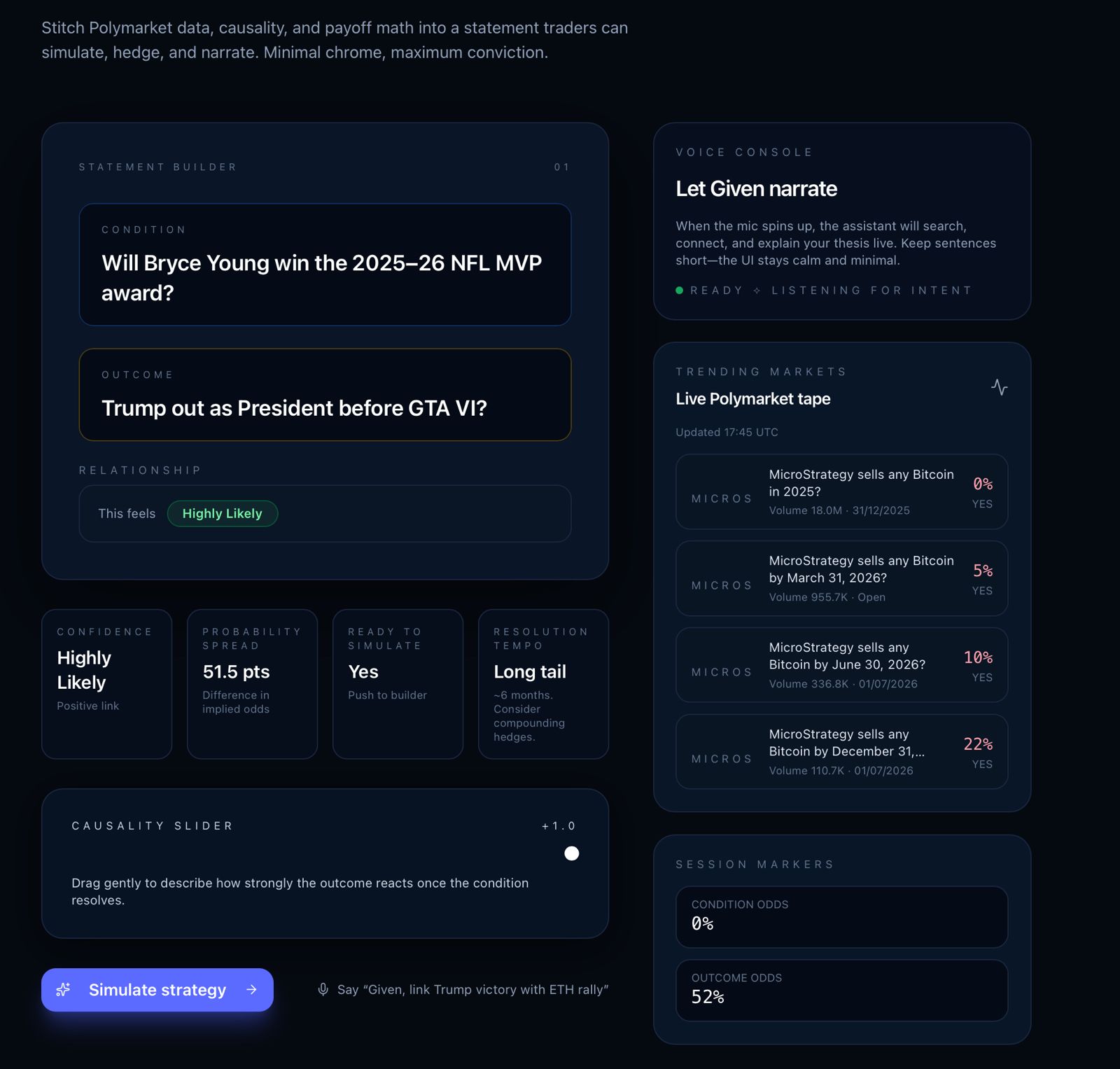
We noticed that most people already reason about their lives and finances using conditional logic: “If X happens, then I’ll do Y.” “If X happens, then I’ll do Y.” Our goal was to turn that natural way of thinking into something actionable, using prediction markets as the foundation. "If we win the hackathon, we all have internships."
What it does
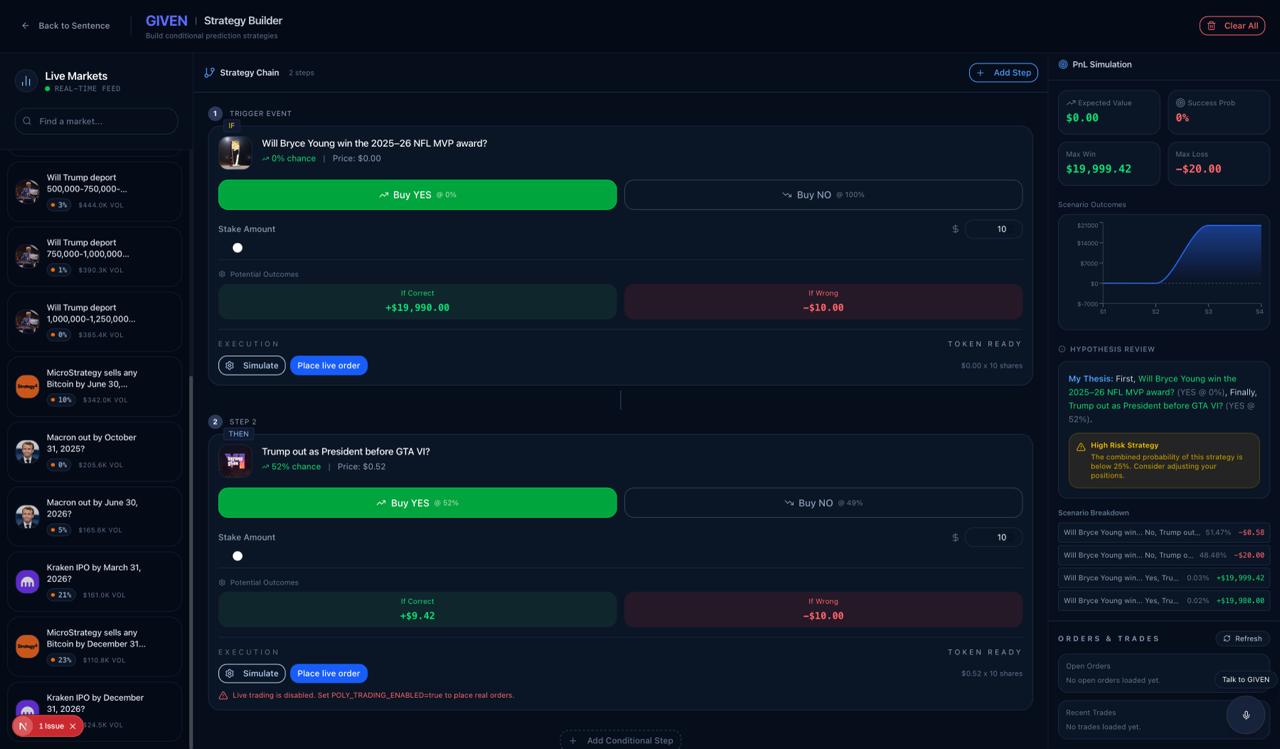
Our project uses the Polymarket API to enable consequential trades, trades that are executed conditionally based on real‑world or user‑defined outcomes.
Formally, users can express strategies of the form:
If A resolves, then automatically execute B. Unlike alerts or manual follow‑ups, the entire decision tree is committed upfront. Only the branch consistent with reality ever executes, guaranteeing correct execution even during fast‑moving events.
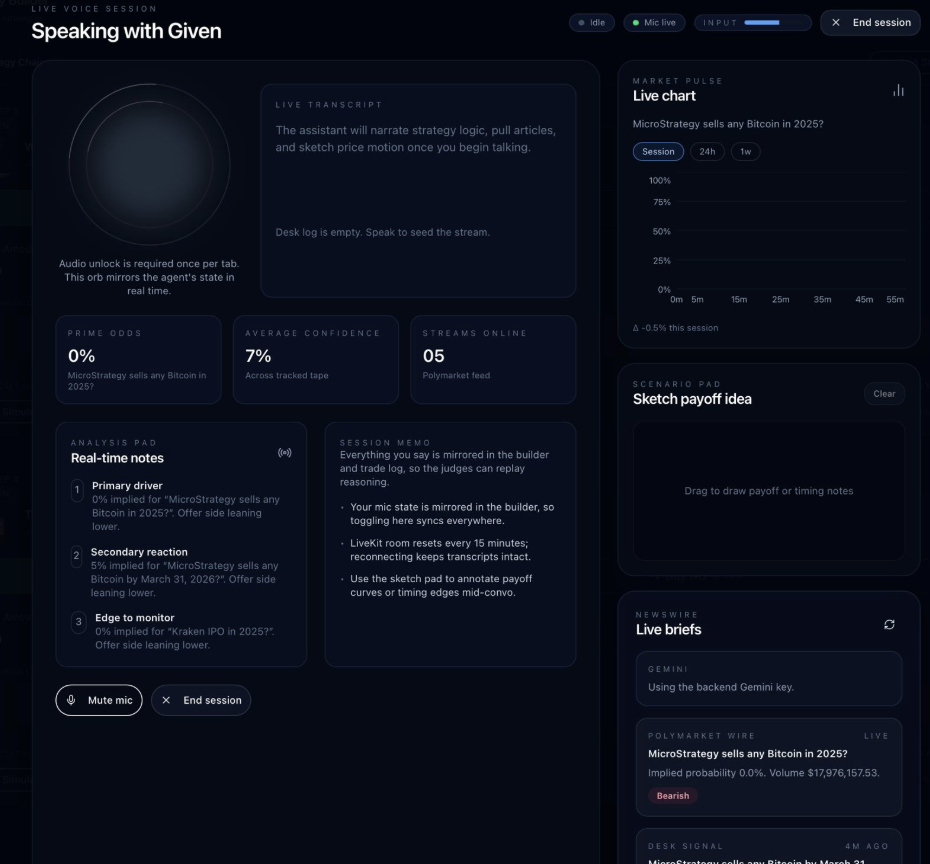
To support better decision‑making, we integrate LiveKit to power a real‑time voice agent that challenges and validates the user’s reasoning before trades are placed. The agent helps users:
- Articulate assumptions
- Consider counterfactuals
- sanity‑check logic
This turns prediction markets into a reflective decision engine, not just a betting interface.
How we built it
We built Polymer as a full‑stack, voice‑native Polymarket trading interface that enables conditional and consequential execution without requiring protocol‑level changes.
Core architecture The application is built using Next.js (App Router) with a client‑heavy UI to support low‑latency interaction. Shared state is managed via Zustand, allowing the sentence builder, strategy builder, and voice agent to operate off a single source of truth.
Polymarket integration We integrate directly with the Polymarket API for:
- live market data and price normalization
- market discovery for conditional legs
- secure trade execution via proxy routes
Conditional logic is handled entirely client‑side by continuously monitoring market state and executing trades the moment predefined conditions are met. This allows us to simulate native conditional execution with millisecond‑level responsiveness.
Voice agent (LiveKit) We use LiveKit to power a low‑latency, real‑time voice agent that runs alongside the trading workflow.
The agent:
- listens as users talk through their assumptions
- asks clarifying questions
- Challenges to ambiguous reasoning
LiveKit data channels stream transcripts, agent responses, and tool calls in real time, creating an experience that feels closer to a trading terminal than a chat interface.
News & data infrastructure To ground strategies in reality, we built a high‑throughput news ingestion pipeline using the Gemini API. News events are:
- ingested continuously
- normalized and tagged to relevant markets
- queried in real time during strategy construction
This ensures strategies evolve as information breaks, not minutes later, which is critical for consequential execution.
Challenges we ran into
Initially, we assumed Polymarket would require fundamental changes to support conditional or consequential trades. Through deeper exploration of the API, we realized this functionality could be built entirely client-side by monitoring conditions and executing trades instantly once they are met. Designing this in a reliable and low-latency way was our biggest technical challenge.
Accomplishments that we're proud of
- Designing a novel trading primitive on top of existing prediction markets.
- Successfully combining voice-based reasoning with real financial actions
- Building a working end-to-end system that feels meaningfully different from existing Polymarket interfaces
What we learned
- How to work effectively across different technical environments and APIs
- How to blend multiple hackathon tracks (AI, fintech, real-time systems) into a single cohesive product
- That powerful new behaviors can emerge from existing platforms without requiring protocol-level changes
Why this matters for Polymarket
Polymer introduces a new execution layer for prediction markets.
Higher user lifetime value (LTV) Consequential trades naturally increase LTV because:
- One belief leads to multiple linked trades
- Capital stays engaged across longer time horizons
- users commit to plans, not one‑off bets
More time spent in the product Voice‑based reasoning, live news grounding, and multi‑step strategies turn Polymarket into a place where users think, not just transact.
Better incentive alignment Consequential trades unlock new incentive models:
- bonuses for correctly executed multi‑step strategies
- reduced fees for structured trades
- clearer loss attribution when assumptions fail
This aligns incentives with good forecasting, not impulsive betting.
Scalability beyond prediction markets While built on Polymarket, the execution model: belief→condition→consequence applies to many domains, positioning Polymarket as the market leader in consequence‑based trading.
A product for everyday users Importantly, Polymer is designed not just for professional traders, but for day‑to‑day users who want to reason about the future and make small, structured decisions.
This is how prediction markets evolve from a niche product into a habitual, lifestyle platform.
What's next for Polymer
Next, we want to:
- Work toward native Polymarket integration, including potential deployment on Given, to create an immersive, spatial interface for reasoning about uncertainty and consequence
- Expand the voice agent into a more rigorous reasoning partner (tracking assumptions over time)
- Add portfolio-level consequence visualization (P&L across conditional futures)
Built With
- er


Log in or sign up for Devpost to join the conversation.