-
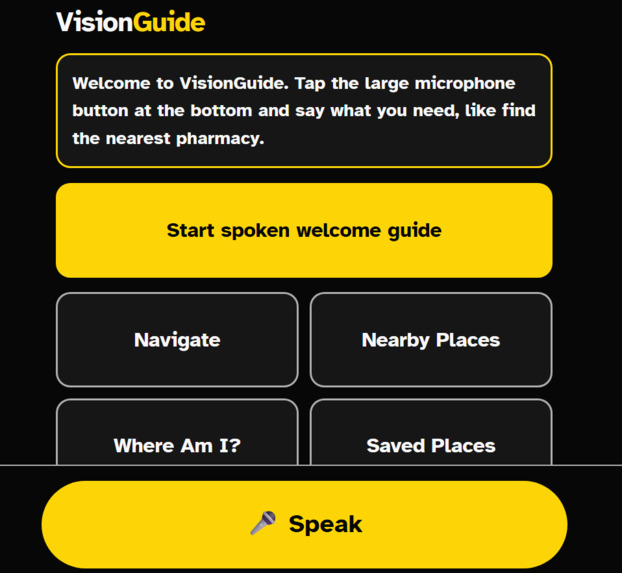
UI interface
-
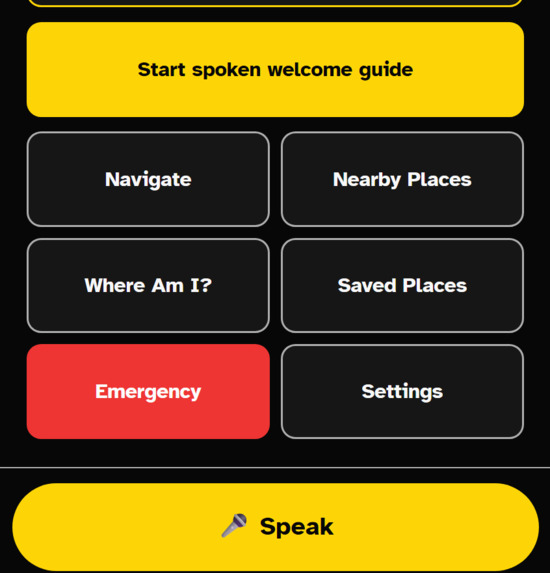
features of this website
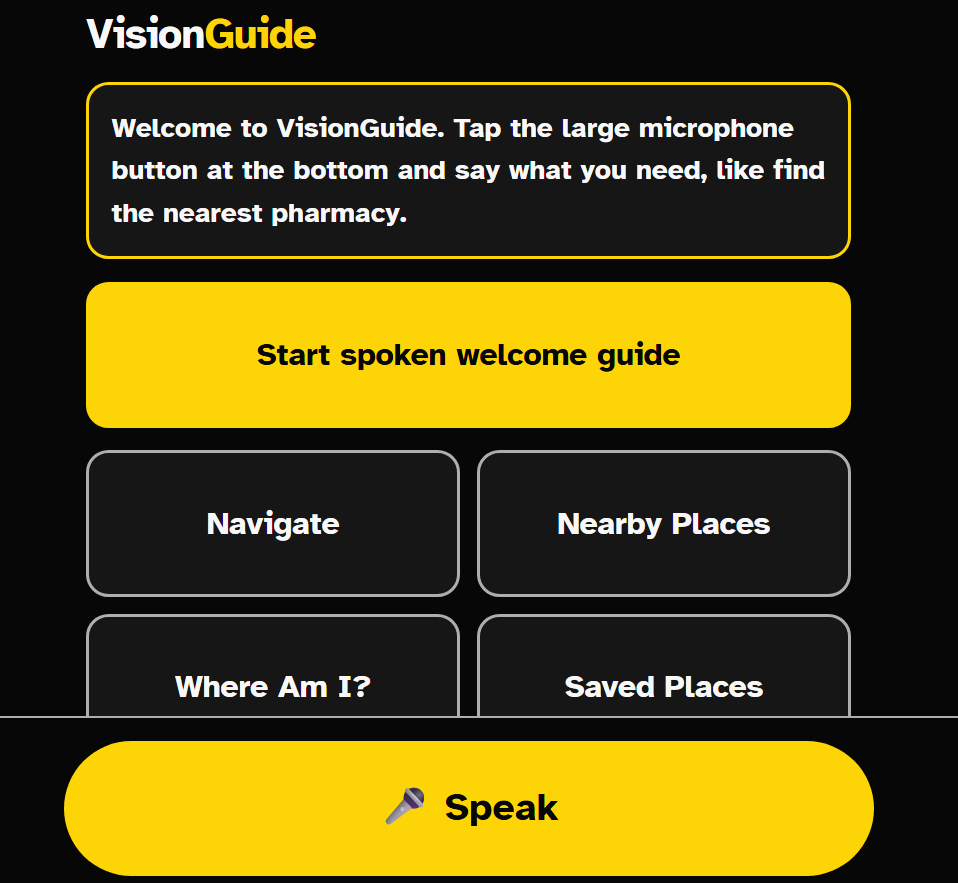
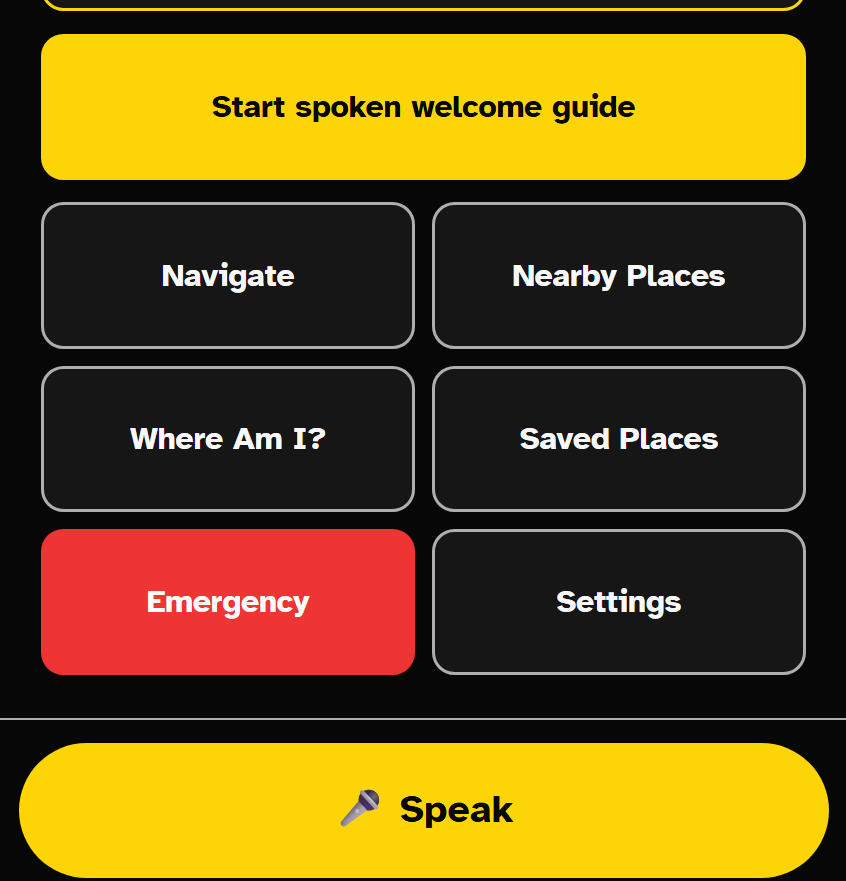
VisionGuide – Smart Voice Navigation for Blind People
Project Overview
VisionGuide is an AI-powered assistive navigation application designed to help blind and visually impaired people navigate their surroundings independently. The application uses GPS, Google Maps, voice commands, and audio instructions to guide users to their destinations through earphones without requiring them to constantly look at their phones.
Problem Statement
Blind and visually impaired people often face difficulties navigating unfamiliar places, locating nearby facilities, and following directions independently. Traditional navigation applications rely heavily on visual maps and on-screen information, which can make navigation challenging for users who cannot see the screen.
Proposed Solution
VisionGuide provides a voice-based navigation system that allows users to search for destinations, discover nearby places, and receive spoken walking directions. By integrating Google Maps and GPS, the application provides location information, route guidance, and turn-by-turn audio instructions through connected earphones.
Key Features
- Voice-Based Navigation: Users can navigate to destinations using spoken commands and receive turn-by-turn audio instructions.
- Nearby Places Discovery: Find nearby hospitals, pharmacies, restaurants, ATMs, grocery stores, bus stops, and other essential facilities.
- GPS Location Tracking: Identify the user's current location and monitor their progress along a route.
- Earphone Guidance: Deliver clear spoken directions through wired or Bluetooth earphones.
- Voice Assistant: Support commands such as "Where am I?", "Find the nearest hospital," and "Repeat the last direction."
- Automatic Route Recalculation: Update the walking route when the user deviates from the planned path.
- Saved Destinations: Allow users to save frequently visited places, such as home, college, or workplace.
- Emergency Assistance: Provide options to contact trusted people and share the user's location when assistance is needed.
- Accessible Interface: Support screen readers, high-contrast visuals, and simple controls for users with visual impairments.
Technology Stack
- Frontend: React Native and TypeScript.
- Maps and Navigation: Google Maps Platform, Routes API, and Places API.
- Location Services: GPS and mobile device location services.
- Voice Recognition: Speech recognition APIs.
- Audio Guidance: Text-to-speech technology.
- Backend: Python with FastAPI, if required.
- Database: Firebase or Supabase for storing saved destinations and user preferences.
How It Works
- The user opens VisionGuide and gives a voice command.
- The application identifies the user's current location using GPS.
- Google Places API finds nearby places or identifies the requested destination.
- Google Maps Platform calculates an appropriate walking route.
- The application converts navigation instructions into speech.
- The user receives directions through their earphones.
- GPS tracks the user's progress, and the application updates the route when necessary.
- The application announces arrival at the destination.
Expected Impact
VisionGuide aims to improve independent mobility, accessibility, and confidence for blind and visually impaired people. By combining voice interaction with location-based navigation, it can make discovering nearby places and travelling to unfamiliar destinations easier.
Future Scope
Future versions could incorporate camera-based obstacle recognition, intelligent descriptions of the surrounding environment, accessible public transport guidance, multilingual voice assistance, and integration with smart wearable devices.
Important Safety Note: VisionGuide is intended to assist with navigation, not guarantee safe passage. GPS and map data cannot reliably detect every obstacle, curb, staircase, or traffic hazard. Users should continue using established mobility techniques and independently assess road-crossing conditions.

Log in or sign up for Devpost to join the conversation.