-
This image is currently processing. Please be patient...

-
Computer Vision lacks accessibility.
Whilst modern data descriptors for complex 3D manifolds are developed to be rich and informative, they are difficult to calculate and often require loading the data of an entire mesh. Many descriptors, such as Heat Kernel Signature or Laplacian, involve solving a system of differential equations or attempting to interpolate an entire mesh as a function. Using these types of descriptors limits researchers and developers alike to advanced proprietary software like MatLab: this limits users both financially and in terms of producing integrated solutions. Additionally, computers are slower at calculus than they are at vector math because calculus often requires visualisation of problems: expressing this in a form a computer understands takes up a lot of memory and processing power. The hardware required to effectively compute these descriptors starts at about $750 .
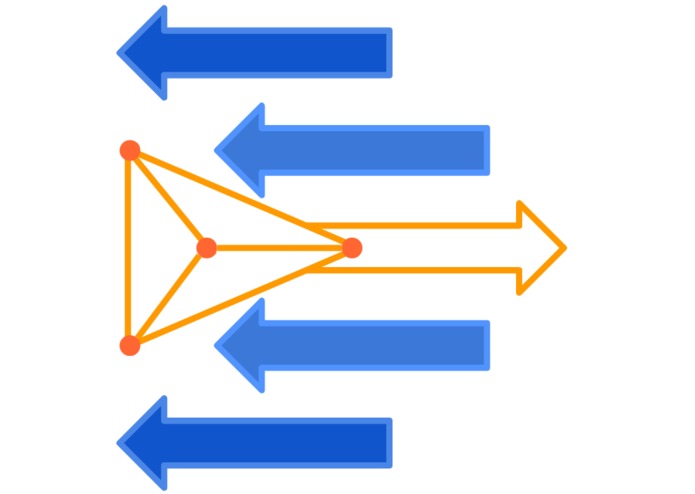
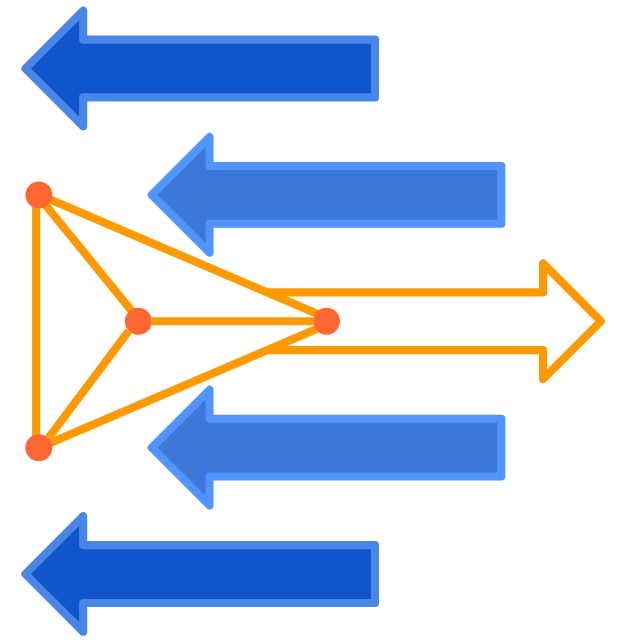
To achieve near or actual real-time 3D shape recognition, more concise and feasible feature descriptors must be developed. These descriptors still need to be rich and informative, but should minimise the quantity of data they need to load, and attempt to avoid the use of calculus. I propose the Fluid Flow Vector as a starting point for developing better, faster descriptors. The Fluid Flow Vector leaves a low memory footprint and shows no sign of exponential compute complexity (although this may change under further analysis). It achieves its goal of being an efficient edge algorithm for a small, prototype scale, and has much potential to be developed further into a powerful 3D recognition solution.Although the Fluid Flow Vector achieves its intended goals, I warmly welcome contributions from the scientific community to optimise its functionality or use it to aid other pieces of work.
Conor McMullan
Distributed under the MIT License

Log in or sign up for Devpost to join the conversation.