-
-
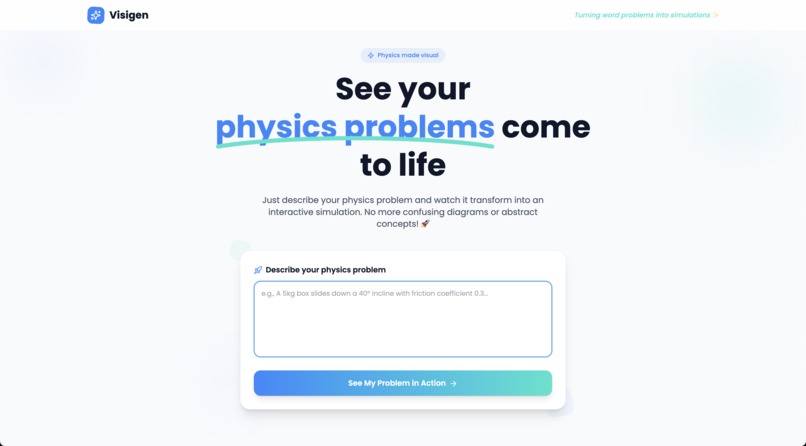
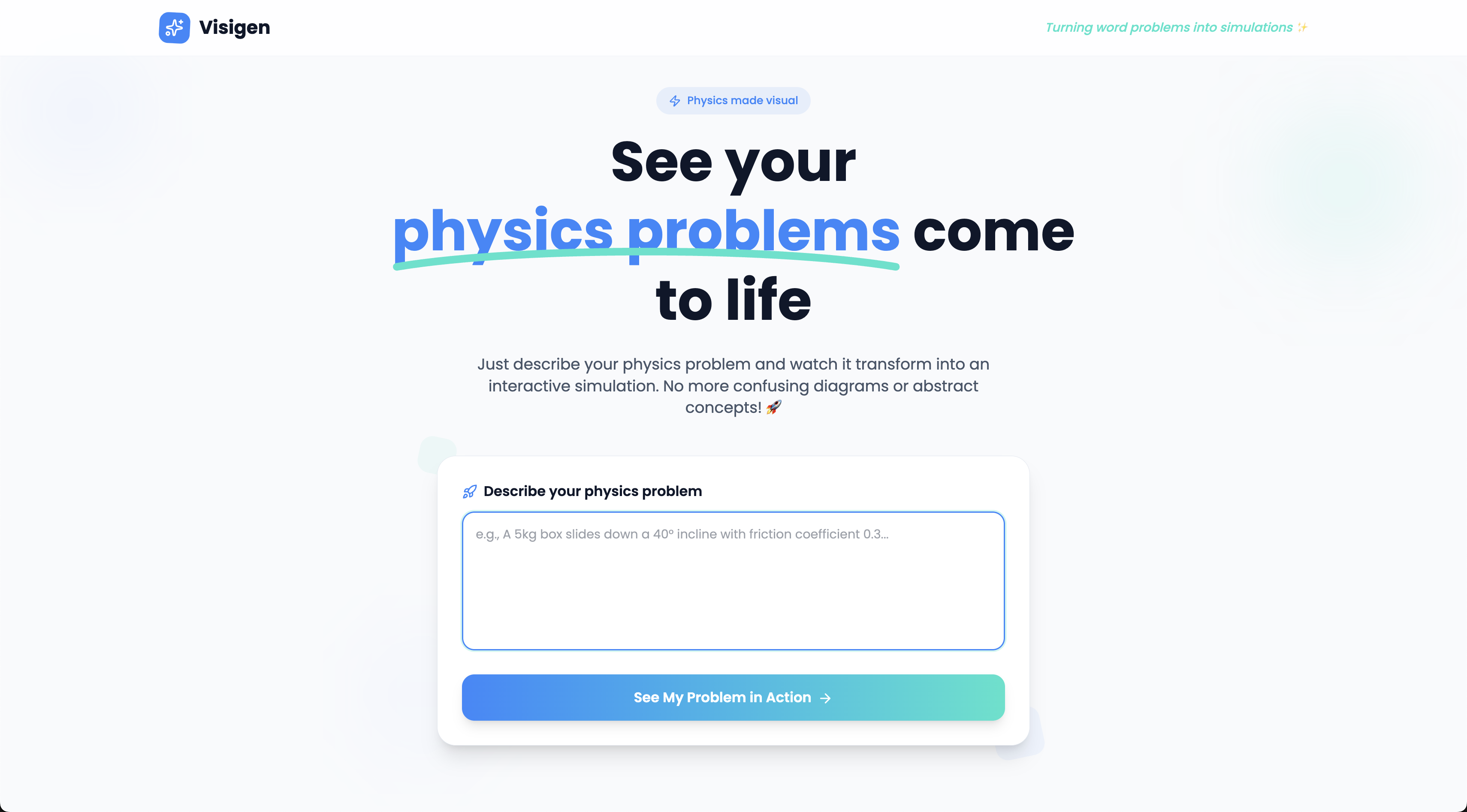
Landing page
-
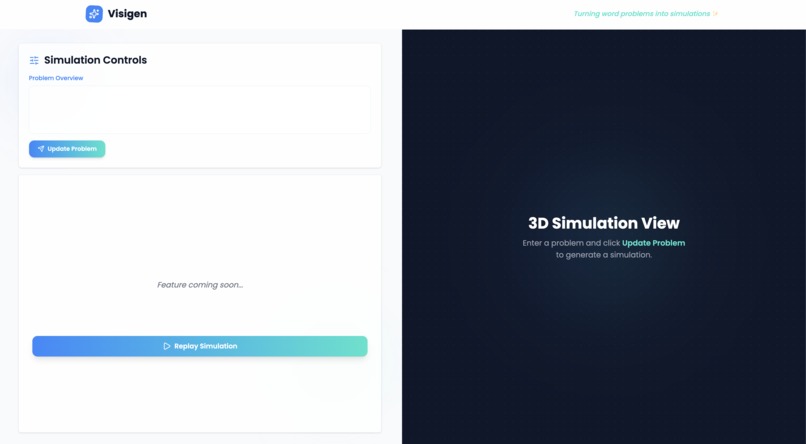
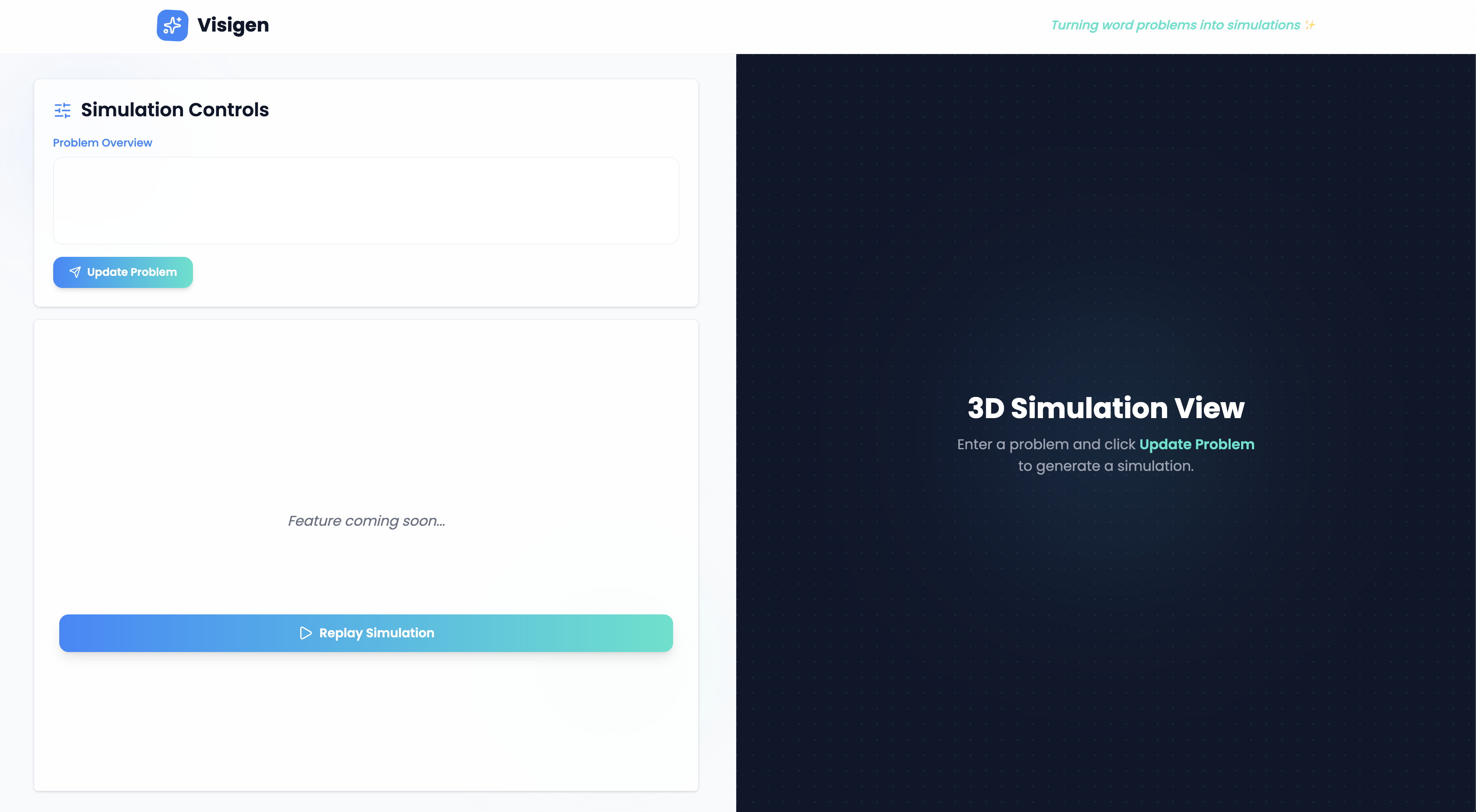
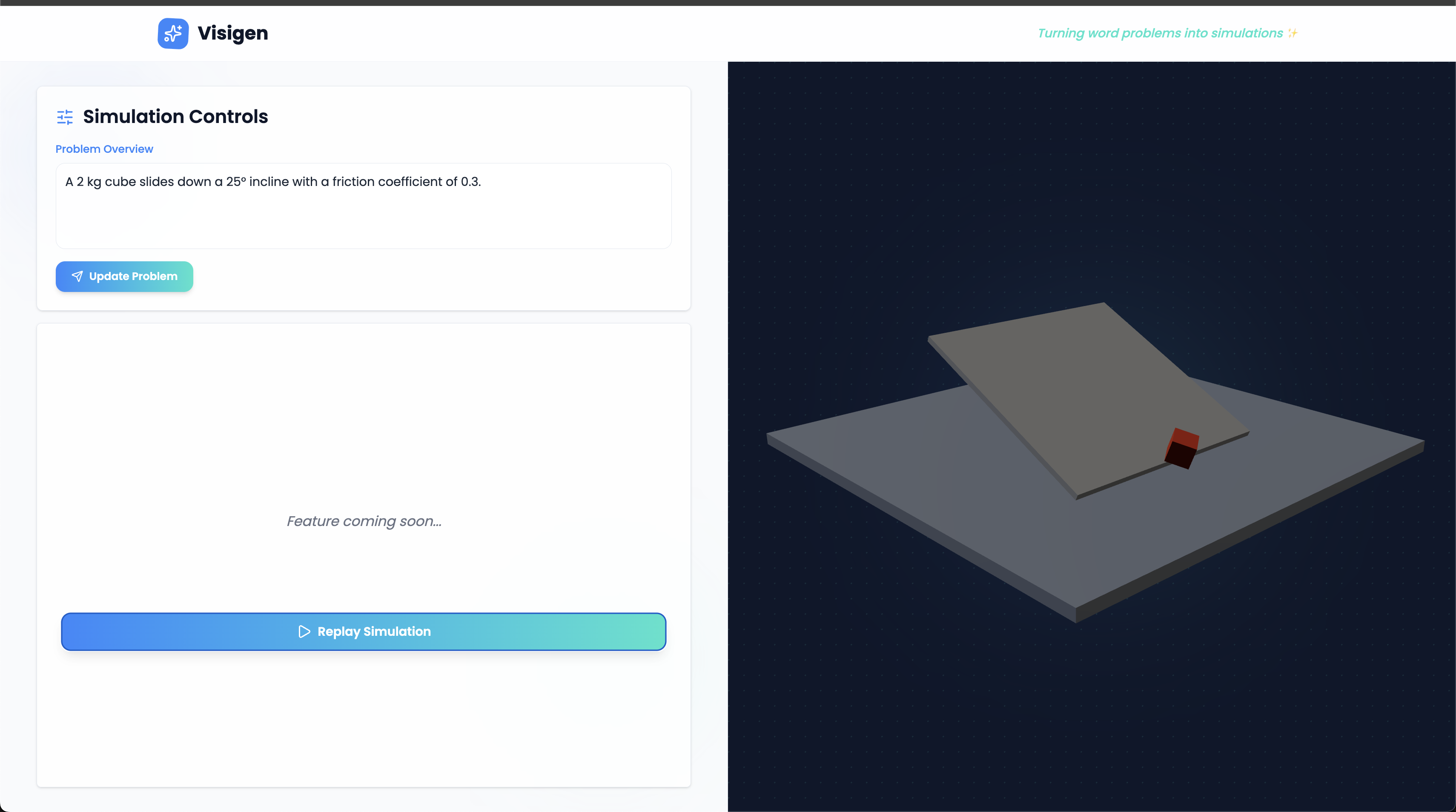
Pre simulation render
-
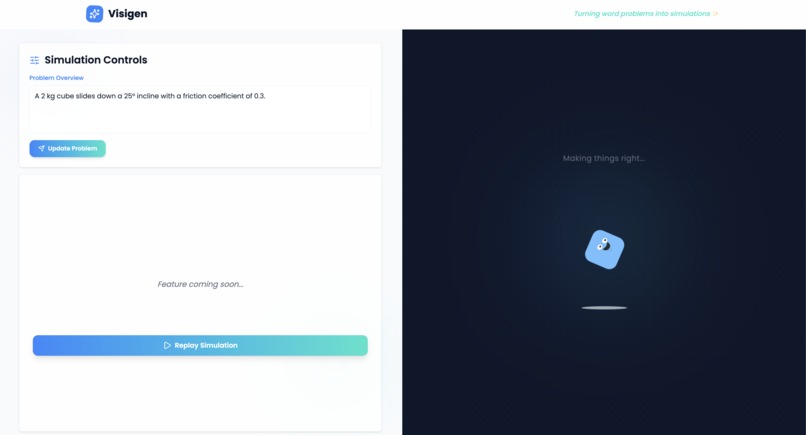
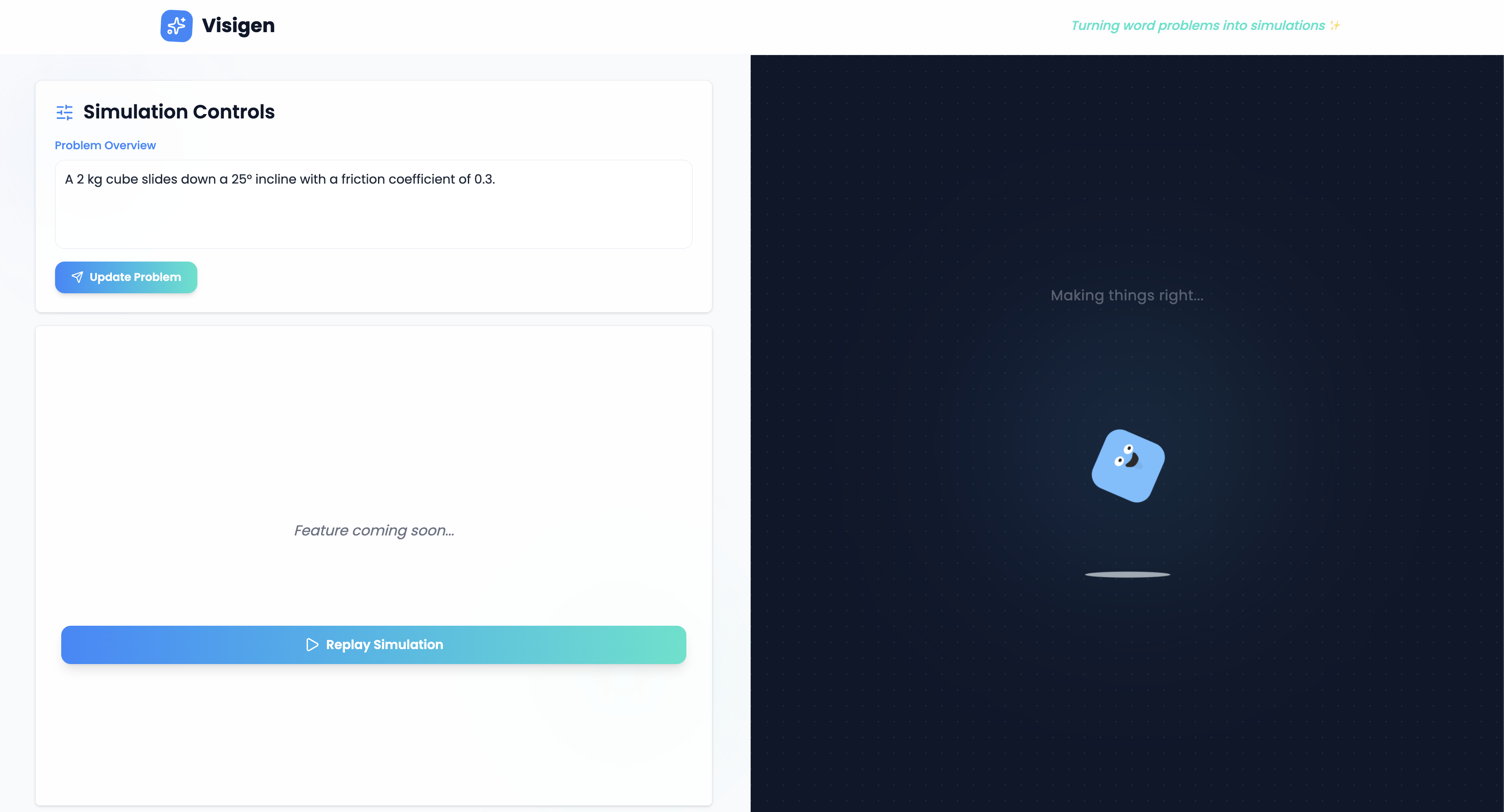
Loading simulation
-
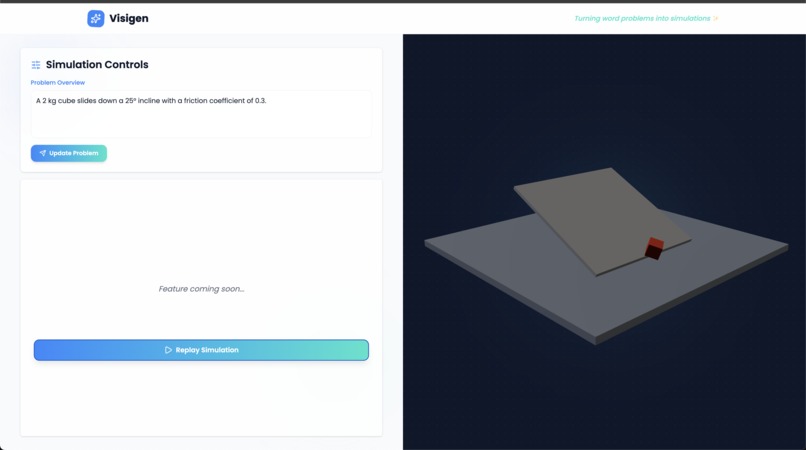
Simulation ready
-
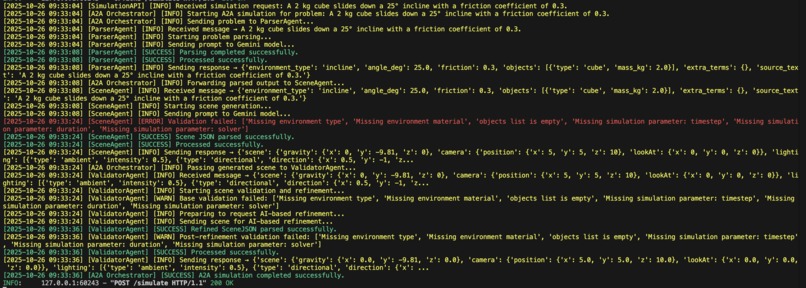
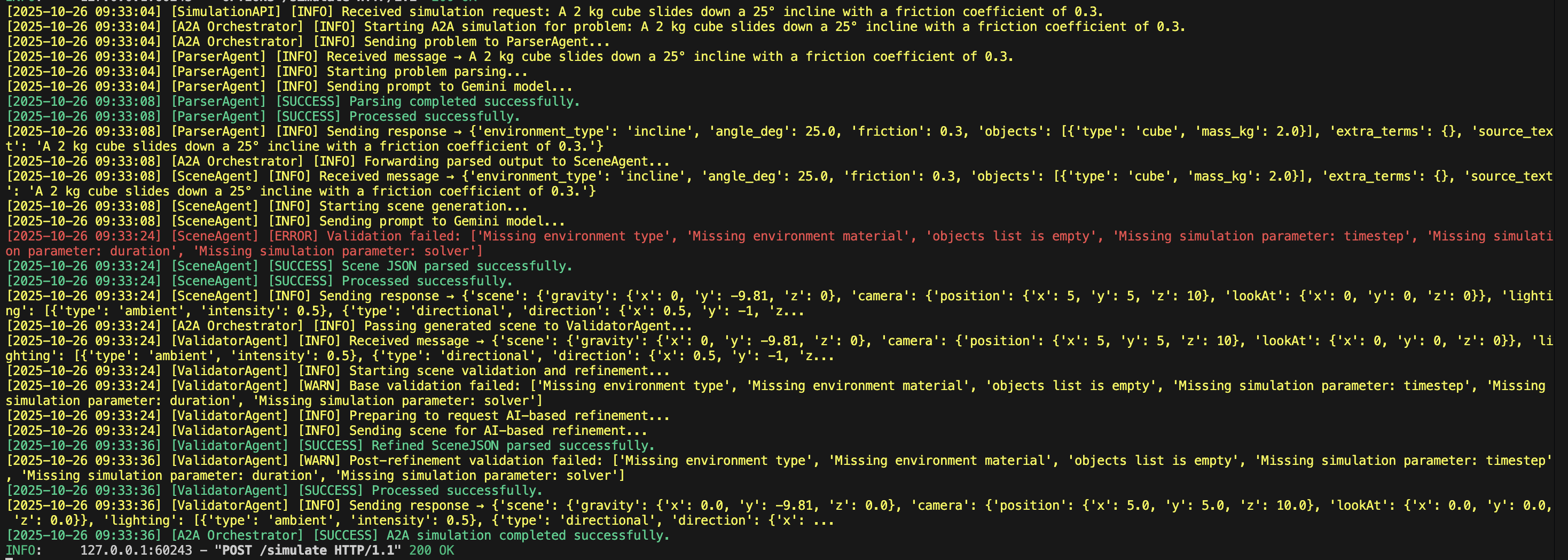
Agent 2 Agent communication pipeline
Visigen
From Words to Worlds — Turning Physics Problems into Interactive 3D Simulations
Inspiration
Physics problems are often described in words — but truly understanding them requires visualization.
When we read something like:
“A 5 kg sphere rolls down a 30° incline without friction.”
we’re forced to imagine what’s happening: the slope, the motion, the forces involved.
That gap between text and visualization inspired us to create Visigen — a system that converts written word problems into interactive 3D physics simulations.
We wanted to make learning intuitive, immersive, and visual, so students can see physics come to life.
What it does
Visigen allows users to input any physics word problem, and within seconds, it:
- Parses the natural language description to extract key parameters like mass, friction, and angle.
- Generates a structured 3D scene (in JSON format) describing objects, environment, and simulation properties.
- Validates and refines the scene through an AI agent feedback loop.
- Renders the simulation in real-time using React Three Fiber and Rapier Physics.
Students can instantly visualize motion, friction, and forces — making complex formulas tangible.
$$ a = g(\sin{\theta} - \mu \cos{\theta}) $$
How I built it
Frontend:
- Built with React + Vite and styled with Tailwind CSS
- Used React Three Fiber for 3D rendering
- Integrated Rapier Physics for realistic motion, collisions, and friction
- Added Lottie animations for dynamic and themed loading visuals
Backend (FastAPI):
- Developed an AI Agent System:
parser_agent— understands natural language problems and extracts datascene_agent— creates 3D environment blueprints in structured JSONvalidator_agent— checks and refines simulation parametersa2a_manager— orchestrates the full autonomous “parser → builder → validator” pipeline
- Supports mathematical reasoning for motion, friction, and gravity using physical equations:
$$ F = ma, \quad \mu = \frac{f}{N}, \quad a = g \sin{\theta} $$
- Connected to the frontend via CORS-enabled FastAPI endpoints
Challenges I ran into
- Understanding Natural Language: Translating text like “slides without friction” vs “rolls down” into meaningful physics parameters
- Scene Construction: Ensuring the incline, objects, and base aligned perfectly in 3D space without clipping or floating issues
- Realistic Physics Tuning: Balancing Rapier’s parameters for realistic acceleration, restitution, and motion
- Camera Composition: Creating a fixed but cinematic view that works for all simulations
Accomplishments that I am proud of
- Built a complete AI-to-Simulation pipeline from scratch within a short time frame
- Achieved fully dynamic 3D rendering directly from natural language
- Designed an elegant UI/UX that feels both educational and futuristic
- Demonstrated autonomous agent collaboration between parsing, validation, and visualization
What I learned
- How to merge language models, mathematical reasoning, and 3D physics into one cohesive system
- The power of AI-driven interpretation in education — bridging human text with computational understanding
- That visual feedback is one of the fastest ways to reinforce conceptual learning
- How to debug physics simulations that don’t always behave as expected (yes, we lost a few spheres through the floor)
What's next for Visigen
- Support more complex scenarios — projectiles, pendulums, pulleys, and rotational dynamics
- Display live equations and numeric outputs alongside simulations
- Enable adjustable sliders for mass, friction, and angles (coming soon)
- Deploy to AWS EC2 with a public demo and a shared model inference endpoint
- Partner with educators to integrate Visigen into interactive learning platforms


Log in or sign up for Devpost to join the conversation.