-
-
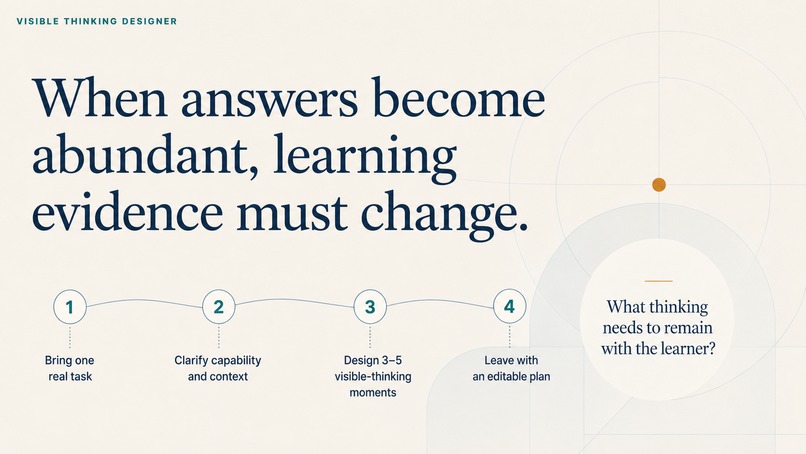
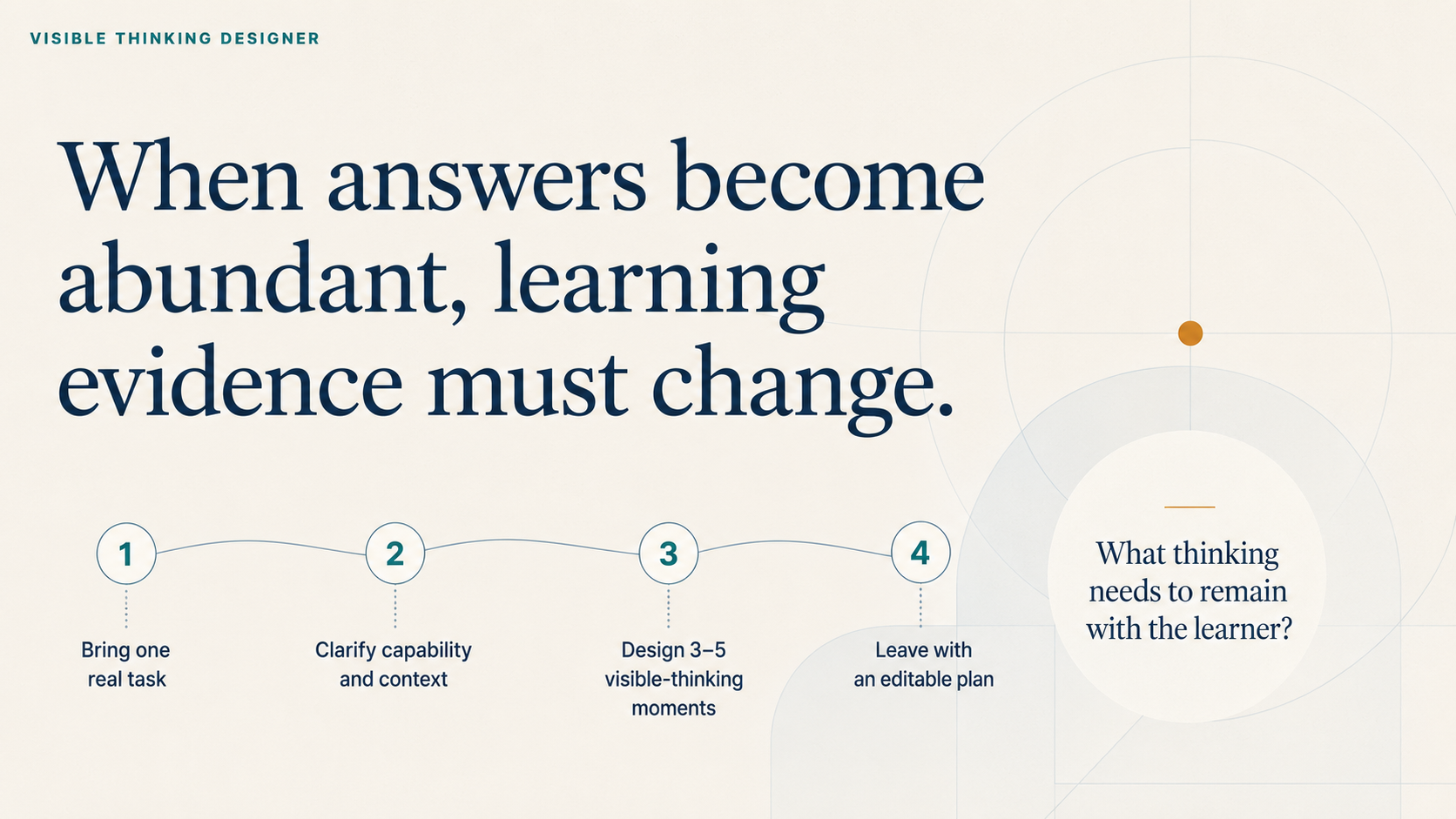
When answers become abundant, learning evidence must change. What thinking needs to remain with the learner?
-
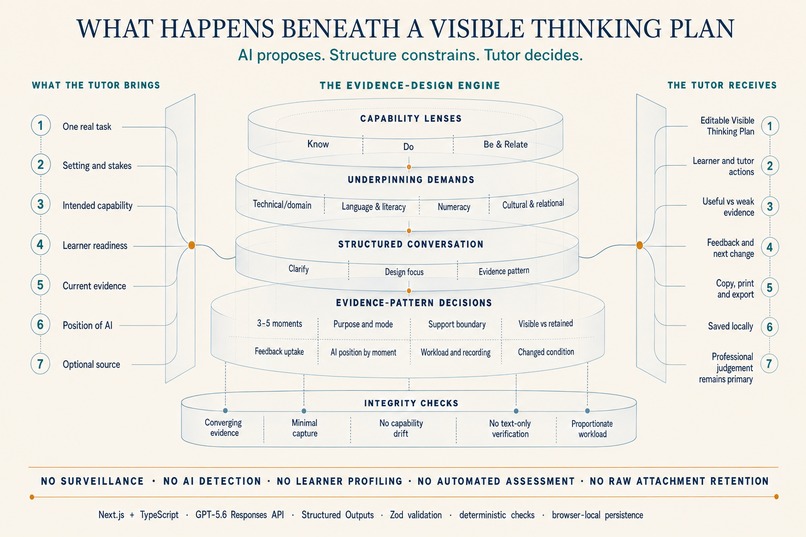
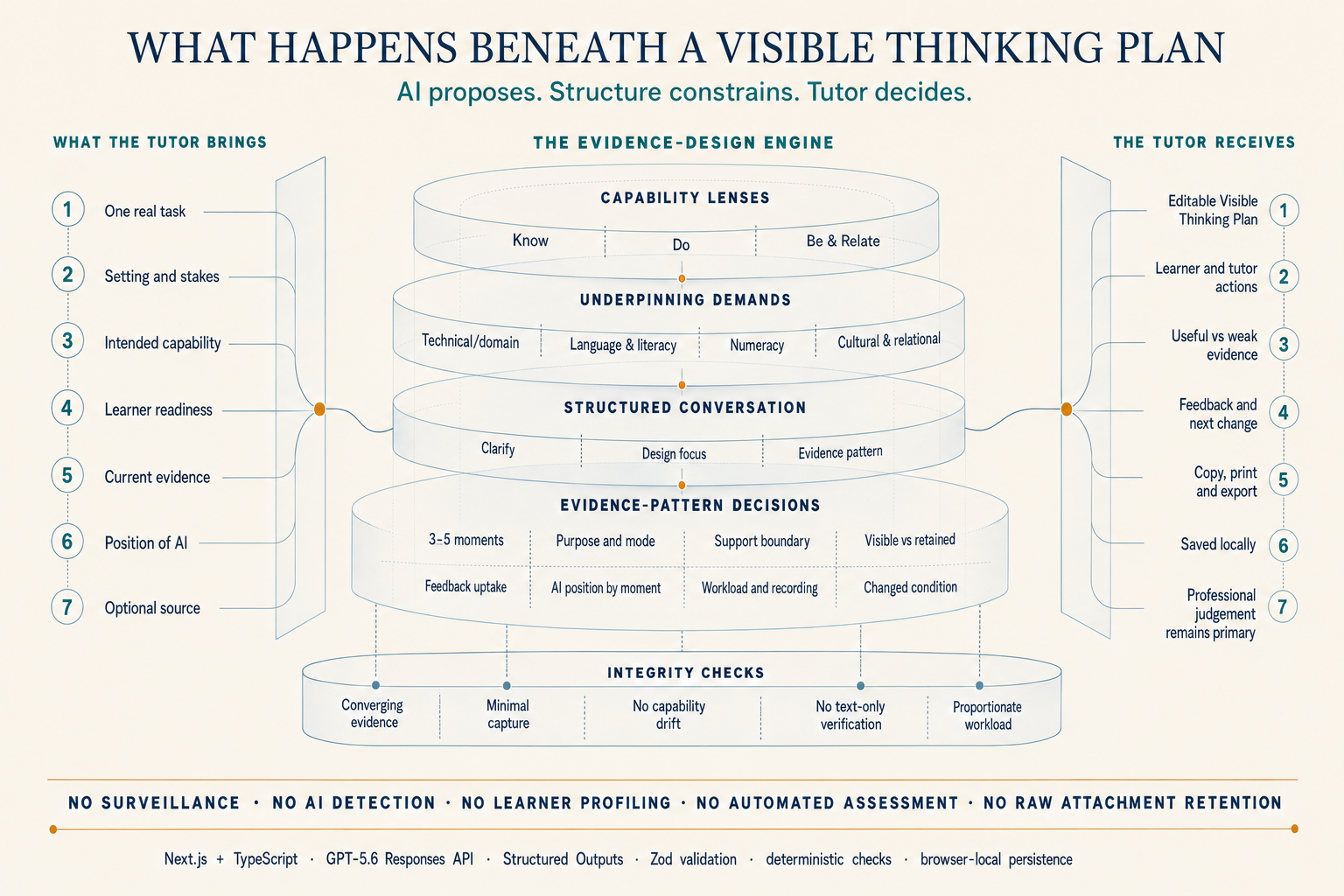
What happens beneath a visible thinking plan? AI proposes. Structure constrains. Tutor decides.
Inspiration
When answers become abundant, getting the answer is no longer reliable evidence that learning has occurred. Two learners can produce equally polished work while only one has developed the capability the task was intended to build.
The Visible Thinking Designer emerged from my work with vocational educators in Aotearoa New Zealand. Tutors could see important learner thinking becoming visible through attempts, questions, practical decisions and professional conversations... but this evidence was often incidental, unrecognised or missing from the task and assessment design.
The problem was not simply whether learners should or should not use AI. Educators and learners hold different positions on that question, and those differences are legitimate. The deeper design question was:
What thinking needs to remain with the learner, and how can we make it visible without creating surveillance or unnecessary workload?
I tested the initial field model against learning-science research and refined it through the What Thinking Remains Visible? field note and When Answers Become Abundant research synthesis.
What it does
Visible Thinking Designer is an AI-assisted design partner for tertiary and vocational educators.
A tutor brings one real learning activity, task or assessment. They can describe it directly or attach a supporting PDF, Word document or photograph. The tutor’s description remains authoritative.
The application then helps the tutor:
- clarify the capability the task is intended to develop;
- consider what learners need to Know, Do, and Be & Relate;
- notice technical, language and literacy, numeracy, and cultural or relational demands;
- establish a focused understanding of the task, learner readiness, context and position of AI;
- design three to five moments where consequential learner thinking could become visible; and
- produce an editable Visible Thinking Plan that can be used in practice.
Each visible-thinking moment identifies the learner action, tutor move, useful evidence, weak or missing evidence, feedback and what the learner changes next. Optional Evidence Pattern Details make the purpose, evidence mode, support boundary, retention requirement, workload and moment-specific AI position inspectable without turning the interface into a compulsory checklist.
The interaction draws on five research-informed conditions:
- Attempt — calibrated to learner readiness;
- Question — supported through guidance;
- Check — grounded in the discipline;
- Explain Judgement — explored through adaptive follow-up and professional conversation; and
- Apply — demonstrated under changed conditions.
Feedback connects these conditions because evidence only becomes useful when somebody interprets it and changes what happens next.
The conditions are design language, not five sequential steps. Not every task requires every condition, and the aim is not to capture everything a learner does. It is to select a small pattern of moments that provides meaningful, converging evidence.
The finished plan can be edited, reordered, copied, printed or exported as Markdown or privacy-bounded JSON. Projects are stored locally in the browser so tutors can return and refine them.
The tool does not use learner surveillance, AI detection, learner profiling or automatic capability judgements. It supports educator professional judgement; it does not replace it.
How I built it
I began with a field-tested educational model and a research review that challenged and sharpened its assumptions. I then translated that work into a bounded product interaction: one educator, one real task and one usable plan.
The Visible Thinking Designer is a public Next.js and TypeScript web application deployed through ChatGPT Sites. It uses the OpenAI JavaScript SDK and the Responses API with GPT-5.6.
The model interaction is divided into three versioned prompt contracts:
- clarification and source interpretation;
- design-focus generation; and
- visible-thinking moment and evidence-pattern generation.
Strict Zod schemas validate requests and structured model outputs. Deterministic application code then renders the final plan rather than asking the model to generate an uncontrolled document.
Supporting documents and images are processed during clarification using OpenAI file and image inputs. The application retains a structured source digest for later stages rather than repeatedly sending the original file. Raw attachment bytes remain session-only and are not stored in the browser, plan, repository or application logs.
Phone images receive EXIF-aware preparation and optional rotation before transmission. The tutor can retry, replace the attachment or continue from the written task description if processing fails.
Browser-local persistence allows projects to survive refresh and reopening without requiring accounts or a database. Plans can be duplicated independently, edited, reordered and exported.
The build was validated through 62 automated tests, TypeScript checking, linting, production builds and complete live journeys using text-only tasks, Word documents and photographed resources.
Challenges I ran into
The central challenge was avoiding false certainty. Visible Thinking Designer must help educators make better design decisions without pretending that a language model can determine whether learning has occurred.
A related challenge was designing a coherent pattern of evidence rather than generating several additional learner artefacts. No individual artefact is assumed to be AI-proof. Where judgement or verification matters, the plan looks for converging evidence through observation, explanation, performance, feedback-led revision or application under changed conditions.
The interface also had to make sophisticated educational reasoning accessible to vocational tutors. Early outputs sometimes used unnecessarily academic language or exposed too much evidence architecture at once. I revised the prompts towards plain, direct tutor language and placed the deeper architecture inside optional Evidence Pattern Details.
Real task inputs created practical problems. A long pasted assessment template initially overwhelmed the final plan, so I introduced a concise task summary while preserving the original input. A full-resolution phone photograph then exposed a multipart request limit before the application route or OpenAI was reached. I added image preparation, honest file limits, rotation controls and a genuine continue-without-attachment path.
Model reasoning can also take time. Instead of displaying false percentages, the interface shows rotating messages explaining the actual design work underway.
Throughout the build, I had to keep the Five Conditions recursive rather than presenting them as five compulsory steps, recognise professional conversation and practical activity as legitimate evidence, and preserve tutor judgement rather than automate it away.
Accomplishments that I'm proud of
I am proud that the project begins with an authentic educational problem rather than a technology looking for a use case.
The field model has become a working public application that can accept an authentic task, clarify its purpose and context, generate a coherent evidence pattern, support tutor editing and produce a plan that can be used tomorrow.
Testing with a real adult literacy and numeracy assessment was particularly encouraging. Without being prompted towards a predetermined solution, the application proposed a comparison-map activity closely resembling an approach I had previously used in teaching. It also reframed an old definition-heavy assessment into something better suited to learning and evidence conditions in the age of generative AI.
I am proud of the evidence architecture underneath the simple interaction: different evidence purposes and modes, explicit support boundaries, minimal retention, feedback uptake, realistic workload and one meaningful changed condition.
I am also proud of the restraint. The MVP does not attempt to redesign an entire qualification, determine whether capability has been proven or construct a comprehensive assessment platform. It helps one educator improve one real task.
What I learned
I learned that the educational problem is not AI alone. The deeper shift is that answers and polished outputs have become abundant while evidence of capability has become harder to interpret.
I also learned that:
- capability often involves Know, Do, and Be & Relate, not content knowledge alone;
- technical tasks may contain hidden language, literacy, numeracy and cultural demands;
- an initial attempt supports learning only when it is calibrated to readiness;
- learners need guidance to ask productive questions;
- checking must be grounded in the standards and evidence of the discipline;
- another written explanation is not automatically reliable evidence of judgement;
- live, adaptive follow-up can reveal more than another submitted artefact;
- application must involve meaningful adaptation rather than simple repetition;
- feedback matters when the learner changes, confirms or applies something next; and
- good evidence design selects a few consequential traces rather than documenting everything.
The implementation also reinforced that structured model outputs are only the beginning. Educational quality depends on prompt boundaries, deterministic checks, careful defaults, editable outputs, honest failure states and an interface that returns judgement to the tutor.
Most importantly, AI should support the educator's design reasoning without erasing its trace or silently taking it over.
What's next for Visible Thinking Designer
The immediate next step is to test the public prototype with more tertiary and vocational educators using their own authentic tasks.
I want to learn:
- where tutors hesitate or need additional support;
- whether the proposed moments fit real teaching workloads;
- whether the plans remain useful after teaching the redesigned task;
- how the approach works across practical, professional and academic contexts; and
- which parts of the evidence architecture are most valuable in professional-practice and moderation conversations.
Future versions could support shared plans, team-based refinement, richer reusable examples and structured reflection after teaching. Any use of aggregated design patterns would require explicit privacy, consent and governance decisions.
The larger opportunity is not simply another educational application. It is a capability-evidence ecology in which tasks, conversations, feedback and professional judgement help preserve meaningful traces of human learning in a world of abundant AI-generated output.
Built With
- chatgpt-sites
- gpt-5.6
- next.js
- openai-api
- openai-javascript-sdk
- openai-responses-api
- react
- structured-outputs
- typescript
- zod

Log in or sign up for Devpost to join the conversation.