Inspiration
Every day, citizens across the world try to raise issues that matter, broken infrastructure, unclear healthcare support, environmental complaints, or public safety concerns. Yet most systems today are outdated, slow, and fail to understand urgency, emotion, or even language. We’ve all seen it or lived it, submitting a complaint online and hearing nothing back for weeks, or getting misrouted with no way to track what’s happening.
This gap between people and institutions is not just frustrating, it’s harmful. It delays real solutions.
That’s what sparked Samadhan AI, a platform that doesn't just process grievances but actually understands them. We imagined an assistant that anyone could talk to, in their own voice and language, which would not only listen but also act.
This vision resonated with every member of our team. We weren’t building an app, we were building trust.
What it does
Samadhan AI is an AI-first platform for public grievance redressal. It allows citizens anywhere in the world to:
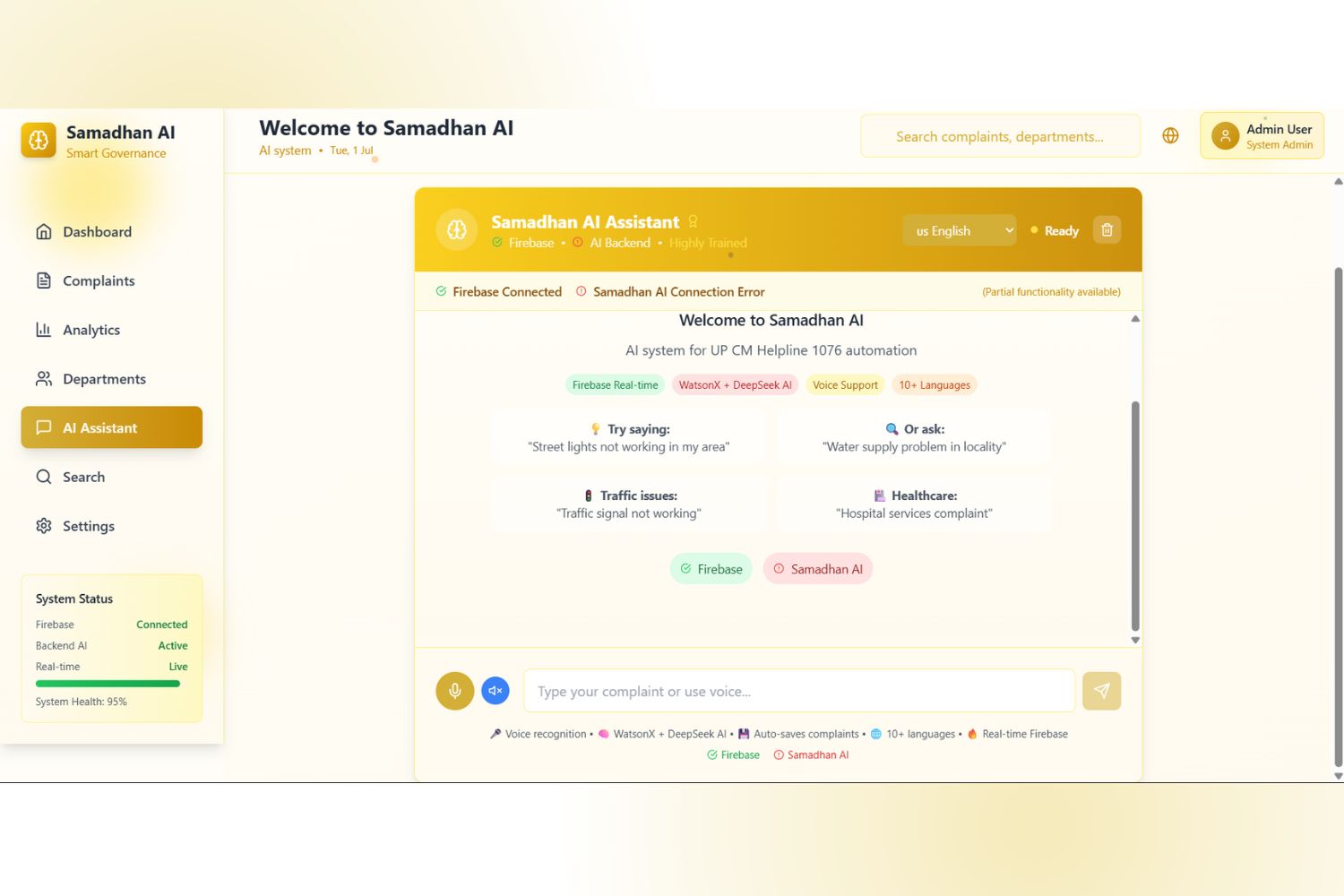
- File complaints via voice or text in over 10+ languages
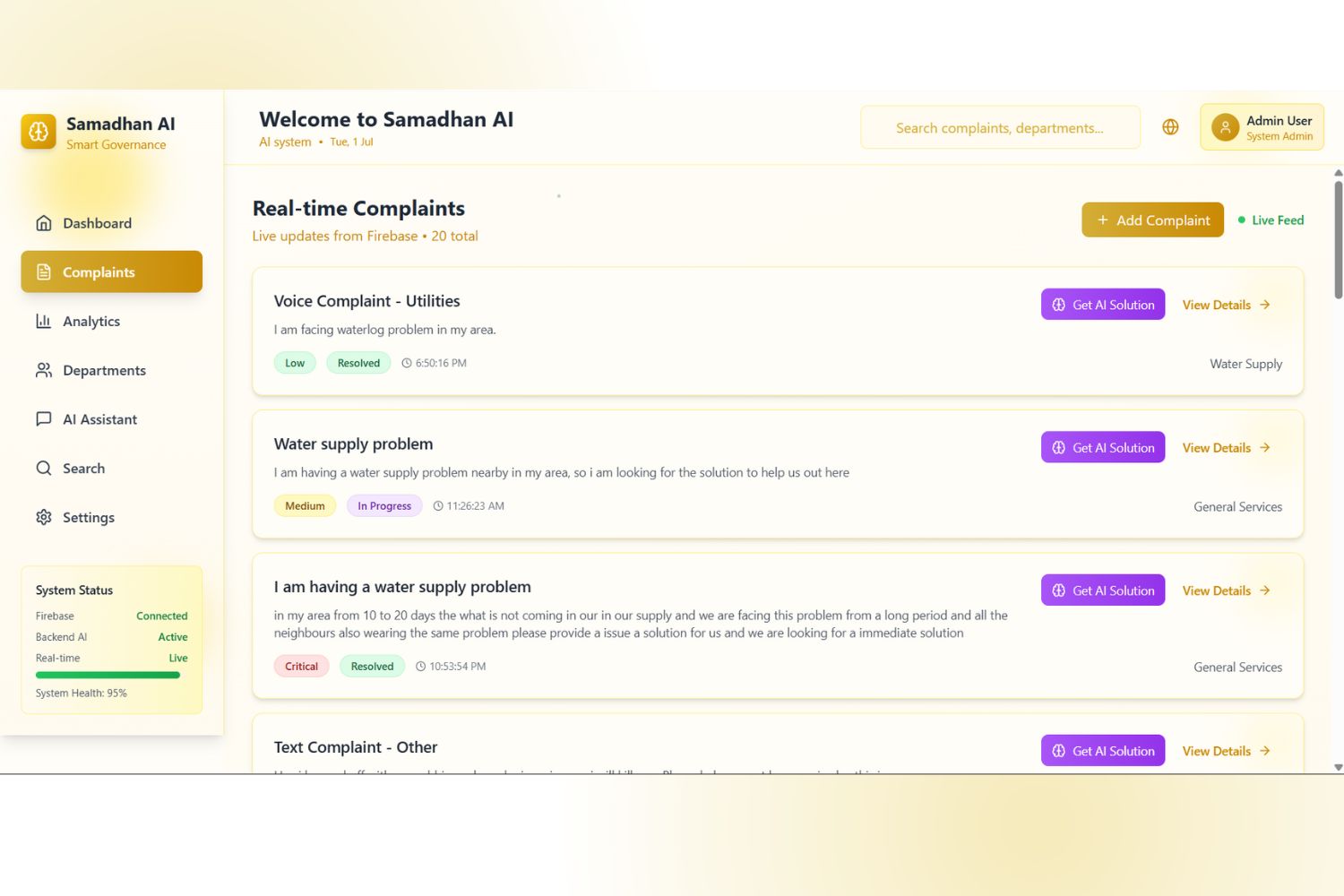
- Automatically categorize issues into domains like healthcare, infrastructure, agriculture, and public welfare
- Detect urgency and sentiment to tag high-priority or critical complaints
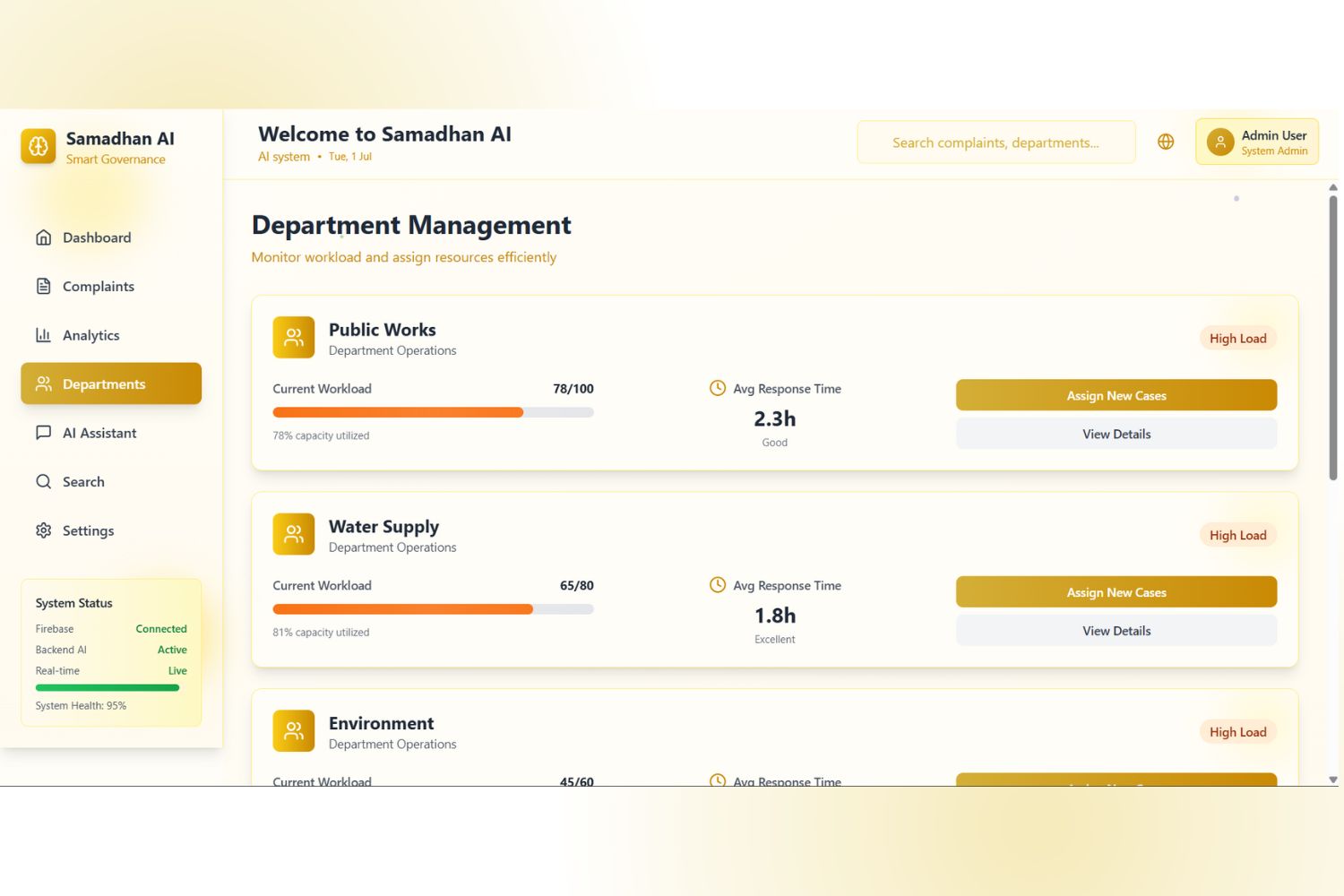
- Route complaints intelligently to the appropriate department or domain expert
- Provide responses using large language models that generate formal, intelligent, and localized replies
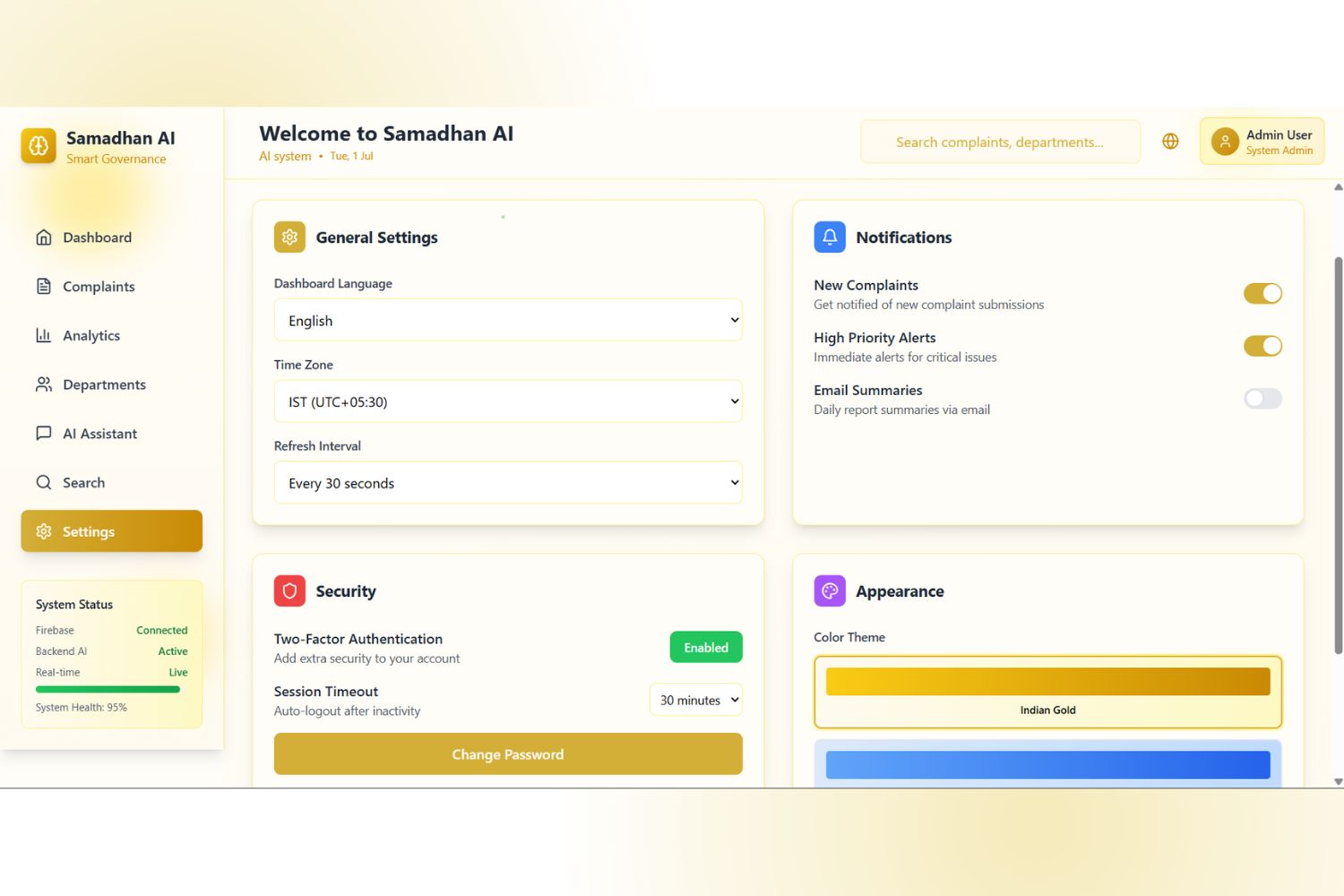
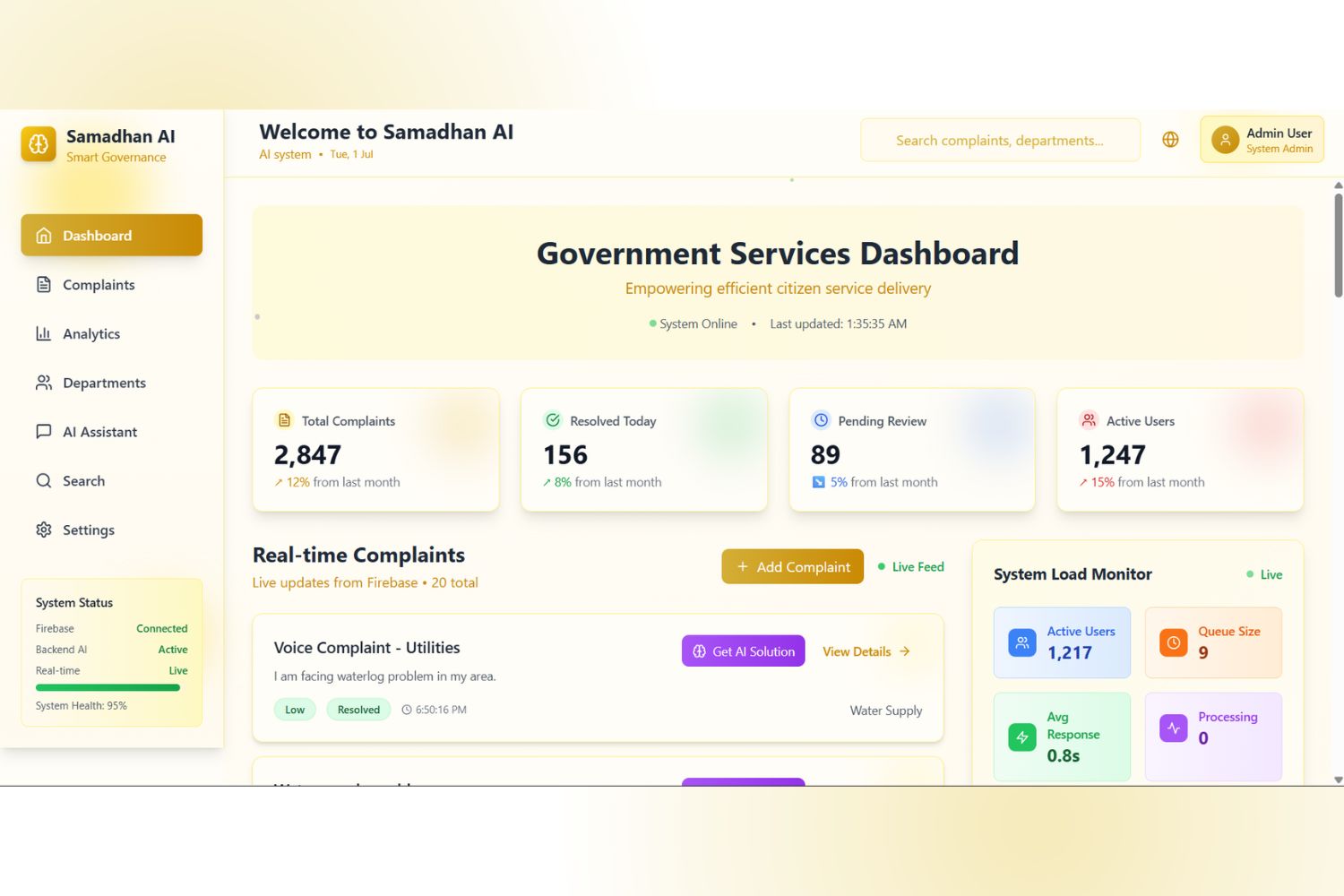
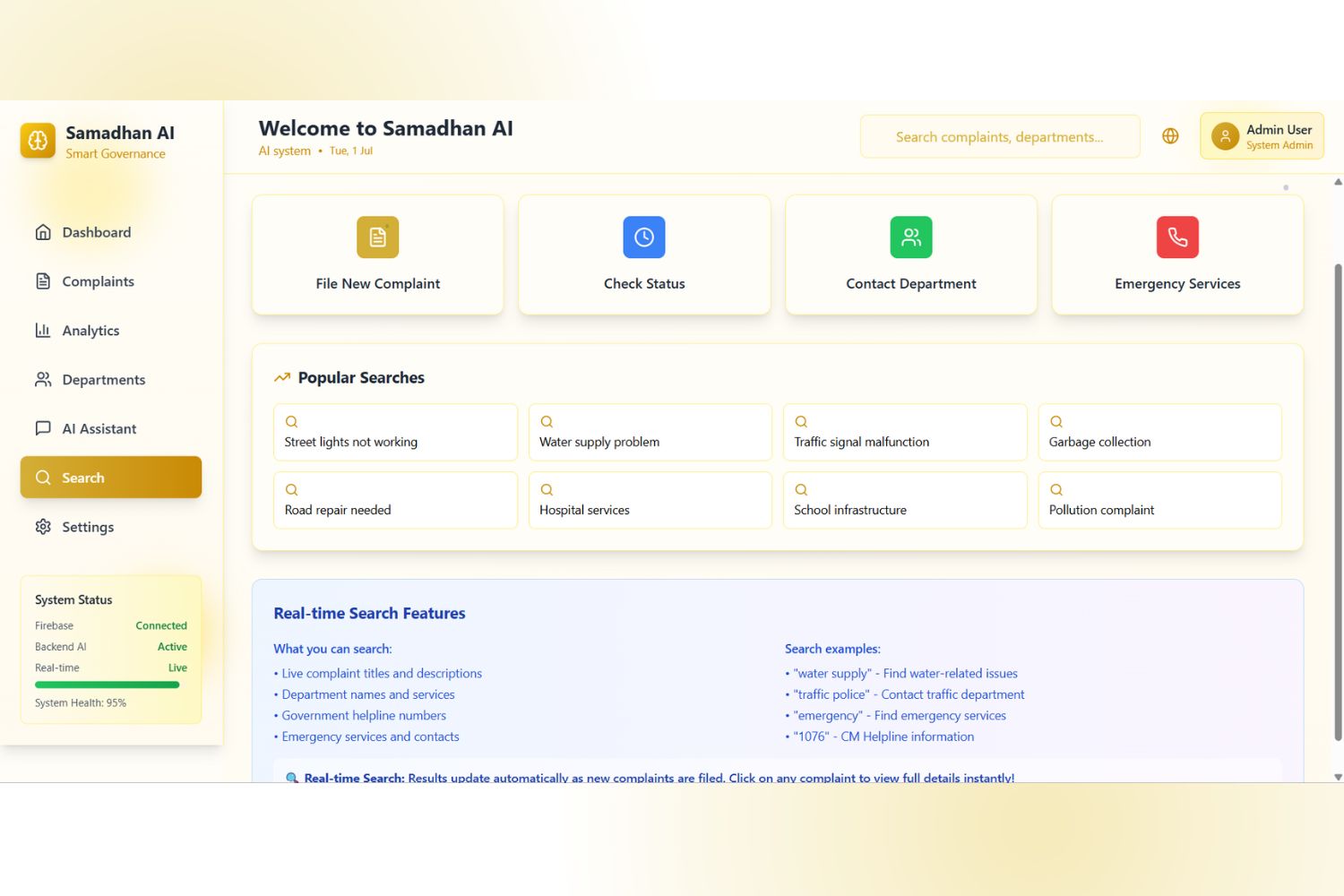
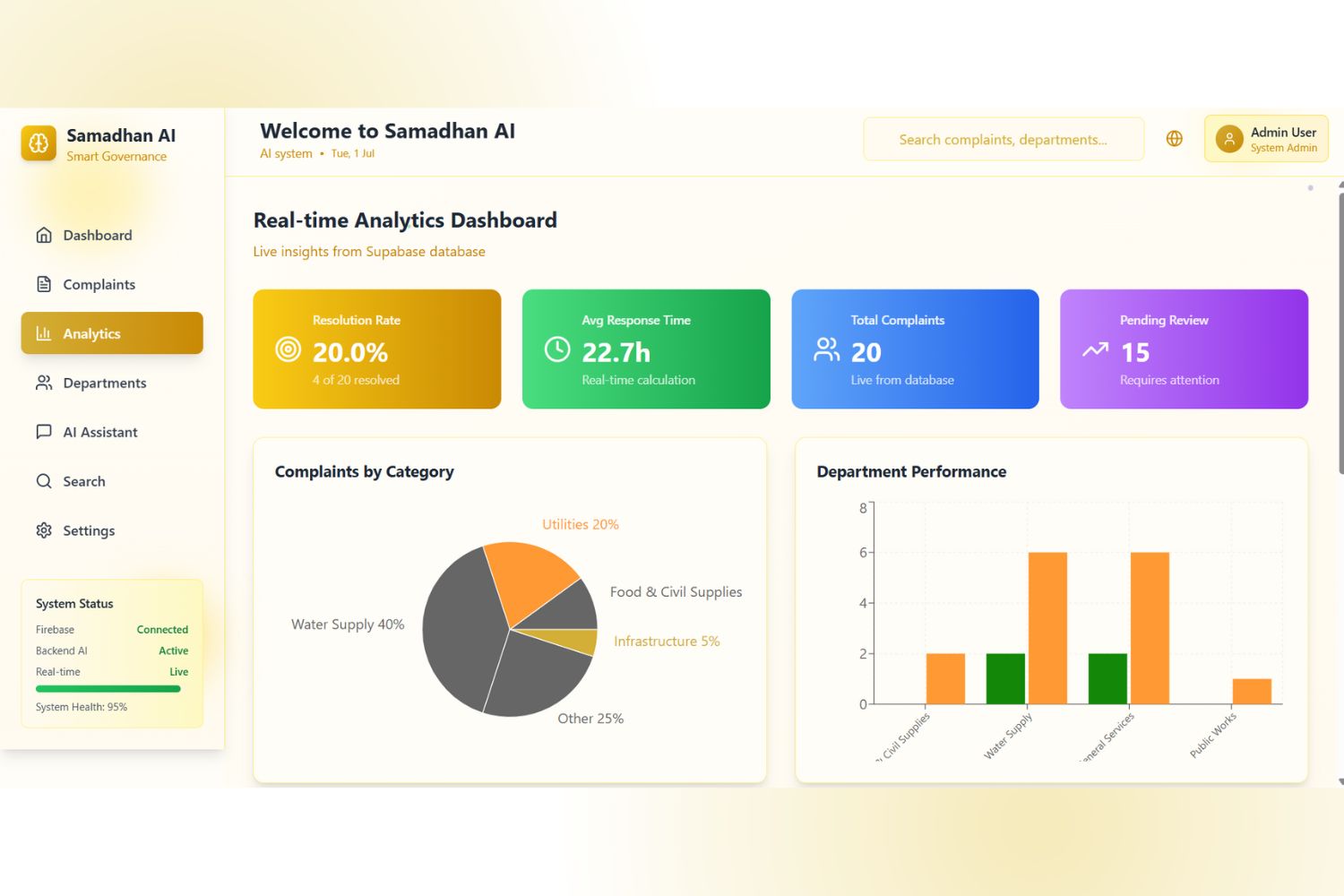
- Display live dashboards for administrators to monitor, analyze, and act
Most importantly, it supports multilingual voice conversations so people don't need to know how to use a website. They can just speak. Our assistant listens and responds clearly using Web Speech API steps in to ensure voice continuity. Users are kept updated through every step, just like chatting with a helpful real assistant.
This isn’t just a digital form, it’s a human-like AI that listens, understands, and solves.
How we built it
The entire journey began on Bolt.new, which helped us rapidly ideate, collaborate, and stay organized during tight sprints. We created wireframes using Figma, Excalidraw, and Visily AI, focusing on clear UX for both citizens and administrators.
Frontend
We built the frontend with React 18, TypeScript, and Tailwind CSS, keeping performance and responsiveness at the core. Animations with Framer Motion and clean design using Lucide Icons gave it a professional yet user-friendly finish.
Backend and AI Integration
This was the most challenging yet rewarding part.
Our backend runs on Flask (Python) and handles voice-to-text, classification, and LLM orchestration. We used Whisper for transcription, and designed LangChain pipelines to manage task flow, reasoning, and fallback logic.
We deployed a multi-model LLM architecture, using WatsonX as our primary brain for intelligent response generation. But we knew AI isn’t perfect, so we designed a robust fallback to DeepSeek via OpenRouter. This dynamic switching ensures the system never fails to understand or respond, even under load or errors.
We store semantic context using Sentence Transformers and FAISS, ensuring smarter responses the more the system learns.
Real-time complaint tracking and dashboards are synced using Firebase and WebSockets.
At one point, when voice-to-text broke for regional accents, our team lead rewrote the fallback logic, patched in Web Speech API for edge browsers, and ensured end users never saw a blank response.
It was a system built not just with code but with empathy, urgency, and care.
Challenges we ran into
Voice support across languages and devices Accents, background noise, speech patterns, and non-standard phrasing made transcription tough. Whisper helped, but required layering fallback, scoring, and clarity correction.
Multi-model logic complexity Designing a graceful AI fallback system that moves from WatsonX to DeepSeek without interrupting user flow took several iterations, load testing, and logic rewiring.
LLM tone control and hallucination mitigation We didn't want robotic or hallucinated answers. Prompt engineering across multiple languages and scenarios required both research and trial.
Real-time performance under pressure Getting WebSocket sync across Firebase to update dashboards with under 100ms lag was a major milestone. This required efficient client state management and server optimization.
Team syncing under short timelines With contributors working across different time zones and devices, coordination became critical. Bolt.new’s structure and clarity helped us stay aligned without chaos.
Accomplishments that we're proud of
- A multilingual AI grievance assistant that listens, speaks back, and tracks issues from start to finish
- Integrated WatsonX, DeepSeek, LangChain, and ElevenLabs into a cohesive, agentic AI system
- Achieved real-time dashboards powered by Firebase, synced with WebSockets
- Delivered accurate voice-based interaction across 20+ languages using fallback via Web Speech API
- Implemented RAG-style contextual response generation with tone control, sentiment detection, and urgency analysis
- Maintained 95%+ classification accuracy, sub-5s response time, and stable uptime throughout testing
We proved that a powerful agentic AI can be built in just a few days when the right people come together with the right purpose.
What we learned
Fallback-first design makes AI usable No model is perfect. True resilience comes when there’s a plan B, C, and D. Fallbacks between LLMs and voice systems made us confident in any scenario.
Voice is inclusion Voice interaction across languages is not just convenience, it’s access. People don’t always want to type, they want to be heard.
Empathy isn't optional The AI needs to sound human, speak in tone, and respect urgency. These were design goals, not add-ons.
The right tools matter From Bolt.new to LangChain, from ElevenLabs to DeepSeek, the right tools helped us focus on innovation instead of just integration.
Real teams solve real problems With complementary strengths across AI, UI, system design, and testing, we turned ideas into reality faster and better than we imagined.
What's next for Samadhan AI
- Image, video, and document upload for better complaint context
- Offline-first support for low-connectivity or remote areas
- Smart insights and trend analysis to help authorities act proactively
- Multi-identity integrations like national ID, email-based login, and role-based admin access
- Advanced multilingual tuning for regional voice support and local dialect understanding
- Domain expansion into education, public safety, environment, and emergency services
We envision Samadhan AI as a scalable, modular, multilingual AI assistant for governments, communities, and global platforms to build trust and solve problems at scale.
The world deserves systems that listen, understand, and act. That’s the future we’re building.
Built With
- colorlog
- date-fns
- dotenv
- eslint
- faiss
- firebase
- flask-cors
- framer-motion
- gunicorn
- headless-ui
- ibm-cloud-sdk-core
- ibm-watson
- langchain
- langchain-openai
- lucide-icons
- numpy
- openai
- pandas
- postcss
- prettier
- python-(flask)
- python-dotenv
- rag
- react-18
- react-hot-toast
- react-router-dom
- recharts
- requests
- scikit-learn
- tailwind-css
- tiktoken
- typescript
- uuid
- vite
- vite-plugin-environment


Log in or sign up for Devpost to join the conversation.