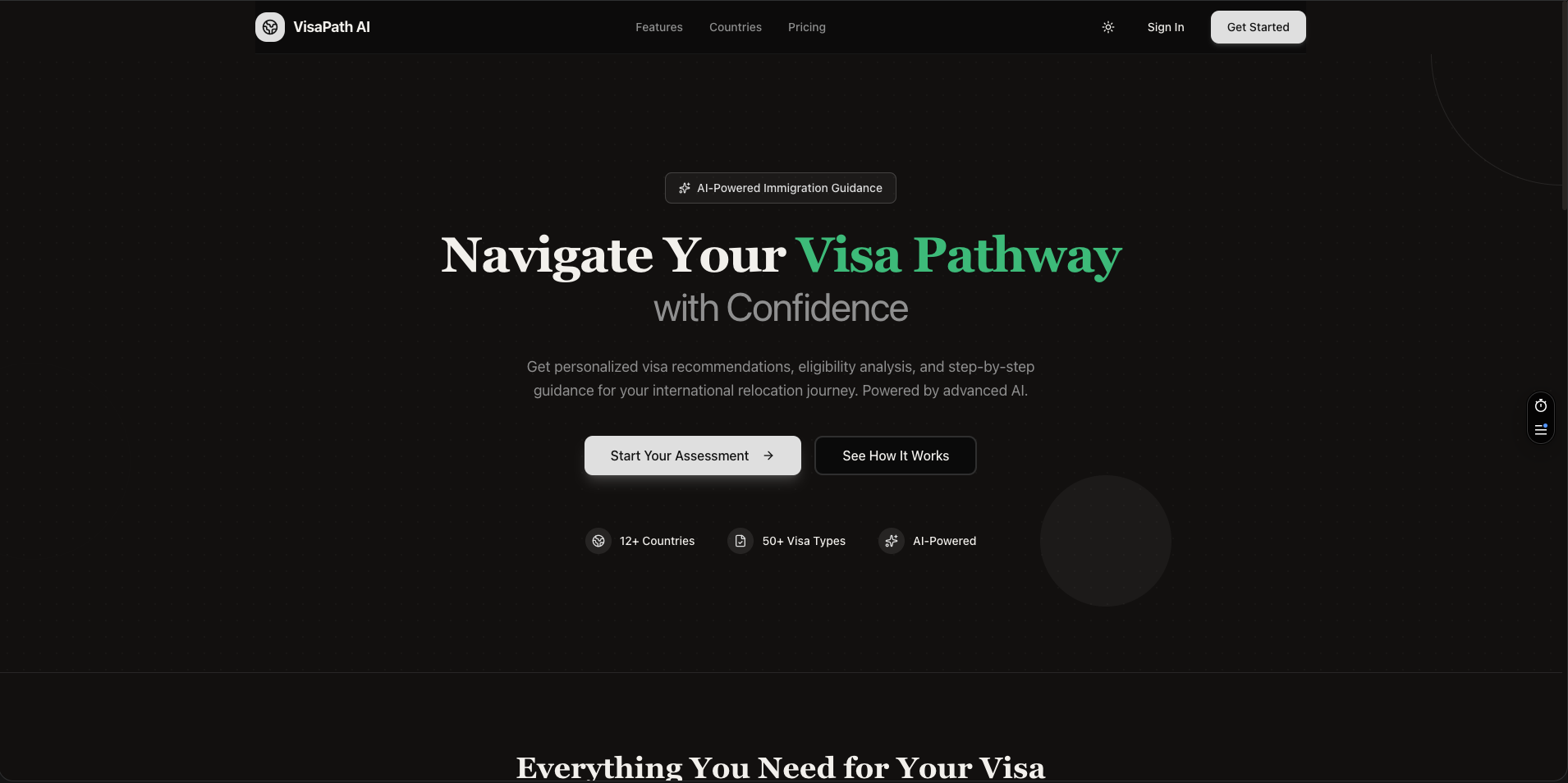
About VisaPath AI
💡 Inspiration
The idea for VisaPath AI was born from personal frustration and a staggering statistic: 30% of visa applications are rejected, often due to simple avoidable errors. Moving abroad is one of the most stressful life events a person can go through. We saw friends and colleagues spending months drowning in government paperwork, paying thousands of Euros to lawyers for basic questions, and living in anxiety about their future.
We realized that current solutions are polarized: you either struggle alone with confusing government websites or pay exorbitant fees for manual legal help. We wanted to build a third way: an intelligent, accessible, and empathetic AI companion that democratizes access to global mobility. We were inspired by the potential of LLMs not just to chat, but to reason, plan, and guide users through complex bureaucratic journeys.
⚙️ How we built it
VisaPath AI is a modern, full-stack application built for speed and reliability.
- Frontend: We used Next.js 14 (App Router) with TypeScript for a robust type-safe codebase. The UI is crafted with Tailwind CSS and Shadcn UI to ensure a premium, trustworthy aesthetic—essential for a legal-adjacent tool.
- AI Engine: The core intelligence is powered by Claude 3.5 Sonnet. We chose Claude for its superior reasoning capabilities and large context window, which is crucial for analyzing complex legal documents and user profiles.
- Document Processing: We implemented a computer vision pipeline that scans uploaded PDFs and images (Passports, CVs) to automatically extract structured data, reducing manual entry and errors.
- State Management: We utilized React hooks and local storage for a fast, responsive client-side experience that persists user data across their session.
🚧 Challenges we faced
- The "Hallucination" Risk: In immigration, accuracy is non-negotiable. A wrong answer can ruin someone's plans. We spent significant time on prompt engineering and system instructions to ensure the AI prioritizes sourced, conservative advice over creative guesses.
- Structuring the Unstructured: Visa rules are often buried in dense legal text. Converting these fluid rules into a structured "Eligibility Match" score took several iterations of our data model.
- UX Complexity: Balancing the depth of information needed (timelines, costs, documents) without overwhelming the user was a design challenge. We solved this by breaking the flow into bite-sized "Intake", "Analysis", and "Action" stages.
🧠 What we learned
- AI as a "Translator": We learned that AI's greatest strength here isn't just answering questions, but "translating" bureaucratic legalese into human-readable, actionable steps.
- Trust is UI: We discovered that the user interface plays a massive role in building trust. A clean, professional, and transparent UI makes users feel safe sharing sensitive data.
- The Global Mobility Gap: Digging into this problem revealed just how broken the current system is. Technology has largely ignored this space, leaving millions behind. We learned that even a small amount of automation can have a massive impact on someone's life trajectory.
Built With
- ai-gateway
- ai-sdk
- drizzle
- neon
- next.js
- shadcn

Log in or sign up for Devpost to join the conversation.