Inspiration
We're building from a region, where visa interviews carry enormous weight:- they decide scholarships, careers, and family reunions. Refusal rates across African & Asian corridors run 40–52%, the fee is never refunded, and the whole outcome turns on a conversation that often lasts under five minutes.
Here's the asymmetry that hooked us: every other step of a visa application has an industry behind it, agents for documents, lawyers for forms, banks for statements. But the interview itself, the one moment a human decides your case, has almost nothing. YouTube videos. Memorized answers that collapse at the first unexpected follow-up. Consultants at $100–300/hour, if you can afford them. The interview is a performance problem, not an information problem.
What it does
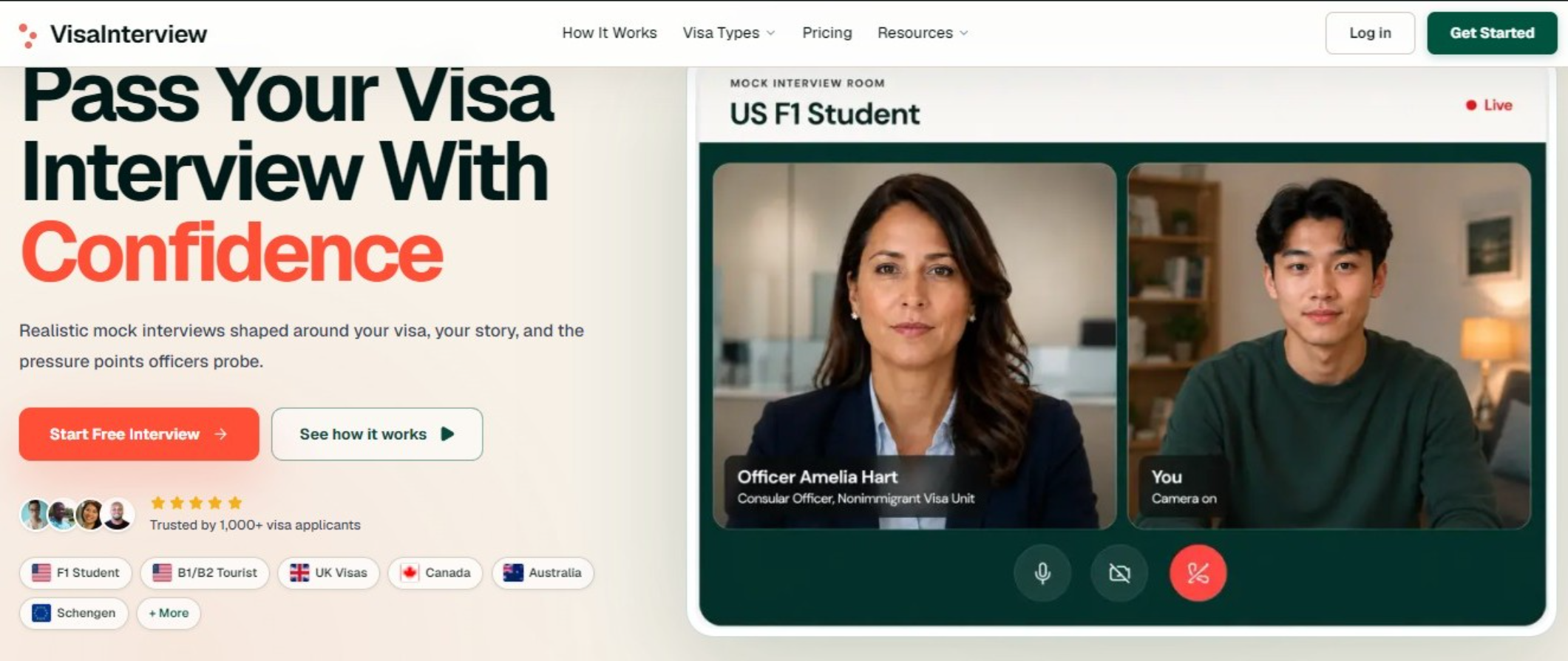
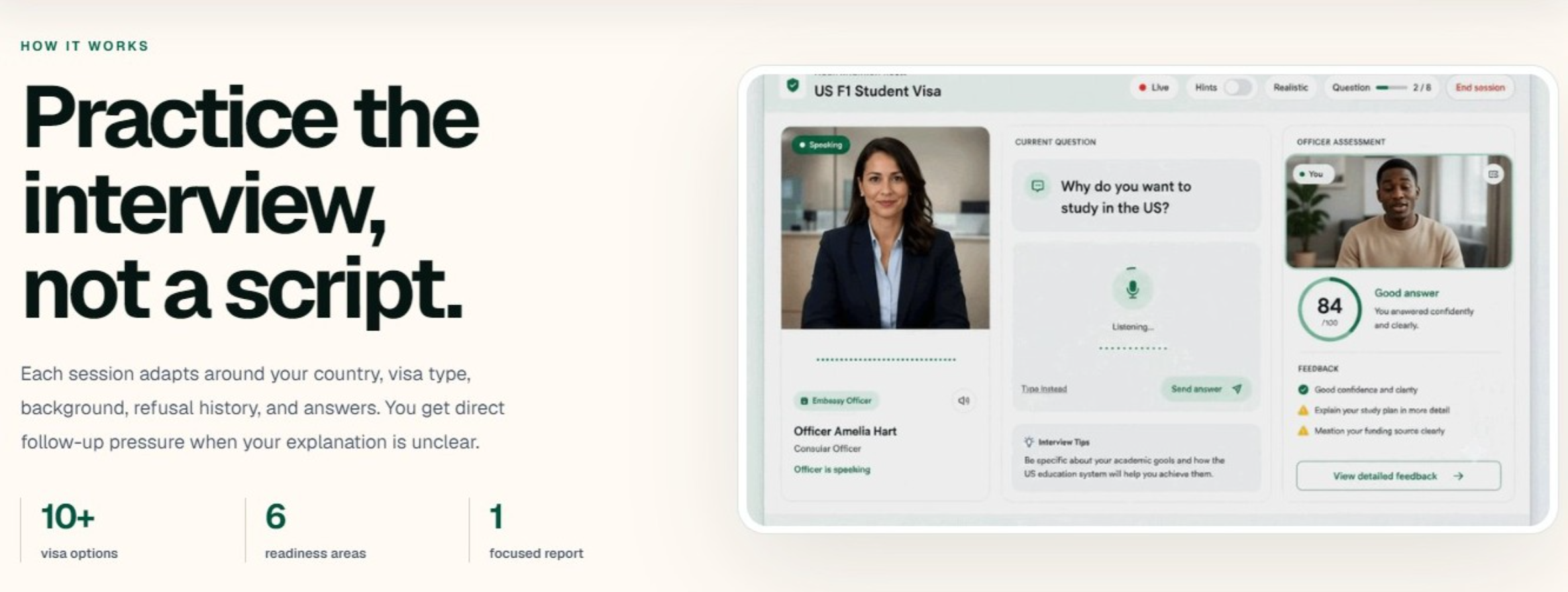
VisaInterview.ai simulates a realistic embassy interview, shaped around your actual case:
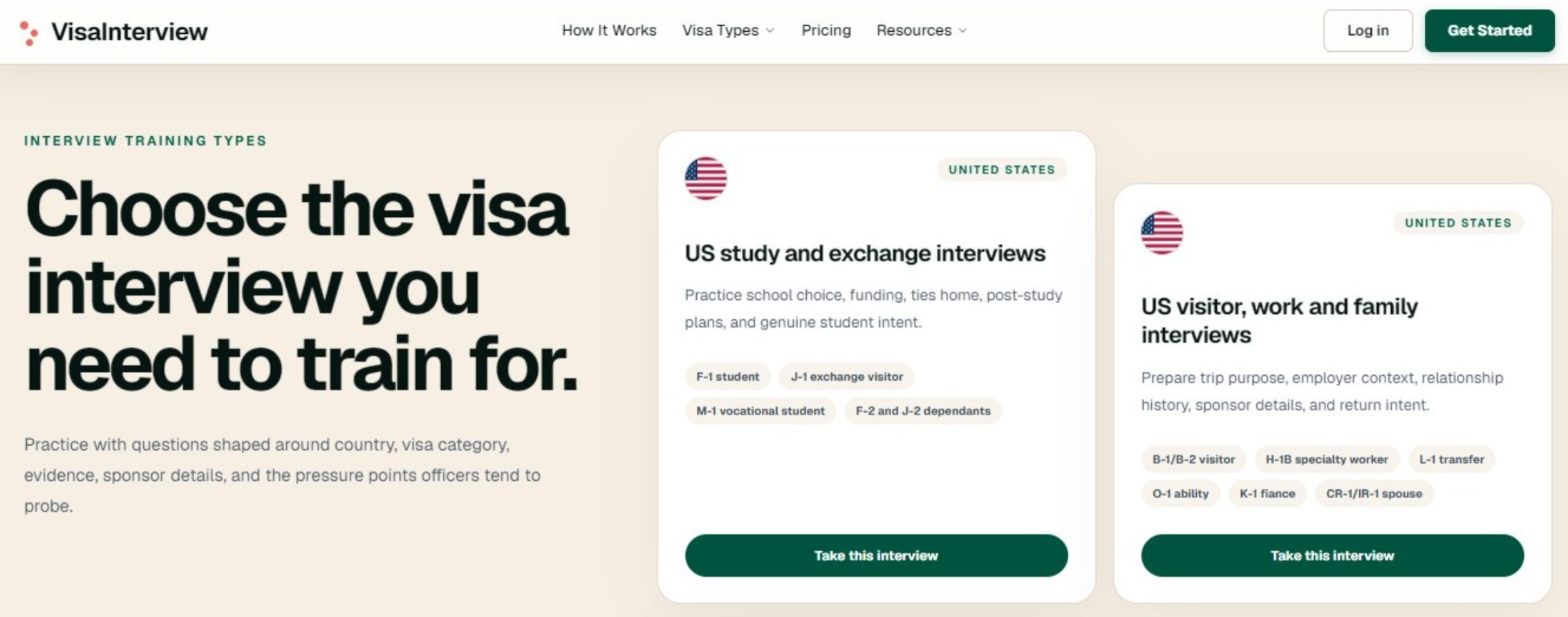
1. Adaptive AI officer:- questions adjust to your country, visa type, finances, sponsor details, and even a prior refusal 2. Real follow-up pressure:- vague answers get probed, exactly where officers push 3. Voice or text:- speak your answers for full realism, or type to practice quietly **4. Readiness report:- a score across 6 areas (financial clarity, home ties, return intent, composure...) with one specific fix for your next session 5. Progress tracking:- from first practice to appointment week 6. Institution portal:- universities and study-abroad agencies monitor applicant readiness at scale Live today across US, UK, Canada, Australia, Germany, and Schengen interviews. First session free.
How we built it
Two people built this — with Codex as the third pair of hands, working both inside Codex directly and plugged into Visual Studio.
Built with Codex
- Scaffolded whole features from scratch: the interview engine, the institution portal, authentication, and much of the design implementation
- Wrote the parts we'd have lost days on: multi-tenant logic, the Prisma schema, and the realtime voice handling
- Took the full practice flow:- dashboard, live session, scoring, and report output — from idea to working in an afternoon, not a week
- Used across the whole codebase to refactor, debug, and catch issues, not just write new code
- The result: a two-person team shipped a product this size in days because Codex covered the ground of a much larger one
The interview engine
GPT-5.6 is the officer's brain:- reads the applicant's case, asks adaptive questions, pushes back on weak answers, and generates the readiness score gpt-realtime powers the spoken back-and-forth, fast enough that it feels like a real conversation instead of talking to a machine
The rest of the stack
Next.js · React · TypeScript · Prisma · PostgreSQL · Supabase (multi-tenant) · Stripe · Resend · MDX · Vercel · Azure
Challenges we ran into
1. Making the AI adversarial but fair. ** Default LLM behavior is agreeable:- the opposite of a visa officer. Tuning the officer to apply pressure without becoming a caricature took the most prompt-engineering iteration of anything we built. **2. Voice latency. An interview stops feeling real if the officer pauses too long "thinking." Tightening the loop between speech, model, and voice synthesis to conversational speed was a real engineering fight. 3. Consistent scoring. A readiness score is only useful if the same performance earns the same score twice. Getting rubric-stable evaluations out of a probabilistic model took careful structuring.
Accomplishments that we're proud of
We went live on July 17th, right in the middle of Build Week, and 20 people signed up on the first day without us spending a shilling on ads. But the moment we're proudest of is quieter than that: watching someone finish a practice session, look at their score, and go straight back in for another round. That's when we knew the officer felt real.
What we learned
We went in thinking the hard part was the questions i.e getting the officer to ask the right things. Turns out that was the easy bit. The hard part was making it uncomfortable in the right way. A visa officer isn't chatty or encouraging, but by default that's exactly how an AI wants to behave. The moment the officer felt too friendly, the whole thing turned into a study buddy and the pressure vanished. You don't build confidence by being told you did well. You build it by being pushed and coming out the other side.
The other thing that surprised us was how much small delays mattered. A pause of even a second or two before the officer responds, and your brain clocks it as a machine. Chasing that feeling of a real back-and-forth taught us that with something like this, the details you'd never put on a feature list are the whole experience.
What's next for VisaInterview.ai
Land institutions:-get the built portal into universities, colleges, and study-abroad agencies managing applicants at scale Expand coverage:- more countries and visa types Focus on reapplicants:- dedicated support for people refused once and determined to pass the second time White-label for consultants:- let agents offer unlimited practice under their own brand Beyond visas:-extend the same officer to job interviews, university admissions, and scholarship panels
Built With
- azure
- codex
- gpt-realtime
- mdx
- nextjs
- openai
- postgresql
- prisma
- react
- resend
- stripe
- supabase
- typescript
- vercel



Log in or sign up for Devpost to join the conversation.