-
-
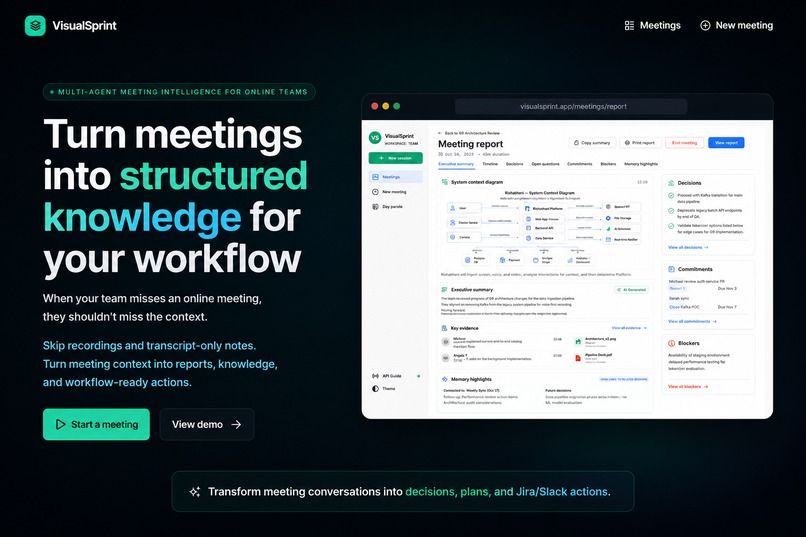
ladingPage
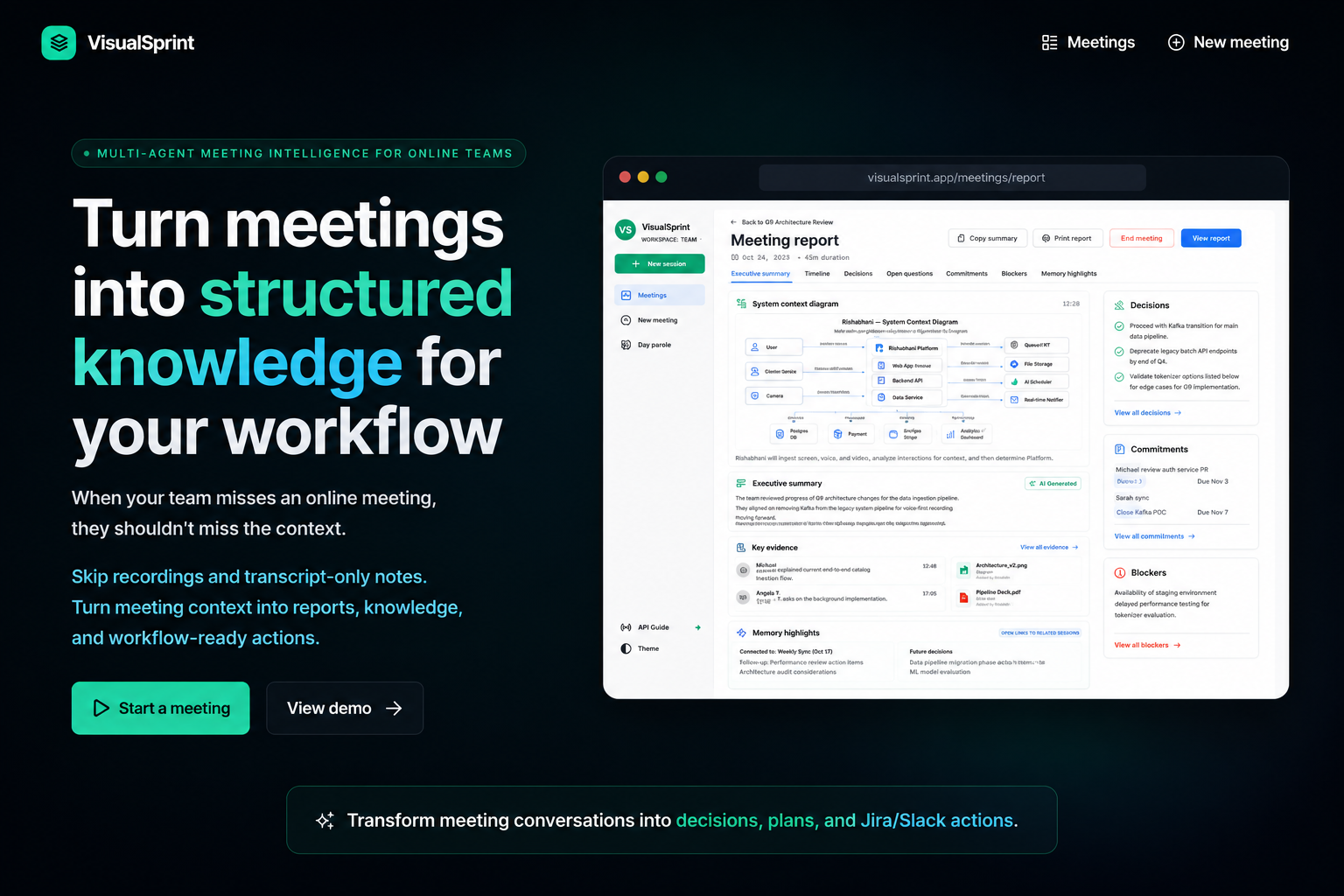
VisualSprint
Inspiration
Modern teams spend hours reviewing meeting recordings, searching through transcripts, and manually tracking decisions, commitments, and action items. Most meeting tools stop at transcription, leaving teams to do the hard work of extracting insights and turning them into action.
We wanted to build a system that understands what happened during a meeting, not just what was said. Our goal was to create a platform that captures conversations, screen activity, decisions, commitments, and context, then automatically transforms them into structured knowledge and workflow-ready outputs.
What it does
VisualSprint is a multi-agent meeting intelligence platform.
Instead of relying only on transcripts, VisualSprint combines conversation data, screen context, and meeting events to identify:
- Key decisions
- Commitments and ownership
- Action items
- Risks and blockers
- Open questions
- Important meeting context
The platform automatically generates:
- Executive summaries
- Structured meeting reports
- Searchable team knowledge
- Workflow-ready recommendations
- Historical meeting intelligence
This allows teams to skip full recordings and quickly understand what happened and what needs to happen next.
How we built it
We designed VisualSprint using a multi-agent architecture.
Different AI agents specialize in different responsibilities:
- Summary Agent
- Decision Extraction Agent
- Commitment Analysis Agent
- Recommendation Agent
- Knowledge Generation Agent
The backend orchestrates these agents and combines their outputs into a single structured meeting record.
Technology Stack
- Google Gemini
- Google Agent Development Kit (ADK)
- Vertex AI
- FastAPI
- React
- Cloud Run
- Elasticsearch
- Docker
The system processes meeting data, generates structured insights, stores organizational knowledge, and enables semantic search across past meetings.
Challenges we ran into
One of the biggest challenges was moving beyond transcript-based analysis.
Meetings contain context that is often missing from raw text. We needed a way to combine conversational signals with screen activity and structured meeting events.
Another challenge was coordinating multiple AI agents while maintaining consistency across outputs. We had to design validation layers, structured schemas, and orchestration workflows to ensure reliable results.
Scalability and deployment were also important considerations, requiring cloud-native architecture and automated deployment pipelines.
What we learned
Building VisualSprint taught us how to design production-ready multi-agent systems rather than single-prompt AI applications.
We learned:
- Multi-agent orchestration patterns
- Structured AI outputs
- Cloud-native deployment
- Knowledge retrieval systems
- Meeting intelligence workflows
- Agent reliability and validation techniques
Most importantly, we learned that AI becomes significantly more valuable when it transforms information into actions rather than simply generating summaries.
What's next for VisualSprint
Our roadmap includes:
- Real-time meeting intelligence
- Slack integration
- Jira integration
- Advanced organizational memory
- Cross-meeting trend analysis
- Personalized AI copilots for teams
- Enterprise-scale knowledge retrieval
Our vision is to help teams transform conversations into actionable knowledge, ensuring that important decisions, commitments, and insights never get lost.
Built With
- elastic
- fastapi
- googleadk
- multi-agent
- python
- react
- tailwind
- typescript

Log in or sign up for Devpost to join the conversation.