-
-
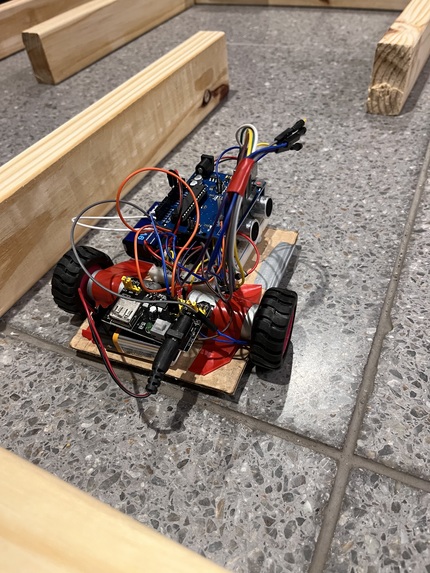
Prototype of the trolley
Inspiration
Visual impairment affects over 2 billion people worldwide, while 17 million are legally blind and another 83.5 million are impaired by cataracts. The inspiration for VISA came from recognizing the everyday challenges that visually impaired individuals face while shopping.
Navigating a busy store, locating specific items, and avoiding obstacles can be overwhelming and often requires assistance from store staff or companions. We wanted to create a solution that fosters independence, allowing users to shop confidently without relying on others.
By combining advanced navigation, voice recognition, and obstacle detection, VISA transforms an treacherous shopping trip into an accessible, seamless experience. Our goal is to empower individuals with visual impairments, making grocery shopping more inclusive, efficient, and stress-free.
What it does
The VISA is an automated shopping cart which can lead visually impaired (or lazy) customers directly to products in a supermarket. The cart contains technology to drive to, scan and describe items just by placing them into the basket. It operates on an algorithm that maps out the entire supermarket and can calculate the shortest path from 2 different areas of the store. The cart also has voice recognition users can be directed to desired products or areas. The algorithm also contains fail safes so that if an object suddenly appears, the cart will stop and reroute if necessary.
How we built it
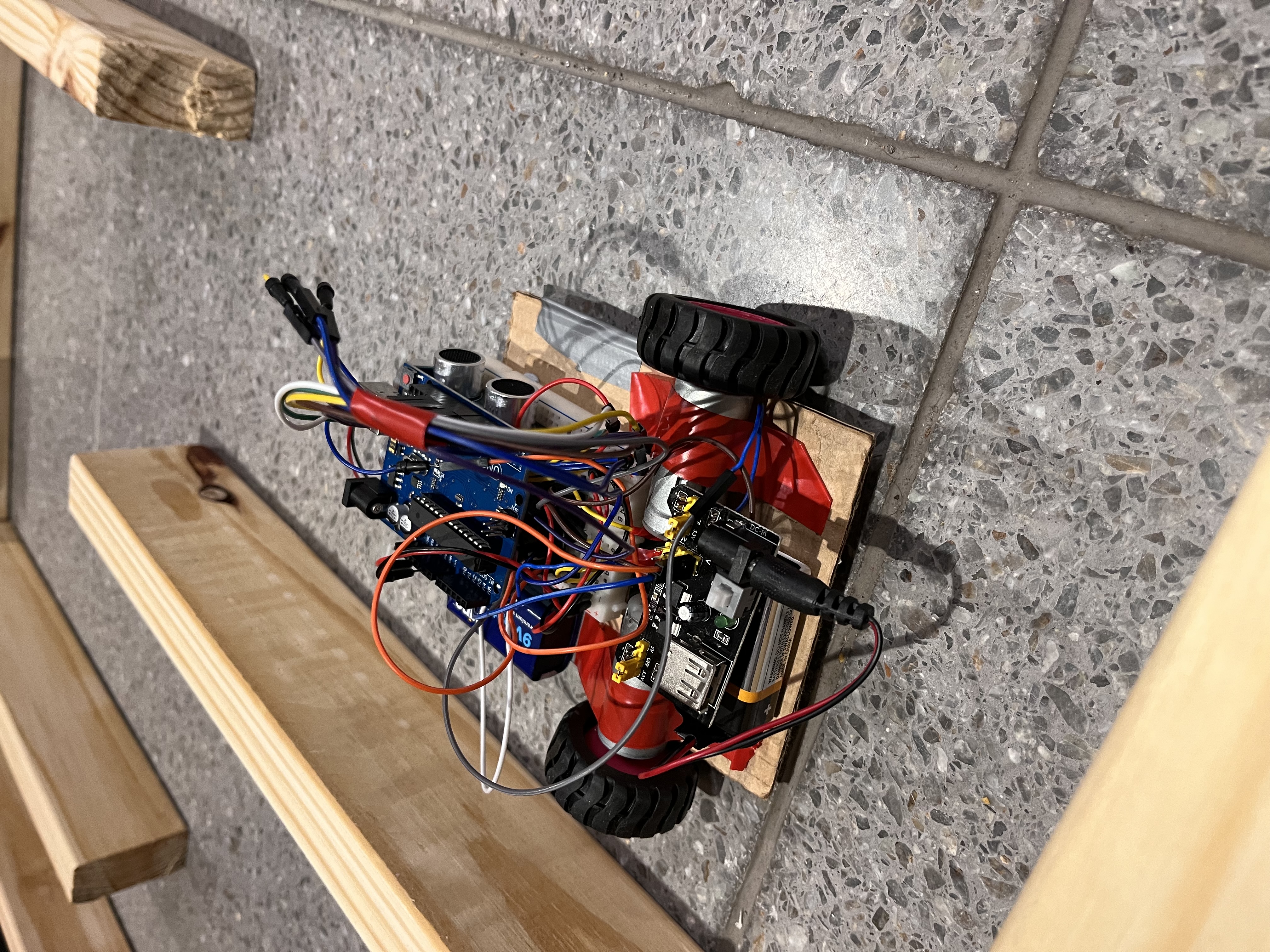
Hardware: Battery powered DC motor vehicle, using an Arduino microcontroller and a L293D integrated circuit to control the motors and direction. Software: C++ code to allow the “trolley” to traverse a maze of aisles, mapping out each as a position, and storing the map in memory. Software was also implemented for voice activation and RFID scanning to allow for a user-friendly and accessible product.
Challenges we ran into
The main challenges we ran into were our lack of experience with many of the hardware and software components. We struggled at first to get the motors to run in the way we wanted them and then had the difficult task of integrating all the subsystems of our prototype together (sensors, motors and navigation).
Accomplishments that we're proud of
Developing this idea targeting the visually impaired community to allow them to feel more welcome in everyday activities, and taking a step in this direction. We are pleased with the success we found in creating the prototype and are excited to perhaps expand on this idea in the future; integrating more features and perhaps even a full-scale model!
What we learned
Undertaking the prototyping of VISA allowed us to develop both hardware and software skills in developing the product, becoming more familiar with C++, algorithms and general electronics. As a team, constructing the pitch also taught us that designing a product is not just about the prototype but also the marketing and other aspects of the project. We also learned to consider the bigger picture behind ideas, and how simple technology can be used to enhance the living experience of others.
What's next for VISA (Visually Impaired Shopping Assistant)
Along with the pathfinding algorithm, VISA hopes to expand on the areas of automated scanning and even develop a mobile app for convenient user experience. Our team hopes to upscale our product, working with larger supermarket corporations and potential investors, to ensure that the impact of our technology reaches the maximum number of the visually impaired community across the globe.


Log in or sign up for Devpost to join the conversation.