Inspiration
Healthcare referral decisions are often made with incomplete, inconsistent, or outdated information. Patients and caregivers rely on search engines, word of mouth, or luck. Meanwhile, district planners must allocate services based on population needs, yet their tools rarely connect facility capabilities with public health indicators.
We wanted to build one system that supports both journeys: individual care navigation and regional planning, grounded in trust and transparency.
What it does
Virtue Referral Copilot is an evidence-grounded referral assistant for patients, caregivers, and planners.
It helps users:
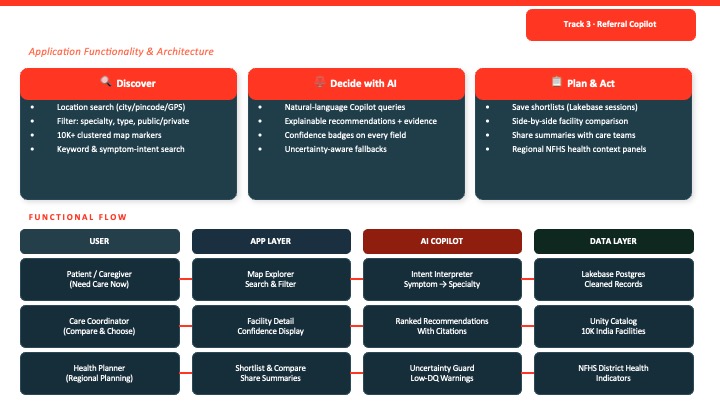
- Find nearby facilities using specialties, procedures, equipment, capacity, and district context.
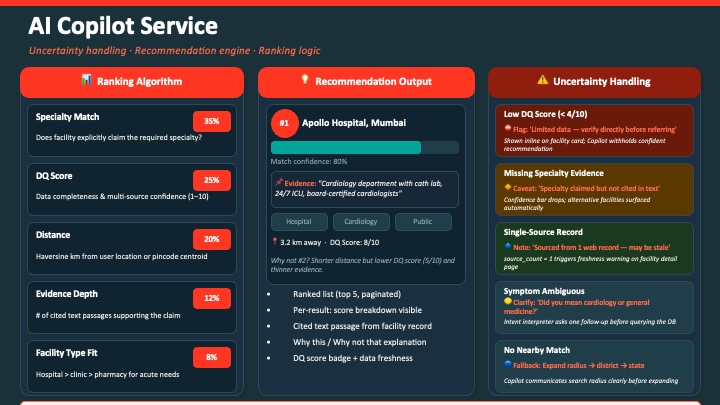
- Review transparent AI recommendations with citations, confidence tiers, and missing-data callouts.
- Compare 2 to 5 facilities with AI trade-off narratives.
- Shortlist options, add notes, and export or share decisions.
- Use district health context for smarter regional care planning.
How we built it
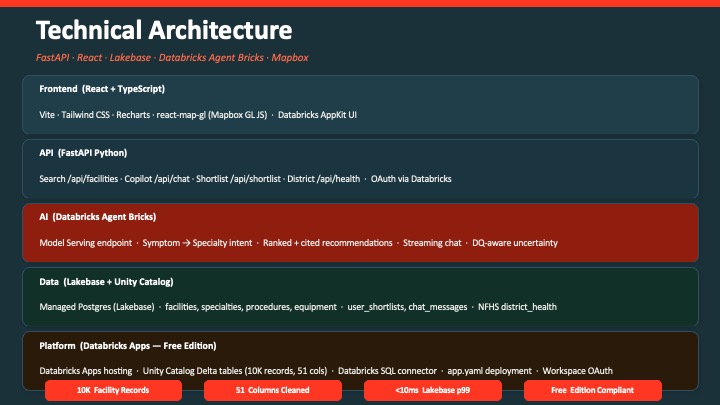
- Backend: FastAPI with modular routers for search, evidence, facilities, shortlist, and health context.
- Frontend: React + TypeScript with map, filters, evidence panel, confidence badges, and comparison flows.
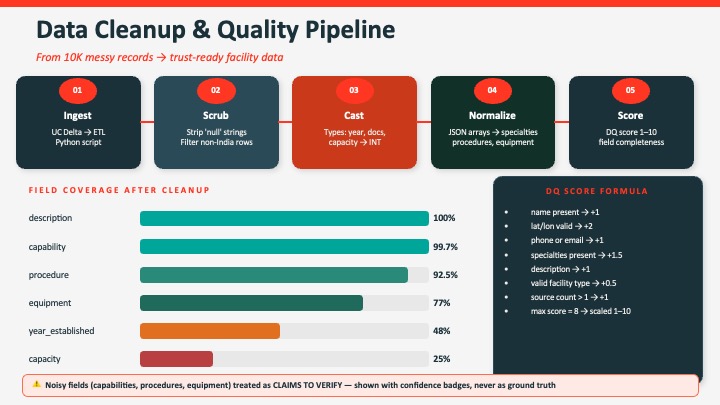
- Data pipelines: ETL scripts to prepare facility and pincode-health datasets.
- AI Platform: Databricks Lakebase for data and Model Serving for AI reasoning and narratives.
- Reliability: token auto-refresh and guardrails for uncertain or missing evidence.
Challenges we ran into
- Uneven data quality across facilities.
- Balancing useful AI output with strict transparency.
- Avoiding hallucinations while keeping responses actionable and grounded to the truth with citations.
- Managing latency in evidence retrieval and AI generation.
- Designing for both patient and planner personas without UX overload.
Accomplishments that we're proud of
- Built transparent recommendations with source-backed evidence.
- Added confidence tiers and explicit gap reporting.
- Enabled priority-switchable facility comparison narratives.
- Combined district health indicators with facility discovery.
- Delivered an end-to-end flow from search to shortlist to shareable output.
What we learned
- In healthcare AI, honest uncertainty builds more trust than false certainty.
- Explainability is a core product feature.
- Hybrid design (rules + AI) improves reliability.
- Users adopt decision tools faster when evidence is visible.
- One architecture can serve both individual and policy-level workflows.
What's next for Virtue Referral Copilot
- District landscape and gap-analysis views.
- Stronger export and persistence features.
- Performance and observability improvements for production readiness.


Log in or sign up for Devpost to join the conversation.