-
-
Entry
-
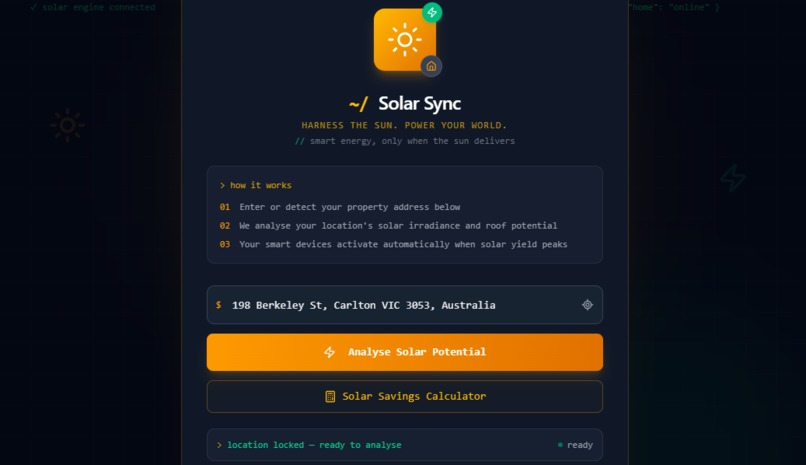
Main User Interface
-
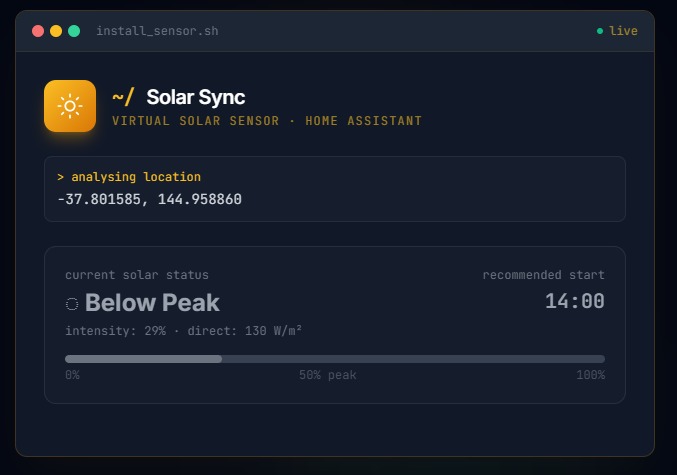
Result Page
-
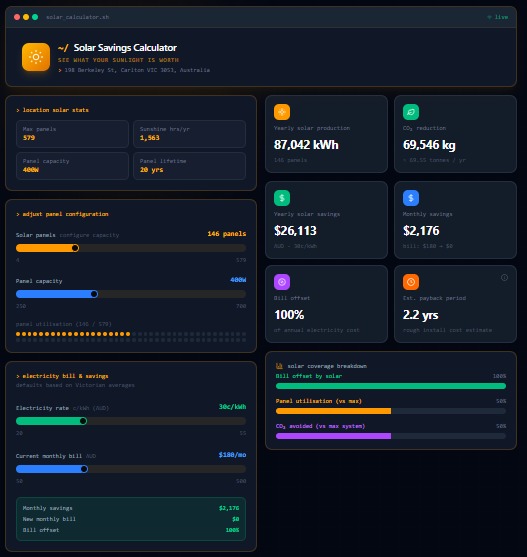
Solar Calculation Page
-
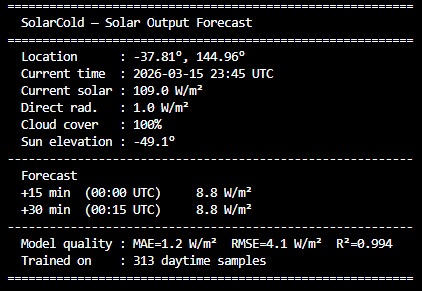
Machine Learning Model Output
Inspiration
Nearly 730,000 Victorian households have solar panels on their roofs, accounting to roughly one in three. They invested thousands of dollars in the promise of lower bills and energy independence. But there's a catch that nobody talks about: fewer than 5% of rooftop solar owners have a battery storage system installed. Project-chip That means when the sun goes down, the vast majority are right back on the grid and of course, paying full price.
The deeper problem is behavioral. Most energy-heavy tasks happen in the evening: the washing machine runs after dinner, the dishwasher fires up before bed, commercial refrigeration hums through the night at your local butcher or fishmonger. For an average Victorian household, the annual electricity bill sits between $1,500 and $2,000; and for small businesses, the bill climbs to around $3,530 a year. Solar panels were supposed to change that equation, yet for most people, they haven't. Not because the technology failed, but because there's no bridge between what the panels are producing and how the home or business actually behaves.
Solar Sync is that bridge.
What it does
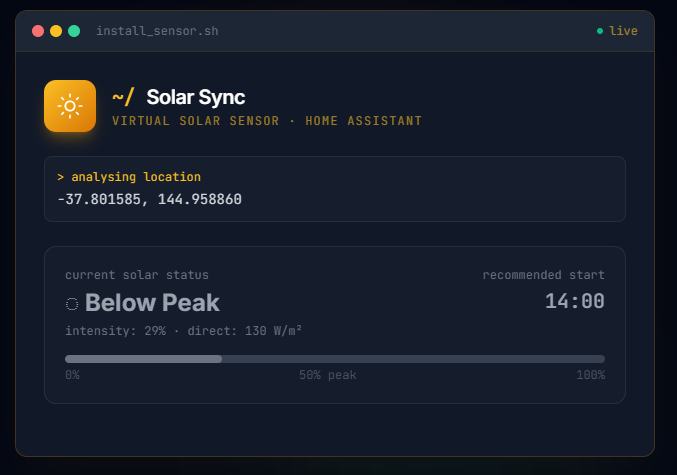
Solar Sync is a virtual device that runs on Home Assistant and makes your home or business genuinely solar-aware for the first time.
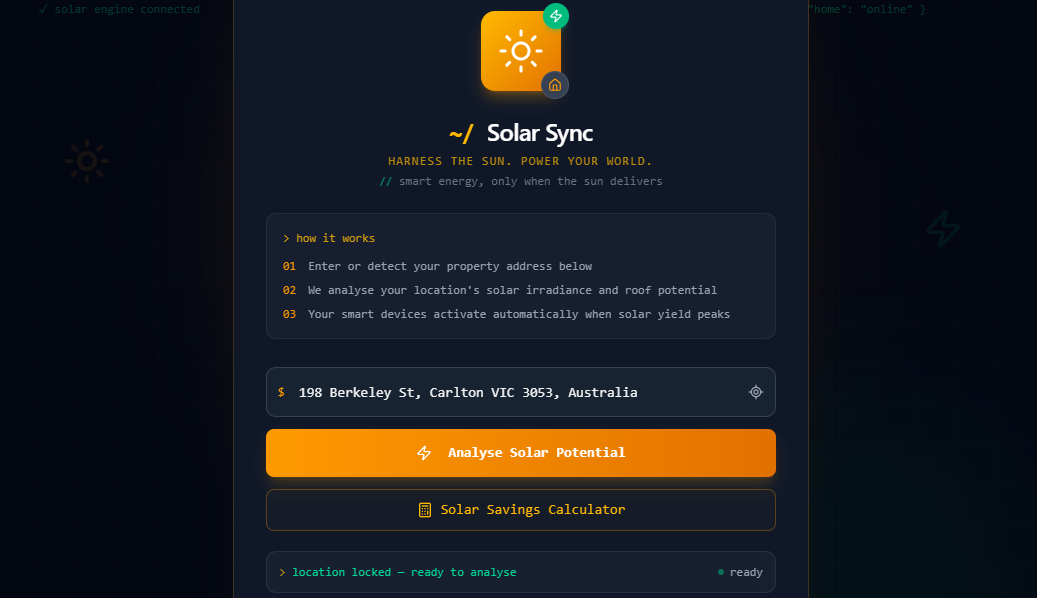
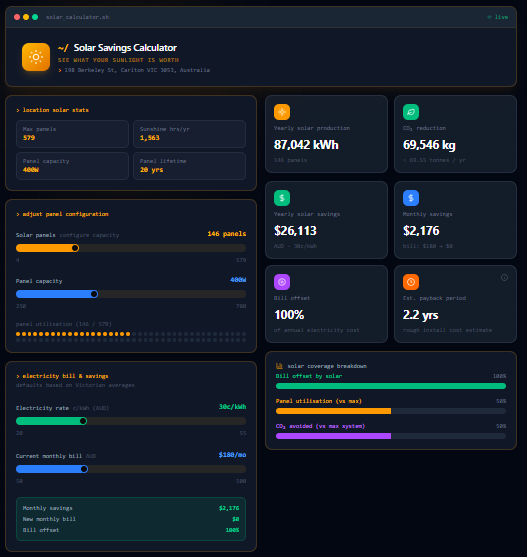
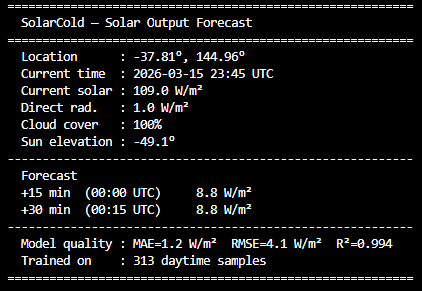
You give it two things: your address, and an energy threshold. Solar Sync does the rest. It continuously pulls live solar irradiance data from the Open-Meteo API, converts your address to coordinates automatically, and monitors your solar output in real time. When output exceeds your threshold, meaning the sun is producing enough free energy, Solar Sync triggers your high-consumption devices to turn on: the washing machine, dishwasher, EV charger, or commercial refrigeration units running a defrost cycle. When output drops below the threshold, those devices are switched off or deferred. It also keeps score. Solar Sync generates a running summary of sunlight output, how many kilowatt-hours you've shifted to solar-produced windows, and an estimate of how much money that's saved you in dollars, on your actual tariff rate.
For a homeowner, that means clothes washed on sunshine, not on grid power at 11pm. For a butcher or a supermarket, it means defrost cycles, compressor rests, and non-critical equipment automatically scheduled around the sun. Without a facilities manager, without manual monitoring, and without an expensive battery system.
How we built it
We first focused on setting up repositories and assigned roles to ensure that everyone knew what to do and could work cleanly and independently. We then split into sub-teams. One sub-team worked on the consumer side while the other focused on the business side.
The app was built on the Express and Next.js backend. Majority of time was spent on researching how we could build a virtual sensor that allowed integrations with different smart devices in a smart home automation app.
Challenges we ran into
Too many!
Ideally the virtual sensor could work in different smart home apps (e.g. Google Home, Apple Home, Tuya Smart). But these apps were very restrictive in how they allowed developers to customise automations. We spent a lot of time trying to create a virtual Matter Hub device but it would only appear on the app and not enable toggling of devices based on its ‘state’.
Accomplishments that would be a shame to hide
We managed to integrate plenty of features made by different people into one centralised app with a landing page. This proved to be pretty challenging, yet allowed for the project to feel more complete and cohesive.
The ability to have our code be integrated to Home Assistant through the outputted configuration.yaml is an idea we’re proud of. This means our application is working with a well-established industry product, indirectly increasing the usability of our code without making existing features from scratch. Of course, due to the challenges we’ve run into, we’re also very proud in our ability to pivot ideas. After we faced an insurmountable wall caused by tight security and lack of equipment (Home hubs), we quickly used our existing code to come up with new ideas to pivot towards to minimise lost time. This is also representative of the cohesion of the team and willingness to work together towards a new idea in high stress environments.
Future Roadmap
- Expansion of service to other countries and regions
- Improvement of prediction algorithm for farther lookahead and higher accuracy
- Implement support for google smart home, apple smart home, amazon smart home
- Implement support for alternative devices to act as matter hubs(e.g: smart TVs, raspberry pi, etc)
EU Shared future prize
In an era where geopolitical instability threatens global energy markets, the security of our energy infrastructure is a primary concern for both Australia and the EU. SolarSync uses digital twin technology to create a 'virtual sensor' layer that empowers citizens to become active participants in grid stability. By intelligently timing high-powered device(e.g: EV charging, water heater, etc) usage to match peak solar generation, we protect critical energy infrastructure from surges and reduce the systemic pressure on the grid. This project enhances community resilience by shielding households from price volatility while directly contributing to a secure, decentralized, and self-sustaining energy future that reflects the shared values of Australia-EU cooperation.
Built With
- amazon-web-services
- docker
- eslint
- javascript
- matter
- node.js
- react
- tailwind
- typescript
- vercel


Log in or sign up for Devpost to join the conversation.