-
-
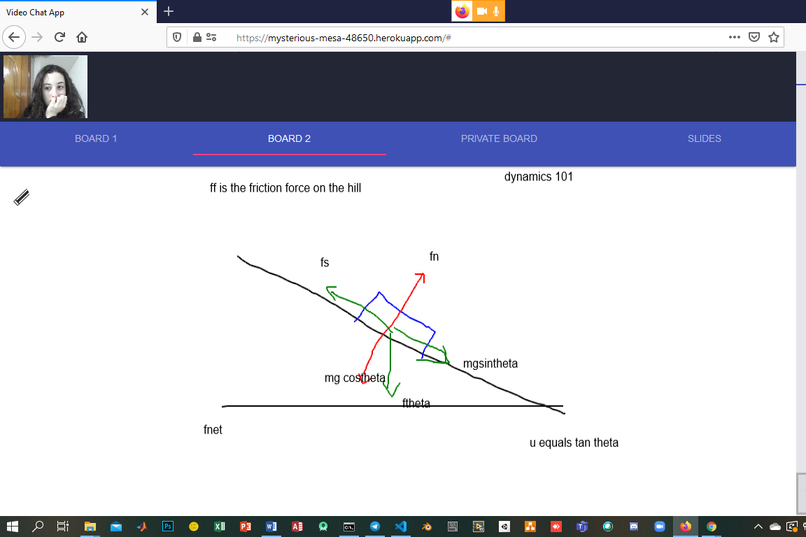
example
-
logo


Inspiration
Ever since lockdown started, schools and universities had to adjust and give their courses online. However, the world of education wasn’t ready for it. Teachers are using video conferencing tools meant for business in order to give real-time classes. In a lot of cases, they had to change their teaching methods and prepare slides for the students to follow. Two of our team’s member mothers are teachers and their struggle is real. They can’t explain the lessons step by step by writing on the board like they used to. Moreover, they feel isolated and in some cases as if they are speaking alone because those video conferencing tools don’t feel quite interactive.
Our student friends feel the same way. The slides are boring to watch and in most cases, they aren’t really paying attention. Besides, not all courses can be explained well-using slides. In math and physics, for example, solving exercises step by step is essential to understanding the lesson. Stacking information and equations on slides feels overwhelming, even when slides are chunked up to small pieces. This is why successful online learning platforms and YouTube channels like Khan Academy and the Organic Chemistry Tutor explain by writing on a board step by step.
What it does
To solve this problem, our solution is to use an interactive whiteboard where teachers can write and draw on a virtual board to explain the lesson just like they do in physical classrooms. The board updates in real-time for all participants and teachers can assign students to write on the board as well. A chatroom and real-time video and audio streaming will be included as well just like the usual online conferencing. Very few applications have addressed this issue and included a whiteboard to their software solutions. Moreover, none of those solutions we found are free, which dramatically limits their target audience.
What’s more, the asset we consider to be the strongest in our solution is adding a private board. Every student will have a private board that’s only accessible to him and to the teacher. This allows the teacher to ask students to work on a problem individually and then check what they’re doing one by one. Moreover, the student can add participants to his board making it accessible to them as well, and this allows the teacher to group the students and make them work together. We haven’t found any solution yet that makes online learning as collaborative by including this simple asset.
One other major problem that teachers are facing in these times is the verification of the learning process. In real life, the teacher can ask the students questions frequently or give them a small quiz at the end of the session. But in these times of isolation, interaction is at its minimum. So we decided that our platform needs to include real time quizzes where the result can show up immediately and the teacher can get a sense if the class as a whole understood the concept.
All in all, we made sure the user interface is as simple and as intuitive as possible. After all, not all teachers are used to working with electronic devices. This can be surprising to some people, but even today, some school teachers, especially of older ages, have barely ever used computers before.
So far, however, we only have a prototype, considering the short duration of this hackathon. Not all features of the idea are complete and the code needs cleaning and fixing some bugs. We truly believe there is a need for our application though and we plan on working on it and completing it even when the Hackathon ends!
How we built it
To build this app, we used:
- socket.io that relies on WebSockets for real-time communication.
- Javascript, HTML, and CSS for Front-end
- Node.js and Express.js for Back-end
- MySQL for the database.
Challenges we ran into
We began to work on the quiz section via Node and Express.JS but soon we found that even for the simplest quiz programs to work, we needed a fully developed Database. The database took up most of the time of back-end development, but in the end, we were able to develop a fully working Database with a working API for students, teachers, classrooms, and quizzes. However, we had no time to combine it with the Front-end part.
Accomplishments that we're proud of
We developed the idea and started working on it all from scratch during this hackathon, which means in less than 3 days. Since we are a team of students with not much experience, we had a lot to learn in a short period of time and so we found ourselves stuck very often! However, learning all that in only 3 days does feel like an accomplishment.
What we learned
We learned how to use node.js, Git, socket.io, jQuery and Express.js in less than 3 days. It's amazing how much one can learn in such a short period of time!
What's next for Virtual Classroom
As this project is just a prototype for now, there's a lot of room for improvement. First, we need to add some essential features like the ability to clear the board and to write mathematical equations for example. We plan on adding real-time poll-like quizzes with instant results so that the teacher can get a feel of how well the students understand the lesson. Of course, we want to combine the database to the Front-end and then we can assign privileges to the teacher like allowing students to write on the board and checking students' private boards. We can also create a forum where students can ask questions and share files with the class at any time. Also, video streaming is only available for two users currently. The possibilities for improvement are endless.


Log in or sign up for Devpost to join the conversation.