
Track 2: I'm a Creator
ViralTrail
AI powered travel planning for content creators: destinations, itineraries, and content strategies optimized for going viral.
Inspiration
Travel planning tools tell you where to go and how much it costs. Social media tools tell you what to post. But for the millions of creators who travel for content, those worlds rarely meet.
A lifestyle creator planning a 5 day trip on a $2,000 budget doesn’t just need a hotel and a flight, they need a destination that photographs well, fits their niche, respects their passport, and comes with hooks, captions, shot lists, and a posting calendar. Today, that means hours of research across travel blogs, TikTok trends, visa databases, and content calendars.
ViralTrail bridges that gap. We built an AI travel planner that thinks like a creator: every recommendation is scored for visual impact, trend potential, and content variety, not just tourist appeal.
What It Does
ViralTrail turns a short creator profile into a complete, actionable trip plan in one generation.
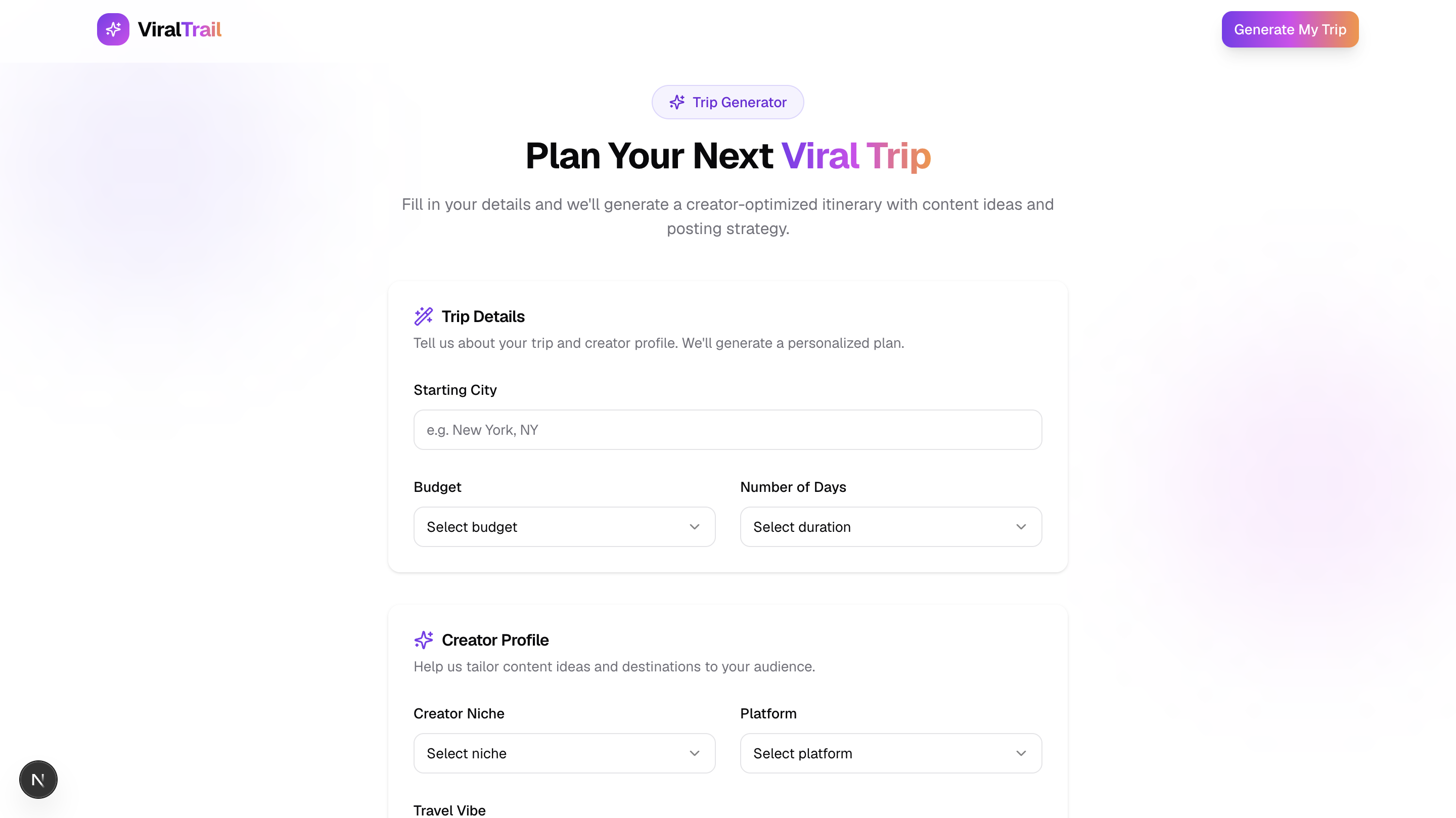
- Smart intake form Users enter:
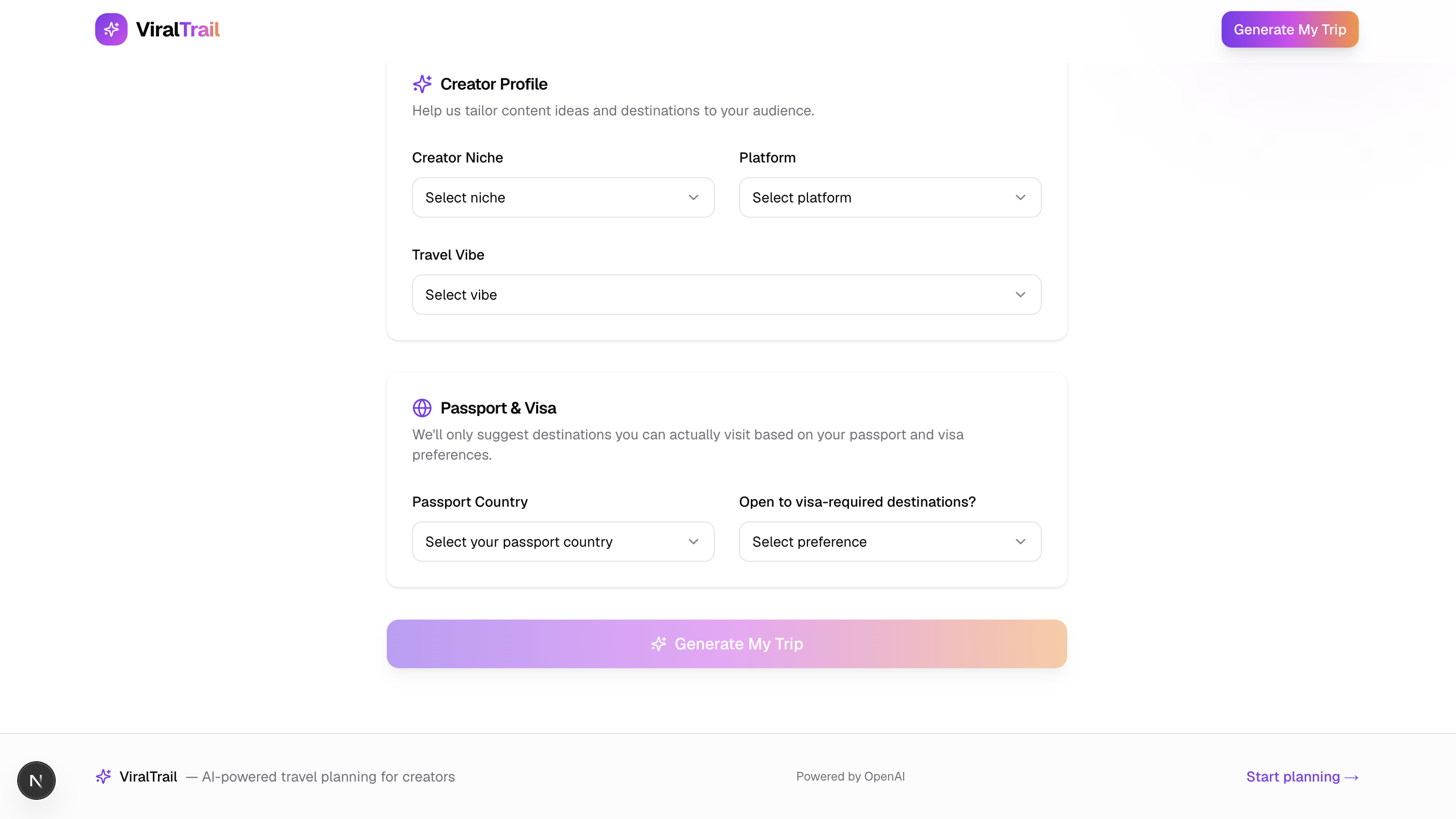
Starting city and trip duration (3–14 days) Budget ($500 to $5,000+) Creator niche (Lifestyle, Travel, Food & Dining, Fashion, Adventure, Tech, Fitness, Beauty) Primary platform (Instagram, TikTok, YouTube, YouTube Shorts, Pinterest) Travel vibe (Adventure, Luxury, Budget Backpacker, Cultural Explorer, Foodie, Beach & Chill, Urban Creator) Passport country and visa preference (visa free only, or open to advance visa applications)
- AI generated trip plan In a single API call, OpenAI returns a fully structured trip result:
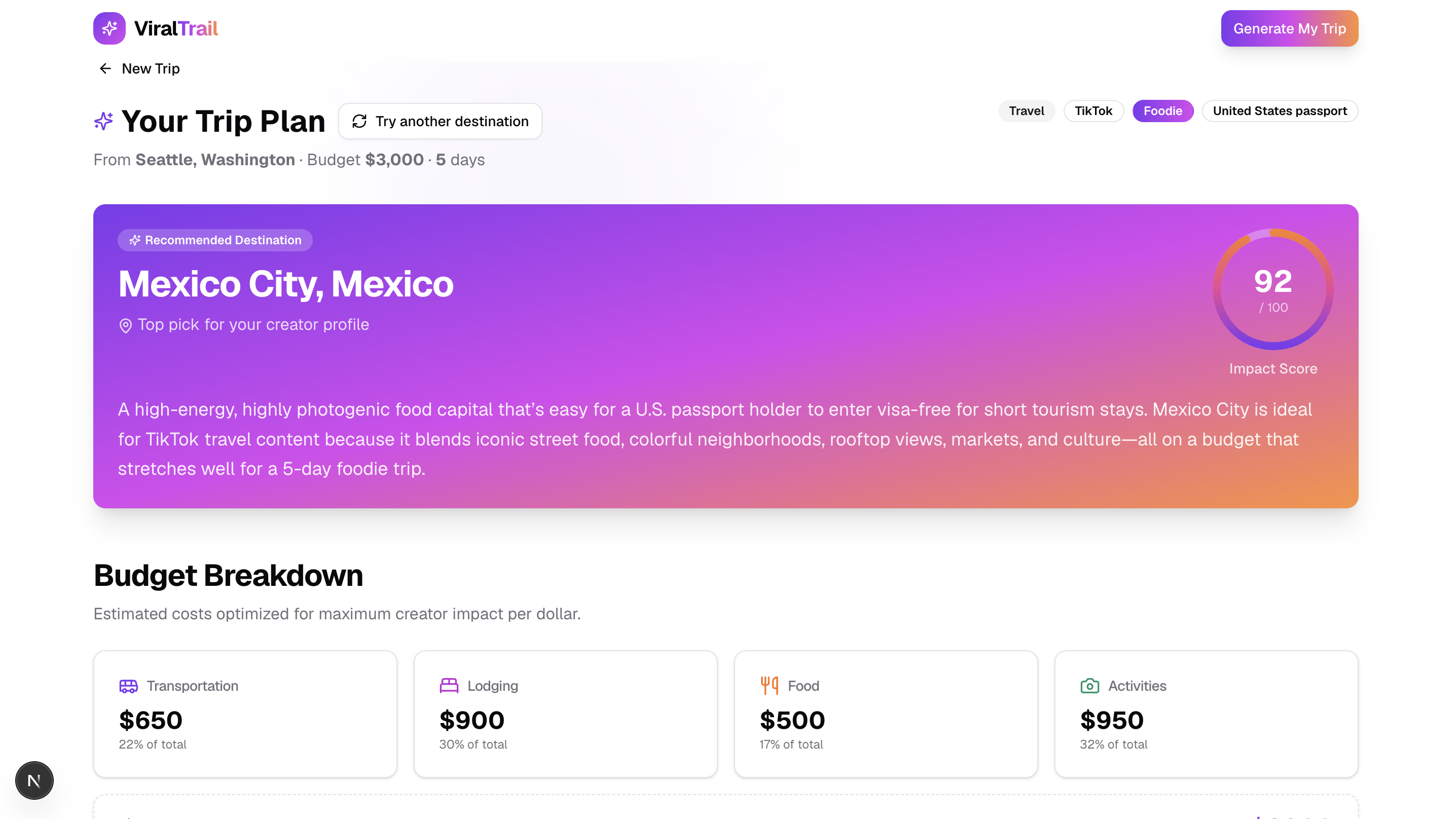
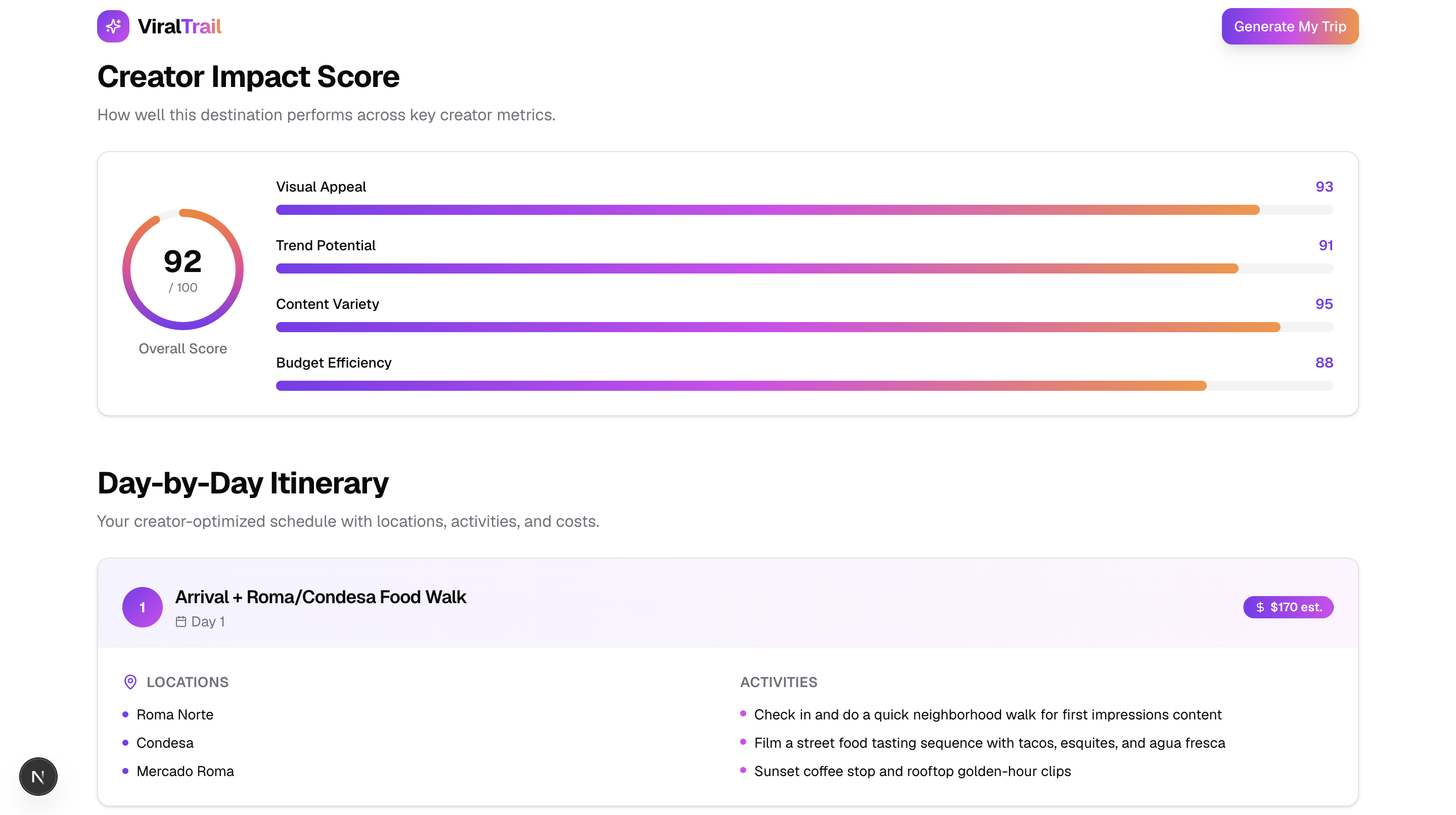
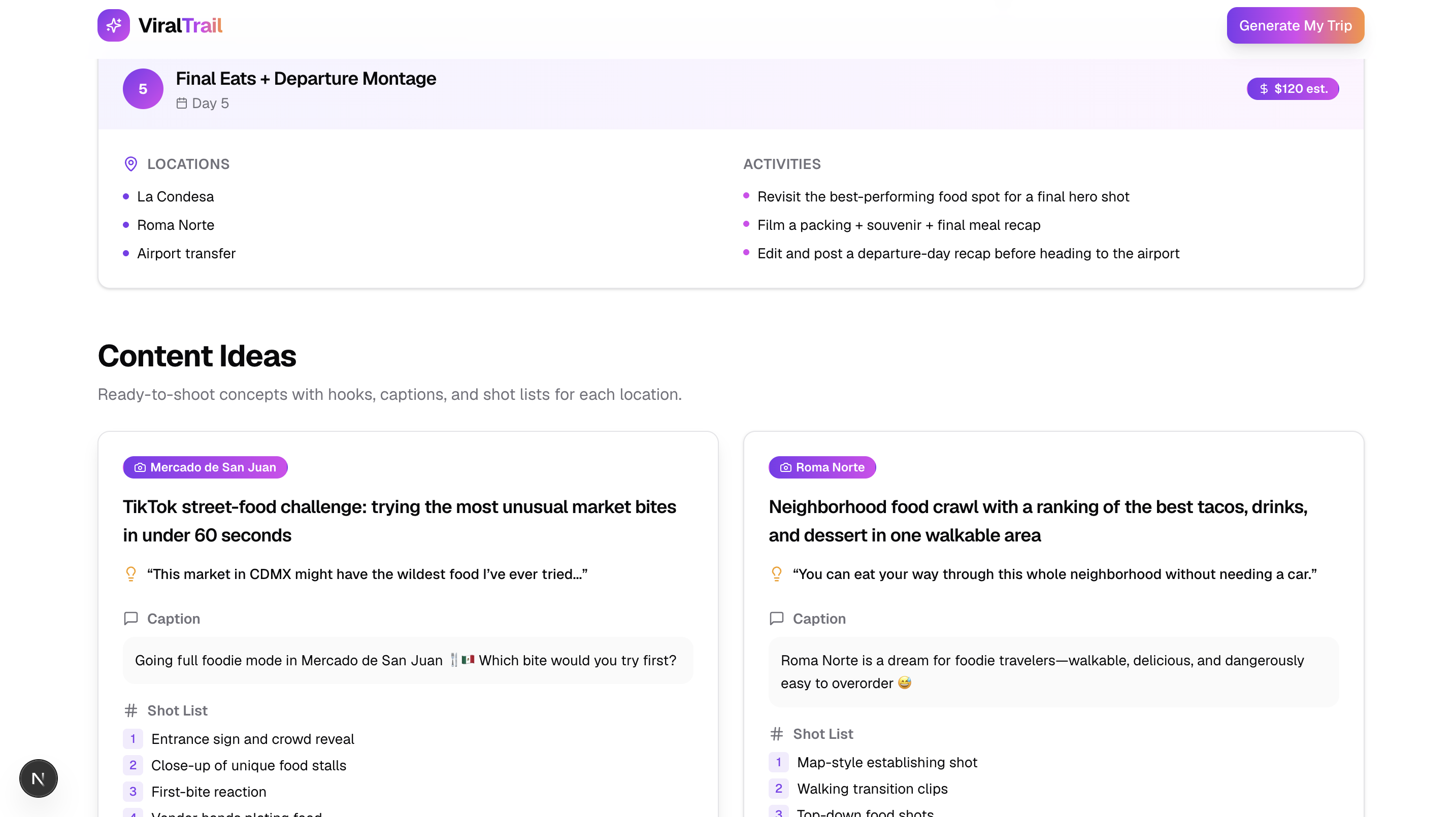
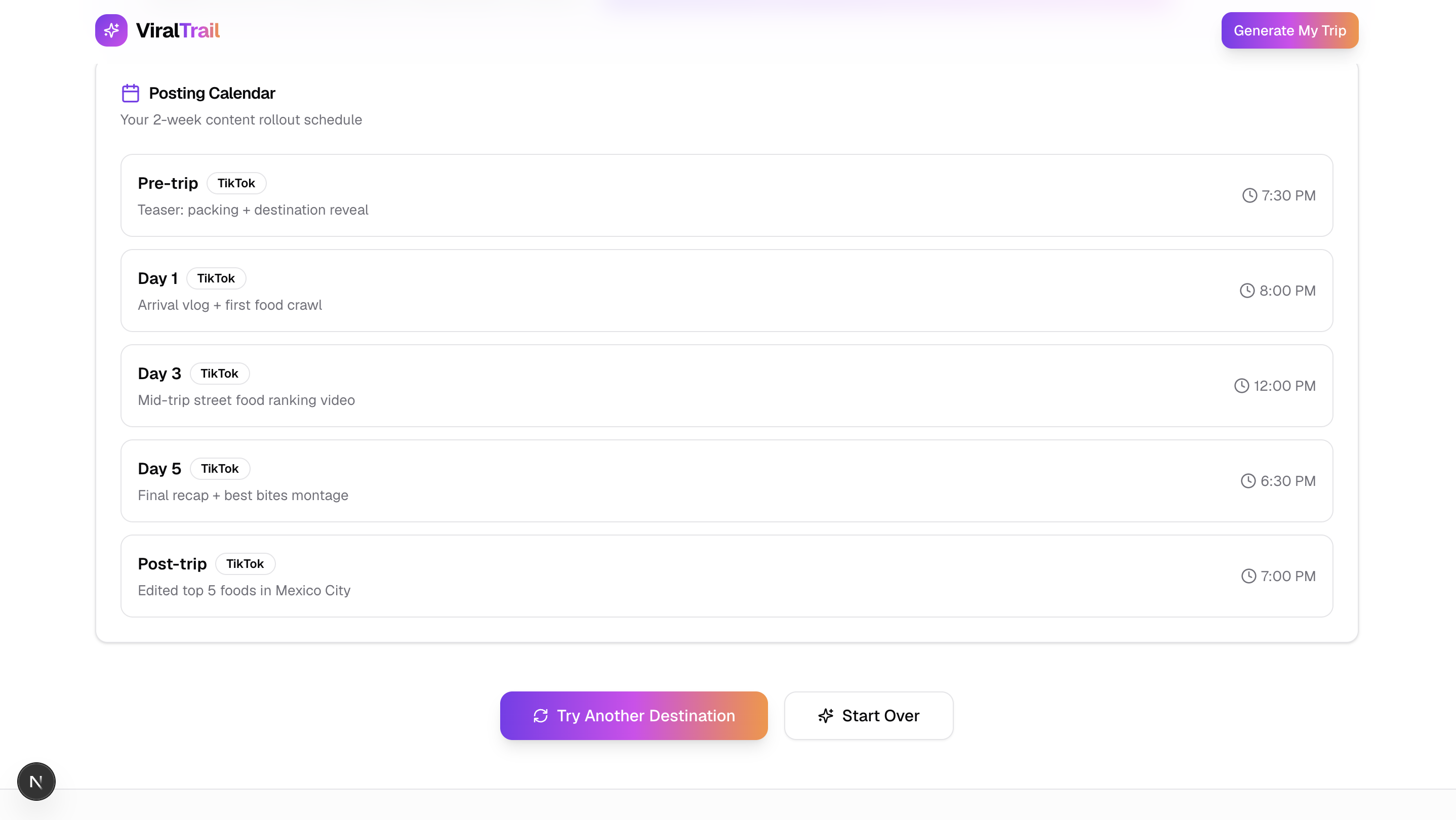
Recommended destination: City/region with creator impact score and rationale Budget breakdown: Transportation, lodging, food, and activities in USD Creator impact metrics: Visual appeal, trend potential, content variety, budget efficiency, and overall score (0–100) Day by day itinerary: Locations, shoot friendly activities, and per day cost estimates Content ideas: 3–5 concepts tied to real itinerary locations, each with a hook, caption, and numbered shot list Posting strategy: 2 week posting calendar (platform, content type, best time) plus a “best performing content” recommendation
3. Passport & visa awareness
Unlike generic travel AI, ViralTrail treats visa constraints as non negotiable. Users who select “visa free only” get destinations their passport can realistically enter without embassy applications. Users open to visas still avoid destinations where entry is routinely denied.
4. Destination regeneration
Don’t love the suggestion? Hit “Try Another Destination” to get a fresh pick for the same trip parameters. Rejected destinations are tracked in session storage and passed to the API so the model avoids repeating them, including similar cities in the same region.
How We Built It
ViralTrail is a full stack TypeScript application with a clean separation between a polished Next.js frontend and an Express API backend.
Frontend: Next.js 15 (App Router)
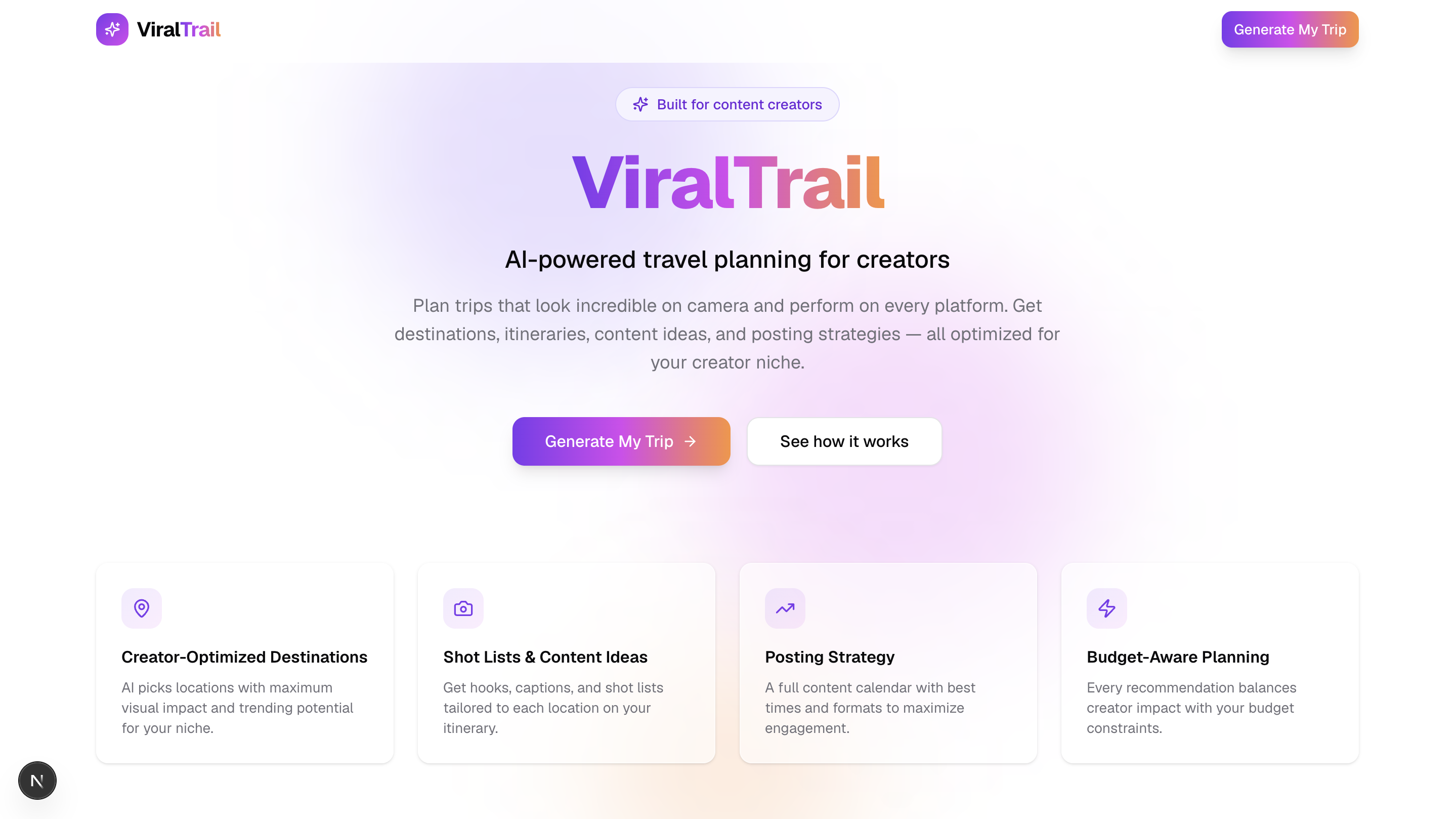
- Landing page with hero, feature highlights, and CTA
- Trip generation form with shadcn/ui components and Tailwind CSS
- Results dashboard with dedicated cards for each section of the trip plan: --Destination hero card with impact score ring --Budget breakdown with category percentages --Creator impact score bars --Expandable day by day itinerary --Content idea cards with hooks, captions, and shot lists --Posting calendar and top content recommendation -Responsive, creator focused UI with gradient accents, score visualizations, and loading states during generation and regeneration
Backend: Express + OpenAI
- POST /api/generate — validates form input and calls OpenAI with structured output
- Strict JSON schema (tripResultJsonSchema) ensures every response is parseable and type-safe on both ends
- Prompt engineering encodes creator optimization, budget realism, visa rules, and exclusion logic for regeneration
- Provider abstraction: OpenAI is implemented today; Azure OpenAI and Anthropic are scaffolded for future swap in
Key technical decisions
1) Structured outputs over free form text: OpenAI’s JSON schema mode guarantees consistent fields (scores, costs, shot lists) so the UI can render rich components without fragile parsing. 2) Creator first prompts: The system prompt positions ViralTrail as a planner for content creators, not tourists. Hooks, captions, and shot lists are tailored to the chosen platform and niche. 3) Client side session persistence: Trip results and rejected destinations live in sessionStorage, so users can navigate without losing their plan. 4) Regeneration with guardrails: Up to 3 retry attempts if the model returns a destination that fuzzy-matches a rejected one.
Challenges We Ran Into
Balancing creativity with structure. Travel AI can be vague; creators need specifics. We solved this with a strict schema that forces concrete locations, dollar amounts, and numbered shot lists, while still leaving room for creative hooks and captions.
Visa constraints are hard. Passport rules vary widely and aren’t in most training data. We embedded explicit visa instructions in the user prompt (visa free vs. open to applications) and marked them as non negotiable so the model treats them as hard filters.
Destination regeneration without repetition. Simply asking for “another destination” often returns similar picks. We track rejected names client side, pass them as excludeDestinations, and instruct the model to avoid similar regions, with client side fuzzy matching as a safety net.
End to end type safety. Trip types are shared conceptually between frontend and backend (TripFormData, TripResult, BudgetBreakdown, etc.), keeping the API contract clear as the schema evolves.
Accomplishments That We're Proud Of
- Built a complete creator workflow in one app: from “I want to plan a trip” to “here’s what to film, caption, and post”
- Delivered a production quality UI that feels like a real product, not a hackathon demo: score rings, budget cards, posting calendars, and smooth regeneration UX
- Made visa aware travel planning a first class feature, which most AI travel tools ignore
- Achieved reliable structured AI output so every generation renders consistently in the results UI
- Designed for extensibility: multi provider AI support, modular result components, and a clean API boundary
What We Learned
- Structured outputs are essential for multi-section AI products. Free-form markdown doesn’t scale when you need 6+ distinct UI sections from one generation.
- Domain-specific prompts beat generic ones. Telling the model it’s planning for a TikTok food creator produces meaningfully different output than “plan a vacation.”
- Real-world constraints (visas, budget) need to be prompt-level requirements, not afterthoughts — otherwise the model optimizes for spectacle over feasibility.
- Creator tools need iteration UX. The “try another destination” flow turned out to be as important as the initial generation.
What's Next for ViralTrail
- Budget feasibility checks: flag when the AI’s cost breakdown exceeds the user’s stated budget and suggest adjustments
- Real-time destination imagery: integrate Unsplash or Google Places photos for each itinerary stop
- Export & share: PDF itinerary, Notion export, or shareable trip link for collaborators
- Multi-destination trips: city-hopping itineraries for longer creator tours
- Platform-specific formatting: TikTok script timing, YouTube chapter markers, Pinterest pin descriptions
- Azure OpenAI / Anthropic providers: swap models via environment config for cost and latency optimization
- User accounts & saved trips: persist plans beyond the session
Built With
- eslint
- express.js
- gpt
- javascript
- json-schema
- lucide-icons
- next.js
- node.js
- openai-api
- postcss
- radix-ui
- react
- rest-api
- shadcn/ui
- tailwind-css
- typescript


Log in or sign up for Devpost to join the conversation.