Inspiration
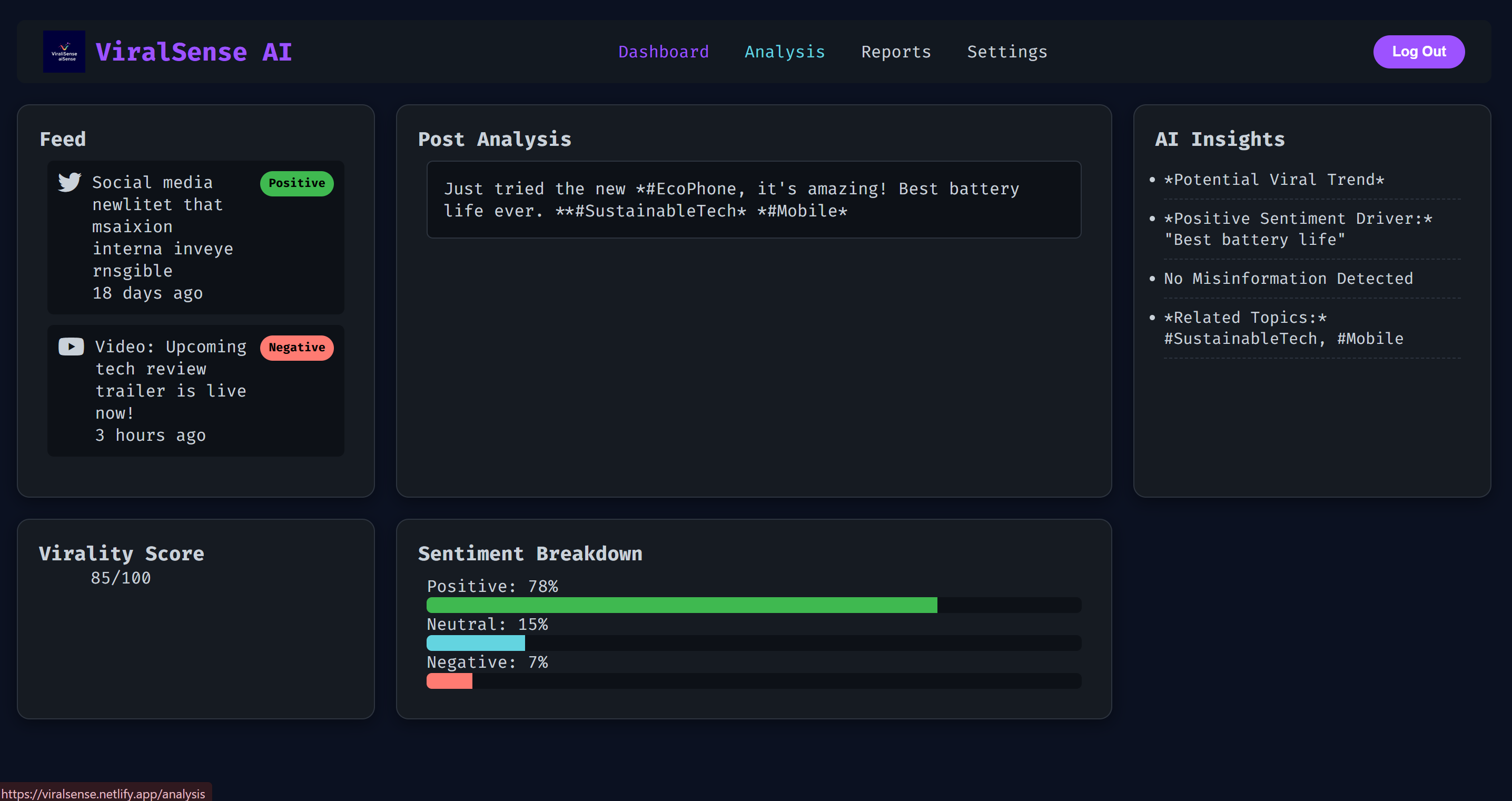
Social media produces a vast amount of real-time data that influences public opinion, brand views, and social narratives. However, important signals like sudden changes in sentiment, viral trends, or harmful content often get lost in the noise. I was motivated to create ViraliSense AI after seeing how misinformation and hate-filled content can spread quickly before anyone notices. The goal was to develop an AI system that constantly monitors social platforms and turns unstructured text into meaningful, actionable insights in real time.
What it does
This project helped me build practical skills in:
- Gathering real-time data from multiple APIs
- Using Natural Language Processing (NLP) for sentiment and content analysis
- Applying AI models to detect trends and estimate virality
- Designing scalable systems for streaming data
- Creating user-friendly dashboards for live analytics I also learned that small changes in preprocessing and model thresholds can significantly impact real-time results. ## How we built it ViraliSense AI uses a modular real-time analytics pipeline:
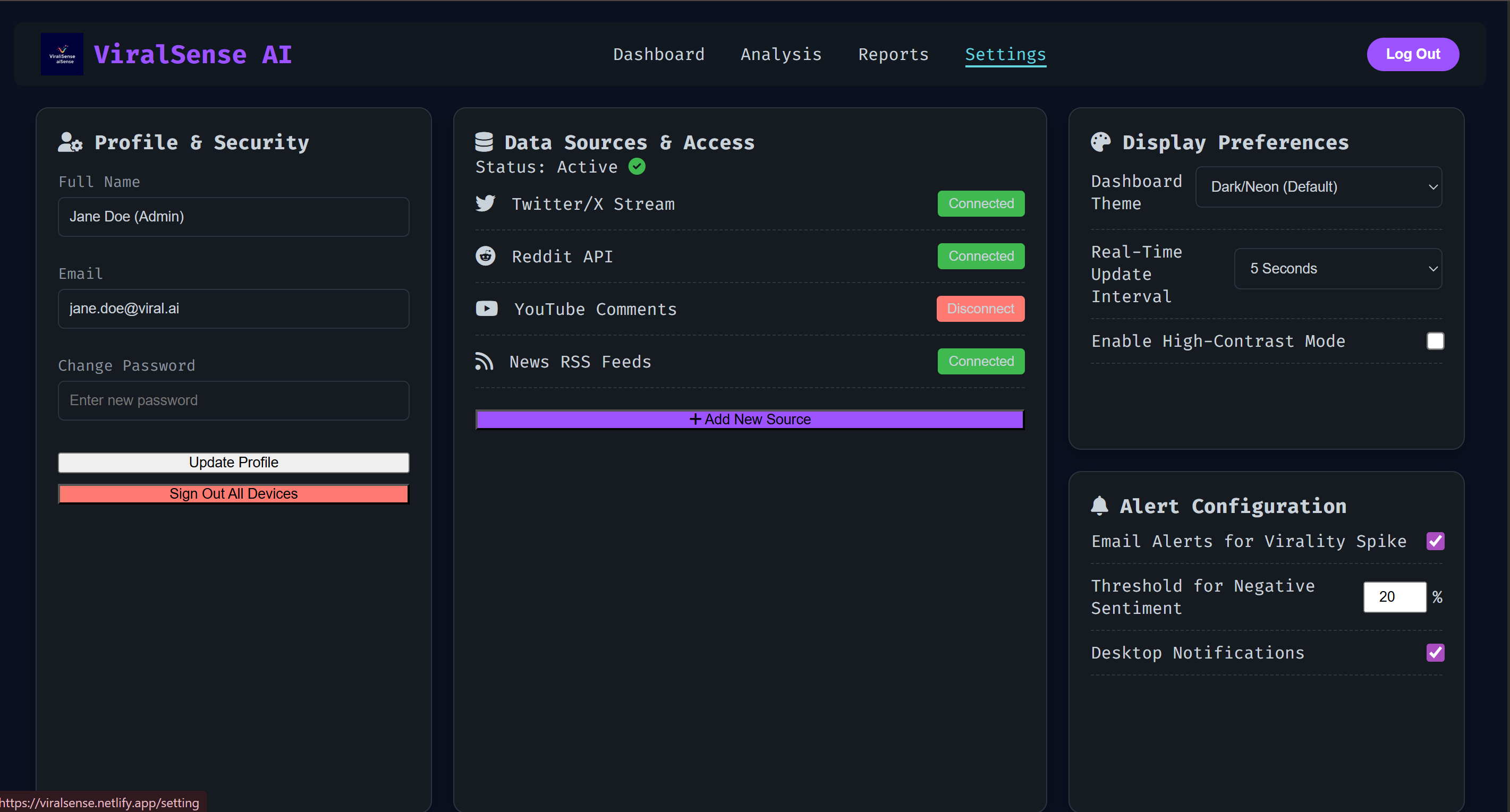
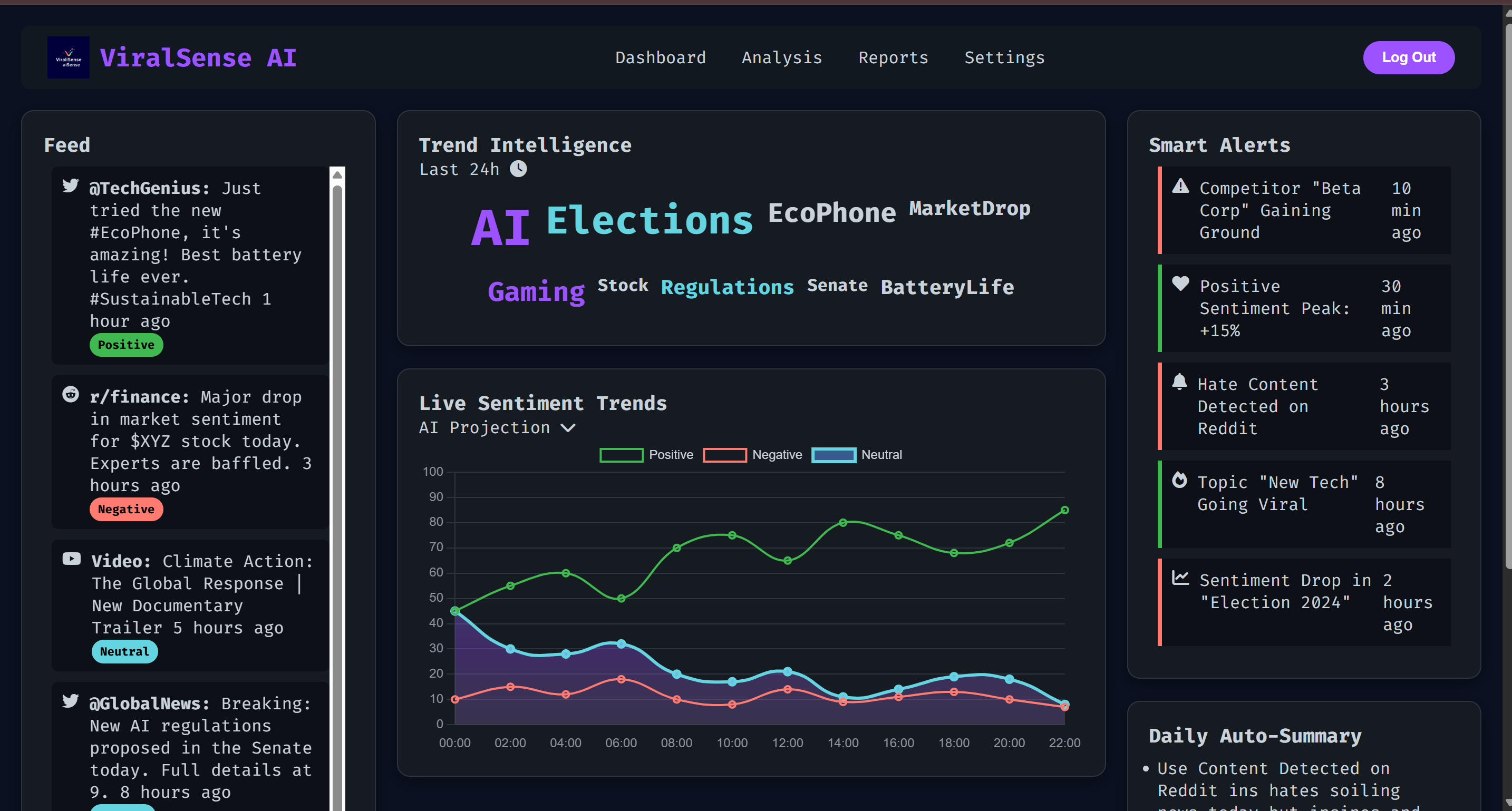
- Data Streaming: Live data is collected from Twitter/X, Reddit, YouTube comments, and news APIs.
- Text Processing: Incoming text is cleaned, tokenized, and prepared for NLP tasks.
- AI Analysis:
- Sentiment is calculated with an NLP model, resulting in a score
text{Sentiment Score} \in [-1, 1] - Virality potential is estimated using engagement signals like likes, shares, and comment speed:
V = \alpha \cdot E + \beta \cdot R + \gamma \cdot T where (E) = engagement, (R) = repost rate, and (T) = time-based growth.
- Sentiment is calculated with an NLP model, resulting in a score
- Aggregation & Trends: Hashtags and keywords are grouped to identify emerging trends.
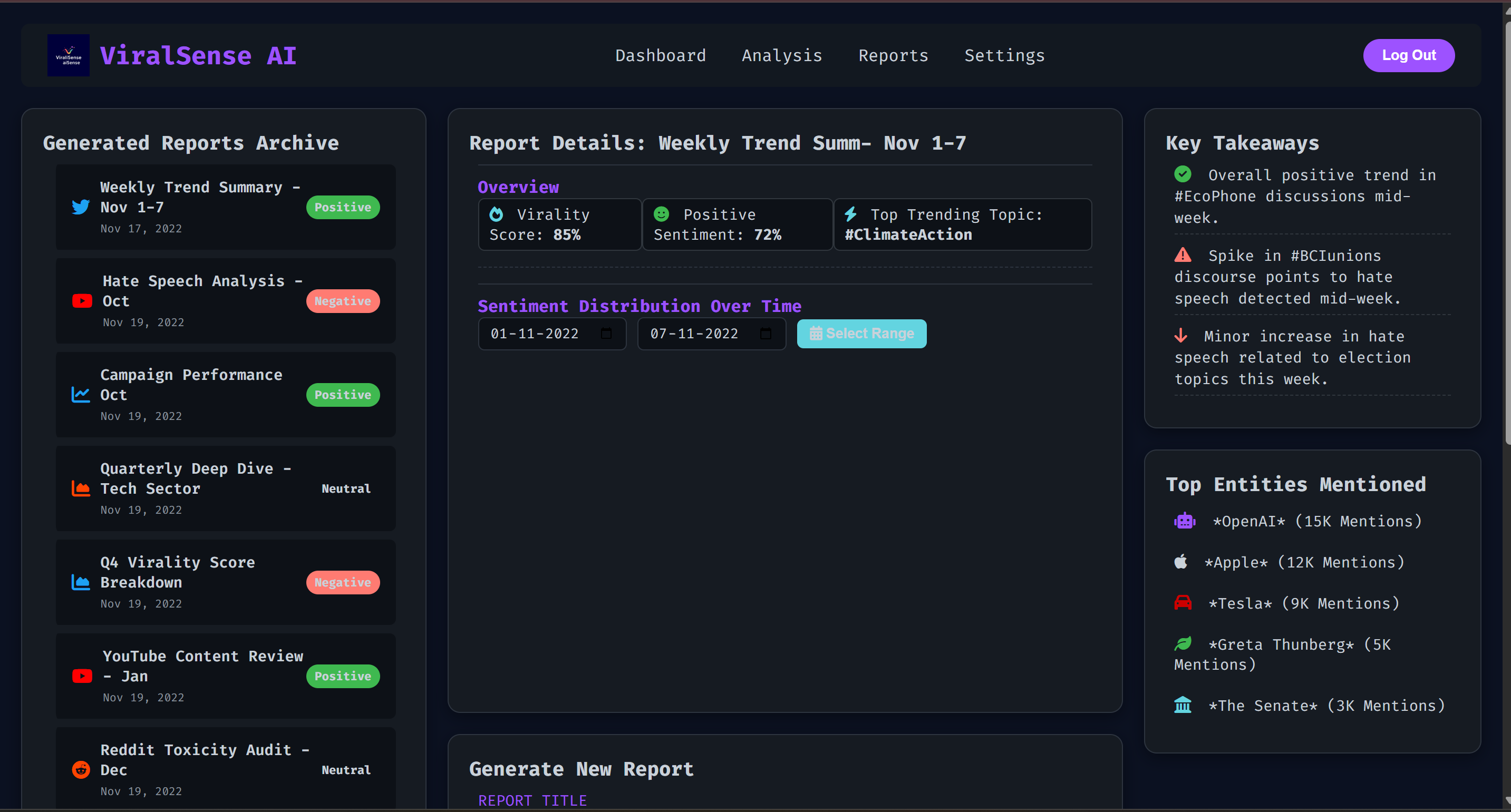
- Visualization & Alerts: Insights are shown on a live dashboard with word clouds, sentiment graphs, and alerts for viral topics, hate speech, or sudden drops in sentiment. ## Challenges we ran into
- Noisy Text Data: Social media content can have slang, mixed languages, and emojis, requiring careful preprocessing.
- Model Threshold Tuning: Setting the right thresholds for detecting hate speech and virality alerts was complex.
- Scalability: Designing the system to stay responsive as data volume grows required careful planning. ## Accomplishments that we're proud of ViraliSense AI shows how AI-driven sentiment and trend analysis can turn raw social media data into timely, actionable insights. The project highlights my growth in applied AI, system design, and creating solutions that have a real-world impact ## What we learned Building ViraliSense AI showed that real-time intelligence needs more than just data; it needs precision. We mastered High-velocity pipelines, syncing live APIs from X, Reddit, and YouTube into a smooth data stream. Our complex NLP refined sentiment scoring to filter through noisy social media text, slang, and various expressions. System calibration taught us that small threshold adjustments are essential for accurate hate speech and trend detection. ## What's next for ViraliSense AI: Instant social sentiment and trend decoding The next phase focuses on moving from observation to prediction. Predictive Forecasting: Using early growth signals to anticipate trends before they peak. Multi-Modal AI: Expanding analysis to include sentiment in images and short-form video. Enterprise Scaling: Strengthening the architecture to handle large data surges during global events. Automated Action: Integrating smart responses to help brands manage reputation hits the moment sentiment drops.

Log in or sign up for Devpost to join the conversation.