-
-
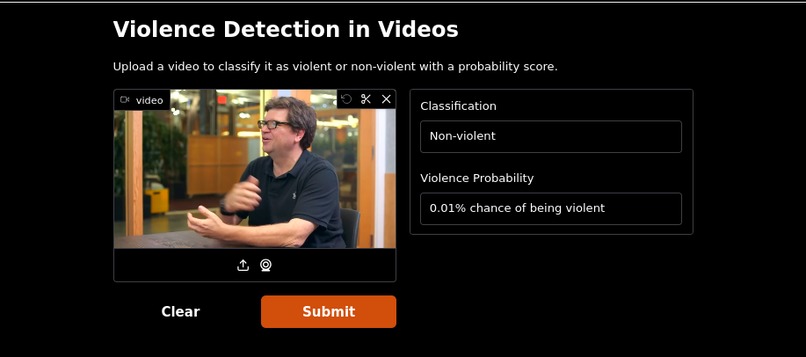
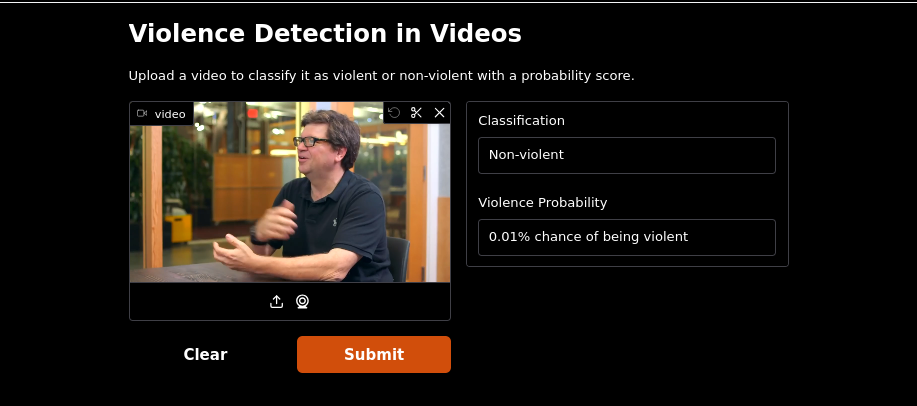
demo of the model classifying a video as non-violent
-
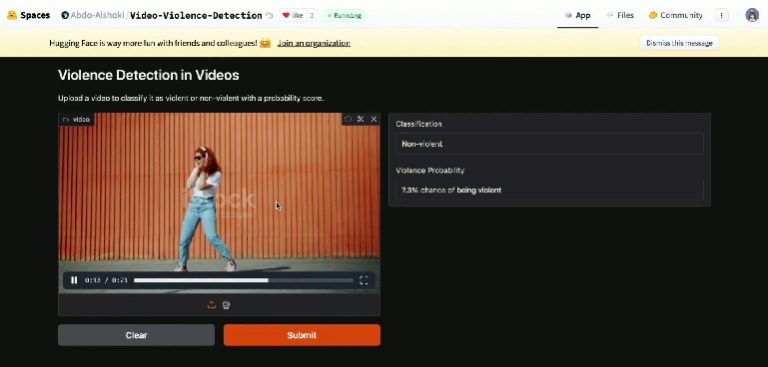
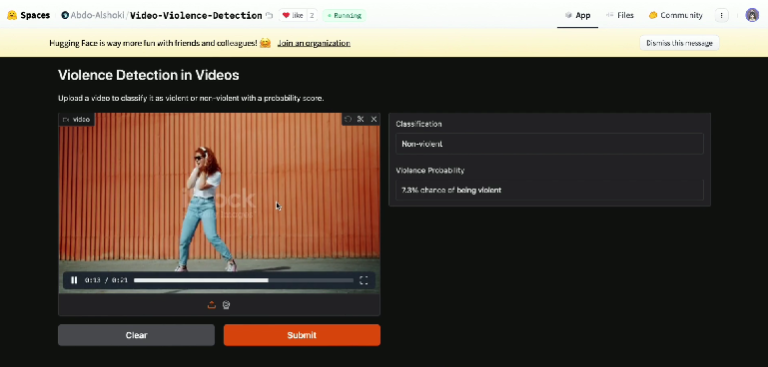
demo of the model classifying a video as non-violent
-
-
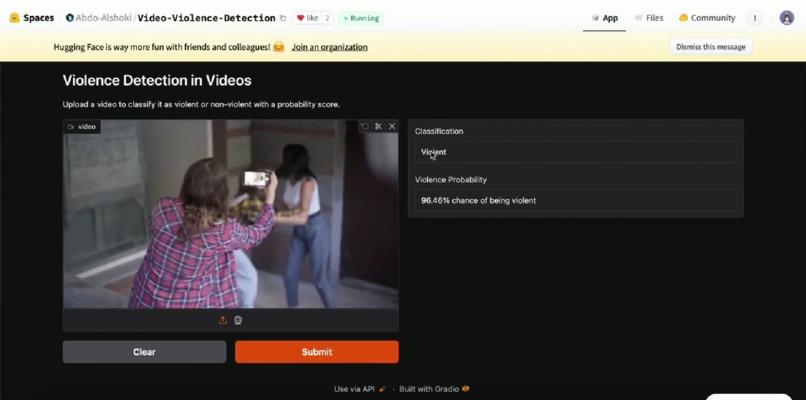
Project Story: Empowering Women’s Safety Through AI
🌍 Who We Are
We’re a group of Egyptian university students, mostly women, who are all too familiar with stories of violence around us. Growing up in Cairo, we’ve seen how quickly a busy street or crowded metro can turn into an unsafe environment, especially for women and girls. These incidents are often brushed off, left unseen, or ignored. As students, we hear about these occurrences from friends, family, and news, and it’s often frustrating how helpless people feel to do anything about it. That’s where our project began—born from a shared determination to leverage AI to make a meaningful difference in our communities.
💡 Inspiration Behind the Project
Our inspiration was simple but powerful: visibility. We wanted to shine a light on violence that often goes unnoticed, using the tools we’re learning in our studies to create a solution that could really work in Egypt and beyond. We set out to build a model that didn’t just detect violence but could recognize it in real-time, making our neighborhoods, campuses, and public spaces safer. The concept of using AI for this felt both revolutionary and necessary, especially in places where tech-based safety solutions are still developing.
📚 The Learning Journey
For most of us, this was our first time working on something this complex and meaningful. As students, our AI knowledge was theoretical—but turning it into a working model was a whole new world. We learned about video processing and how AI can interpret movements, expressions, and body language. Using Google’s advanced AI tools and resources was an adventure in itself; every tool we used taught us something new about the power and potential of AI to serve a real social need.
🔧** Building the Model**
We started with a question: How can we train a model to see what a human eye would notice in a moment of danger? Answering that question meant understanding both the technical and ethical aspects of building a violence detection model. Using convolutional neural networks combined with recurrent layers (LSTMs), we trained the model to detect moments of aggression in videos. Every step felt like solving a puzzle: from finding the right datasets, handling huge video files on limited hardware, to tuning the model so it wasn’t just accurate but also fast enough to work in real-time.
🚧 Challenges Along the Way
Our journey wasn’t smooth. We faced challenges at nearly every stage, from finding the right data to training the model within our hardware constraints. We had limited GPU power, which forced us to get creative with our training techniques, cutting down processing time without compromising accuracy. False positives were another hurdle—our model needed to be sensitive enough to detect violence without confusing it with normal human interactions. This process taught us resilience and the power of persistence, as we iterated through countless versions to make the model as effective as possible.
🌠 Why This Matters to Us
This project isn’t just an assignment—it’s personal. In Egypt, discussions around safety are part of daily life. Women here face a unique set of challenges, and we believe that as students, we have a duty to apply our skills to address these issues. This project is our way of turning the theoretical knowledge we learn in class into something that could genuinely make a difference for women and girls. As we navigate our studies and prepare to enter the workforce, we’re incredibly proud of the idea that we’re contributing to a safer, more equitable future.
🌌 Looking Forward
This hackathon has only strengthened our commitment to making technology work for social change. We hope our AI model will continue to grow, not only as a tool for detecting violence but as a statement on what’s possible when young women use their skills to make a difference. We see a future where this model could be implemented across public spaces, on campuses, and in areas where safety is a priority. We’re excited to keep learning, keep pushing, and keep dreaming of a world where AI helps make every woman feel safe.


Log in or sign up for Devpost to join the conversation.