-
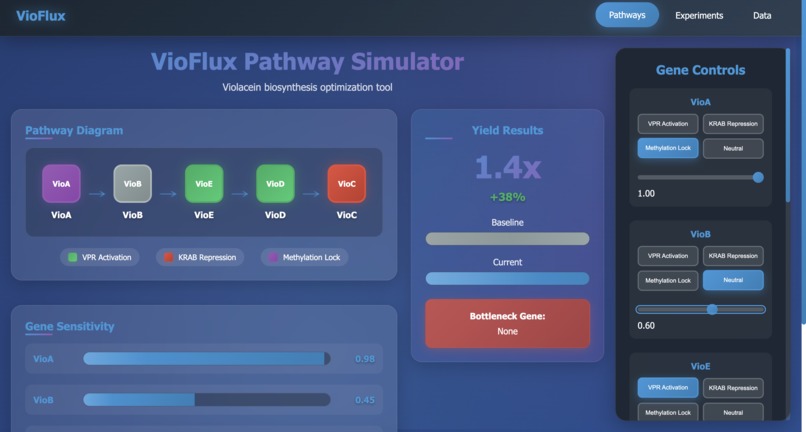
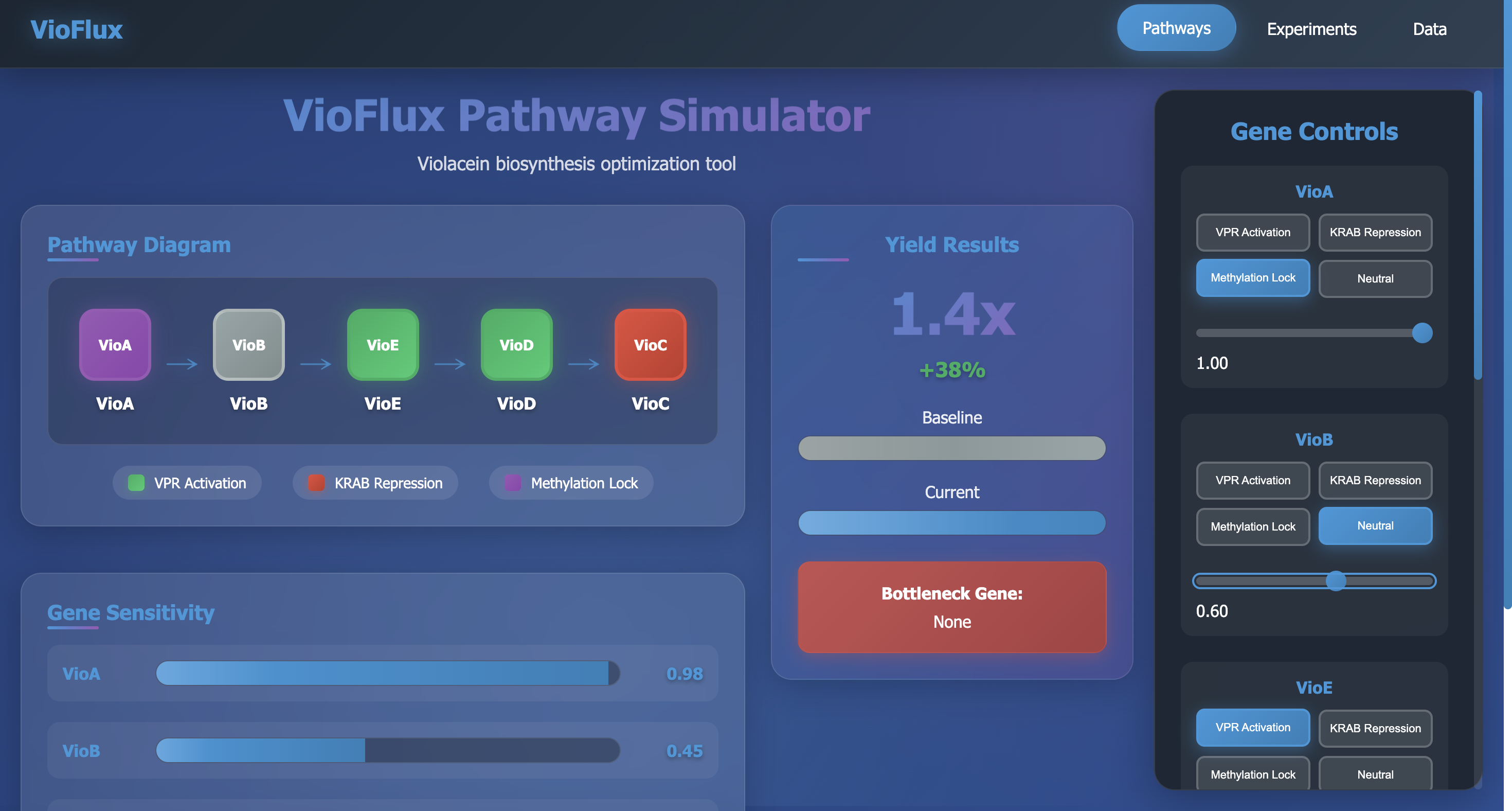
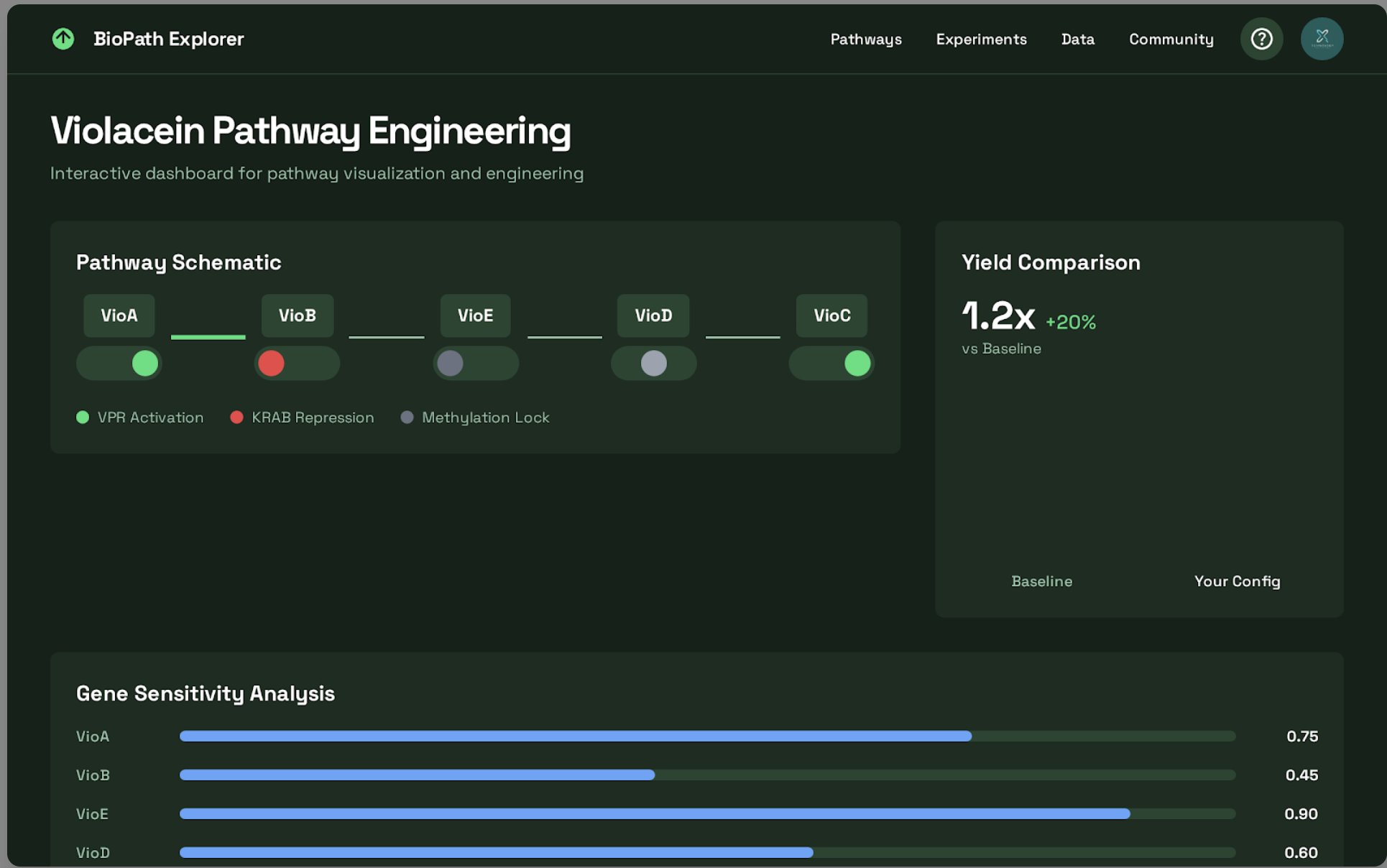
VioFlux Pathway view: per-gene epigenetic toggles with live yield, bottleneck callout, and sensitivity bars for next-edit guidance.
-

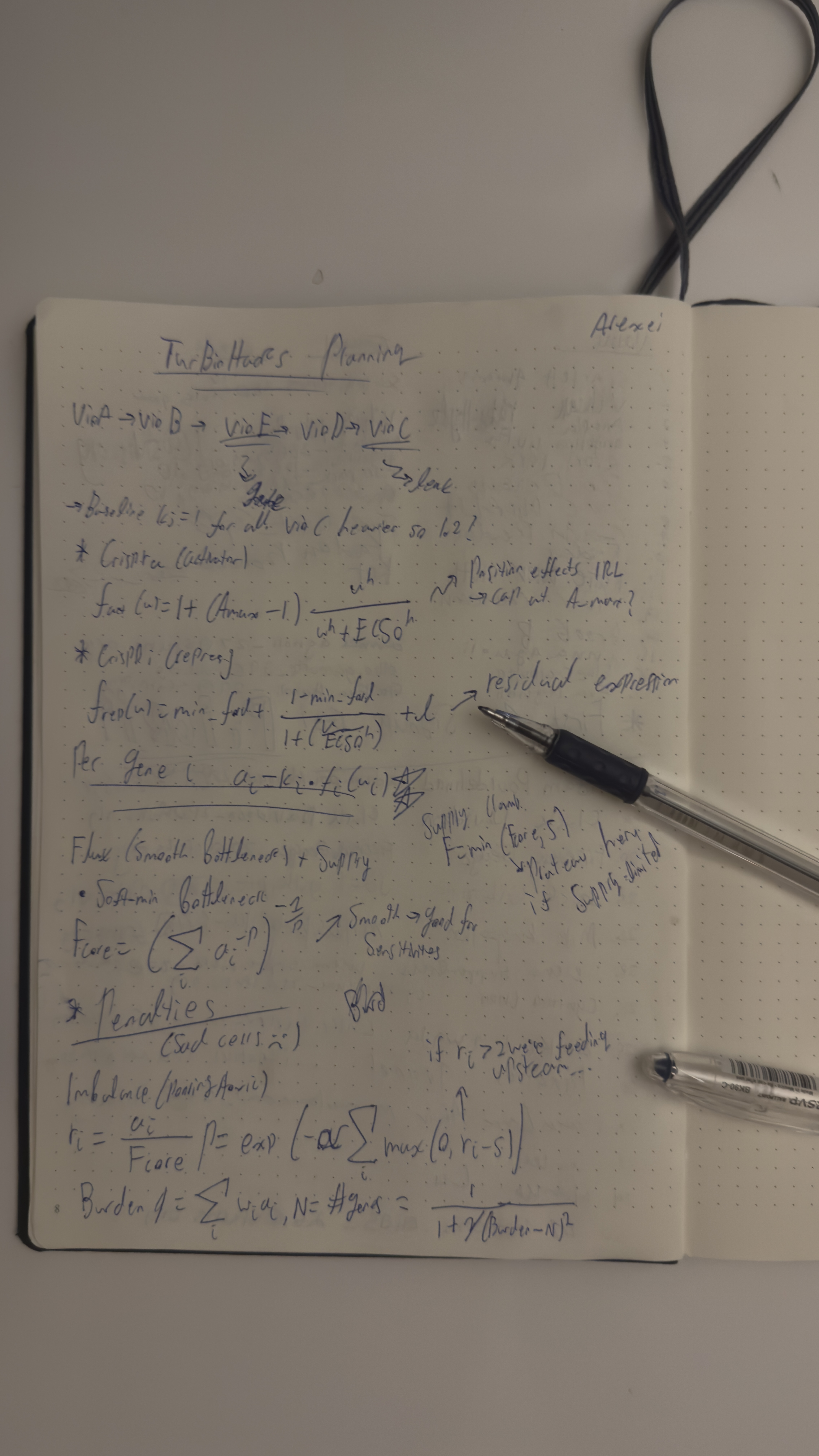
(Alexei notebook): fold-change models, soft-min bottleneck, penalties, and VioE/VioC rules. the early reasoning behind VioFlux’s equations.
-
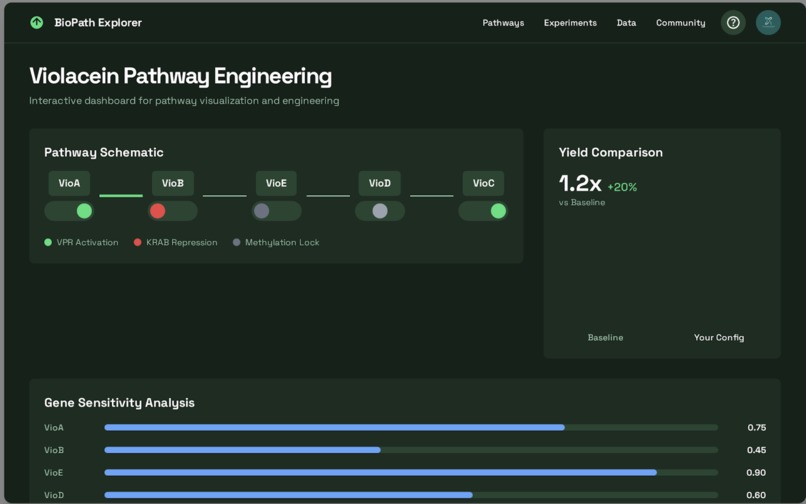
Early UI concept
Inspiration
Biomanufacturing yield isn’t just “add the genes.” It’s how much and when each enzyme runs. Promoter/RBS tuning is brittle across hosts and conditions; epigenetic controls (CRISPRa/i, methylation) are programmable, reversible, and composable. We wanted a lightweight, transparent tool that lets you think like a pathway - toggle regulatory dials and immediately see bottlenecks, burden, and the most leverageable next edit.
What it does
VioFlux is an interactive simulator for the violacein pathway (VioA–E). For each gene you pick CRISPRa, CRISPRi, or a methylation lock, set a level (0–1), and the app returns:
- Yield (×) relative to baseline and the current bottleneck
- Gene sensitivities (which edit buys the most yield next)
- A quick OFF/MED/ON grid to compare a handful of configurations
It bakes in two real behaviors: VioE acts like a gate (too low → CPA diversion → no product), and weak VioC leaks to chromoviridans.
How we built it
All client-side (HTML/CSS/JS). The engine is intentionally rules-based and explainable:
Per gene $i$, a module + level $u\in[0,1]$ yields a fold-change:
- CRISPRa: $$1+(A_{\max}-1)\,\mathrm{Hill}(u;EC50,h)$$
- CRISPRi: $$\text{min_fold}+\dfrac{1-\text{min_fold}}{1+(u/EC50)^h}+\ell$$
- Methylation: binary ON/OFF with a small leak
Effective capacity: $$a_i=k_i\cdot f_i$$
Smooth bottleneck: $$F_{\text{core}}=\big(\sum a_i^{-p}\big)^{-1/p}$$, then clamp by a supply cap
Penalties: imbalance (too much upstream for too little downstream) and burden (proteome/RNAP cost)
Violacein rules: VioE threshold ⇒ $$Y=0$$; low VioC ⇒ leak
Final score: $$Y=F\cdot P\cdot(1-\text{leak})\cdot Q$$ Sensitivities come from tiny log-perturbations per gene (±5%).
Challenges we ran into
- Realism vs. simplicity: enough biology to matter (VioE/VioC) without burying users in kinetics.
- Making “why” obvious: if yield moves, the bottleneck/sensitivity story should be visible in one glance.
- Priors, not promises: effect sizes for CRISPRa/i vary by context; we chose conservative caps and leaks.
Accomplishments that we’re proud of
- A zero-install tool that anyone can open and learn from in under a minute.
- A model that’s transparent (you can read the equations) and pathway-aware (paper-backed rules).
- Built-in design guidance: bottleneck labels, sensitivity bars, and a quick configuration grid.
What we learned
- The qualitative trends hold: boosting late steps usually helps until you hit supply; cranking early steps often buys you burden more than product.
- Thresholds matter more than we expected. A cautious VioE gate keeps us honest, but we’d like to calibrate it with data where possible.
- Sensitivities are situational. Under supply cap or heavy penalties, “the best next edit” can flip—flagging those regimes helps users read results correctly.
- Simple beats clever. Clear controls and plain math got us farther than fancy features we didn’t have time to validate.
What’s next for VioFlux
- Not just “Vio”, anything: the core should work for any pathway. Think a tiny “FluxKit”: drop in a CSV/SBML, pick a host preset, go. Violacein is just the on-ramp.
- Pathway & host library: add lycopene (crtE/B/I/Y), vanillin, and a yeast preset with host-specific priors. One dropdown: pathway × host.
- SBML/CSV import with auto-wiring: ingest models, order steps, detect late oxidations/hydroxylations, and warn on cycles/branches that need user tags.
- Uncertainty & “honesty mode”: show yield bands from prior ranges, highlight “supply-limited” states, and surface assumption cards (what’s heuristic vs. paper-backed).
- Design-of-experiments helper: propose a minimal ON/MED/OFF panel that maximizes information gain; export a 24-well sheet with expected contrasts.
- Suggest-next-edit (with guardrails): rank edits by $\Delta Y$ and cost/risk (burden, imbalance, leak), not just raw yield.
- Learn-as-you-go hybrid: fit a small surrogate (ridge/forest) to user data to tighten priors; keep the rules visible as the backbone.
- Temporal sketches: prototype simple epigenetic pulses (early repression → late activation) and visualize transient burden vs. final yield.
- One-click exports: CSV of configs, SVG pathway diagrams, and templated build sheets for bench handoff.


Log in or sign up for Devpost to join the conversation.