-
-
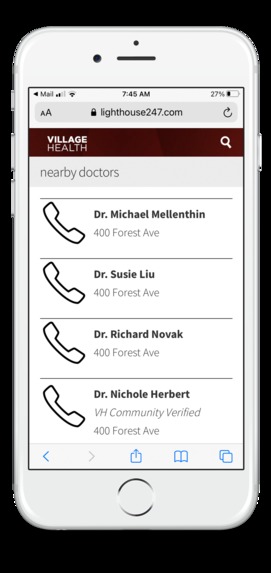
Simple English results, no geo enabled
-
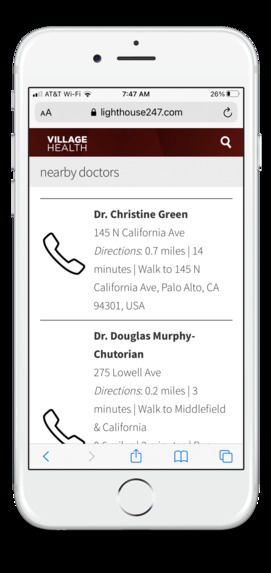
Geo enabled, bus/train/walking instructions now included
-
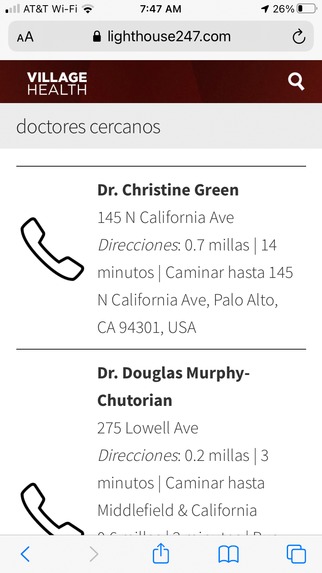
In Spanish, both headlines and mid-sentence phrases
-
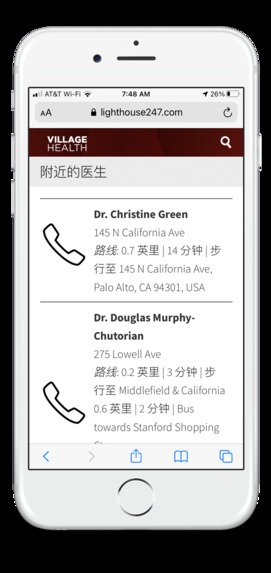
Chinese
-
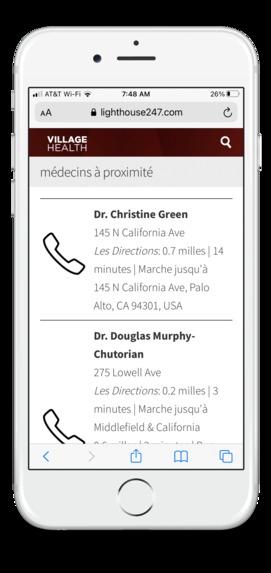
French
-
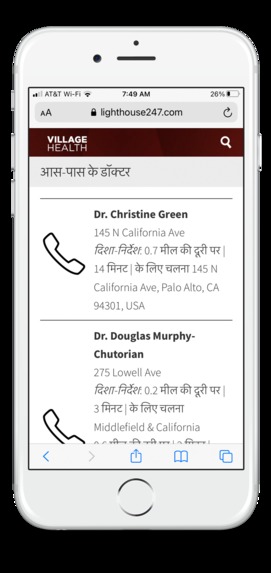
Hindi
What Underserved Means to Us
Our starting point for this project is the definition of underserved. It can be people who don't live near health care facilities, or have the ability to get to a doctor, but it can also be much broader than that. It can be anyone who for any reason isn't taking advantage of the care that is available to them. Sometimes it is a language barrier. Sometimes it is a literacy challenge. Sometimes an informed and trusted source can be the difference between action and in-action. Our experience is with Chronic Care programs, and there are close to zero education and content sets for Asian population, despite their population. For this project we treated "underserved" as anyone not getting the care they need in the way they want it, and we are choosing the Asian Pacific Fund as our Charity.
We Had A Cool Idea 
An Amazon Alexa voice experience where a patient could find vaccines, find doctors and get trusted information about COVID. We could use difference voices tap into the power of voice to help encourage education and action.
We Looked Around the Room... 
Before we got too excited, we looked around the room and pretty quickly figured out that none of us were in the customer target...so we picked up a 20-pack of Walmart gift cards and headed to the Walmart in the lowest income neighborhood in Phoenix to learn more about what COVID meant to our future members.
Here's what we heard...
- I'm not going to download an app for this
- I don't really need another website, I maybe need a website that is recommended by someone
- I will travel a little farther on a bus than if I have to walk, I can't always guarantee I have a ride
- I don't really like those chat things, or just texting > it would be better if it is was in my preferred language, especially if I'm going to get my abuela to get a vaccine
Conclusion and Perspectives
- No Alexa product, it's a mismatch for our audience
- Native language was the most common request
- Lower health literacy members (either for ESL or education level reasons) comprehend information at a higher level when they hear it vs. read it -- we still want an audio product, just not Alexa
- Where can I get a vaccine was the 2nd most common ask
So Here is What We Built
A multilingual (we're starting with English, Spanish, Mandarin, French, Chinese and Hindi) phone call experience that can be delivered mostly through audio, but also has an element of SMS drive to web.
We took the healthcare finder API and laid two additional information sources over the top of it -- transit directions and the ability for a community center to identify preferred physicians and have them marked differently in the results. For this challenge, we're demo-ing our consumer experience, but we've also built an experience where someone working at a community center could do outbound SMS/phone programs to their members to drive activity.
Finally, we addressed the specific requirements of the challenge to help build a better product
QUALITY
Our product requirements were "patient-driven" and we didn't let too much "cool" overshadow impact. We also used an innovative implementation of Twilio to manage the conversation. Usually you would design an IVR-like tree with conditional branches when applying Twilio to this solution, however between the language requirements and complex flows it started to collapse under its own weight and adding a new language/program seemed daunting. So instead, we used backend-hosting pathing logic to handle "turn management" and it reduced our time to add new languages to about 30 minutes. Additionally, on Quality, we ran the dialog through Flesch-Kincaid review to target a 5th/6th grade reading level.
IMPLEMENTATION
We ended up with a truly multi-lingual experience, with recorded messages in each language and a dynamic web experience that drew a little bit on the method that healthcare locator API uses to internationalize -- we had language specific JSON files that we used to templatize the experience. From information headings to event "Walk to" in our directions, we made it local language.
USE OF THE SDK
To create a more individualized experience and have multi-language beyond the two or three the healthcare locator has finished implementing, we took over the UI so that we could do data overlays (e.g., transit instructions and endorsed-physicians. We kept "call" buttons, although the SDK doesn't have that many phone #s. We also gave our members access to the full search capability if our experience didn't get them what they wanted.
SCALABILITY
We think of scalability in three ways. First, there is technical scalability, and between our AWS backend and Twilio, we should be in good shape. Secondly we think of "program scalability", i.e, how easy is it to edit the program, add new languages, or even add a new education stream come flu season or a push for child inoculations. And finally, we built with "demand scalability" -- it's hard, expensive, slow to market programs to the general population, so we built it in such a way that a community center could send out phone calls/SMS messages to their members and (in the future) tailor the content.
How we built it
- Twilio does the heavy call handling and SMS delivery
- Our python API does "turn management" and organizes the multilingual content
- We mostly used the GraphQL implementation of the healthcarelocator API so that we could overlay other data on top
- We tried to "help" to create a better experience -- for vaccine appointment information, we ask your zipcode so that we can find the appropriate state list of appointments and get the member closer to the answer
Challenges we ran into
Between HCL, AWS, vax services and Twilio, there were a lot a lot a lot of CORS hustling and work arounds. There was also a lot of discussion on the best way to implement async and await solutions, that I still don't think we totally understand. Finally, it's hard to debug Twilio -- you have to make a phone call and then sift through the logs to find errors. It gave us some gray hairs.
Accomplishments that we're proud of
Low effort multi-language and creating overlays to HCL have made for a good experience.
What we learned
Debugging Twilio is a 4x multiplier to the dev timeline
What's next for Village Health
We're finishing up the community center experience over the next week. A lot of the audio prompts are Google Translate + Polly and even my average-level French and Spanish can tell the grammar is a little stilted. The experience would benefit from real-human voices and real-translation.
Down below we'll put a link to github repository, its fragmented and we do a lot of 3rd party calling so we've pulled out our API keys and credentials. You can try the service at 415-231-1255, although we have only built it for US at this time. Over the weekend we'll add the shortcode for the community experience (our provider is down right now, so we'll either get a different short code or different provider).
Try it 415-231-1255
Built With
- healthcarelocatorapi
- html
- javascript
- python


Log in or sign up for Devpost to join the conversation.