-
-
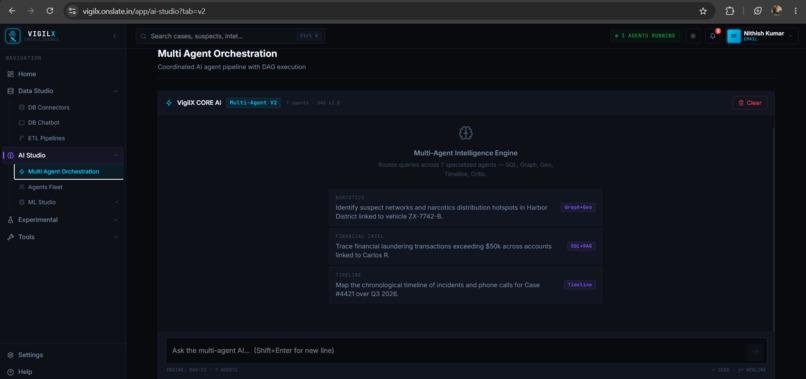
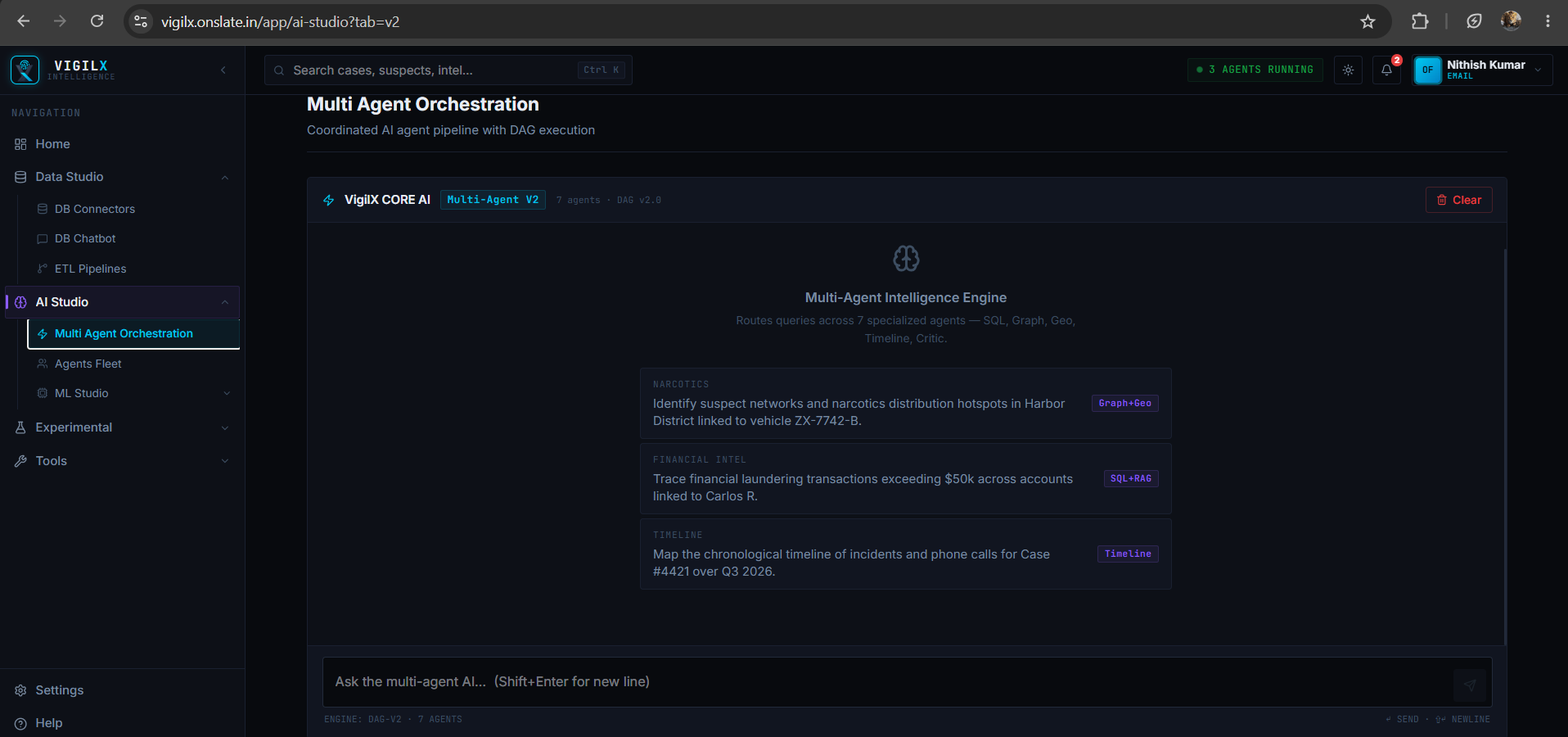
Conversation AI with Multi Agents
-
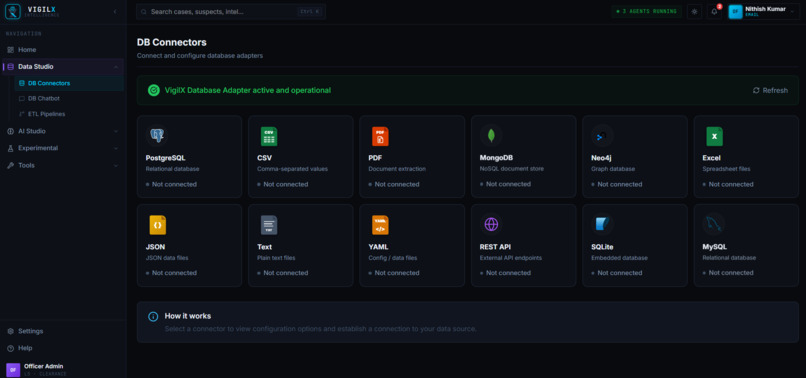
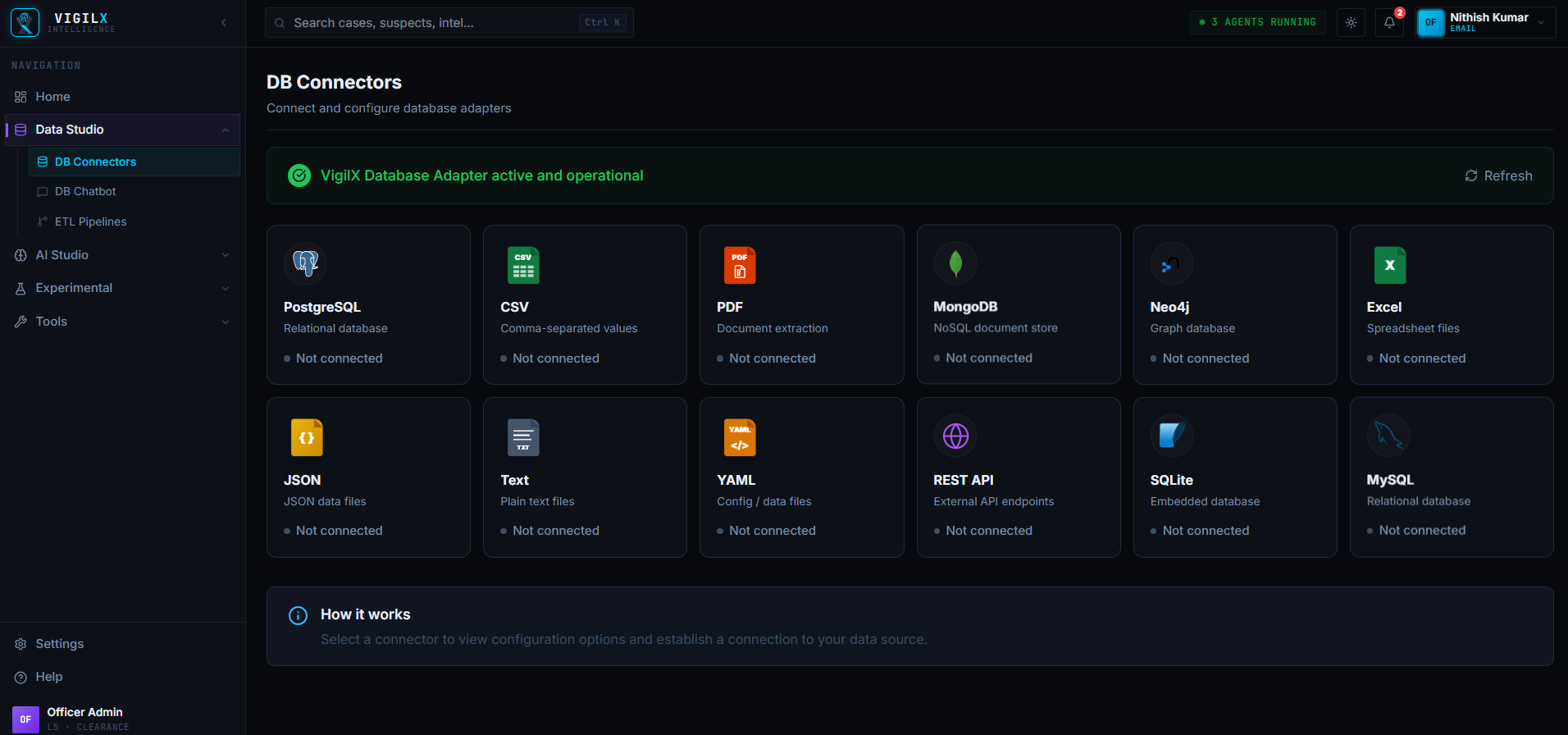
Database Connectors
-
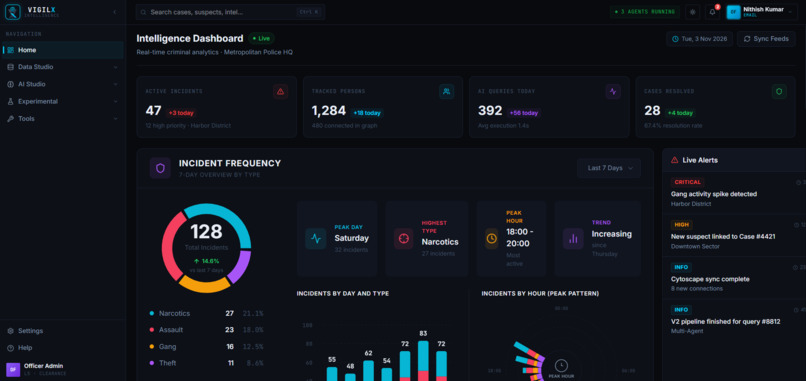
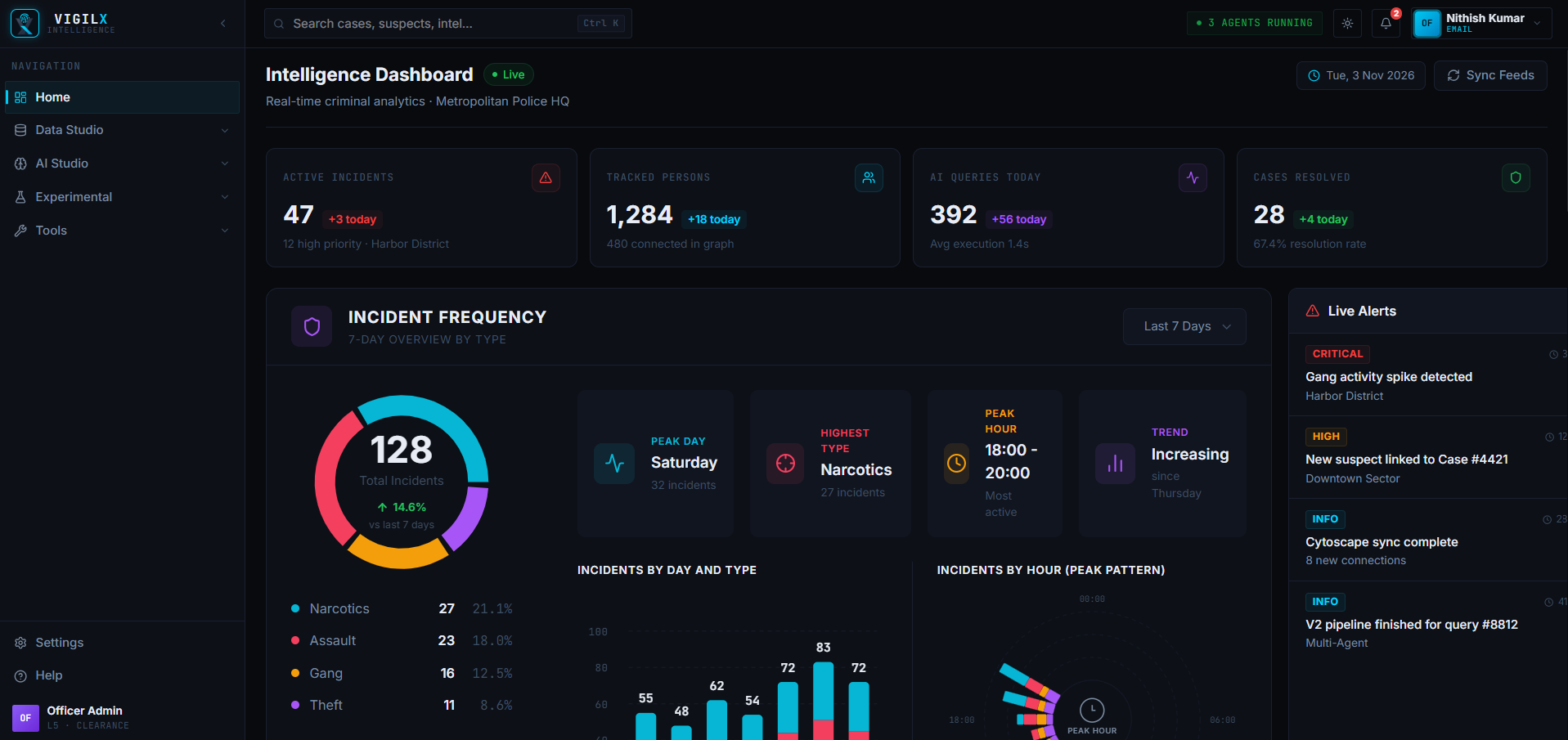
Dashboard with Analysis
-
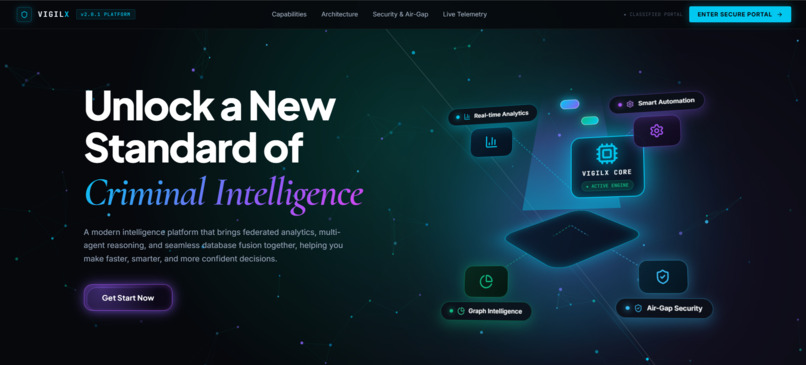
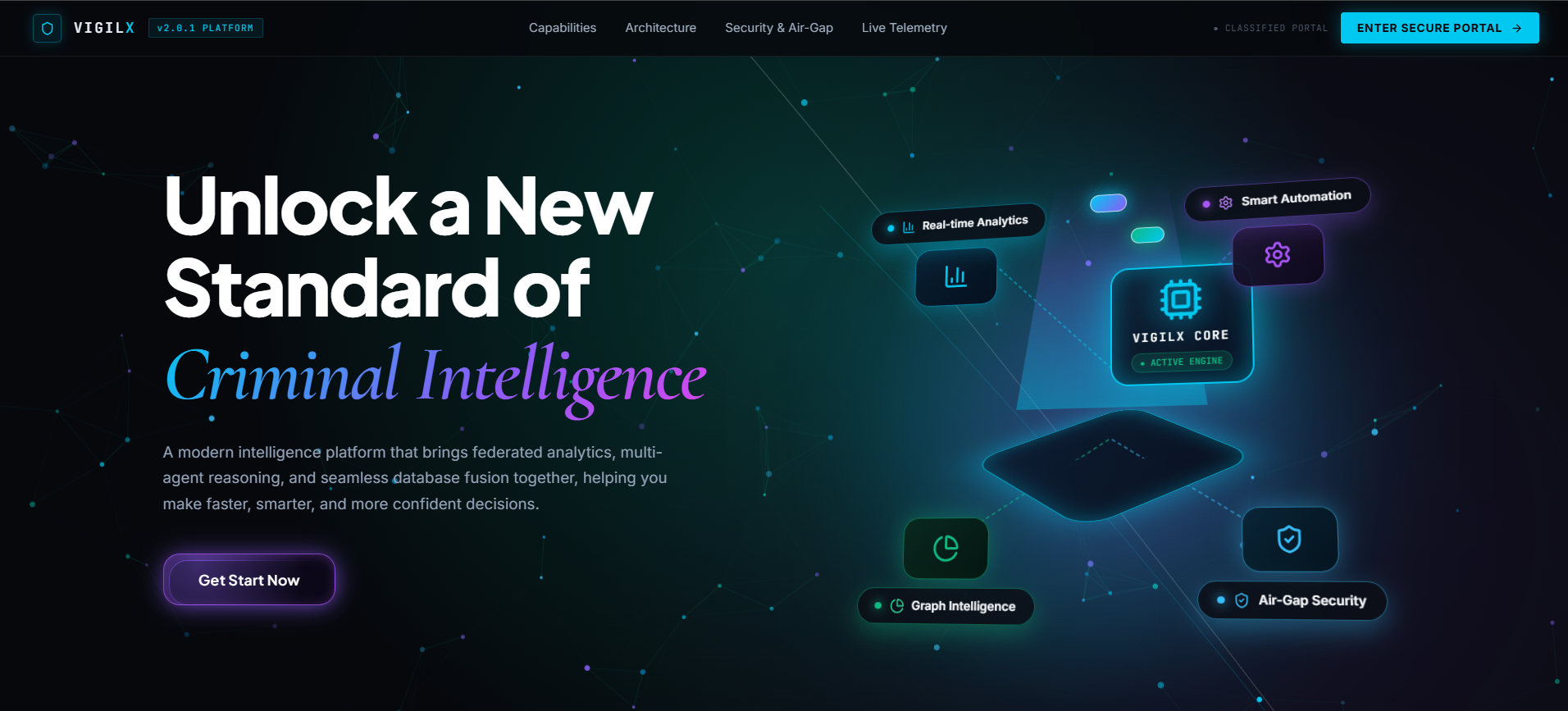
Landing Page
-
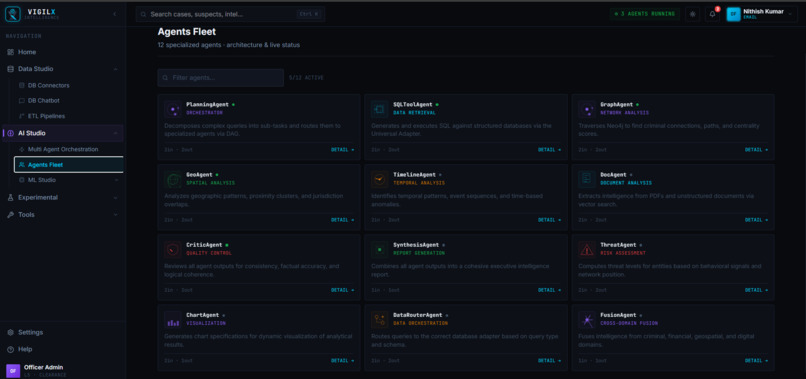
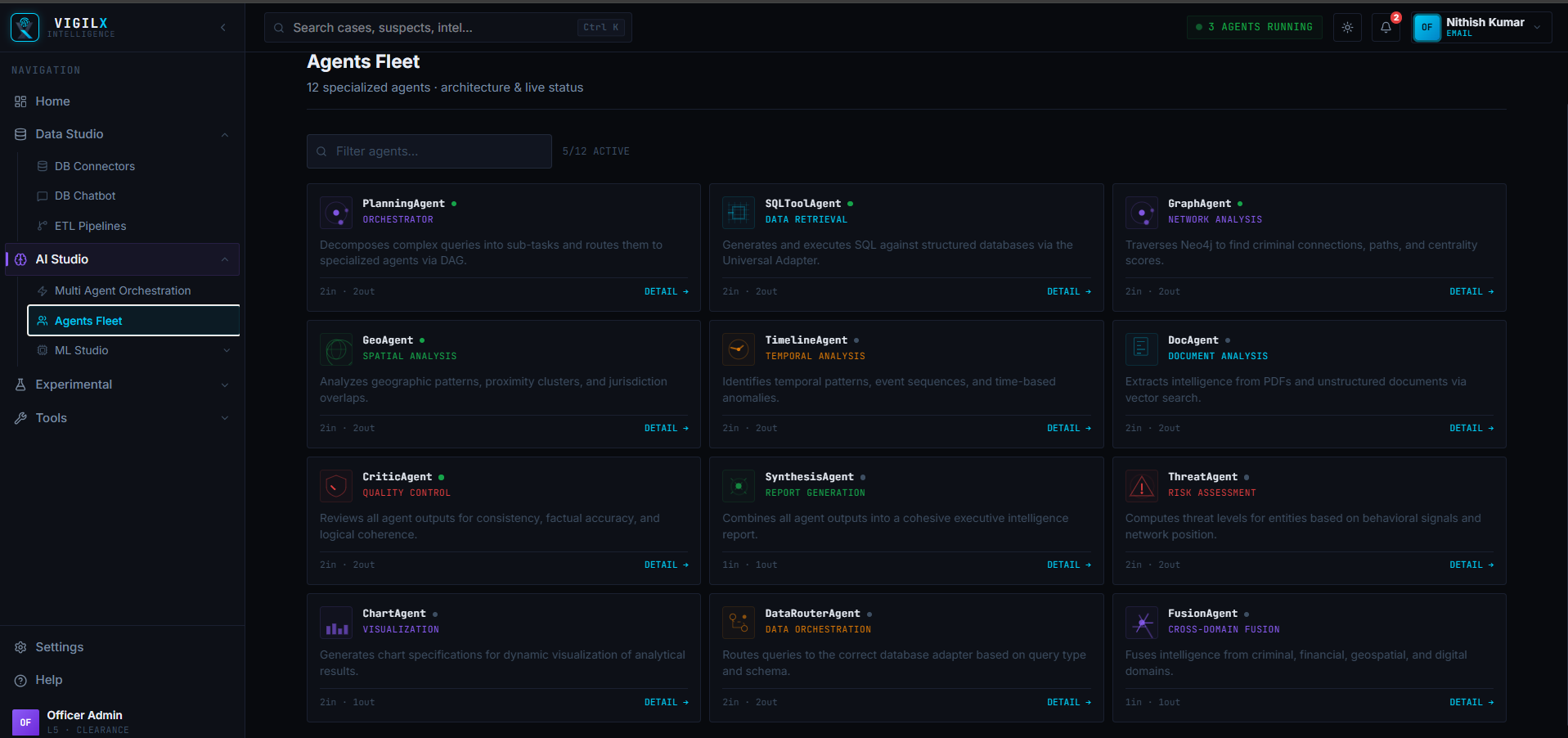
Agents Fleets
VigilX — A Crime Intelligence Platform
Inspiration
The rapid advancement of Large Language Models has transformed how we interact with information. However, when dealing with complex investigations, fragmented data, and multi-dimensional problems, a single AI model is often insufficient.
Traditional AI assistants primarily focus on generating responses rather than conducting systematic investigations. They can overlook critical evidence, produce unsupported conclusions, struggle with complex task dependencies, and lack proper verification mechanisms.
We envisioned something different: What if AI could investigate like a team of specialized experts rather than respond like a single chatbot?
This question inspired VigilX, an Agent Intelligence Platform designed to transform fragmented information into structured, evidence-backed intelligence through autonomous multi-agent collaboration.
Our goal was to move beyond conversational AI and build a system capable of planning, investigating, analyzing, validating, and reasoning systematically.
What it does
VigilX is an intelligent multi-agent investigation platform that coordinates specialized AI agents to solve complex tasks through collaborative reasoning and evidence-driven workflows.
Instead of relying on a single LLM response, VigilX distributes responsibilities across specialized agents, each handling a specific stage of the intelligence pipeline.
Key Capabilities
- Autonomous Task Planning: Breaks complex user requests into smaller, manageable investigation tasks.
- Multi-Agent Orchestration: Coordinates specialized agents through structured workflows using LangGraph.
- Dynamic Tool Execution: Routes tasks to appropriate tools and execution environments based on their requirements.
- Intelligent Data Analysis: Processes information, identifies patterns, and extracts meaningful insights.
- Evidence Fusion: Combines information collected from multiple sources into a unified evidence context.
- Evidence Ranking: Evaluates the relevance and importance of collected evidence.
- Cross-Validation: Compares findings across different sources to identify inconsistencies and strengthen conclusions.
- Intelligent Verification: Validates intermediate findings before they contribute to the final response.
- Traceable Intelligence: Connects generated conclusions with supporting evidence and citations.
- Response Criticism: Evaluates generated outputs for accuracy, completeness, consistency, and relevance before final delivery.
The central philosophy behind VigilX is simple:
Don't just generate answers. Investigate, validate, and deliver intelligence.
How we built it
VigilX is designed around a modular, multi-agent architecture in which each specialized agent has a clearly defined responsibility.
Our architecture separates application-level responsibilities from the AI intelligence engine, enabling independent development, scalability, and maintainability.
Technology Stack
- Backend: Django and FastAPI
- Agent Orchestration: LangGraph
- Relational Database: PostgreSQL
- Graph Database: Neo4j
- Vector Database: Qdrant
- AI Intelligence: Large Language Models and specialized AI agents
- Deployment: Zoho Catalyst AppSail
Multi-Agent Intelligence Pipeline
The intelligence engine follows a structured execution lifecycle:
- Context Understanding: Understands the user's request and establishes the investigation context.
- Planning and Decomposition: Converts complex objectives into smaller subtasks.
- Agent Coordination: Assigns subtasks to specialized agents through an orchestration layer.
- Tool Execution: Executes relevant operations, retrieves information, and performs analytical computations.
- Evidence Processing: Consolidates, ranks, and cross-validates collected evidence.
- Verification: Evaluates findings and identifies unsupported or inconsistent conclusions.
- Reasoning and Recommendations: Develops conclusions based on validated evidence.
- Response Composition: Produces a structured, understandable, and traceable final output.
LangGraph provides the orchestration foundation, allowing agents to operate through controlled workflows, shared state, conditional transitions, and iterative execution.
PostgreSQL supports structured application data, Neo4j enables relationship-oriented knowledge representation, and Qdrant supports semantic retrieval through vector similarity search.
The architecture is designed to make intelligence generation a systematic process rather than an uncontrolled sequence of LLM calls.
Challenges we ran into
Building a multi-agent intelligence platform introduced several engineering challenges:
- Agent Coordination: Designing communication and execution flows between specialized agents without creating unnecessary complexity.
- Context Management: Maintaining relevant investigation context across multiple agents and long-running workflows.
- Evidence Reliability: Preventing unsupported information from propagating through the investigation pipeline.
- Hallucination Control: Introducing verification and cross-validation stages to reduce incorrect AI-generated conclusions.
- State Management: Maintaining consistent shared state while agents execute tasks through conditional and iterative workflows.
- Scalability: Designing independently deployable services and modular components that can evolve without tightly coupling the entire system.
- Execution Reliability: Handling failures, unexpected tool outputs, and incomplete intermediate results without compromising the entire investigation.
One of our biggest challenges was ensuring that agents did not simply produce individually convincing responses, but collectively contributed to a consistent and evidence-supported conclusion.
Accomplishments that we're proud of
- Designed a modular multi-agent intelligence architecture rather than building another conventional AI chatbot.
- Developed an orchestration-driven approach to complex task decomposition and execution.
- Incorporated evidence fusion, ranking, cross-validation, and verification into the intelligence lifecycle.
- Designed an architecture integrating relational, graph-based, and vector-based data storage.
- Established a separation between application services and the AI intelligence engine.
- Built a foundation that can accommodate additional specialized agents, tools, and intelligence capabilities.
- Focused on explainability and traceability as fundamental requirements rather than optional enhancements.
Most importantly, we are proud of the architectural direction: making AI systems accountable for how they reach their conclusions, not just what they generate.
What we learned
Developing VigilX taught us that building reliable agentic AI systems requires much more than connecting multiple LLMs.
We gained practical insights into:
- Multi-agent system design and orchestration.
- Stateful and graph-based AI workflows using LangGraph.
- Context propagation and inter-agent coordination.
- Retrieval systems and vector database integration.
- Knowledge graphs and relationship-based information representation.
- Evidence evaluation and hallucination mitigation.
- Backend service modularization and distributed architecture.
- Designing AI systems with verification, reliability, and explainability in mind.
One of our biggest takeaways was that adding more agents does not automatically make a system more intelligent. The real engineering challenge lies in defining clear responsibilities, controlling information flow, validating intermediate outputs, and ensuring that every agent contributes meaningful value.
What's next for VigilX — An Agent Intelligence Platform
VigilX is envisioned as an extensible intelligence ecosystem that can evolve beyond its initial investigation capabilities.
Our future roadmap includes:
- Adaptive Agent Creation: Dynamically creating or configuring specialized agents based on investigation requirements.
- Advanced Memory Architecture: Building persistent, structured memory to retain important context and relationships across investigations.
- Expanded Tool Ecosystem: Integrating more APIs, external data sources, analytical tools, and execution environments.
- Advanced Knowledge Graphs: Building interconnected knowledge representations to uncover hidden relationships and contextual dependencies.
- Improved Evidence Verification: Introducing stronger source reliability assessment, contradiction detection, and confidence evaluation.
- Human-in-the-Loop Intelligence: Enabling human review, intervention, and approval for critical decisions.
- Enterprise Integration: Supporting secure, scalable deployments and integration with enterprise workflows.
- Continuous Evaluation: Introducing systematic benchmarks to measure agent accuracy, reliability, latency, and execution efficiency.
Our long-term vision is to transform VigilX into a platform where autonomous agents can collaborate, investigate, reason, and deliver trustworthy intelligence across different domains.
VigilX is not just about making AI more autonomous. It is about making autonomous AI more reliable, explainable, and intelligent.
VigilX — Intelligence through investigation. Confidence through verification.
