-
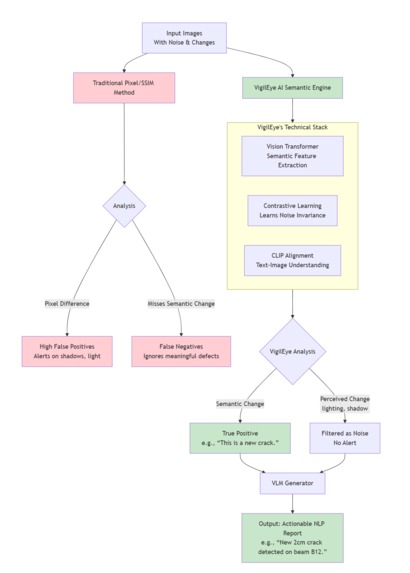
why it works
-
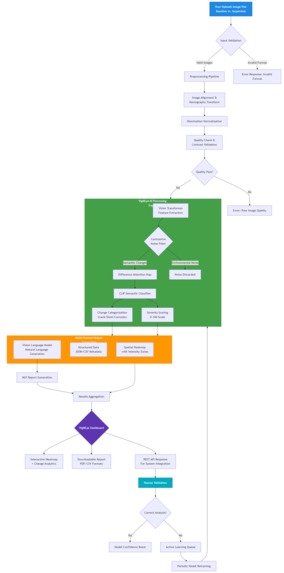
protype workflow
-
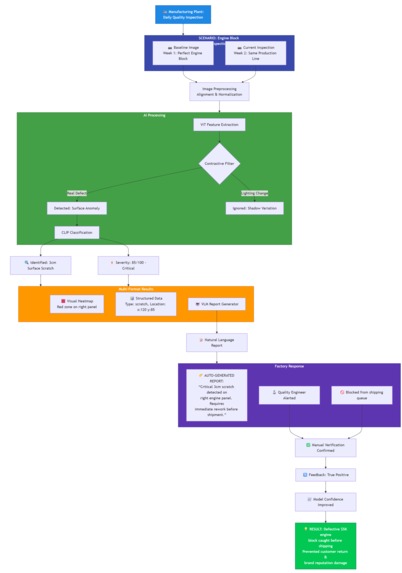
working scenario
-
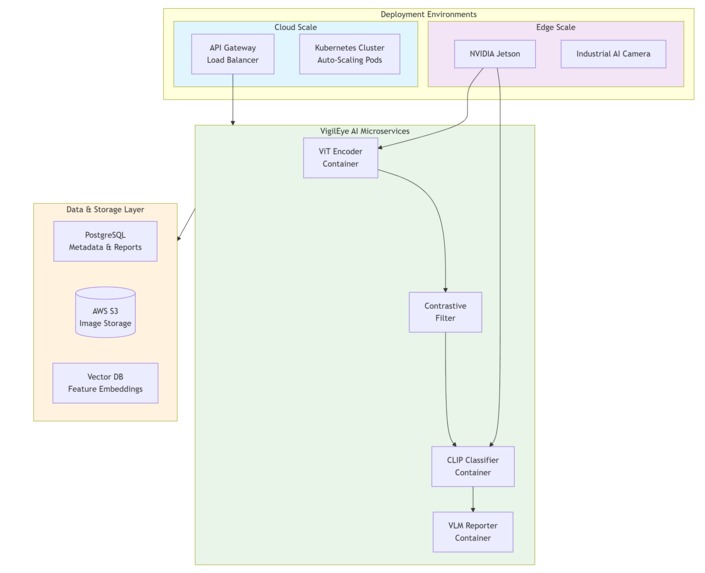
scalability
-
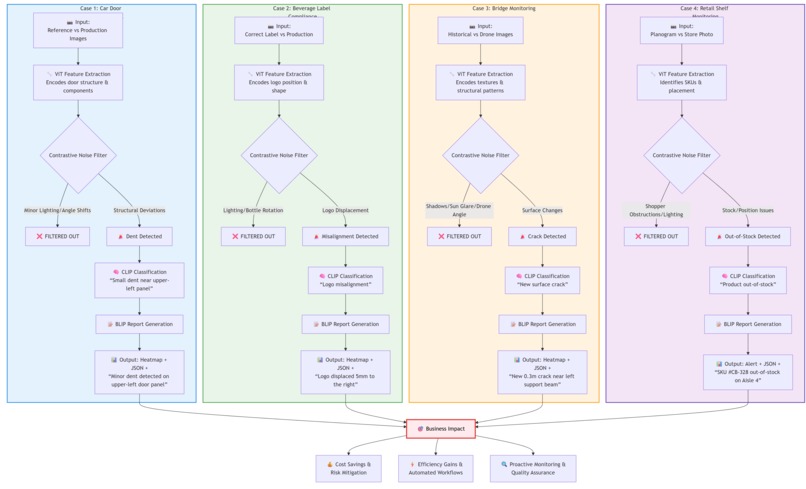
Cases


VigilEye AI – Project Story
Inspiration
We noticed that manual inspection in factories, infrastructure monitoring, and brand compliance is tedious, error-prone, and inconsistent. Inspectors often miss subtle defects or spend hours checking repetitive tasks. We wanted to create a system that not only sees changes but understands and explains them, acting as a vigilant eye for humans.
What it does
VigilEye AI detects meaningful visual changes across time-series images — like cracks, dents, or misaligned logos — while ignoring irrelevant noise such as lighting, shadows, or camera angles. It outputs:
- Annotated heatmaps showing where changes occurred.
- Semantic classification of the type and severity of the change.
- Human-readable reports explaining the detected differences in natural language.
How we built it
- Feature Extraction: Used Vision Transformers (ViT) to capture high-level image embeddings.
- Noise Robustness: Applied contrastive learning (SimCLR) to ignore irrelevant variations.
- Difference Computation: Latent-space subtraction highlights meaningful changes.
- Semantic Classification: CLIP maps differences to categories like dents, cracks, or misalignments.
- Vision-Language Reporting: BLIP / MiniGPT generate readable summaries for human inspection.
- Frontend & Dashboard: Built with React.js and Plotly.js for interactive visualization.
- Deployment: Docker, ONNX/TensorRT, and cloud/edge deployment for fast, scalable inference.
Challenges we ran into
- Data Scarcity: Labeled examples for rare defects were limited; solved with few-shot learning.
- Environmental Noise: Shadows, glare, and angles initially caused false positives. Contrastive learning improved robustness.
- Domain Diversity: Manufacturing, brand compliance, and infrastructure images required careful feature generalization.
- Compute Constraints: Large models were resource-intensive; optimized for edge inference without sacrificing accuracy.
Accomplishments that we're proud of
- Built a fully modular, end-to-end system from image input to semantic report.
- Enabled cross-domain adaptation with minimal retraining using CLIP embeddings.
- Delivered explainable outputs combining visual heatmaps and natural-language summaries.
- Achieved a robust pipeline that ignores noise, lighting changes, and viewpoint variations.
What we learned
- Semantic embeddings allow models to understand “what matters” beyond pixels.
- Contrastive pretraining is essential for noise-robust real-world inspection.
- Multimodal AI enables human-readable explanations, increasing trust and usability.
- Building scalable AI systems requires balancing model performance, deployment, and user experience.
What's next for VigilEye AI
- Multi-view and temporal analysis for video streams or drone surveys.
- Continuous learning pipelines to improve performance with new labeled data.
- Expanded domain applications such as agriculture, retail compliance, and safety inspections.
- Commercial-ready dashboards and APIs for enterprise deployment.
Built With
- amazon-web-services
- blip
- docker
- fastapi
- javascript
- kubernetes
- onnx
- opencv
- plotly
- postgresql
- python
- pytorch
- s3
- tailwind
- tensorrt

Log in or sign up for Devpost to join the conversation.