-
-
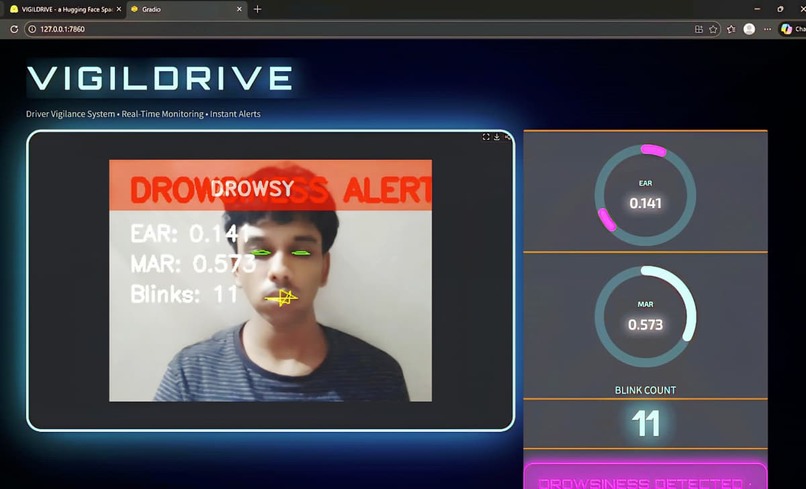
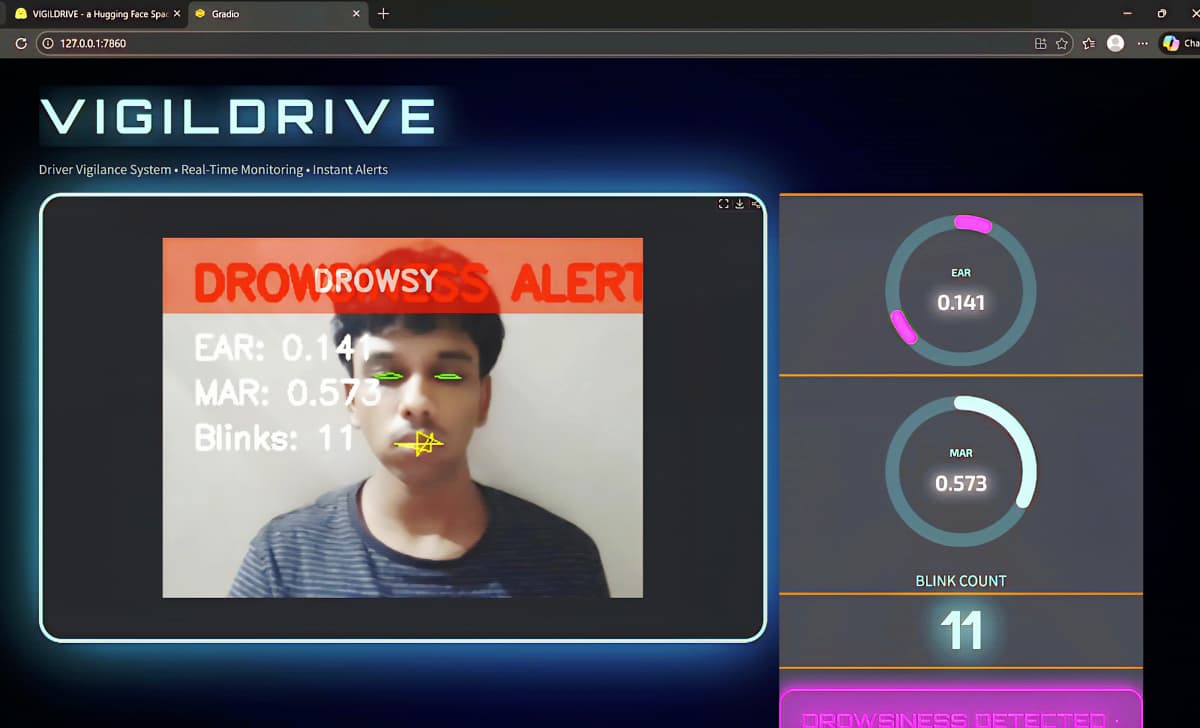
VIGILDRIVE Web Interface showing driver drowsiness detection
-
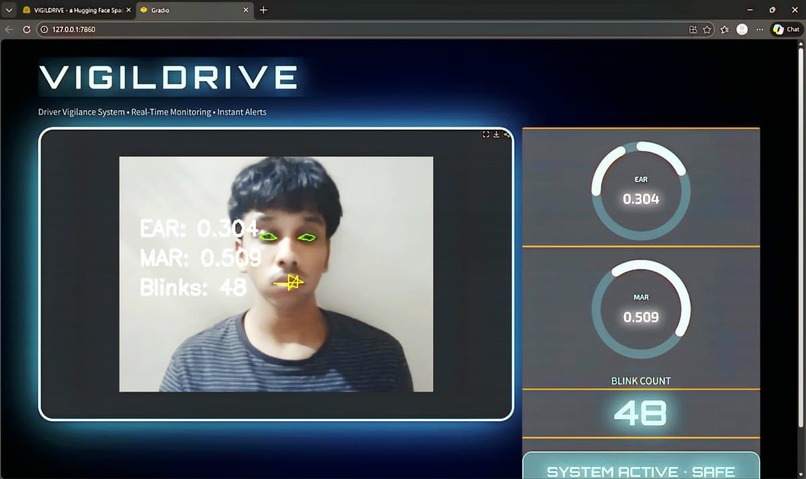
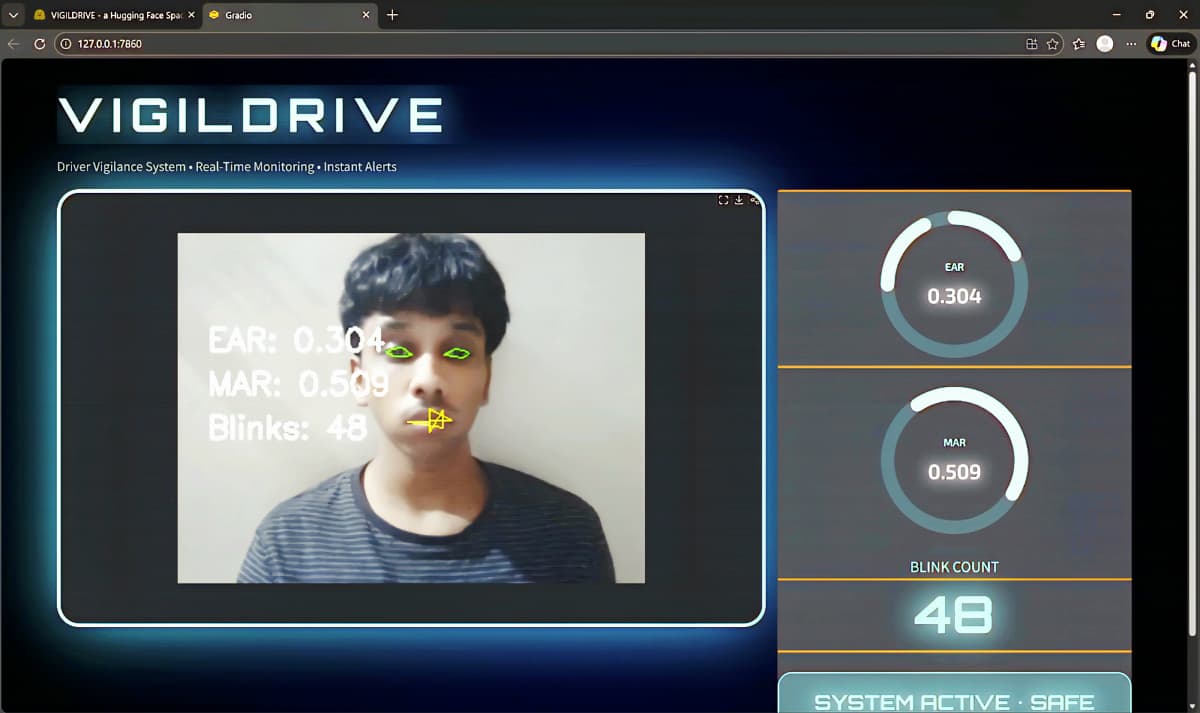
VIGILDRIVE Web Interface
Inspiration
VIGILDRIVE was motivated by what I saw happen in the world because of driver fatigue. I remember the big car accident I saw and it was really bad, My father was hit by another driver impaired by drowsiness. Seeing how drowsy the other driver was and how that led to such an accident made me think about how important it is to find ways to detect driver fatigue early on. VIGILDRIVE is about making sure people like my father are safe on the road. The accident showed me that when a driver is too tired they can cause a lot of harm and it can be very serious. VIGILDRIVE wants to help prevent accidents like the one my father was in, by making sure drivers are not too tired to drive.
In India driver fatigue is a problem that people do not talk about enough. It is one of the reasons for road accidents especially on highways when it is dark outside. The Ministry of Road Transport and Highways says that India has than 150,000 road deaths every year. This is one of the numbers in the world. Some studies by the Central Road Research Institute and the Indian Institutes of Technology show that driver fatigue and microsleep are causes of accidents when people drive long distances or drive big vehicles like trucks and buses. Driver fatigue is an issue that affects road safety in India and it is important to understand the role of driver fatigue, in these accidents.
The World Health Organization or WHO says that every year about 1.19 million people die in road accidents around the world. The National Highway Traffic Safety Administration, which is also known as NHTSA thinks that driving when you are really tired causes than 100,000 crashes every year. These crashes result in a lot of people getting hurt. Around 70,000 injuries. And a lot of people die. Than 1,500 fatalities. If you stay awake for a time like 18 to 20 hours it can really affect how quickly you react to things and how well you make decisions.
The problem of fatigue is really big. Systems that detect fatigue are usually only found in expensive cars or special vehicles used by companies. This means that most people who drive do not have access, to affordable ways to prevent accidents caused by fatigue. Fatigue detection systems are just not something that most drivers can use.
What it does
The main thing VIGILDRIVE does is to make things simple. The Project does this by doing tasks at the same time. This way the Project saves time for the people who use it.
VIGILDRIVE is a system that helps detect when a driver is getting sleepy. It uses a webcam to watch the drivers eyes and face. VIGILDRIVE looks for things, like eyes closing for a time and a lack of attention. When it sees these signs of sleepiness it sends out warnings away with lights and sounds. The goal of VIGILDRIVE is to alert the driver before they get too tired to drive. This way the driver can stay awake. Avoid accidents that might happen when they are too tired to react quickly or control the vehicle. VIGILDRIVE is always watching, so it can help the driver stay safe on the road.
How we built it
VIGILDRIVE is made with a technology stack that's open to everyone and really good, at getting things done. This technology stack is special because it is source and it helps VIGILDRIVE perform really well. The people who made VIGILDRIVE chose this technology stack because it is source and it is performance-focused which means it helps VIGILDRIVE work fast and do its job well.
1) Programming Language: Python
2) Computer Vision: OpenCV
3) Facial Landmark Detection: MediaPipe Face Mesh
4) Fatigue Detection Logic: Eye Aspect Ratio (EAR)–based analysis
5) User Interface & Demo: Gradio (web-based interface)
6) Audio Alerts: Pygame
7) Numerical Computing: NumPy, SciPy
The system looks at the driver's face, Tracks the shape of their eyes to figure out how tired they are. It does this by calculating something called the Eye Aspect Ratio using euclidean distance formula. If you have two points, \( P₁(x₁, y₁) \) and \( P₂(x₂, y₂)\), the Euclidean distance formula is is given by \(d = √[(x₂ – x₁)² + (y₂ – y₁)²]\). This is a way to measure how tired the driver's eyes are. If eyes are closed for more than half a second it probably means they are very tired.
The system uses something called MediaPipe Face Mesh to look at peoples faces and track the shape of their eyes. This works well and does not need special computer hardware to run quickly. It can even work on computers without needing extra help from special sensors or graphics cards. The Eye Aspect Ratio is used to detect when someone's tired.
What we learned
Through building VIGILDRIVE, we learned how to design a real-time computer vision system under tight time constraints, balance accuracy with performance, and tune fatigue detection thresholds for real-world conditions. The project also reinforced the importance of building safety-focused systems that are effective without being intrusive, while remaining lightweight and accessible on standard hardware.
Challenges we ran into
Developing VIGILDRIVE was tough. We had to work fast due to limited time availability. This meant we had to focus on the important things. We had to make sure VIGILDRIVE worked properly and did not stop working.
We wanted VIGILDRIVE to find things quickly.. This was hard to do. Sometimes the light was not good. The cameras were not all the quality.. The people using VIGILDRIVE were moving around. All these things made it hard for VIGILDRIVE to work correctly.
One big problem was finding the balance between being sensitive and avoiding false alarms. We wanted to make sure the alerts were useful without being annoying. The project had to be simple and work with any hardware. This was on purpose because we wanted to make it easy for people to use, not people with special equipment in their vehicles. We were trying to make it work for everyone so we did not want to rely on fancy vehicle systems. The goal of the project was to make it accessible to many people, as possible.
Accomplishments that we're proud of
We are proud that VIGILDRIVE is about stopping bad things from happening in the first place. It does this by using a camera and some smart software. This shows that computer vision systems can actually make a difference when it comes to keeping our roads safe. In places where a lot of accidents happen and people do not have access to the latest safety features, in their vehicles. The main goal of VIGILDRIVE is to help people drive safely by giving them another way to stay aware of what is going on around them. This can really help cut down on accidents that happen because someone is too tired to drive. VIGILDRIVE wants to help people who drive to be more careful and avoid accidents that could have been prevented.
What's next for VIGILDRIVE
The future of VIGILDRIVE could be really cool. VIGILDRIVE might be used on devices like Raspberry Pi or NVIDIA Jetson. It could even work on tiny computers that are made just for this job.
If we do this VIGILDRIVE can be a box that works all by itself. We can put this box on the car dashboard or near the steering wheel, using technologies like TinyML through embedded systems. It will not be, in the way of the driver's vision nor will it obstruct or distract the driver in any way . VIGILDRIVE will just do its thing.
Some other things that could be added to make it better are:
1) Integration of infrared or low-light cameras for nighttime robustness
2) Detecting fatigue is really important. We can do this by looking at how our eyes behave and the position of our head. So we are talking about fatigue detection that uses different methods, like eye behavior and head pose analysis. This is what we mean, by modal fatigue detection, which combines eye behavior with head pose analysis.
3) On-device optimization for reduced power consumption
4) Development of non-intrusive alert mechanisms (audio, haptic, or peripheral visual cues) designed to avoid obstructing the driver’s vision
These improvements will make it possible for the system to be used in the world. This is a thing because the people who are driving will still be comfortable and safe when they use the system. The driver comfort and safety of the system are very important. These improvements will help to make sure that the driver comfort and safety are maintained.
References
1) Ministry of Road Transport and Highways (MoRTH), Government of India — Road Accidents in India
2) World Health Organization (WHO) — Global Status Report on Road Safety
3) National Highway Traffic Safety Administration (NHTSA) — Drowsy Driving Statistics
4) Soukupová, T., & Čech, J. (2016). Real-Time Eye Blink Detection Using Facial Landmarks


Log in or sign up for Devpost to join the conversation.