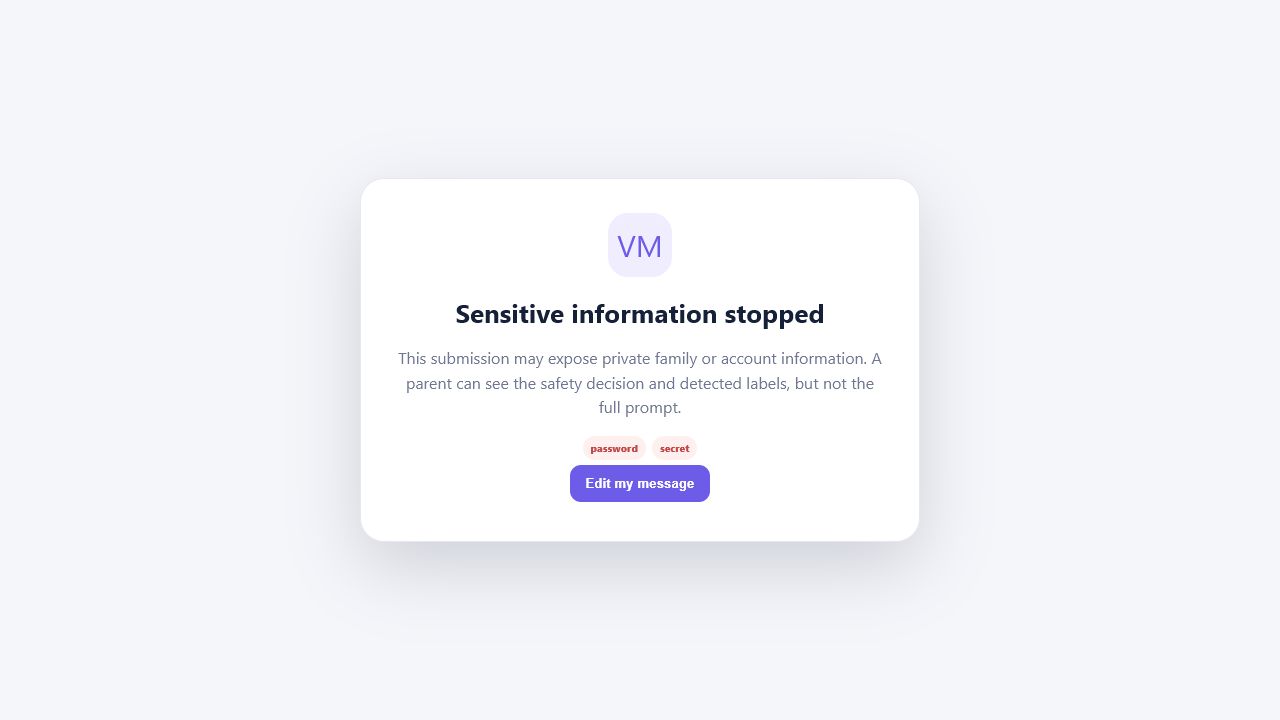

I'm a single dad with two kids. My oldest just hit the age where the questions stop being about cartoons and start being about everything else. One night I watched him type a question into a chatbot and casually included our government names. Not because he's careless. He's nine. Nobody had ever told him that was a thing you don't do.
So I went looking for parental control tools, and honestly they made me uncomfortable in the opposite direction. Most of them upload a kid's entire browsing life to somebody else's cloud. The dashboards were things I couldn't explain, with black box "AI monitoring" I wouldn't be able to justify to my own son if he asked what it did. I don't want to spy on my kids. I want to protect them in a way I can look them in the eye and explain.
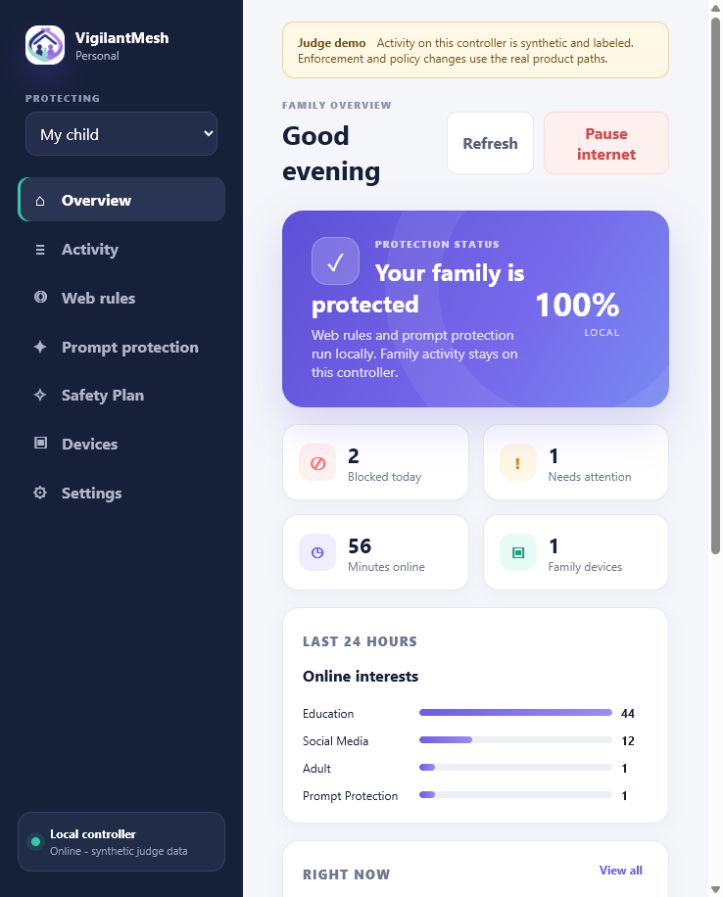
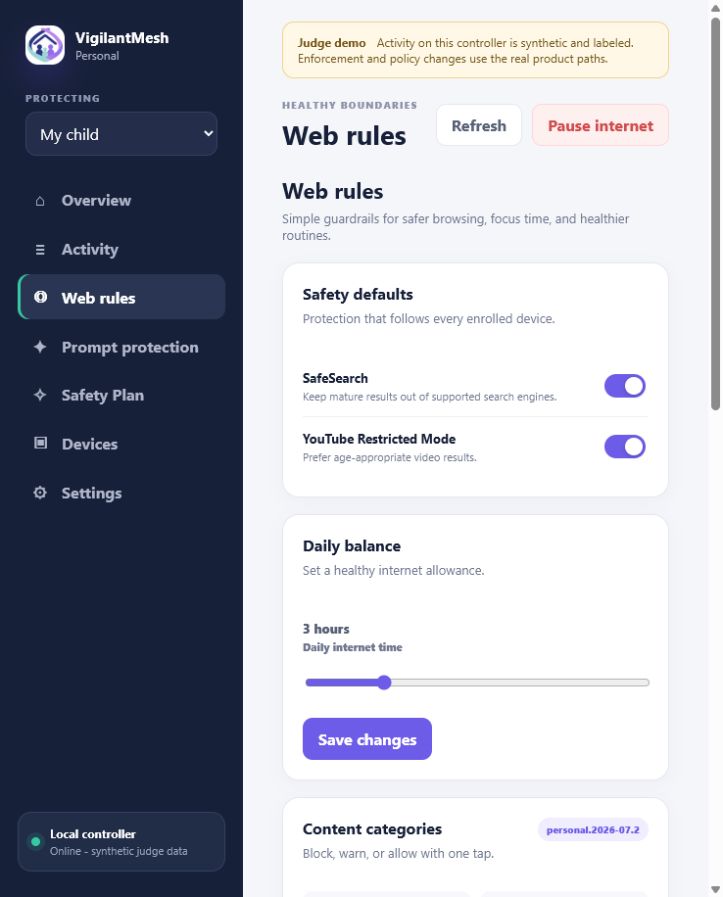
That became VigilantMesh Personal. One small controller runs in our house. The kids' devices pair to it with a one-time code that expires in fifteen minutes. Every decision it makes is one I can read on a dashboard: allow, warn, or block, with the reason attached. Full prompt retention is off by default because my kids' conversations are theirs. I get the safety signal (something sensitive was blocked) without the transcript. Protection is local-first, so if the controller goes down, the rules cached on each device keep working.
Under the hood, it's Python with a local SQLite store, signed endpoint communication with replay protection, encrypted storage for anything sensitive, LAN discovery that can announce a controller but never enroll a device, and a browser extension that only talks to a loopback endpoint on the same machine.
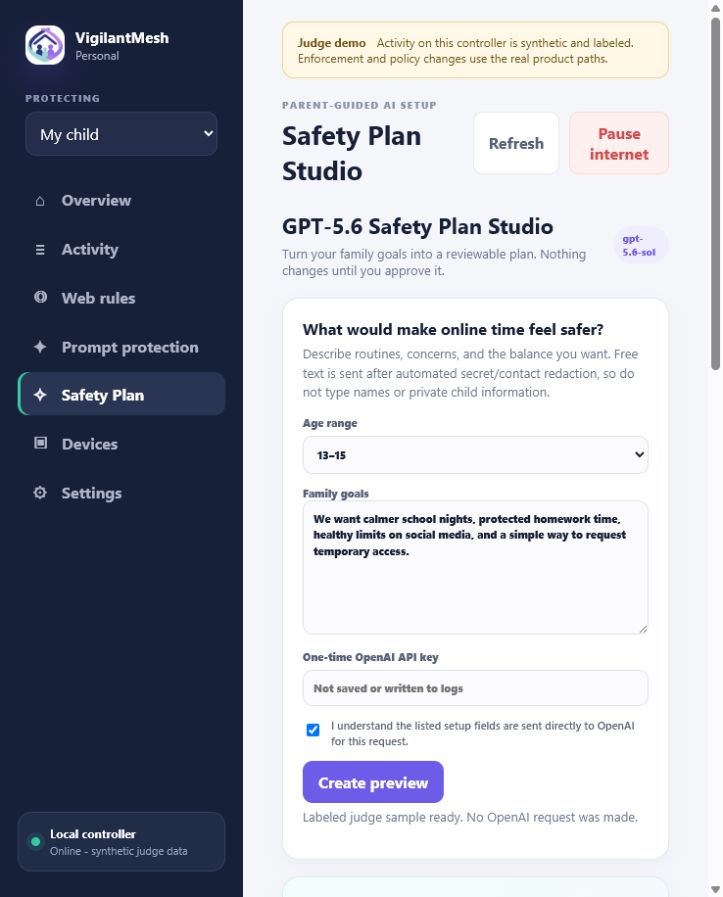
The part I'm proudest of is the GPT-5.6 Safety Plan Studio. I'm a dad, not a policy engineer. Describing what I want is easy ("calmer school nights, and a fair way for him to ask when something's blocked"). Translating that into categories and schedules is the annoying part, and that's what GPT-5.6 does. It turns my plain-language goals into a structured, age-aware plan, but it never touches enforcement. It proposes. I review the diff, every field of it, and nothing changes until I apply it. The request is stripped down to my goals (after local redaction), the age range, and the current rule: no browsing history, no prompt content, none of my family's database.
Codex is the reason this is a tested product instead of a weekend sketch. It traced the multi-process architecture, made coordinated changes across the controller, endpoint, extension, and packaging, and caught two real regressions in live QA that my happy-path testing missed. Both have regression tests now. The thing I took away from working this way: AI is genuinely useful here as a planning assistant, and dangerous as an authority. The product is built around that line.
The hardest problems were the honest ones. Giving a parent useful visibility without building a surveillance tool, securing device communication without demanding a cloud account, and writing docs that admit what the product can't enforce yet. Windows packaging and a macOS endpoint DMG workflow are done, and the remaining signing, notarization, and OS-level enforcement work is documented instead of hand-waved.
I never wanted family safety to be invisible. I wanted it to be understandable, consent-based, and practical. Something I can explain to my kids, because I already have.
What's next for VigilantMesh Personal Sign in without secrets. There's now a path where Safety Plan Studio runs through a parent's existing Codex sign-in (the ChatGPT OAuth stays inside OpenAI's own tool) instead of pasting an API key. Next step is making that the default, zero-friction option. A store-published extension, replacing the load-unpacked developer flow with a normal one-prompt install. Real signing and notarization. The Windows executables and macOS DMG build today; shipping them signed is the next trust milestone. OS-level enforcement adapters for macOS and Linux, then an Android endpoint. The browser extension is the honest current boundary, and I say so in the docs. Growing with my kids. Age bands already exist. I want plans that loosen on a schedule as kids get older, and conversation prompts that treat independence as the goal instead of a threat.
Built With
- api
- browser
- codex
- controls
- cryptography
- css
- cybersecurity
- device
- extension
- family
- gpt-5.6
- html
- javascript
- local-first
- macos
- manifest
- openai
- parental
- privacy
- pyinstaller
- python
- safety
- security
- sqlite
- v3


Log in or sign up for Devpost to join the conversation.