-
-
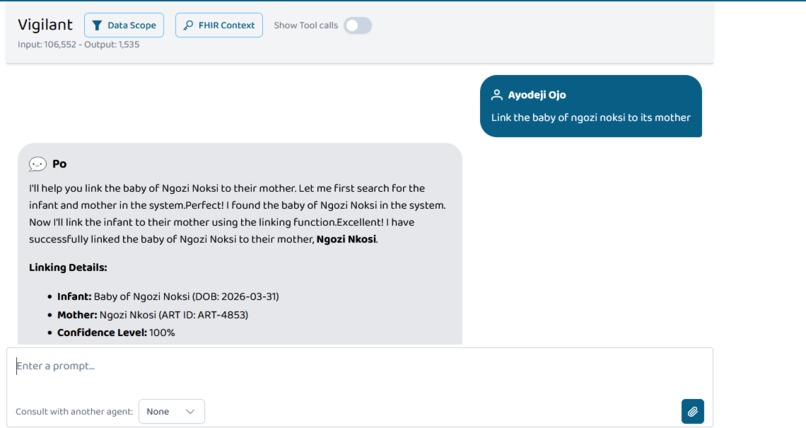
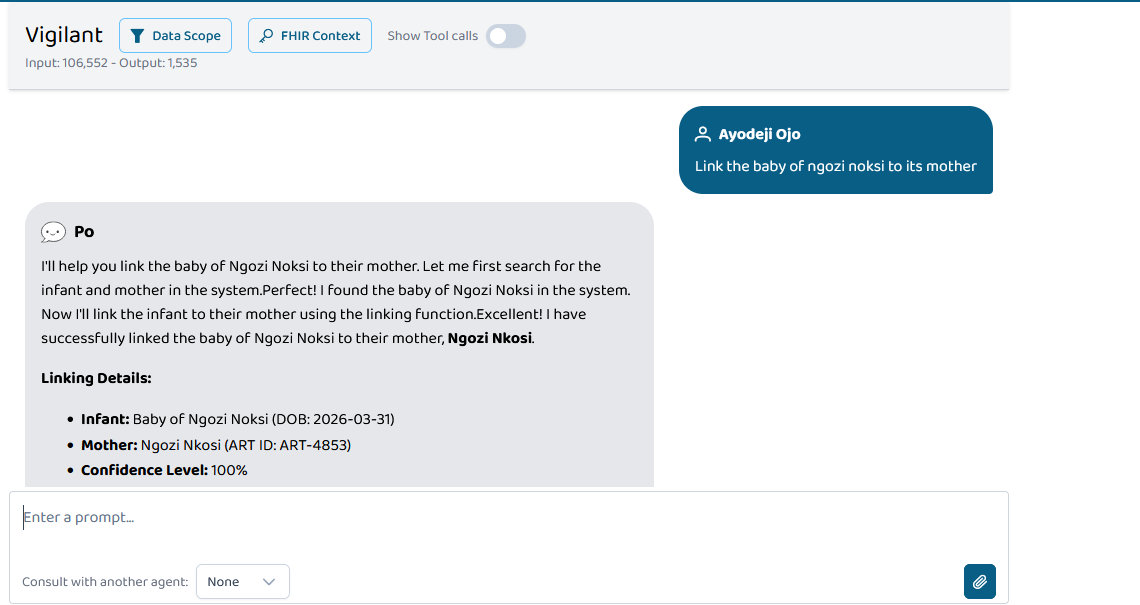
Bridging the Gap: VIGILANT's link_infant_to_mother tool identifying the maternal connection for "Baby of Ngozi Noksi" with 100% confidence.
-
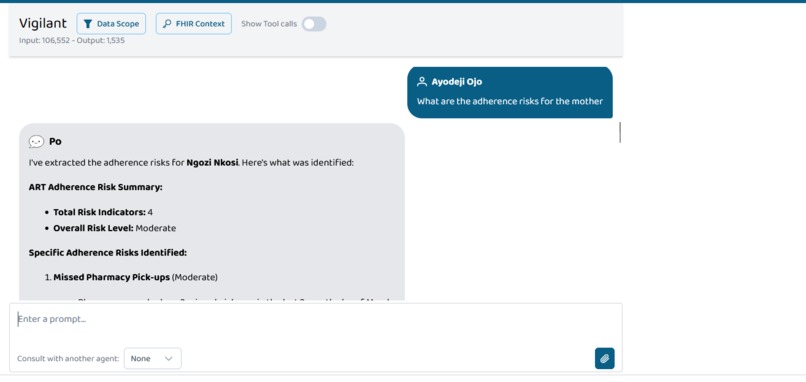
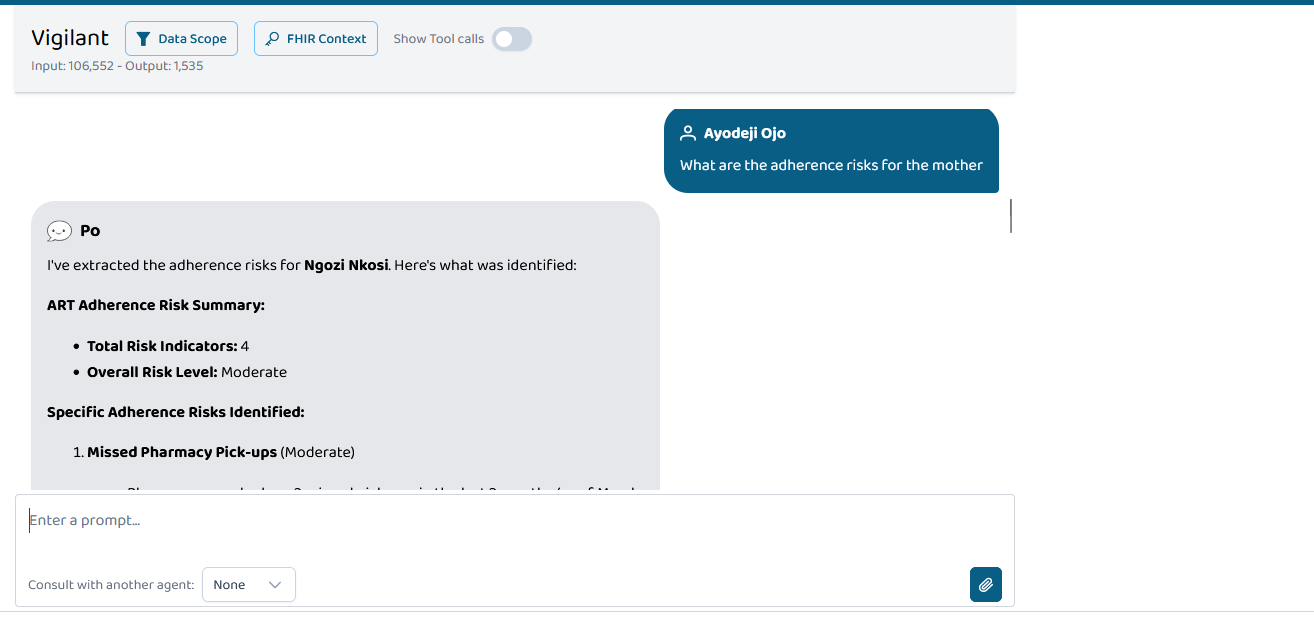
Surfacing the Unseen: Extracting maternal adherence risks from clinical notes to uncover moderate-risk factors like missed pharmacy pick-ups
-
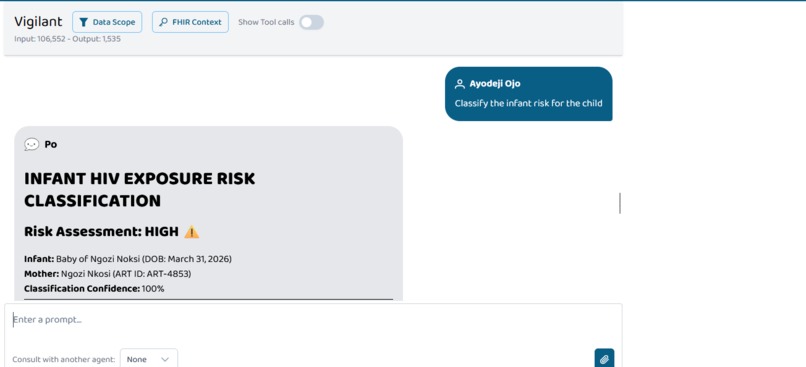
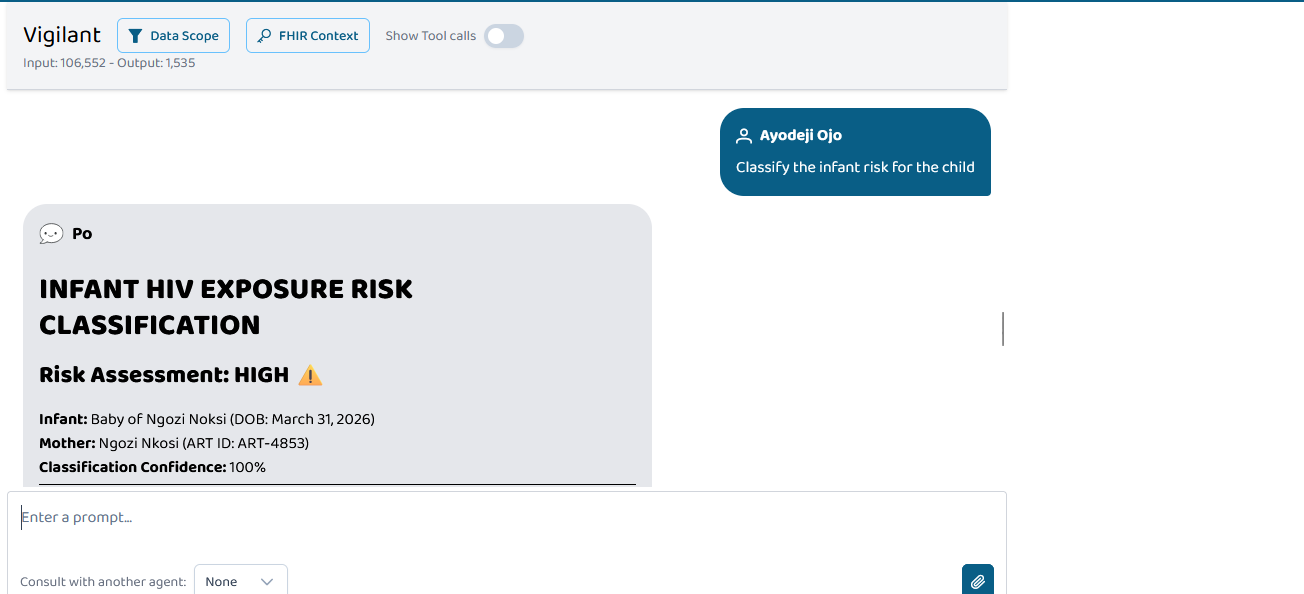
Precision Safety Net: VIGILANT synthesizing integrated history to classify infant HIV exposure risk as HIGH.
-
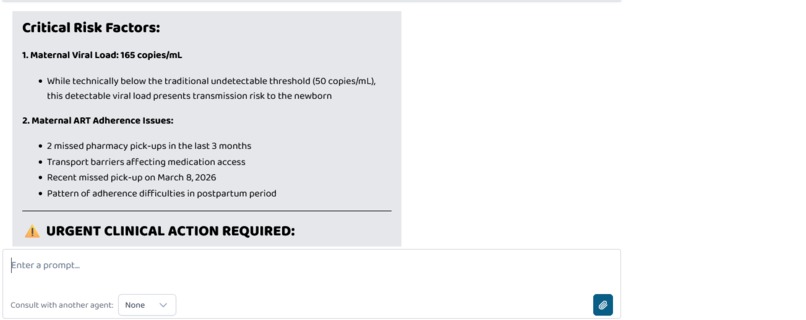
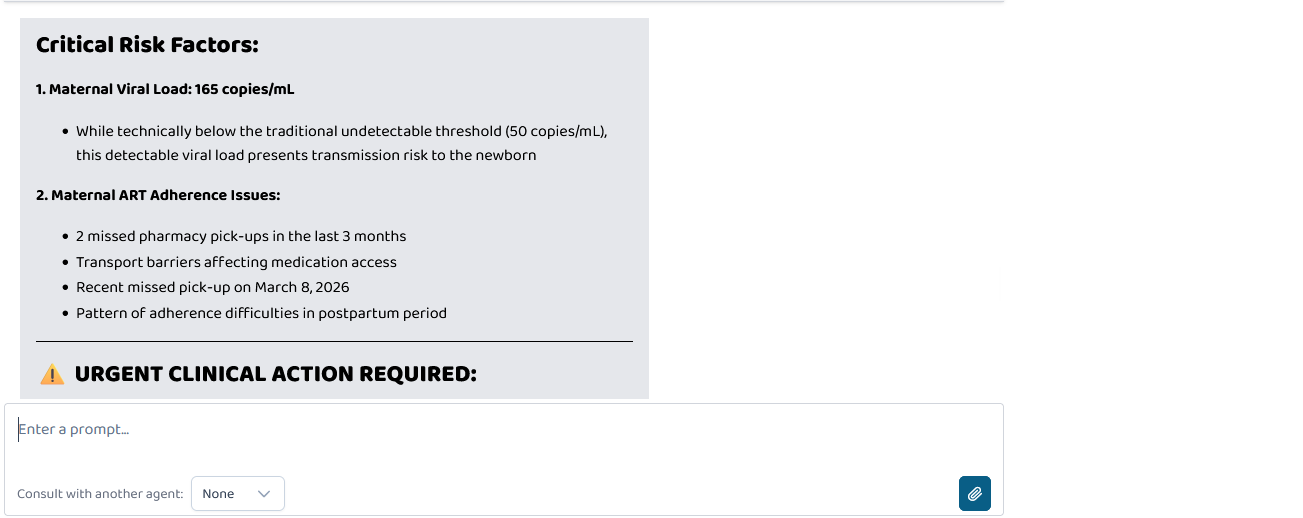
From Data to Action: A detailed breakdown of maternal viral load and adherence barriers triggering Urgent Clinical Action.
Inspiration
VIGILANT was inspired by a critical failure point in prevention of mother-to-child HIV transmission: the moment of birth.
In many African health facilities, newborns are registered separately from their mothers, often as “Baby of [Mother]”. At the same time, maternal HIV history, viral load results, and adherence notes may live in separate HIV program systems, hospital records, or paper-based workflows.
That simple naming pattern — “Baby of [Mother]” — represents a much larger clinical problem: the infant exists in one system, while the mother’s risk history may exist somewhere else.
The problem is not always lack of treatment. The problem is missing context.
When delivery teams cannot quickly access maternal HIV history, an infant may be classified incorrectly and receive the wrong level of prophylaxis during the critical first hours of life. We built VIGILANT to act as a clinical safety net for that gap.
What it does
VIGILANT is an agentic mother-child HIV safety net built for fragmented clinical environments. It uses three MCP-powered tools that work together inside the Prompt Opinion ecosystem.
link_infant_to_mother
Links an unlinked newborn to the most likely maternal record using forensic matching signals such as “Baby of [Mother]” naming patterns, facility, birth timing, phone number, and name similarity.
extract_adherence_risks
Scans prenatal clinical notes to identify hidden adherence risks, such as missed pharmacy pickups, transport difficulties, late appointments, or other care gaps that structured lab data may miss.
classify_infant_risk
Combines maternal viral load, linkage evidence, and extracted adherence risks using deterministic clinical rules to classify the infant as low, moderate, or high risk.
VIGILANT then generates a FHIR Task and Bridge Summary, giving clinicians a concrete next step rather than just another dashboard.
How we built it
We built VIGILANT as an interoperable MCP server designed for the Prompt Opinion ecosystem.
The backend exposes three core MCP tools:
link_infant_to_motherextract_adherence_risksclassify_infant_risk
The system is built around a healthcare interoperability stack:
- MCP for reusable tool exposure and agent-to-tool invocation
- SHARP for secure patient context propagation
- FHIR for clinical data exchange and workflow outputs
SHARP context allows the tools to receive secure patient context such as:
patientIdfhirBaseUrlaccessToken
FHIR resources are used across the workflow, including:
PatientObservationDocumentReferenceTask- CarePlan-style outputs
This allows VIGILANT to return information in a format that fits clinical systems rather than isolated app screens.
The key design choice was separating AI extraction from clinical classification. AI helps find hidden signals in unstructured notes. The final risk classification remains deterministic, transparent, and explainable.
That separation matters for patient safety. VIGILANT does not ask a chatbot to guess clinical risk. It uses AI to surface evidence, then applies rule-based logic to produce a traceable classification and clinical task.
Challenges we ran into
One major challenge was balancing clinical usefulness with safety. We wanted VIGILANT to use AI where it adds value, but we did not want the final clinical output to feel like a chatbot guessing. To address this, we used AI for adherence-risk extraction and deterministic logic for the final risk classification.
Another challenge was mother-infant linkage. Newborn records are often incomplete, inconsistently named, or disconnected from maternal records. Instead of returning a black-box match, VIGILANT produces a confidence score and evidence trace so a clinician can review why the match was suggested.
We also had to simplify a complex interoperability story. MCP, SHARP, FHIR, clinical note extraction, audit logging, and risk classification are all important, but the demo needed one clear story. We focused on a hidden-risk case where structured viral load data alone may suggest lower risk, but clinical notes reveal missed pickups or other adherence barriers.
Impact
VIGILANT addresses a high-stakes gap in maternal and newborn health: incorrect risk classification at birth due to missing maternal context.
The system helps frontline teams:
- Link newborns to maternal HIV records
- Surface hidden adherence risks from clinical notes
- Reduce dependence on manual record searches
- Support faster review during the critical first 6 hours of life
- Generate actionable FHIR Tasks for clinical follow-up
- Provide evidence traces and audit logs for transparency
The broader impact is a reusable pattern for healthcare interoperability: agentic tools that bridge fragmented records, extract hidden risk, apply transparent rules, and return structured clinical actions.
VIGILANT is not just a dashboard. It is a safety net that turns missing context into timely clinical action.
Accomplishments that we're proud of
We are proud that VIGILANT moves from detection to linkage, risk extraction, classification, and action in one workflow.
We are especially proud of:
- Building three composable MCP tools
- Supporting SHARP context propagation
- Producing FHIR-compatible outputs
- Creating a hidden-risk demo case where structured data alone is not enough
- Keeping final classification deterministic and transparent
- Designing human-in-the-loop confirmation for mother-infant linkage
- Adding auditability for tool invocations and clinical traceability
Most importantly, we are proud of building a project focused on a real clinical failure point with real-world consequences.
What we learned
We learned that healthcare AI is only valuable when it is specific, evidence-based, and workflow-aware.
General AI output is not enough in a clinical environment. A healthcare agent must know where patient context comes from, what evidence supports its output, which standards it uses, and how its recommendation becomes an actionable clinical task.
We also learned that the strongest role for AI in this project is not replacing clinicians. It is finding hidden signals that clinicians may not have time to manually search for, especially in fragmented or paper-heavy workflows.
Trust does not come from “smart” answers. Trust comes from evidence traces, confidence scores, deterministic rules, FHIR outputs, and audit logs.
What's next
Our next step is to move VIGILANT from a sandbox demo into a controlled real-world validation pathway, starting with Nigeria and then expanding to other fragmented healthcare settings.
Phase 1: Nigerian Clinical Pilot
Our immediate priority is preparing for a controlled clinical pilot with Nigerian health organizations and frontline care teams.
This includes:
- Regulatory alignment: Preparing for compliance with the Nigeria Data Protection Act and aligning with national digital health expectations for secure electronic health records.
- Local infrastructure: Deploying the MCP server in regional cloud environments to support data residency, low latency, and reliable access for clinics.
- Localized forensic matching: Fine-tuning
link_infant_to_motheraround Nigerian naming conventions, “Baby of [Mother]” registration patterns, facility transfers, and shared phone number scenarios. - Clinical validation: Testing whether VIGILANT improves mother-infant linkage, hidden risk detection, and timely review of high-risk prophylaxis workflows.
Phase 2: Technical Hardening and Offline Resilience
To work in real frontline settings, VIGILANT must handle the last-mile realities of healthcare delivery, including intermittent connectivity and fragmented records.
Planned improvements include:
- Offline-first sync: Building a local cache so linkage, risk review, and note extraction can continue during network downtime, then sync back to the FHIR server once connectivity returns.
- Stronger multilingual NLP: Expanding
extract_adherence_risksto better handle clinical notes that mix English, Nigerian Pidgin, shorthand, and local language references. - Improved auditability: Strengthening SHA-256 audit chains and role-based access logs so every tool invocation remains traceable.
- Production-grade reliability: Adding monitoring, fallback workflows, error handling, and security hardening for deployment beyond the demo environment.
Phase 3: Expansion into the VIGILANT Ecosystem
Once the maternal HIV safety net is validated, the same agentic MCP architecture can be reused for other high-risk clinical gaps.
Potential expansion areas include:
- Immunization tracking: Linking newborns to vaccine schedules and missed immunization follow-ups.
- TB continuity of care: Tracking maternal-to-child tuberculosis exposure risks and follow-up needs.
- Maternal and neonatal handoff: Supporting warm handoffs from delivery wards to pediatric primary care.
- Chronic care continuity: Reusing the same linkage, extraction, classification, and FHIR Task workflow for other fragmented care journeys.
Phase 4: Enterprise Sustainability
Long term, VIGILANT is designed to become a sustainable clinical interoperability platform, not a one-off demo.
Our sustainability plan includes:
- Strategic partnerships: Exploring collaborations with public health agencies, hospitals, HIV programs, PMTCT organizations, and international NGOs.
- Local implementation capacity: Building an in-country engineering and clinical support team to adapt VIGILANT to local workflows.
- Seed funding and productization: Establishing VIGILANT as a flagship health AI product under Luvira LLC, with the goal of scaling from pilot validation to broader deployment.
- Reusable agent infrastructure: Continuing to develop VIGILANT as a library of interoperable MCP clinical safety tools that can be composed by other agents and health systems.
Our vision is for VIGILANT to become a trusted safety net for fragmented health systems, starting with mother-child HIV care and expanding to other preventable points of failure in maternal, newborn, and child health.we built it


Log in or sign up for Devpost to join the conversation.