Inspiration
My main motivation to build this application was to learn and discover how to integrate Atlas Search and MongoDB into applications using SDKs and frameworks,study the operation of Google Cloud Video Intelligence,learn Golang. The increasing demand for effective video content discovery and the developments in machine learning and video analysis technologies served as the impetus for the creation of Clipster. Finding specific information within films has grown to be a time-consuming and difficult endeavour due to the exponential growth of video content that is available online. Traditional manual ways of discovering video information frequently entail watching through extensive videos or depending on labor-intensive, time-consuming manual annotations.
By utilising the capabilities of the Google Cloud Video Intelligence API, Clipster seeks to solve this issue. Clipster was created with the intention of giving consumers access to a strong tool that can automatically analyse and extract useful features from films. Users of Clipster can easily search for specific material within videos by using machine learning techniques.
What it does
This application was created utilising the Golang programming language.All of the videos that have been posted to the application may be searched for video content.To find the features (information) in the video, it makes use of the Google Cloud Video Intelligence API. By utilising the features of the Google Cloud Video Intelligence API, Clipster is an application that focuses on improving video content discovery. Its primary function is to examine and extract useful information from submitted videos so that viewers may quickly and precisely search for specific material within those films. Clipster uses cutting-edge machine learning algorithms to automatically scan and comprehend the visual and aural content of videos by connecting with the Google Cloud Video Intelligence API. Scene detection, object recognition, and word detection are just a few of the potent features that Clipster may take advantage of thanks to the API. With the use of these technologies, Clipster can extract valuable information from videos, facilitating users' searches for particular items, situations, or text within the video stream.
How we built it
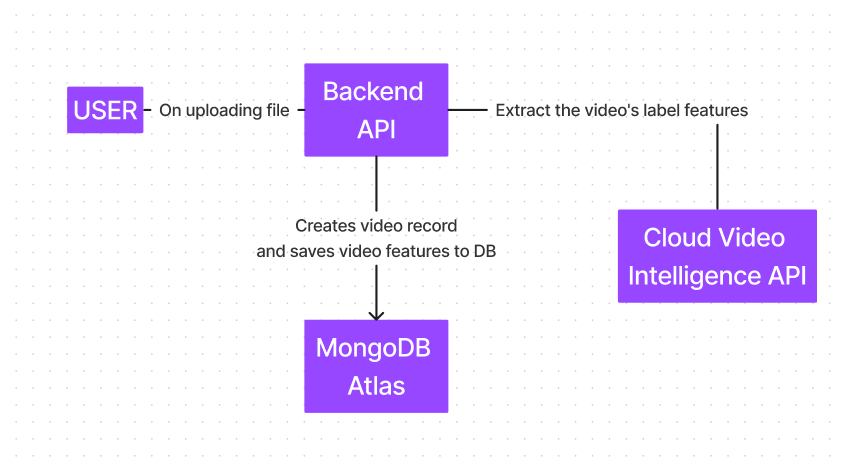
I began my project by creating a Golang API server. I selected the Gin framework to create the HTTP library since it has an easy-to-use interface for creating RESTful APIs. Our API allows users to submit videos. The Google Storage Bucket is then used by our API to upload it. The MongoDB database adds the uploaded file as a record so that we may later refer to it. We record the name, size, and unique UUID of the video file so that we can retrieve the private object later. To retrieve the video features, a file can be sent to the Google Video Intelligence API. In order for Atlas search to index the retrieved features, they are saved to the associated video entity in the MongoDB database.
Challenges we ran into
MongoDB Atlas was a new platform for me, so I had to learn how to use it effectively. I also had some issues with connection errors, which were eventually resolved. Additionally,I had to scale our infrastructure to handle the increased traffic. API Authentication: One challenge was setting up the authentication process to securely communicate with the Google Cloud Video Intelligence API. Handling Large Video Files: Working with large video files can be resource-intensive and may cause performance issues. Optimizing Search Performance: Efficiently searching through a large collection of videos and extracting relevant features required optimization techniques.
Accomplishments that we're proud of
I think it's great that using Golang for this project.Golang is a powerful language that is well-suited for building web applications. I am also proud of using Google Cloud Video Intelligence API. This API is very powerful and can be used to extract a lot of information from videos. I implemented efficient file handling techniques, such as using streaming techniques or optimizing memory management, to ensure smooth processing of video files of varying sizes. I optimized the search functionality by implementing indexing strategies, caching mechanisms, or leveraging database technologies like MongoDB Atlas Search to improve search performance.
What we learned
I gained knowledge about how to operate Google Cloud Video Intelligence, integrate Atlas Search and MongoDB into apps utilising SDKs and frameworks, and master Golang. Learning in-depth video analysis methods including scene detection, object recognition, and text detection was necessary for creating Clipster. To efficiently extract useful information from videos, it was necessary to investigate several algorithms and approaches. Working with the Google Cloud Video Intelligence API taught me how to incorporate third-party APIs into apps efficiently. Key elements of the integration process were comprehending the API documentation, processing API requests and responses, and optimising API utilisation.
What's next for Clipster
-Continue scaling your infrastructure to handle even more traffic. -Add new features to Clipster, such as the ability to search for clips by keyword. -Make Clipster more accessible to users around the world by translating it into other languages

Log in or sign up for Devpost to join the conversation.