Inspiration
Our project started from the Sperry challenge prompt, but its most distinctive feature came from something close to home for our teammate Alex. Near his hometown, a local elementary school spent more than two years building a new community center, and Florida’s unpredictable weather kept delaying it. The crew wasn’t from the area, so they couldn’t get accurate local weather data or see hazards coming ahead of time. That story inspired the center of Vigil, a map that shows what the weather is doing near each work site.
What it does
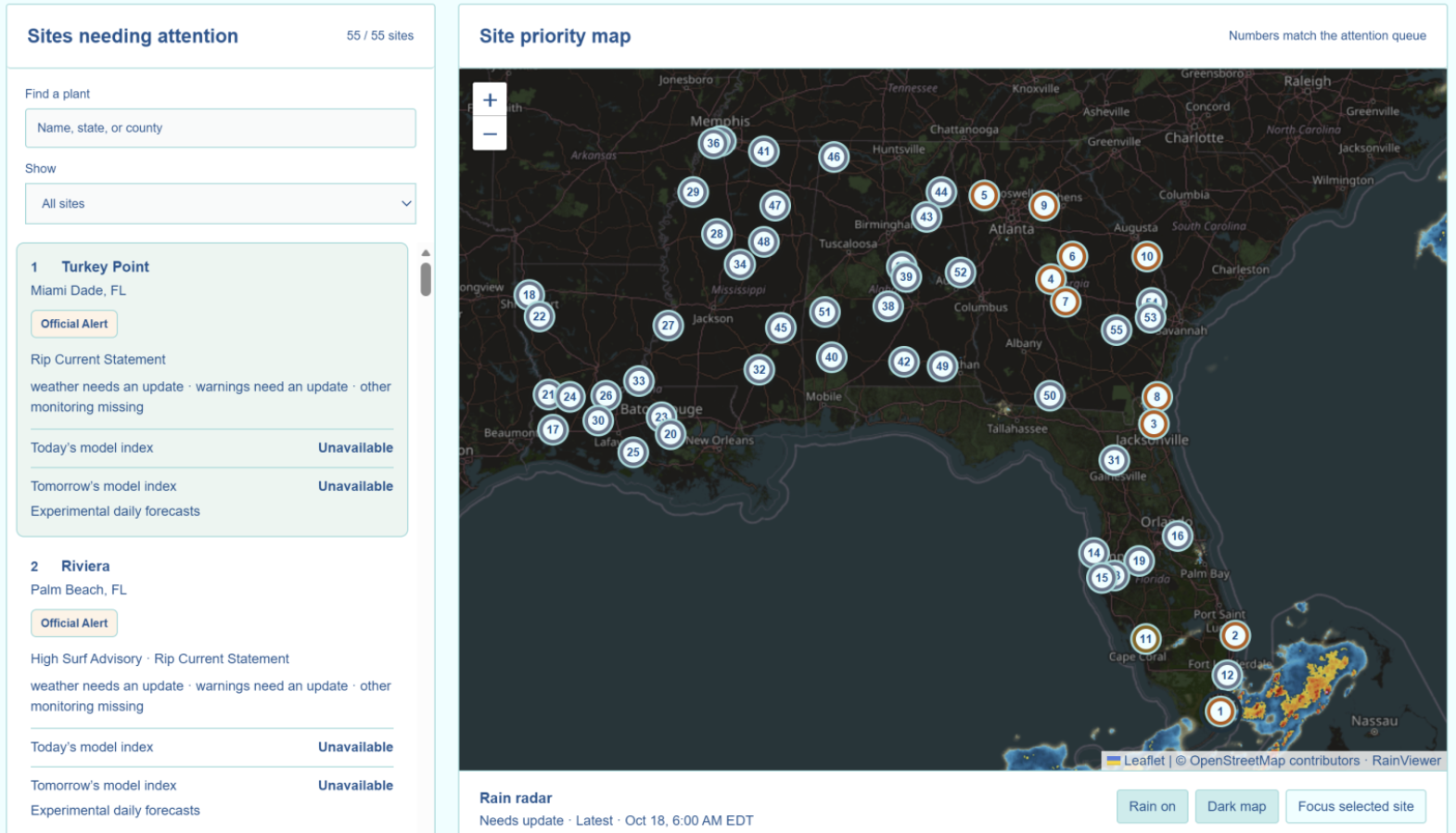
Vigil is a website that keeps track of work sites, along with environmental conditions, nearby hazards, and historical data, to help keep workers safe. It covers 55 real power plants across Florida, Georgia, Alabama, Mississippi, and Louisiana on a map where each numbered pin is colored by how much attention the site needs, with a rain radar layer you can scrub through time. Official National Weather Service warnings and lightning holds are ranked first, a strike within 10 miles starts a 30-minute stop-work hold, and crews can submit photo hazard reports with a map pin. A background worker is set to save tomorrow’s report to each site’s inbox at 6 PM local time, alongside an experimental risk score from a model trained on NOAA storm reports. Vigil also tracks hazards and monitoring coverage separately, so a missing data source shows as unknown, never as safe.
How we built it
We built Vigil around AI coding agents. Each of us owned one part of the project (backend, lightning and reports, machine learning, or frontend) and worked with our own assistant under shared instructions, a shared API contract, and clear file ownership. Once the pieces were merged, we moved to one computer and one coding agent so there were no more merges. A single background worker pulls public data from the EIA, Open-Meteo, the National Weather Service, USGS, and NOAA into a Tiger Data database. The dashboard reads that saved data, so it can show when each piece of information was last updated and when a source has failed.
Challenges we ran into
Our biggest challenge was Git and GitHub. Early on, several of us were editing shared files at the same time, and when our branches came together we hit merge conflicts, which none of us had resolved before. We learned to read the conflict markers, work out what each side intended, and keep everyone’s work. The second challenge was the learning curve of working with agents we had never used. Their output is dense and technical, and understanding what they were asking us took time, so we had to become fluent in reading their diffs, questions, and test results.
Accomplishments that we're proud of
We’re proud of a map that makes weather readable at a glance, which is the idea the whole project grew from. We’re also proud of a backend that runs smoothly and updates the frontend properly, with fresh data and live countdowns. We managed several AI agents we had never worked with before and turned them into one working process. Along the way we also became much more comfortable with terminals, VS Code, and Git.
What we learned
The biggest return from this project was learning how to work with AI agents. We started as first-time hackers who had never built something this large. By the end we understood how to divide work between agents, give them clear instructions, review what they produce, and verify it before trusting it. We went from beginners to a team that could run a real workflow between AI agents and human teammates, and that skill is what we’ll carry forward.
What's next for Vigil
Right now Vigil covers 55 locations, and we want to bring it to many more places and extend the reach of the Sperry brand. We’ll keep refining the system until it is a reliable, production-ready website with minimal bugs. We also plan to analyze the data we collect in more detail, improve the interface based on real user feedback, and connect a verified live lightning feed.

Log in or sign up for Devpost to join the conversation.