Inspiration
This project was inspired by a real operational challenge in my parents' restaurant.
Business CCTV systems generate enormous amounts of video every day, but extracting useful operational insights still requires manual review. Simple questions—such as whether a customer approached the counter, how busy an entrance was, or whether an interaction may have occurred—often require someone to manually review long recordings.
Most vision models produce generic image captions. While useful, they rarely answer business-specific questions such as whether a counter appears occupied, whether a possible customer interaction occurred, or what evidence supports those observations.
VIGI Vision was created to explore whether recent multimodal AI models can transform CCTV footage into structured, explainable business intelligence while explicitly communicating uncertainty and avoiding unsupported conclusions.
What it does
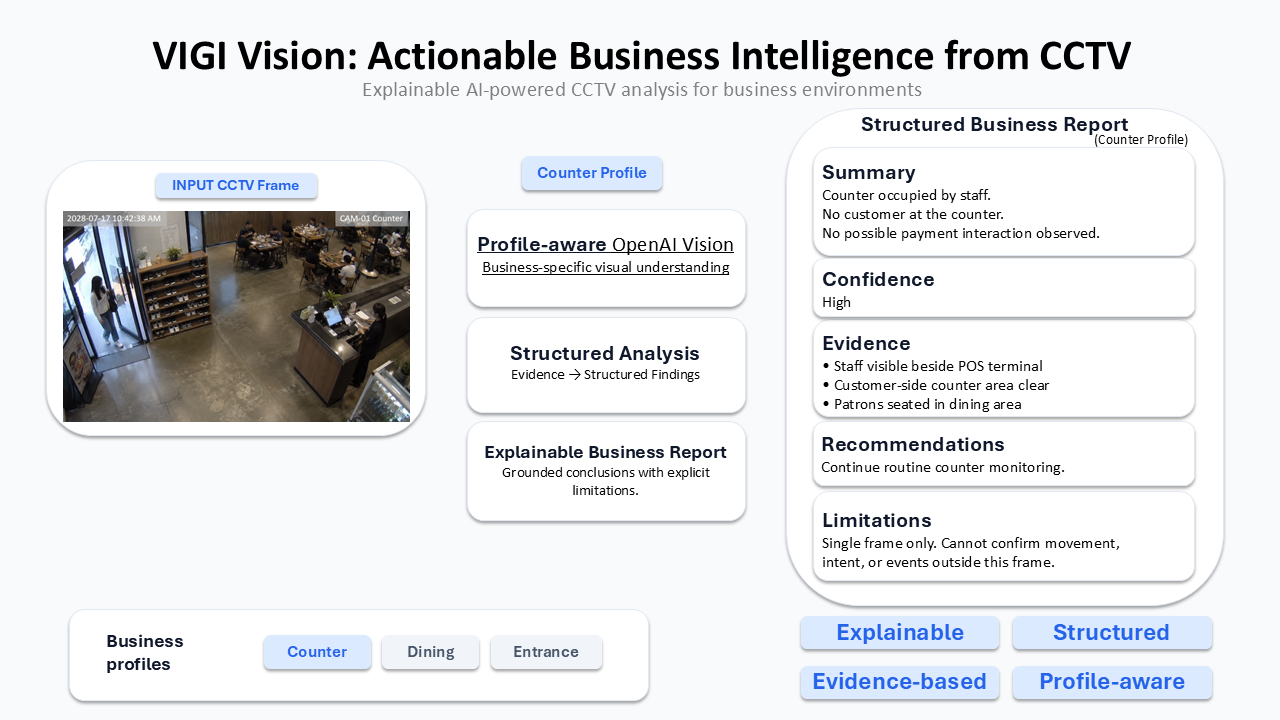
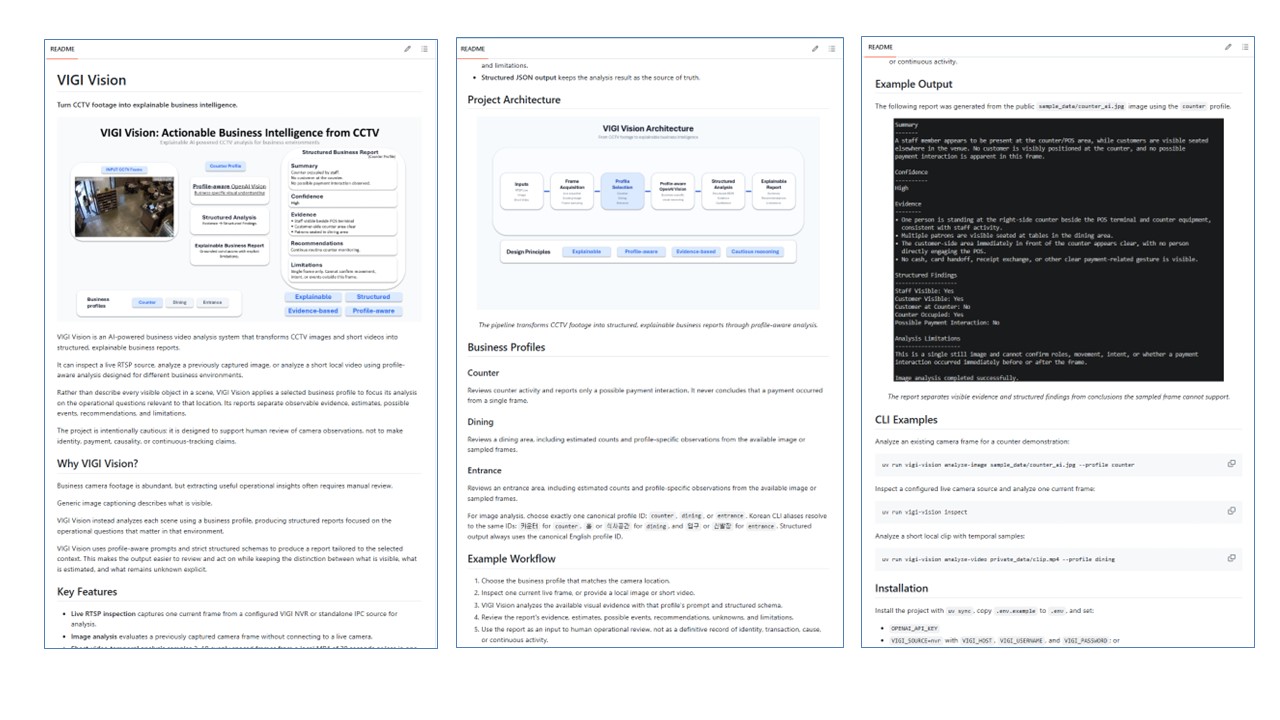
VIGI Vision analyzes CCTV images and short videos using profile-aware AI prompts tailored to specific business environments such as counters, dining areas, and entrances.
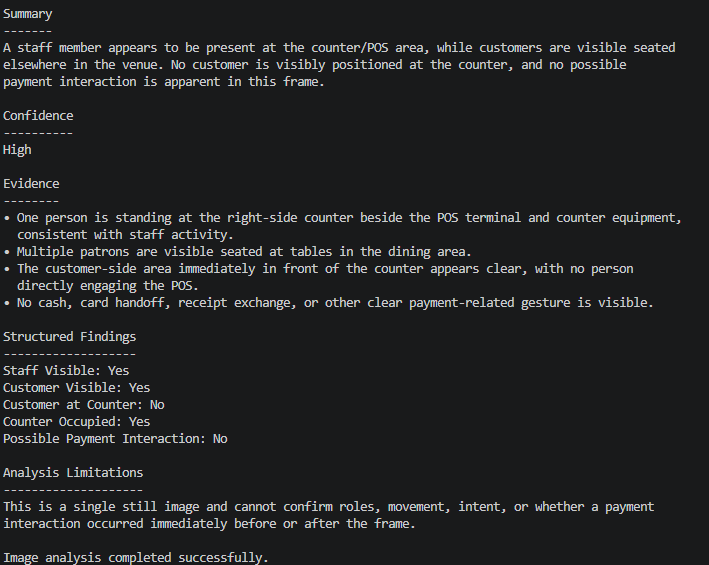
Instead of generating generic descriptions, it produces structured business reports containing:
- Summary
- Confidence
- Observable Evidence
- Profile-specific Findings
- Possible Events
- Recommendations
- Analysis Limitations
The system is intentionally conservative. It does not perform face recognition, identity tracking, payment confirmation, or continuous activity inference beyond the available visual evidence.
How we built it
The project is implemented in Python using OpenAI Vision models together with structured JSON schemas.
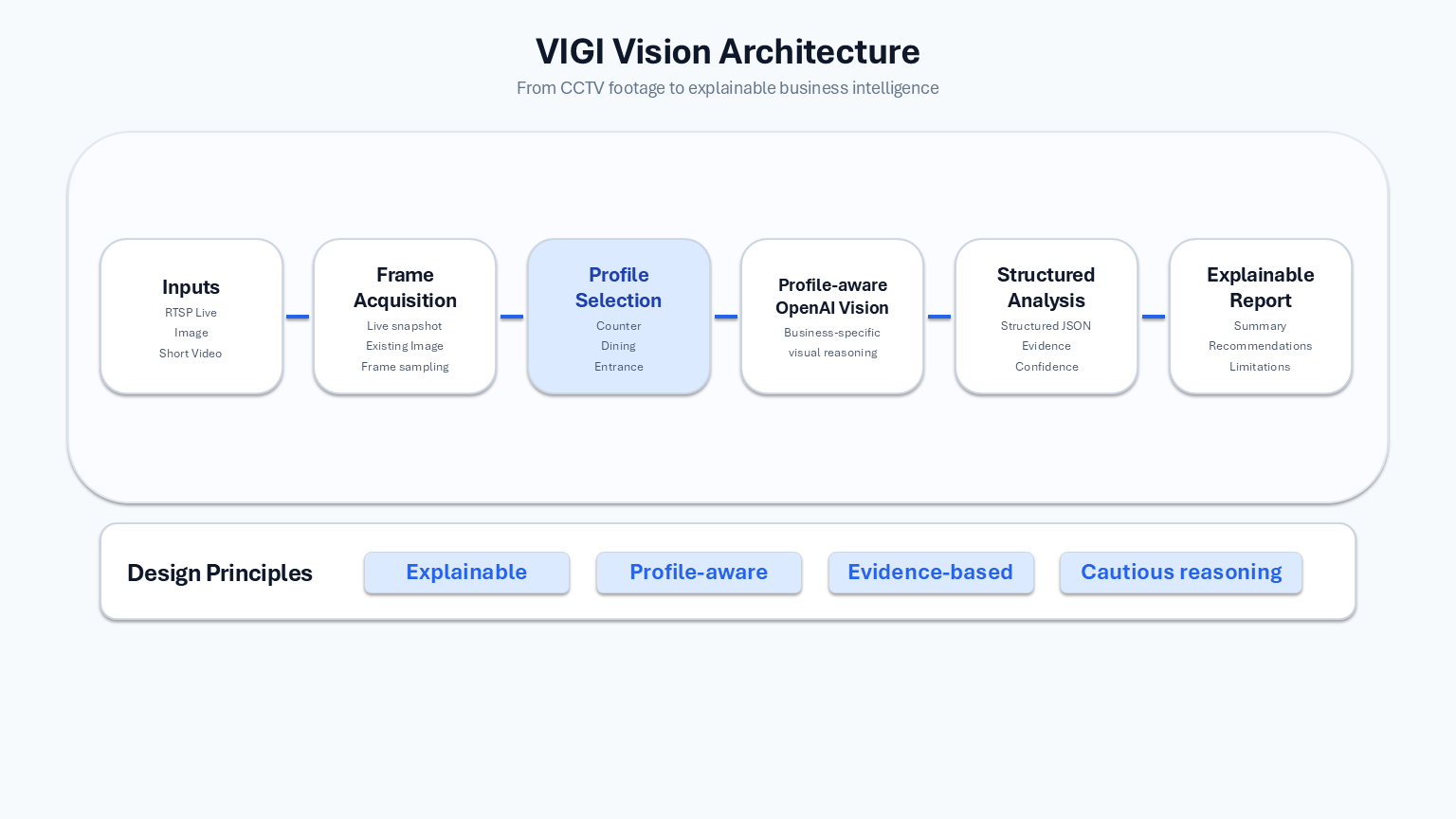
The pipeline consists of:
- RTSP / image / video input
- Representative frame sampling
- Profile-aware prompt selection
- OpenAI Vision analysis
- Structured report generation
- Explainable business output
Development was accelerated using GPT-5.6 and Codex for architecture design, iterative implementation, prompt refinement, documentation, and developer workflows throughout the project.
Challenges
One of the biggest challenges was balancing useful business insights with responsible AI behavior.
Instead of allowing the model to overinterpret visual scenes, we designed prompts and schemas that clearly distinguish observable evidence from estimates, possible events, and explicit limitations.
Another challenge was designing profile-aware prompts that remain consistent across different business environments while keeping the output structured and explainable.
Accomplishments
We're proud of building a complete end-to-end prototype that can analyze live RTSP snapshots, images, and short videos using the same explainable reporting pipeline.
The project demonstrates that multimodal AI can move beyond generic captioning and produce structured business intelligence suitable for human operational review.
What we learned
This project reinforced that prompt engineering alone is not enough for reliable AI systems.
Carefully designed schemas, conservative reasoning, profile-aware analysis, and explicit communication of uncertainty are equally important for producing trustworthy outputs.
What's next
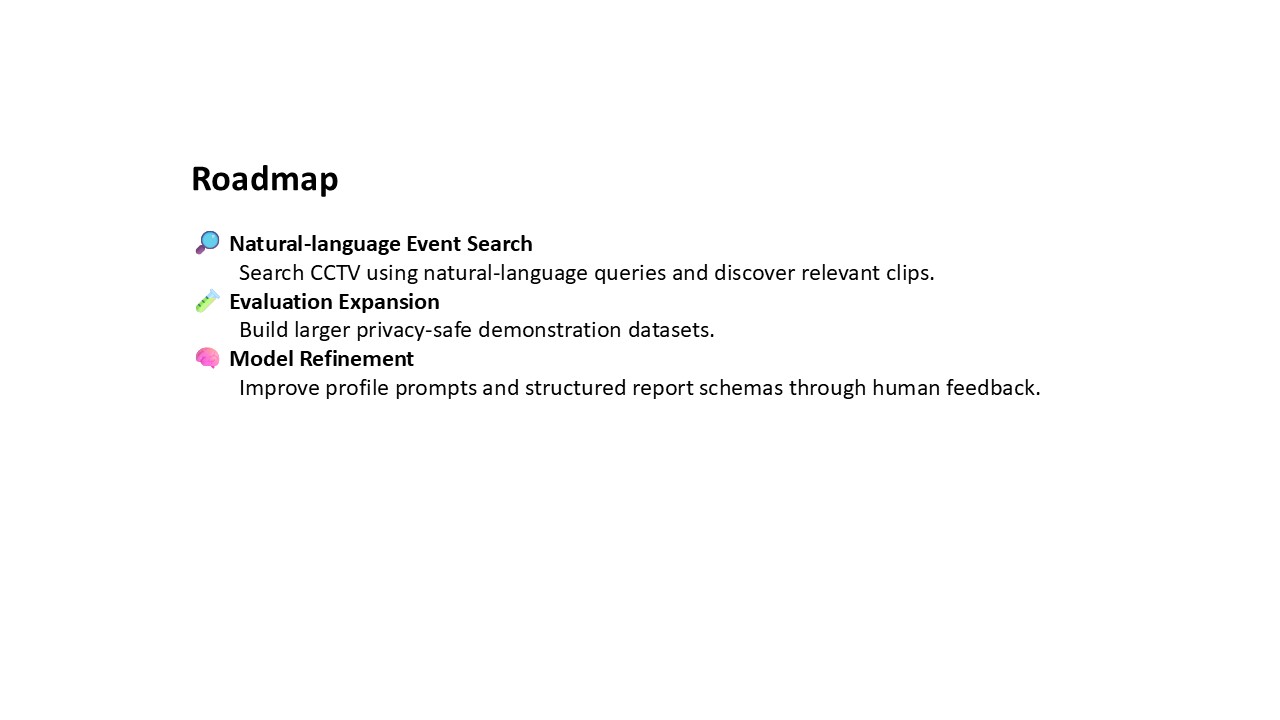
Future work includes:
- Natural-language event search
- Automatic clip discovery
- Integration with object detection and tracking
- Expanded evaluation scenarios
- Continuous improvement of profile prompts and structured report schemas

Log in or sign up for Devpost to join the conversation.