-
-
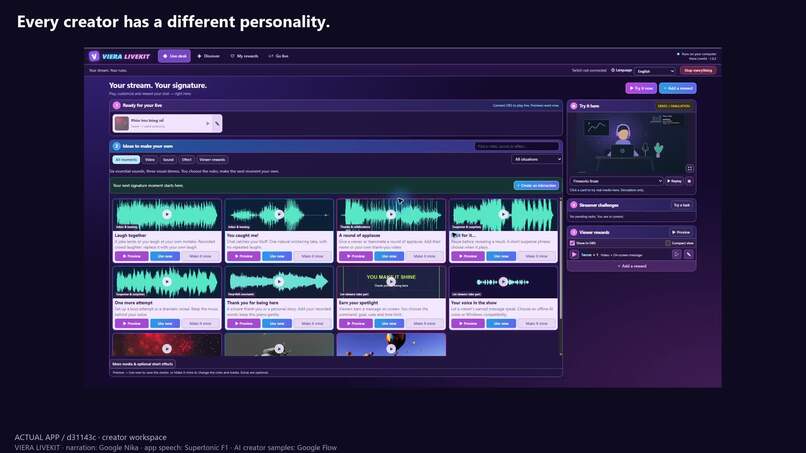
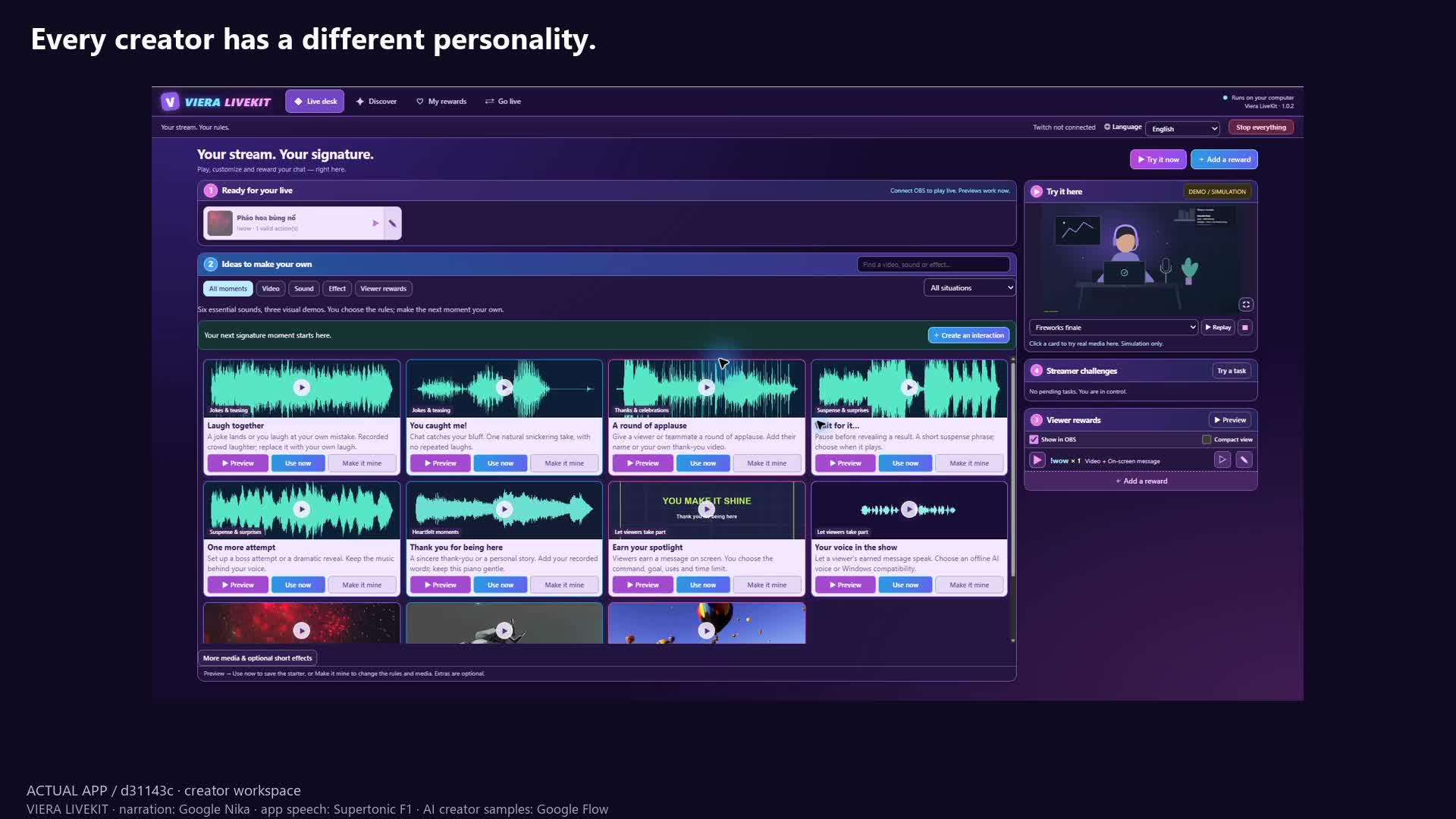
Actual d31143c creator workspace: editable ideas, in-app preview, + Add a reward and Viewer Rewards. Frame from the submitted film.
Inspiration
Every streamer has their own personality. Why should every stream react the same way? We wanted creators to turn their own performances, recordings and community rules into interactions without programming an automation system.
What it does
Viera LiveKit is a local Windows app with a three-step creator flow: choose what viewers do, choose what happens, then preview and save. Start with an editable idea or the + button. Upload video, sound, images or GIFs; record a voice; add text, effects or a moderated streamer challenge. Buttons, shortcuts and supported Twitch events use the same engine.
The central experience is earned participation. A creator chooses a chat command, threshold, per-viewer or community progress, redemption command, uses, expiry and cooldown. Only the account earning a permission can spend it. A public Rewards Board explains the actual rules. A shared community goal awards the completing contributor, not every participant.
Permissions can unlock scrolling text, speech, or both together. One combined message creates one queued job and consumes one use. Text starts with the voice. Failed speech preparation safely returns a still-valid reserved use. Creators remain in control with a bounded FIFO queue, moderation and STOP ALL; ordinary chat is not automatically spoken.
Optional Supertonic 3 presets run on the streamer's CPU through ONNX Runtime. After the one-time official model download, synthesis is offline: no paid API, cloud inference or voice cloning. Windows speech remains an explicit compatibility choice. Existing creator rules are not silently converted. The app offers six UI languages; voice-language quality is a separate claim.
Creators can edit the entire spoken reaction and insert documented event fields such as {viewer_name} and {message}. UI-language defaults follow the selected locale; personal text stays unchanged. Each interaction can choose its own voice and speech language. Video and speech can run together or in sequence.
How we built it with Codex
Codex implemented the Node.js server, configuration engine, Twitch OAuth/EventSub adapter, plain JavaScript interface, OBS overlay, speech worker and tests in session 01a189a4-81a1-7080-9b5b-c9b32b86a8b2. It also helped diagnose identity isolation, speech timing, cancellation and permission refunds using real receipts. The video identifies actual session stills, committed diff and test output; it does not stage a coding animation.
One local process serves the UI and one OBS Browser Source. JSON and uploaded files stay local. Twitch device OAuth requests user:read:chat; tokens remain in memory. The optional model installer pins upstream revisions and verifies every file. Licensed media and open-source components retain their notices.
What we verified
The final Windows candidate passes 127 tests (111 existing plus 16 reaction-script and locale checks). Clean extracted-source setup, an uncached official model installation, READY and real WAV preview were verified on the same Windows host. Two real Twitch accounts earned and spent permissions into OBS. An authorized public test reached the viewer's actual Twitch player with scrolling text and F1 neural speech, then ended safely. Both original OBS and viewer recordings are retained. Subsequent creator workflows were tested locally without another public broadcast.
What makes it focused
Alerts and stream automation already exist. Our focus is a small creator-oriented path from an editable idea to an account-bound, time-limited viewer permission, a public explanation of the rules and a combined local text/voice moment. We do not claim to have invented alerts, TTS or programmable stream reactions.
Limits and lessons
The default sounds are candidates, not a worldwide meme library or a claim of human creative approval. Cleared stock/animation examples demonstrate replacement; they are not self-shot streamer performances. F1 VI/EN comparison samples were accepted by the Owner; other presets and four additional language pronunciations have not been human-approved. Two accounts used the same host/operator, not independent novice users. A physical USB recording was confirmed earlier, but that private recording is excluded.
Bits/Gifted Subs normalization has fixture coverage and listener capability states, but no paid production transaction is claimed. Channel Points and other platforms are unsupported. A new OS/VM, audience retention and mixing against a speaking streamer remain unverified. This is free to evaluate locally. No purchase, paid AI API or cloud backend is required.
Built with
OpenAI Codex, JavaScript, Node.js, Twitch OAuth and EventSub WebSocket, OBS Browser Source, Python, ONNX Runtime CPU, Supertonic 3.

Log in or sign up for Devpost to join the conversation.