-
-
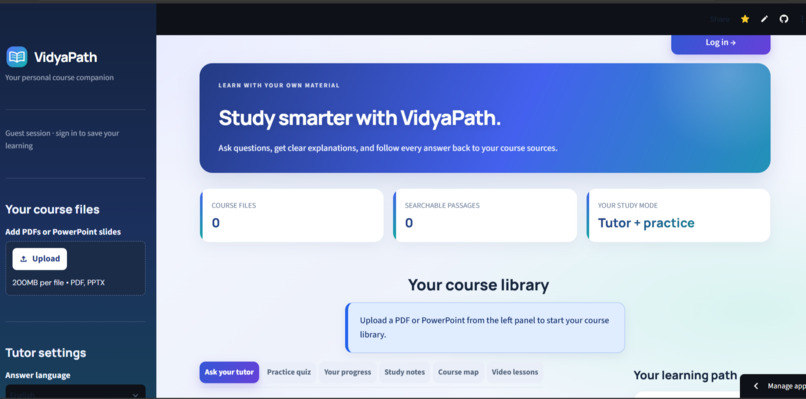
Starting
-
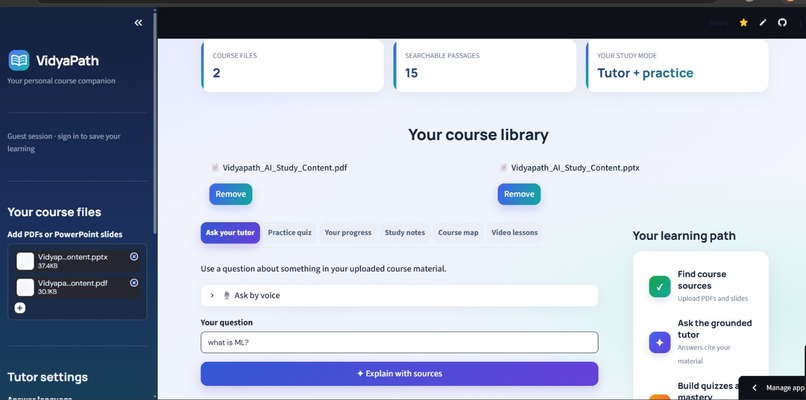
-
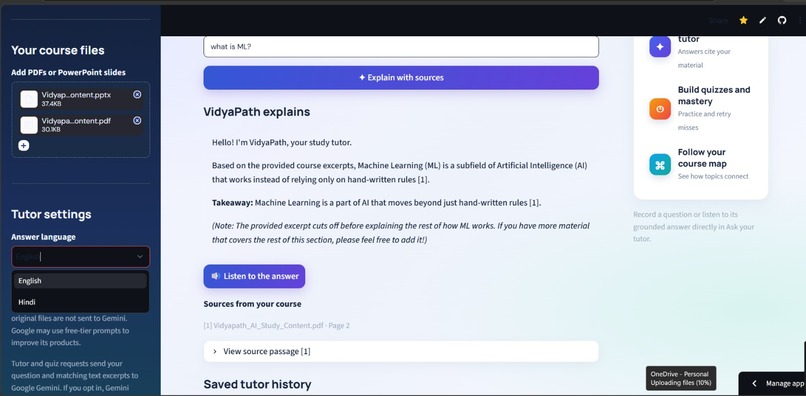
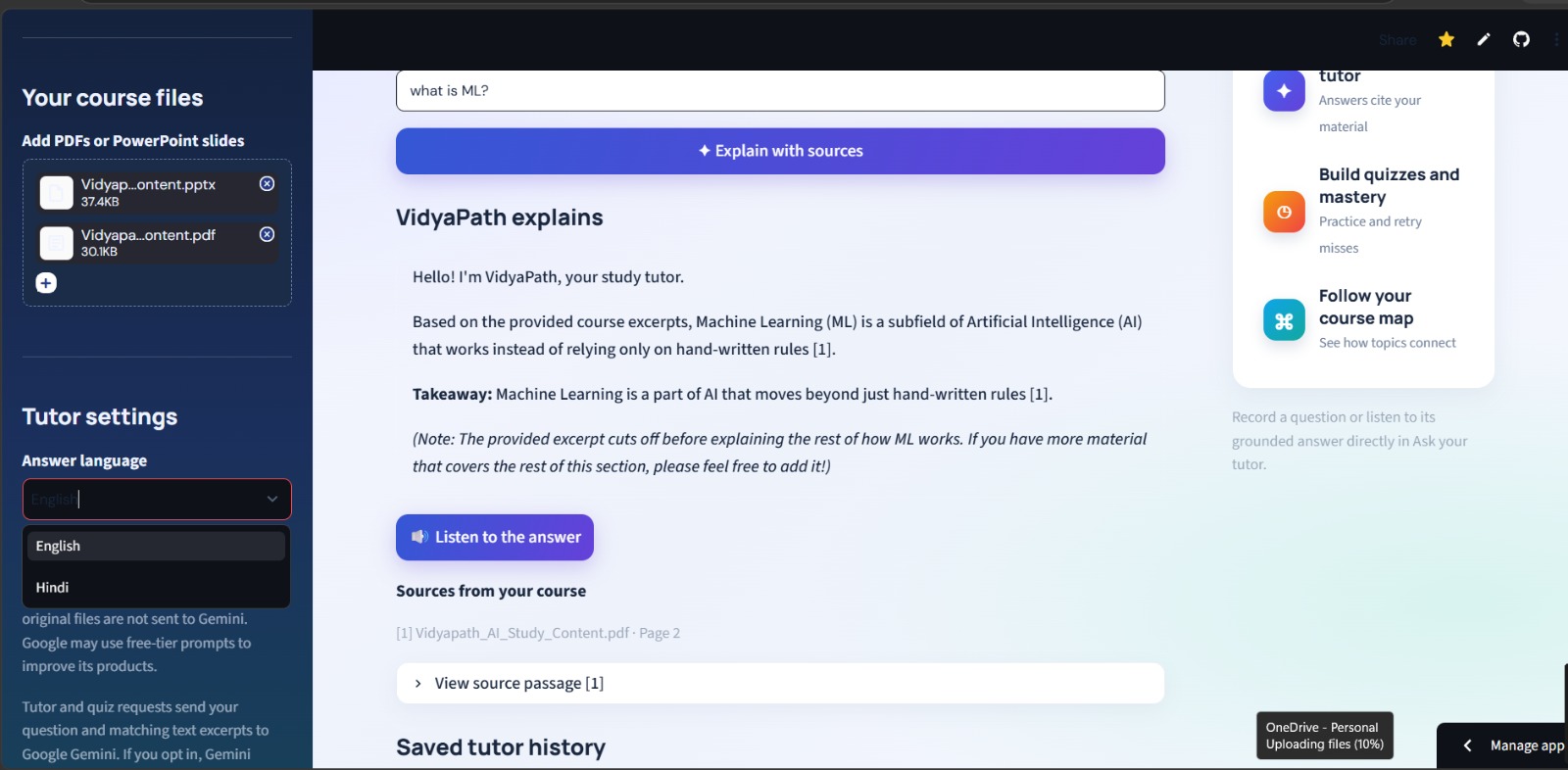
ask the tutor feature
-
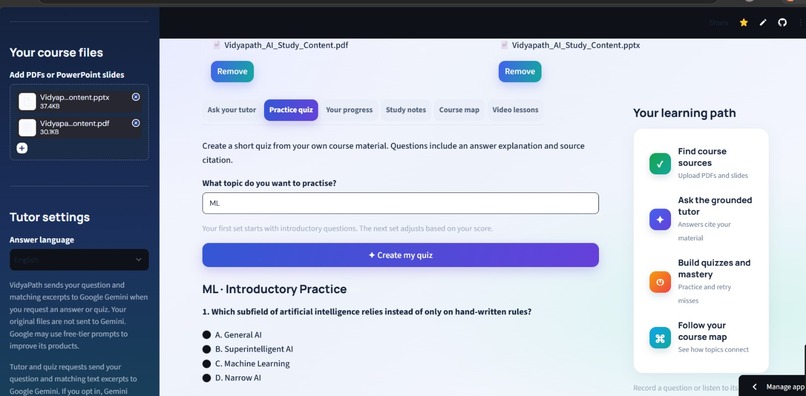
-
-
-
-
Inspiration
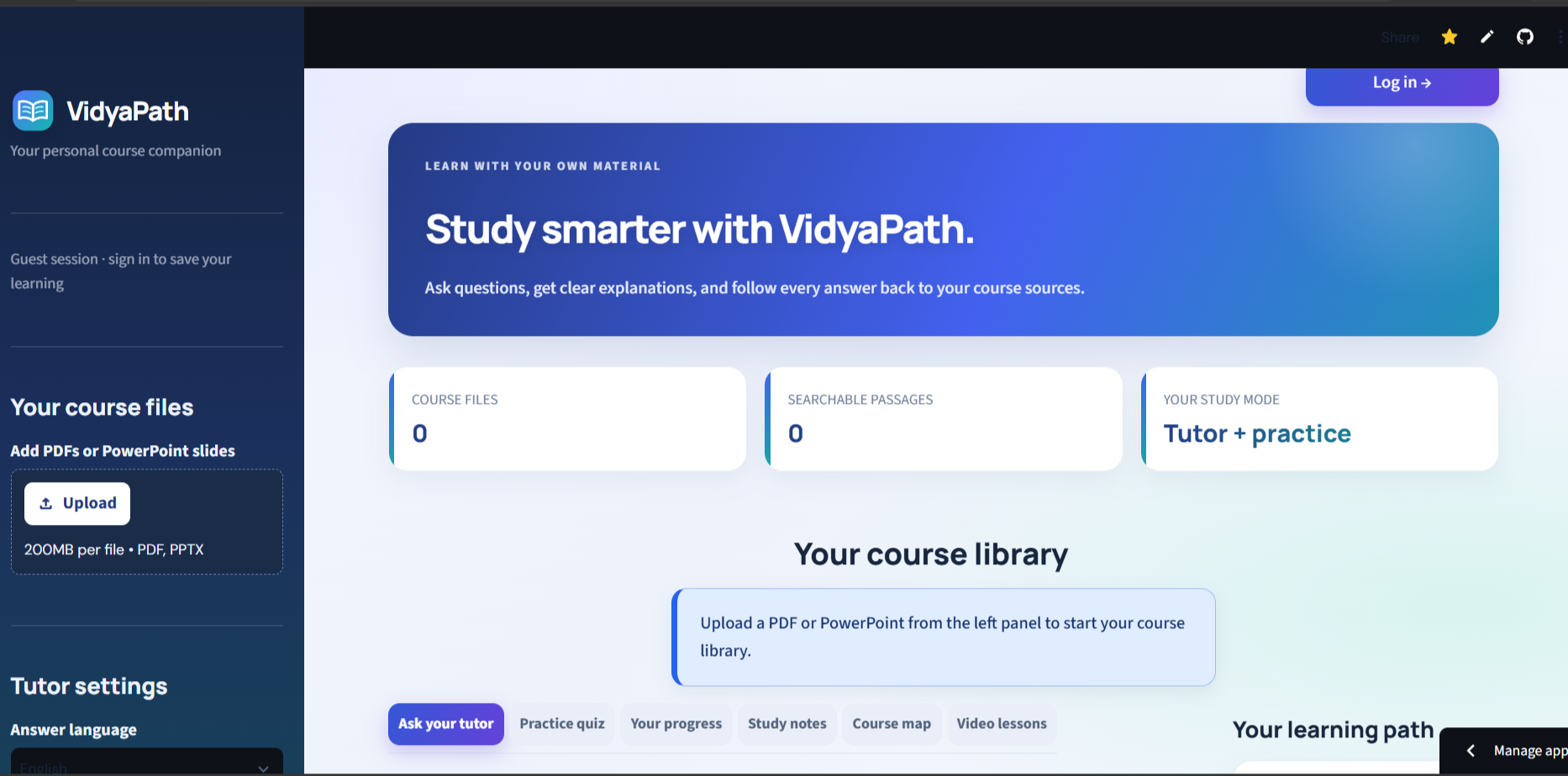
Students often rely on textbooks, lecture videos, and slide decks scattered across different platforms. General AI chatbots may provide answers without reliable connections to course materials or an understanding of a student's learning progress. We created Vidyapath AI to explore a more trustworthy and personalized learning experience, where students can study from their own resources, verify explanations against source material, and improve through adaptive practice.
What it does
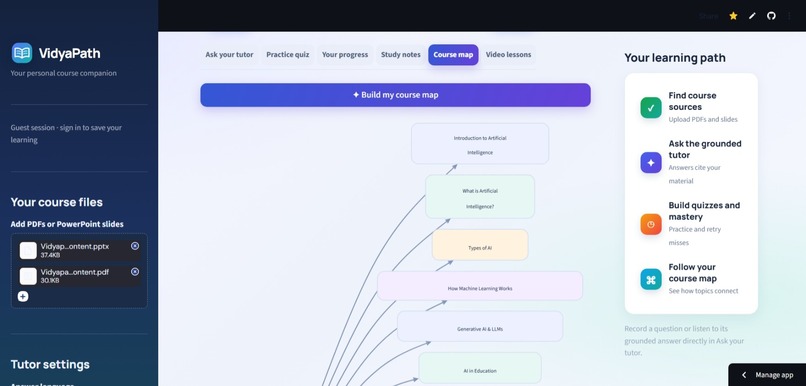
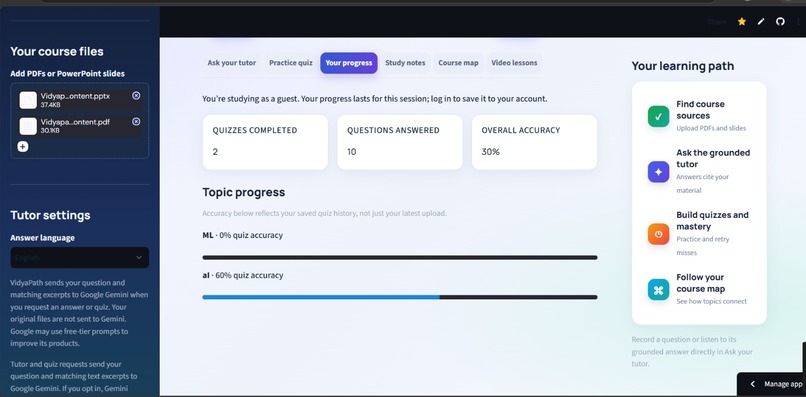
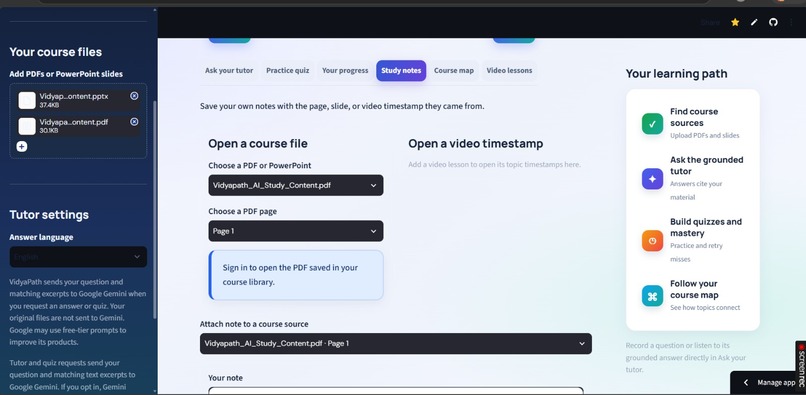
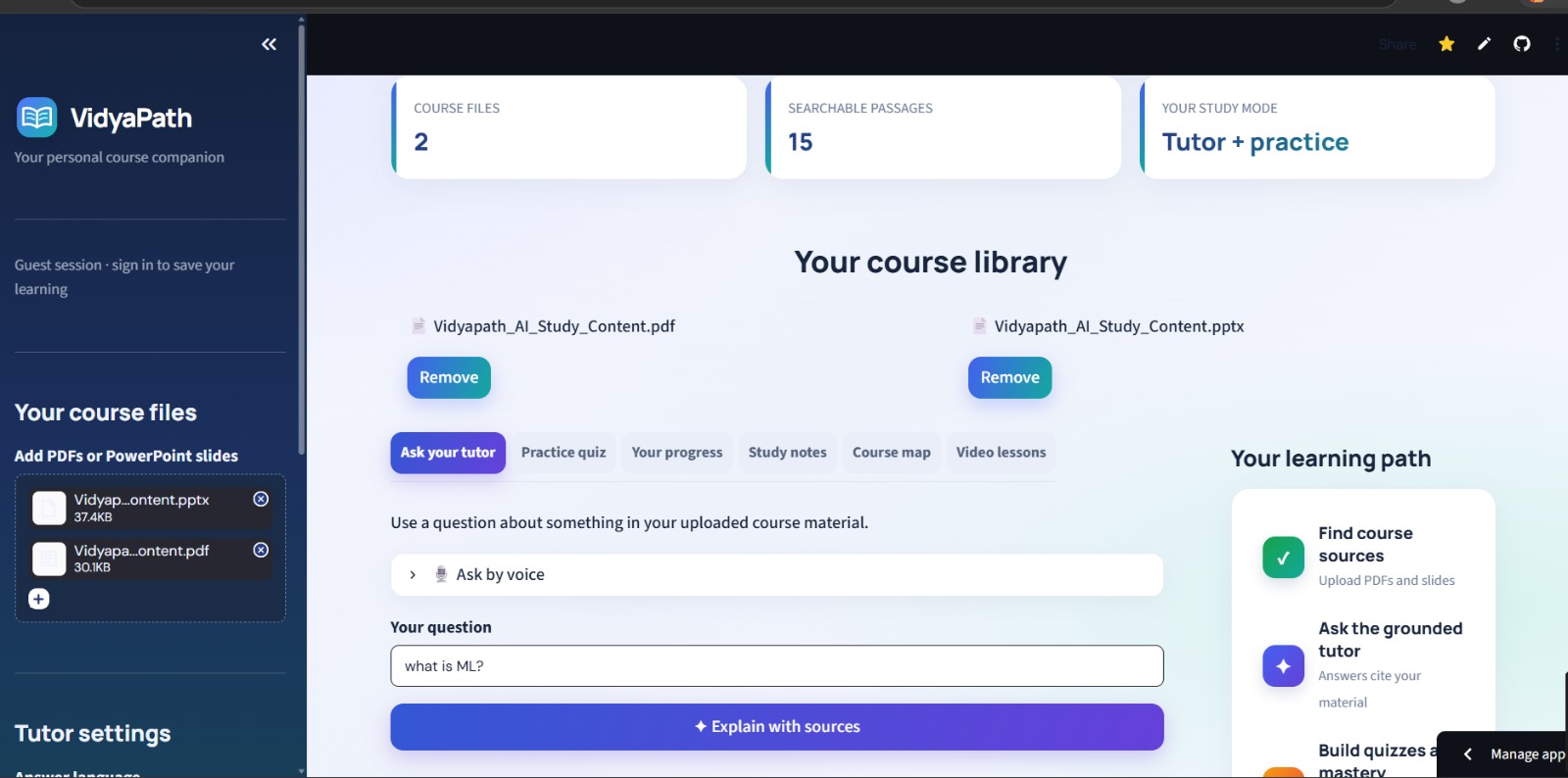
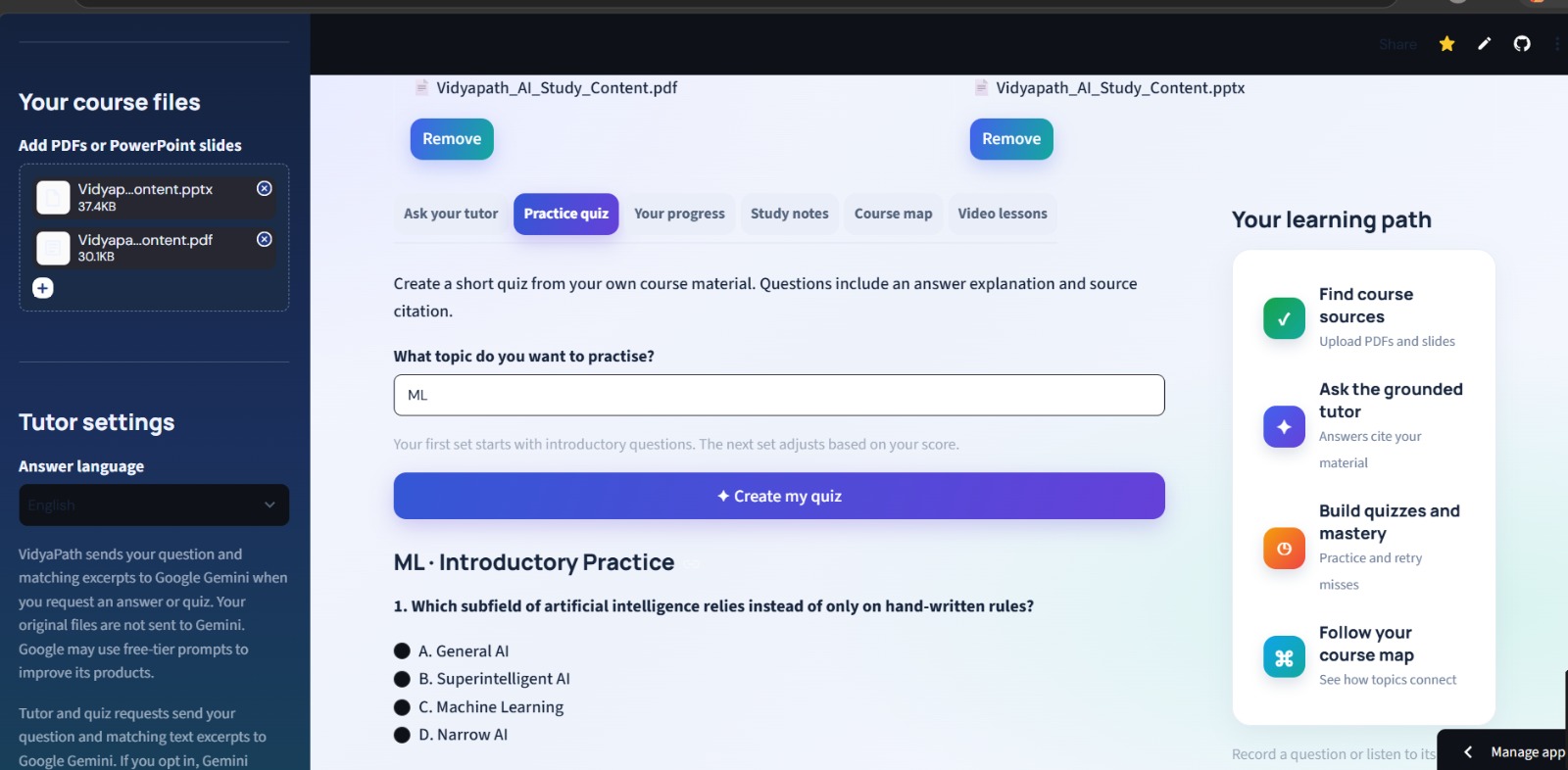
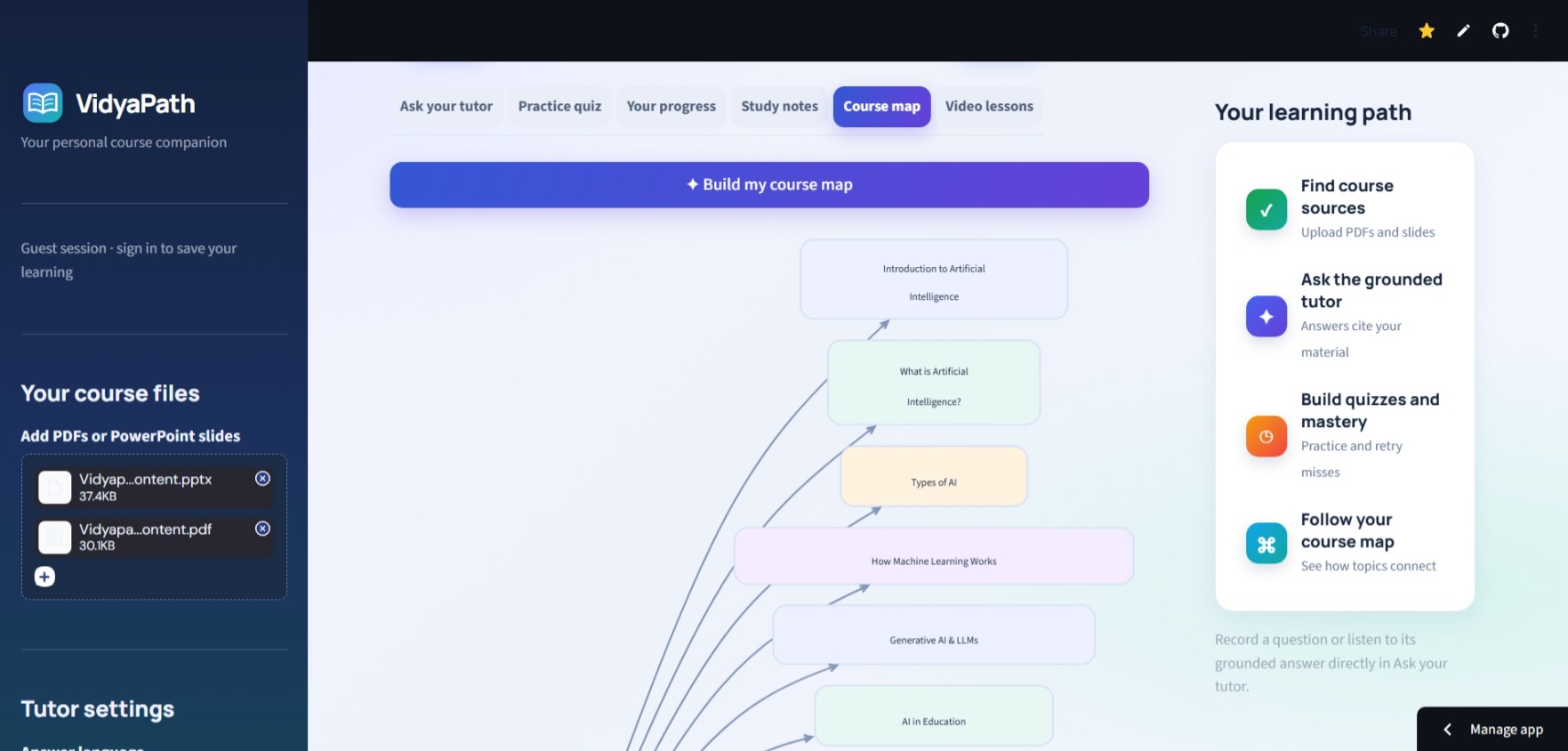
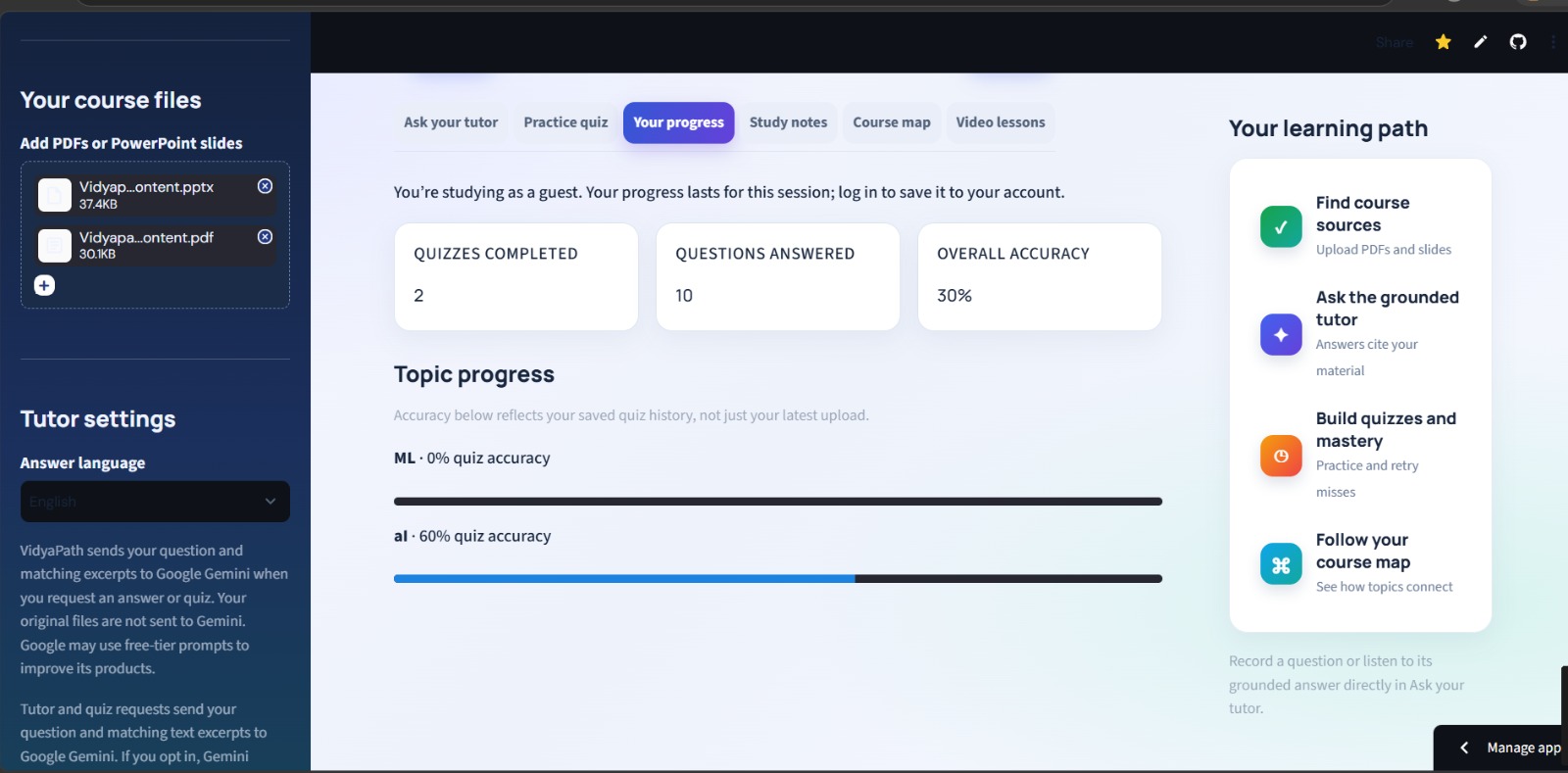
Vidyapath AI is an AI-powered study companion designed around the Track D challenge of Personalized Tutoring and Adaptive Learning. It brings course-material learning, source-grounded tutoring, personalized course maps, AI-generated quizzes, topic-level progress tracking, and Hindi-English audio support into one platform. The platform aims to connect tutor explanations to the relevant source passages and their locations in uploaded materials. It helps students practice concepts, receive feedback on incorrect answers, identify weaker topics, and use their learning progress to guide further study. Reliable source citations and explicit handling of questions not covered by the materials are key parts of our grounding goals.
How we built it
We built Vidyapath AI as a web application using Python and Streamlit, integrated Google Gemini for AI-powered tutoring and content generation, and used Supabase for data storage. The application brings together course-resource workflows, tutor interactions, course-map generation, quiz creation, and student progress tracking. Our design follows the Track D workflow: organize learning resources, retrieve relevant course content for tutor responses, provide source references where available, assess student understanding, and use performance information to inform learning recommendations. Further validation is needed to confirm citation accuracy, multimodal extraction quality, and the consistency of adaptive behavior across sessions.
Challenges we ran into
A major challenge was keeping AI-generated explanations connected to the actual course material instead of relying on unsupported general knowledge. We also encountered model availability changes, response timeouts, audio-generation issues, and deployment debugging. These experiences highlighted the importance of dependable retrieval, clear source attribution, careful error handling, and systematic testing of every learning workflow.
Accomplishments that we're proud of
We developed and deployed a working prototype that brings AI tutoring, course mapping, quiz-based practice, student progress tracking, and bilingual learning support into one student-focused experience. We are proud of bringing these workflows together and of shaping the project around source-grounded learning rather than standalone chatbot responses. Our next milestone is to validate grounding accuracy and demonstrate measurable improvements in personalization.
What we learned
We learned how to integrate generative AI into an educational application, connect user-facing learning workflows with stored progress data, deploy and troubleshoot a web application, and address latency and audio-generation problems. We also learned that trustworthy AI tutoring requires more than fluent responses: answers need reliable source support, assessments need accurate answer keys, and personalization needs measurable evidence.
What's next for Vidyapath AI
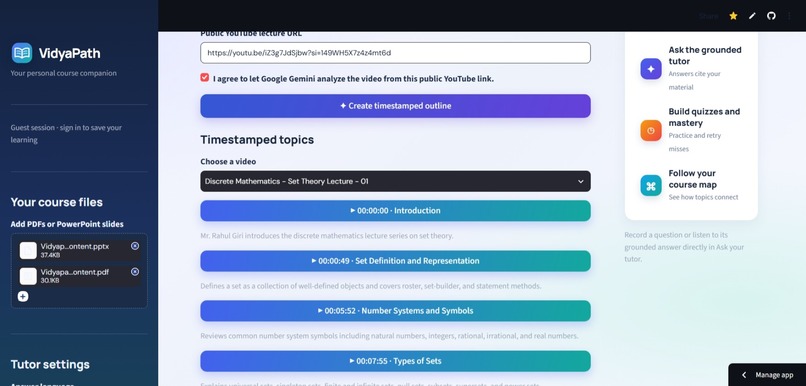
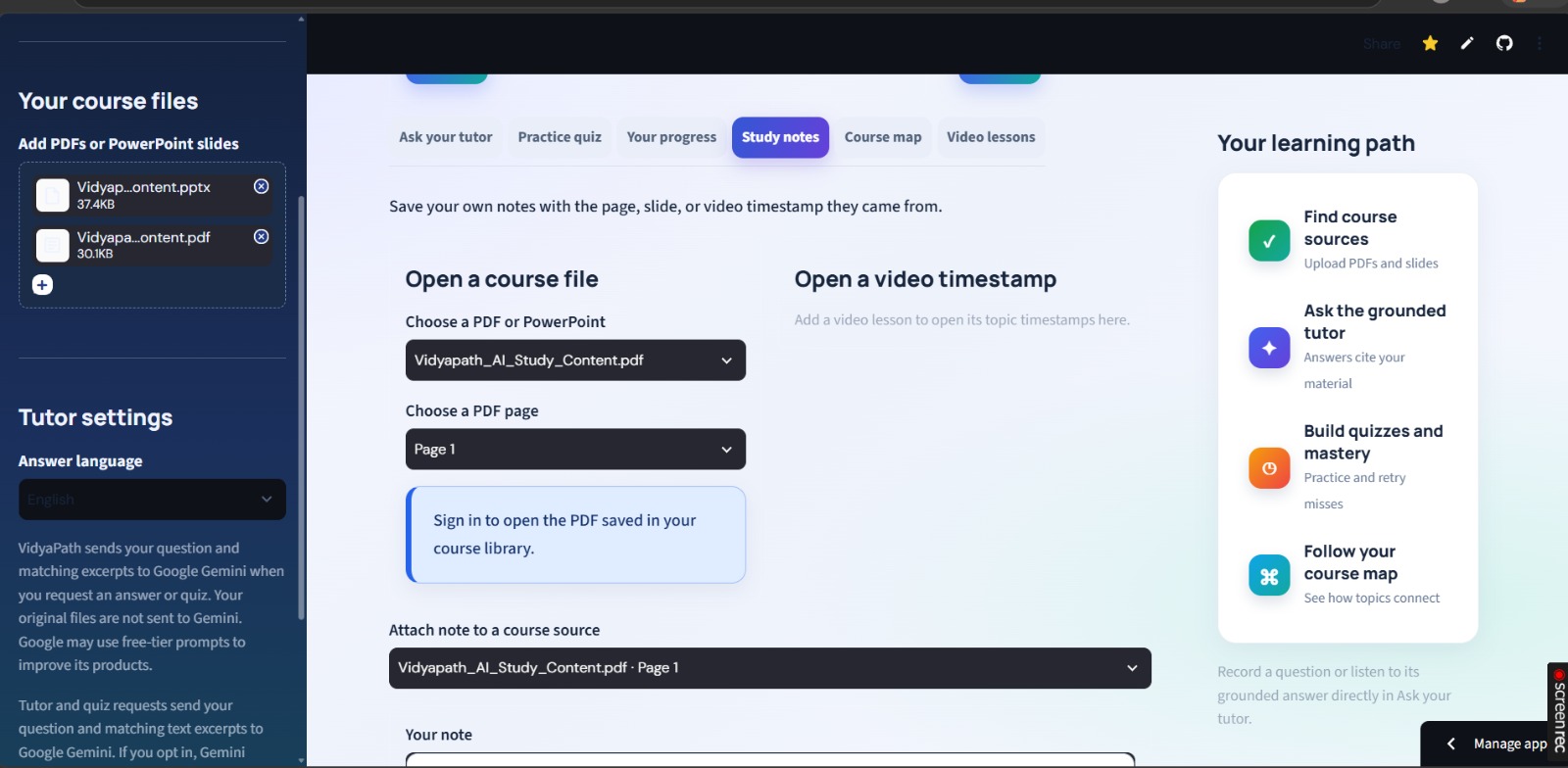
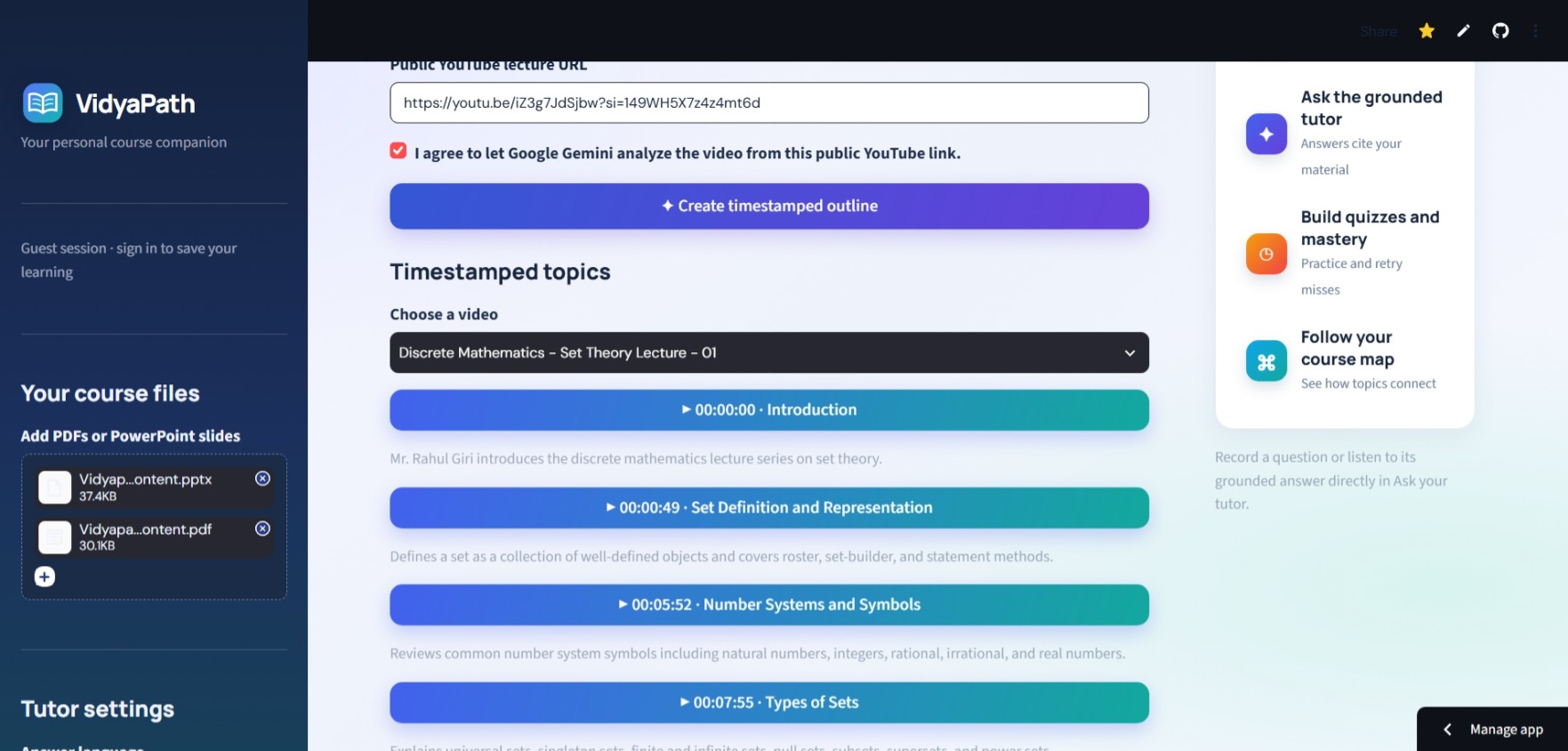
Our next steps are to strengthen automatic ingestion of lecture videos, textbooks, and slide decks; extract information from diagrams and figures; preserve precise page, slide, and timestamp references; and flag questions that are not supported by the uploaded material. We also plan to improve adaptive assessments through question verification, topic and difficulty tagging, repetition prevention, and cited feedback. To align fully with Track D, we plan to refine per-topic mastery estimates, evaluate learning progress across simulated student profiles, and benchmark retrieval and answer generation using a framework such as RAGAS, DeepEval, or TruLens. We will report measured faithfulness, answer relevance, context precision and recall, alongside personalization and question-repetition results. These evaluations will help us identify limitations and measure whether Vidyapath AI becomes more useful as it learns about each student's needs.
Built With
- adaptive-learning
- ai
- education
- generative-ai
- google-gemini
- multimodal-ai
- natural-language-processing
- personalized-learning
- python
- rag
- speech-recognition
- streamlit
- supabase
- text-to-speech


Log in or sign up for Devpost to join the conversation.