-
-
Vidyantra AI logo
-
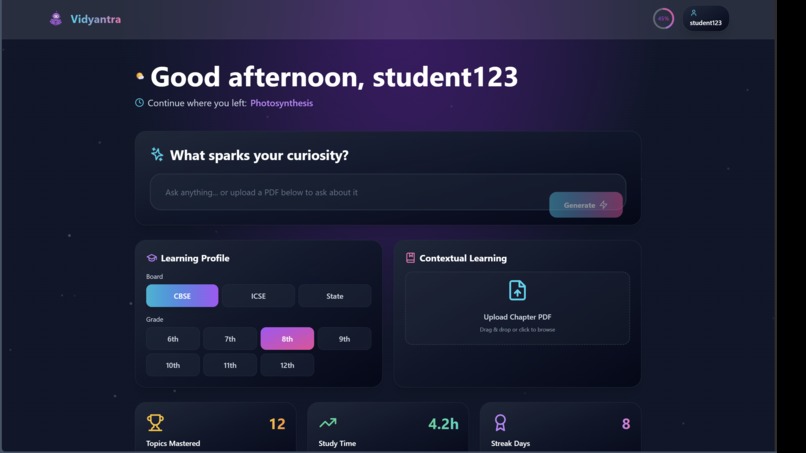
Vidyantra Dashboard
-
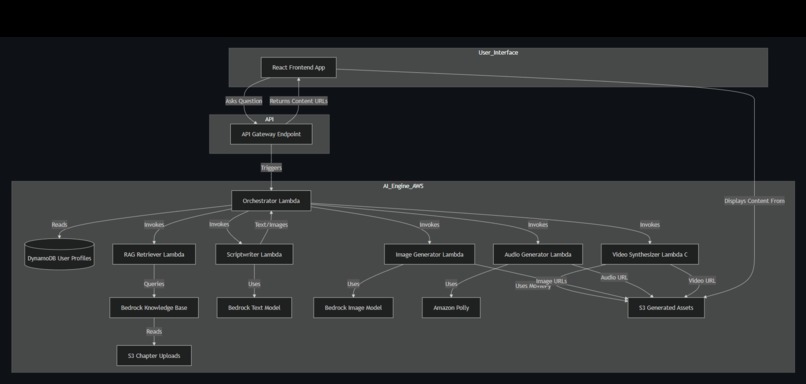
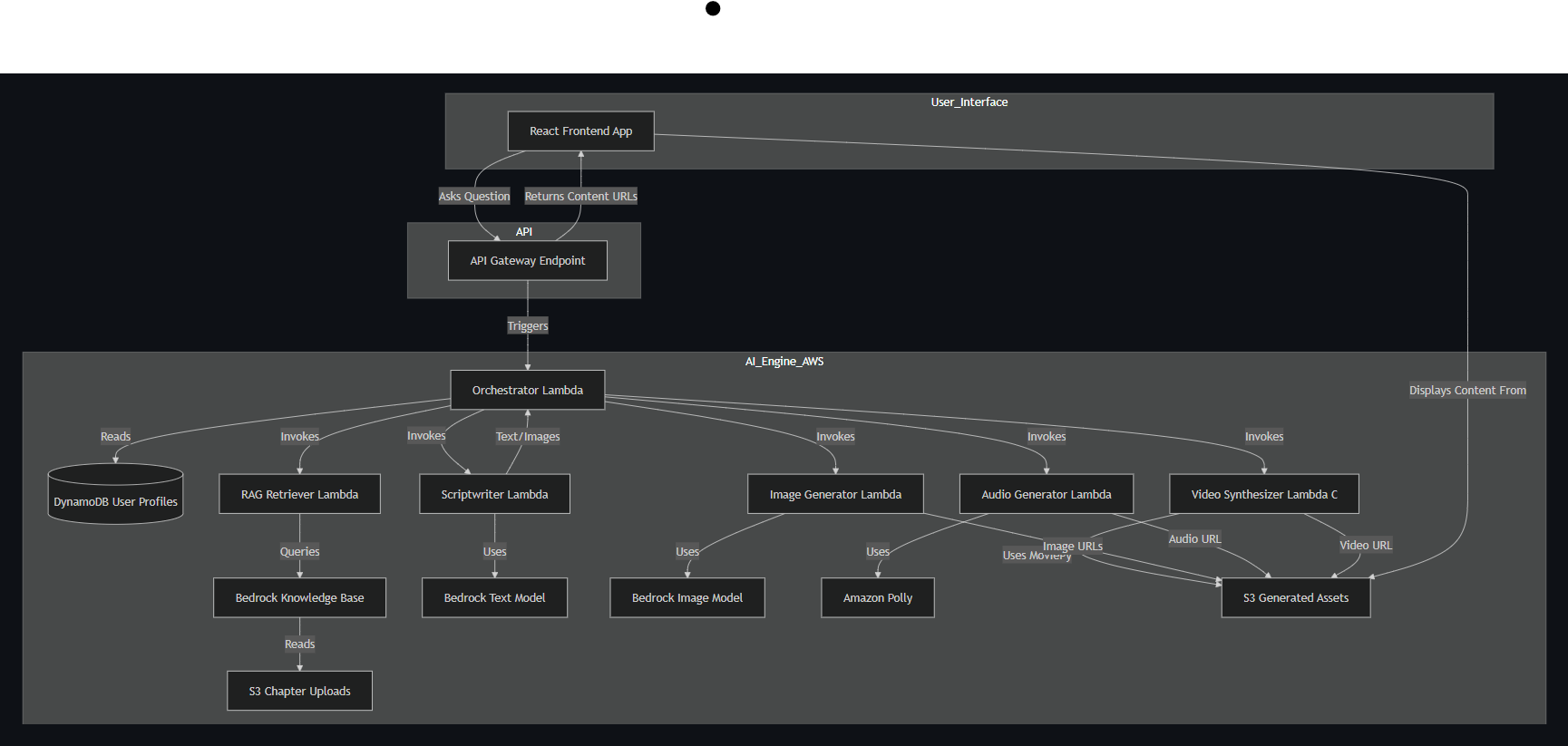
Architecture Diagram

Vidyantra AI: Your Personal AI Tutor. Ask any question, get an instant, custom video lesson.
Inspiration
Today's students face numerous challenges: long travel times, hours spent in traffic, and the struggle to stay engaged with static, traditional textbooks. We see students getting bored reading books, but endlessly enjoying short, dynamic videos on platforms like Instagram and YouTube.
I was inspired to bridge this gap. Why should learning feel like a chore? Why can't it be as engaging as the content they consume every day? I wanted to create a tool that respects a student's time and learning style, making education an active, personalized, and engaging experience. I wanted to build a "personal AI tutor" that doesn't just give an answer, but creates a unique, multi-sensory learning moment for them, on-demand.
What it does
Vidyantra AI is an AI-powered learning companion that transforms any K-12 science query into a personalized micro-lesson.
- Tailored Explanations: A student asks a question (e.g., "What is Photosynthesis?") and receives an explanation tailored to their specific grade and curriculum (CBSE/ICSE).
- Dynamic Video Generation: It doesn't just provide text. It orchestrates multiple AI models to generate AI-powered images, a natural audio summary (using Amazon Polly), and then compiles them into a short, engaging video reel, perfectly synced to the audio.
- Contextual RAG: This is its most powerful feature. A student can upload their own chapter PDF. The AI then uses this document as the single source of truth, allowing the student to ask questions and get answers specifically from their class material.
- Engaging UI: The entire experience is wrapped in a modern, interactive React frontend that tracks progress and makes learning conversational and fun.
How I built it
This project is a full-stack, serverless application built entirely on Amazon Web Services (AWS) by me, as a solo developer.
Frontend:
- React and Tailwind CSS for a polished, responsive UI.
- Hosted on AWS Amplify.
Backend (100% Serverless Microservices):
- API: Amazon API Gateway triggers the main orchestrator.
- Orchestrator: An AWS Lambda function that acts as the "brain".
- AI Models: Amazon Bedrock
- Claude 3 Haiku for text generation.
- Titan Image Generator for visuals.
- Audio: Amazon Polly for natural text-to-speech.
- RAG: Bedrock Knowledge Bases indexes PDFs from S3.
- Video: A custom AWS Lambda Container Image (running Python, MoviePy, & FFmpeg) stitches all assets together.
- Database: Amazon DynamoDB stores user profiles for personalization.
Challenges I ran into
- Complex AI Orchestration: My biggest challenge was coordinating the "assembly line" of AI models. The main orchestrator function has to successfully call the scriptwriter, then the image generator (multiple times), then the audio generator, and finally the video synthesizer, all while managing state and failures.
- Advanced Prompt Engineering: Getting the AI to be both creative and reliable was difficult. I engineered a multi-step prompt chain: one prompt for a concise script (for the video) and a second, more complex prompt to generate a detailed explanation and a 6-8 item JSON array for the image storyboard.
- Deploying MoviePy/FFmpeg on Lambda: The video synthesizer required FFmpeg, which isn't in the standard Lambda runtime. I had to build a custom Docker container image, manually install FFmpeg, and package all Python dependencies (like MoviePy) to run as a Lambda function.
- Managing RAG Data Synchronization: Implementing RAG wasn't just about retrieving data. When a user uploads a new PDF, the AWS Knowledge Base has to ingest and index it. This process is asynchronous. A major challenge was handling the state where a user uploads a file and immediately asks a question, before the Knowledge Base sync is complete.
Accomplishments that I'm proud of
- Building an End-to-End Generative AI App: As a single developer, I successfully built a complete, multi-modal application that generates net-new video content from a single text prompt.
- Complex AI Orchestration: I'm proud of how the system harnesses the power of multiple AI services together. The Orchestrator lambda acts as the "brain," passing context from the RAG Retriever to the Scriptwriter, which then feeds the script to the Audio Generator and the storyboard to the Image Generator, with all assets finally being assembled by the Video Synthesizer.
- The RAG Implementation: The Retrieval-Augmented Generation (RAG) feature is a key accomplishment. Giving students the power to "chat" with their own textbooks is a powerful use case and demonstrates a deep, practical application of AI in education.
- The Polished UI: I built a frontend that feels like a real, market-ready product, not just a proof-of-concept. The interactive dashboard and conversational chat interface make it genuinely fun to use.
What I learned
- Full-Stack Serverless Design: I learned how to single-handedly design, develop, and deploy a highly scalable, event-driven architecture from scratch using AWS. I gained hands-on experience with Lambda, Bedrock, S3, DynamoDB, API Gateway, and ECR.
- Orchestration is Key: A single AI model is powerful, but a chain of models working together is transformative. I learned how to pass context between models (e.g., script to audio, storyboard to images) to create a cohesive final product.
- Prompt Engineering is a Science: I learned that the way you ask the AI is just as important as the model itself. Iterating on my prompts to force JSON output and handle irrelevant context was a major part of the development process.
- The RAG Pipeline Needs Tweaks: I learned that while RAG is powerful, getting perfect retrieval is hard. The current pipeline works well, but to truly perfect it, it needs further tweaks to chunking strategies and retrieval configuration to handle a wider variety of PDF layouts.
What's next for Vidyantra AI
This project is the proof-of-concept for a startup-level idea, and my vision for it is massive. Many features are yet to be added, including:
- Social Learning Platform: Transforming Vidyantra into a social media hub where students can publish their favorite AI-generated videos, allowing others to learn from their creations.
- Adaptive AI Testing: Introducing daily and weekly tests, generated by AI, that adapt to a student's learning pace and performance.
- Parental Insights: The AI will constantly assess students and compile detailed progress reports, which can be automatically sent to parents to showcase their child's growth.
- Gamification & Community: Students will earn badges and achievements from tests, which they can "flex" on their social profiles. This will be combined with leaderboards for healthy, grade-level competition to make learning addictive and fun.
Built With
- amazon-web-services
- amazonapigateway
- amazonbedrock
- amazondynamodb
- amazonecr
- amazonpolly
- amazons3
- awsamplify
- awscodebuild
- bedrock
- boto3
- claude3haiku
- containerimage
- css
- docker
- ffmpeg
- framermotion
- javascript
- knowledgebase
- lambda
- moviepy
- python
- react
- tailwind
- titanimageg1
- vite

Log in or sign up for Devpost to join the conversation.