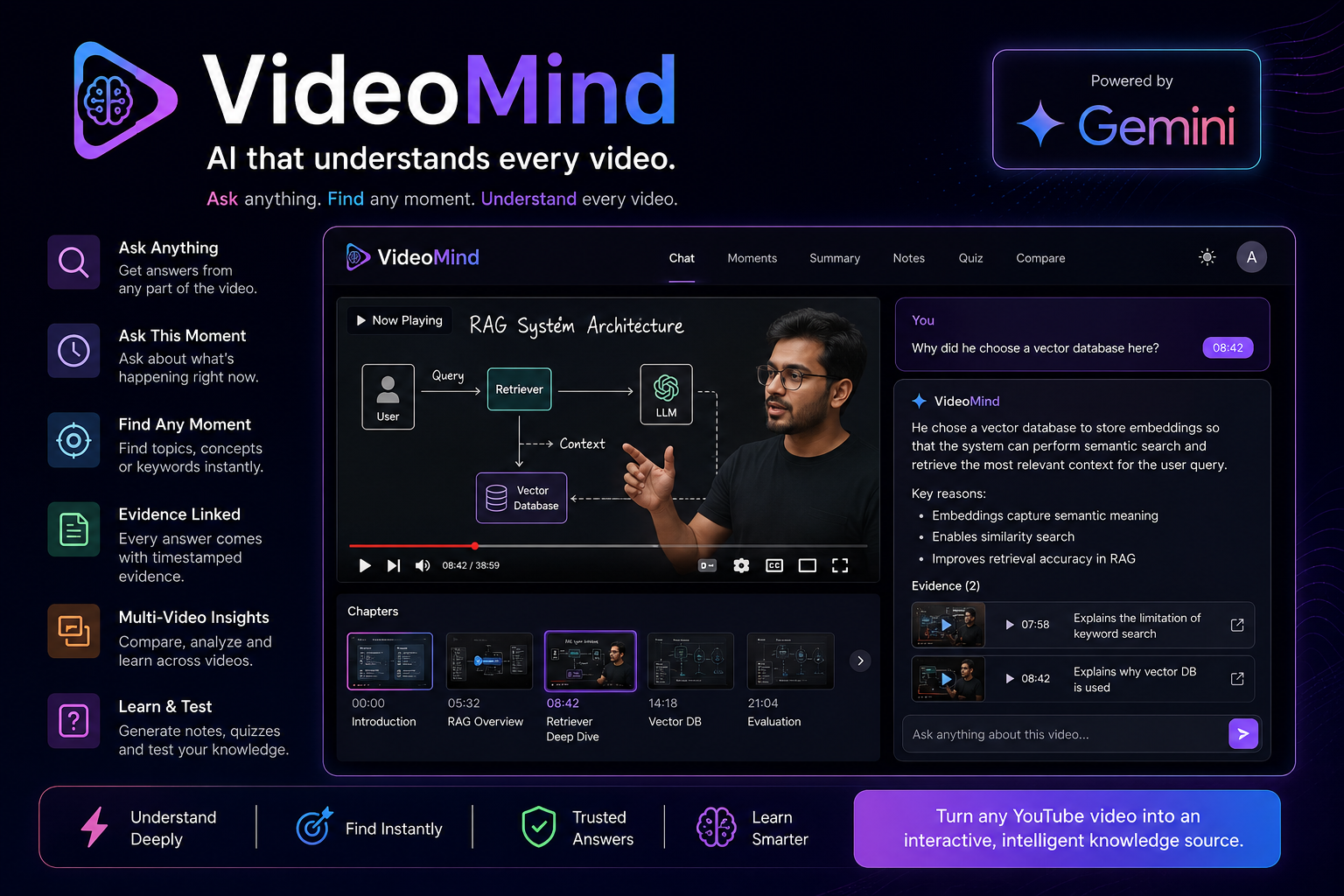
VideoMind — Project Story
Inspiration
YouTube has become one of the largest sources of knowledge, but finding specific information inside a long video can still be frustrating. A user may spend 30 minutes watching a tutorial just to find one explanation that appeared at 18:42, or replay several sections trying to understand a diagram shown briefly on screen.
We wanted to change the way people interact with video. Instead of treating a YouTube video as something you simply watch, we wanted to turn it into something you can search, question, explore, and understand.
That idea led us to build VideoMind — an AI-powered video intelligence platform that creates an interactive knowledge layer over YouTube videos.
What it does
VideoMind allows users to interact with a YouTube video using natural language.
Users can:
- Ask questions about the entire video.
- Ask questions about a specific moment in the video.
- Find where a particular topic, concept, or statement was discussed.
- Receive answers grounded in relevant video timestamps.
- Understand concepts at different levels of complexity.
- Generate intelligent summaries and structured notes.
- Explore important chapters and moments.
- Analyze visual content such as slides, diagrams, interfaces, and code shown on screen.
- Compare information across multiple videos.
- Generate quizzes and learning material from educational videos.
One of our core goals is evidence-linked answers. Instead of simply generating an answer, VideoMind identifies the relevant part of the video so users can verify the information themselves.
How we built it
VideoMind combines video retrieval, multimodal understanding, RAG, and Gemini-powered reasoning.
The high-level pipeline is:
YouTube Video
      ↓
Transcript + Video Metadata
      ↓
Semantic Chunking
      ↓
Embeddings + Vector Retrieval
      ↓
Relevant Text + Video Frames
      ↓
Gemini Multimodal Reasoning
      ↓
Grounded Answer
      ↓
Timestamp-linked Evidence
The frontend was built using React and Vite, providing an interactive interface for video playback, search, conversations, timestamps, and AI-generated insights.
The backend was built using FastAPI, which manages video processing, retrieval, AI orchestration, and communication between the frontend and intelligence layer.
For retrieval, we use embeddings and a vector-based search pipeline to identify the most relevant sections of a video before passing the selected context to the reasoning layer.
Gemini's role
Gemini is an important part of VideoMind rather than simply being used as a generic chatbot.
We use Gemini for intelligent reasoning over retrieved video context and, where applicable, visual information extracted from the video.
This enables VideoMind to reason about both what the speaker says and what is being displayed on screen.
Conceptually:
[ \text{Video Understanding} = \text{Transcript Context} + \text{Visual Context} + \text{Temporal Context} ]
For example, if a tutorial shows an architecture diagram while explaining it, VideoMind can combine the surrounding explanation with the visual context to provide a more useful answer.
Challenges we ran into
One of our biggest challenges was preventing the AI from treating the entire video as a single block of information.
Long videos contain multiple topics, conversations, demonstrations, and visual changes. Sending everything directly to an LLM would be inefficient and could lead to irrelevant or poorly grounded responses.
We addressed this by building a retrieval pipeline that first identifies the most relevant sections and then provides Gemini with focused context.
Another challenge was maintaining timestamp accuracy. An answer is much more useful when users can immediately jump to the exact section where the information came from. We therefore designed the retrieval system around timestamp-aware chunks.
Multimodal understanding introduced another challenge. Spoken explanations and visual information do not always occur at exactly the same time, so aligning transcript context with relevant frames required careful handling of temporal context.
We also had to balance response quality, latency, token usage, and API costs while keeping the experience responsive.
Accomplishments that we're proud of
We are proud that VideoMind goes beyond a conventional AI chatbot.
Instead of simply asking an LLM to summarize a transcript, we built a system that connects:
Video → Retrieval → Reasoning → Evidence → Timestamp
Some of the accomplishments we are particularly proud of include:
- Building an end-to-end working video intelligence pipeline.
- Integrating Gemini into the core reasoning workflow.
- Combining textual and visual context for multimodal understanding.
- Implementing timestamp-aware retrieval.
- Creating evidence-linked AI responses.
- Designing an interactive interface around the YouTube player.
- Turning long-form video into a searchable knowledge source.
- Building the architecture with future multi-video analysis and learning features in mind.
What we learned
Building VideoMind taught us that effective AI applications are not only about selecting a powerful model.
The surrounding system matters just as much.
We learned how important it is to:
- Retrieve the right context before calling an LLM.
- Keep AI responses grounded in source evidence.
- Handle long-form content efficiently.
- Combine multiple modalities instead of relying only on text.
- Design AI features around a real user workflow.
- Balance model quality, latency, and cost.
- Treat timestamps and source references as first-class data.
- Build systems where users can verify AI-generated information.
Most importantly, we learned that an AI model becomes much more useful when it is connected to the right retrieval and interaction layer.
What's next for VideoMind
VideoMind is only the beginning of our vision for intelligent video interaction.
Next, we want to expand the platform with:
- Advanced multi-video comparison and research.
- Automatic knowledge graphs generated from videos.
- Better visual understanding of diagrams and code.
- Personalized learning paths.
- AI-generated quizzes and assessments.
- Cross-video knowledge discovery.
- More accurate temporal reasoning.
- Browser integration for interacting with videos directly while watching them.
- Support for additional video and educational platforms.
Our long-term goal is to make VideoMind a universal intelligence layer for video — transforming passive video consumption into an interactive experience where users can ask, explore, verify, and learn from any piece of content.
Built With
- ai-agents
- ai-assistant
- computer-vision
- embeddings
- fastapi
- gemini-api
- generative-ai
- google-gemini
- javascript
- knowledge-extraction
- llm
- machine-learning
- multimodal-ai
- natural-language-processing
- python
- rag
- react
- semantic-search
- timestamp-retrieval
- vector-search
- video-analysis
- video-understanding
- vite
- youtube

Log in or sign up for Devpost to join the conversation.