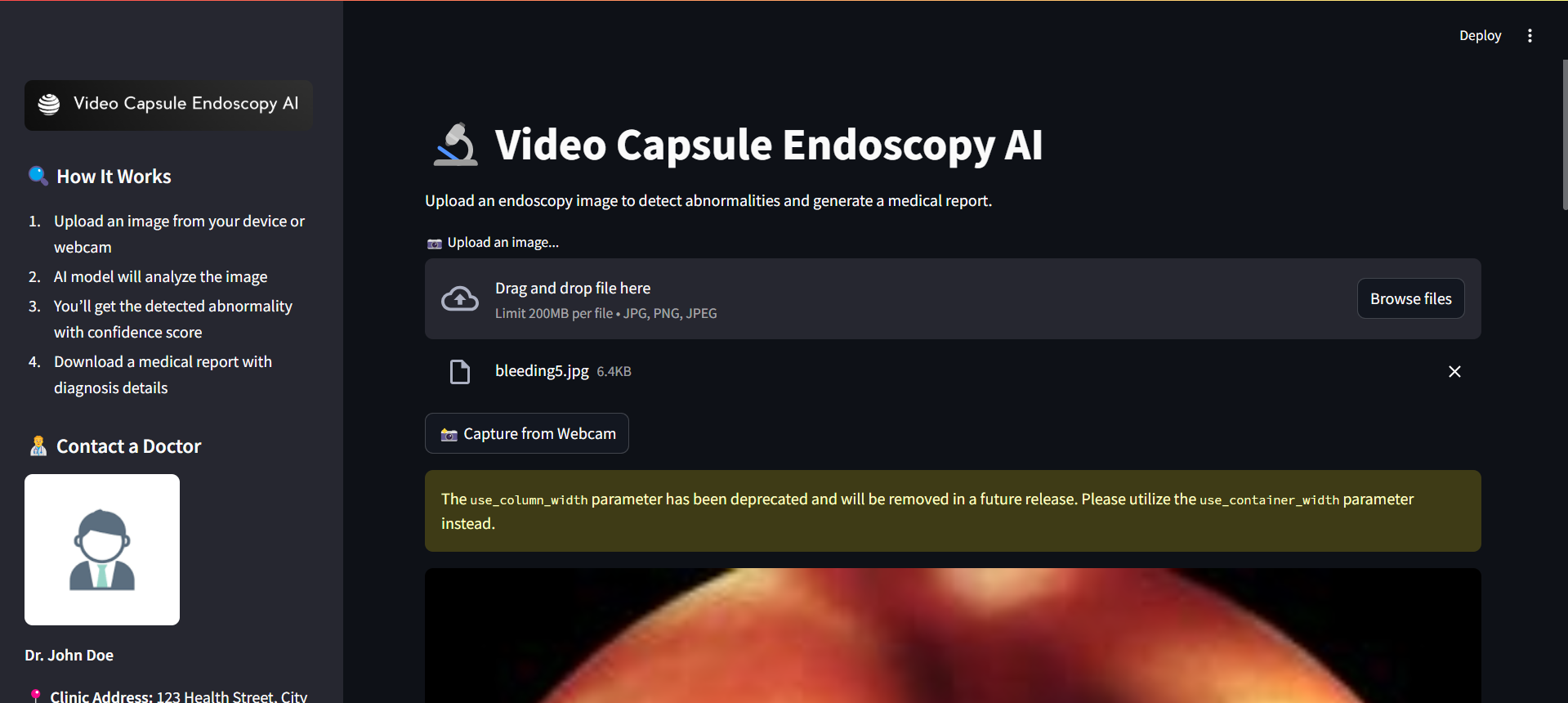

Video Capsule Endoscopy (VCE) is a revolutionary diagnostic tool for detecting gastrointestinal abnormalities, but its reliance on manual interpretation makes it time-consuming and prone to human error. This project was inspired by the need to integrate AI into medical imaging, automating abnormality detection to assist healthcare professionals, reduce workload, and improve early diagnosis.
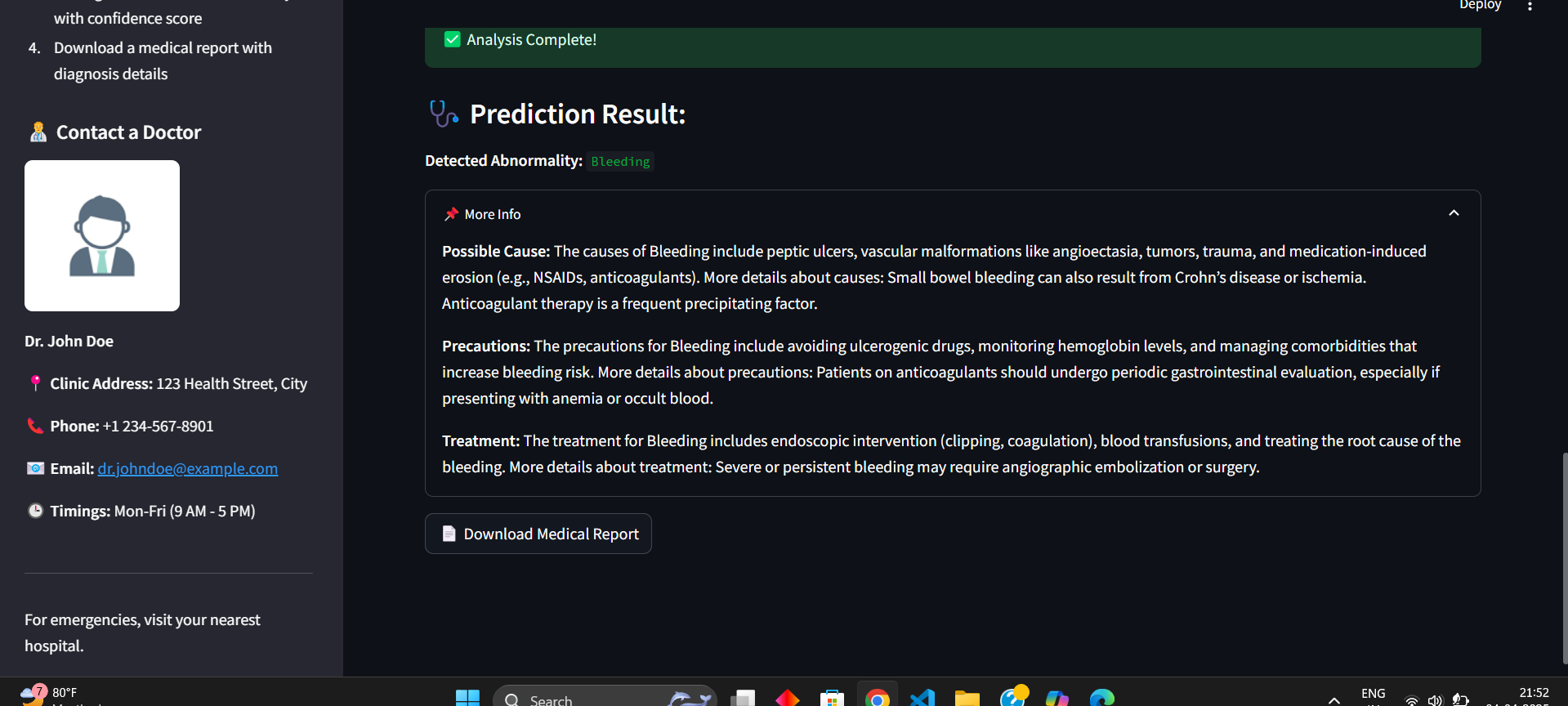
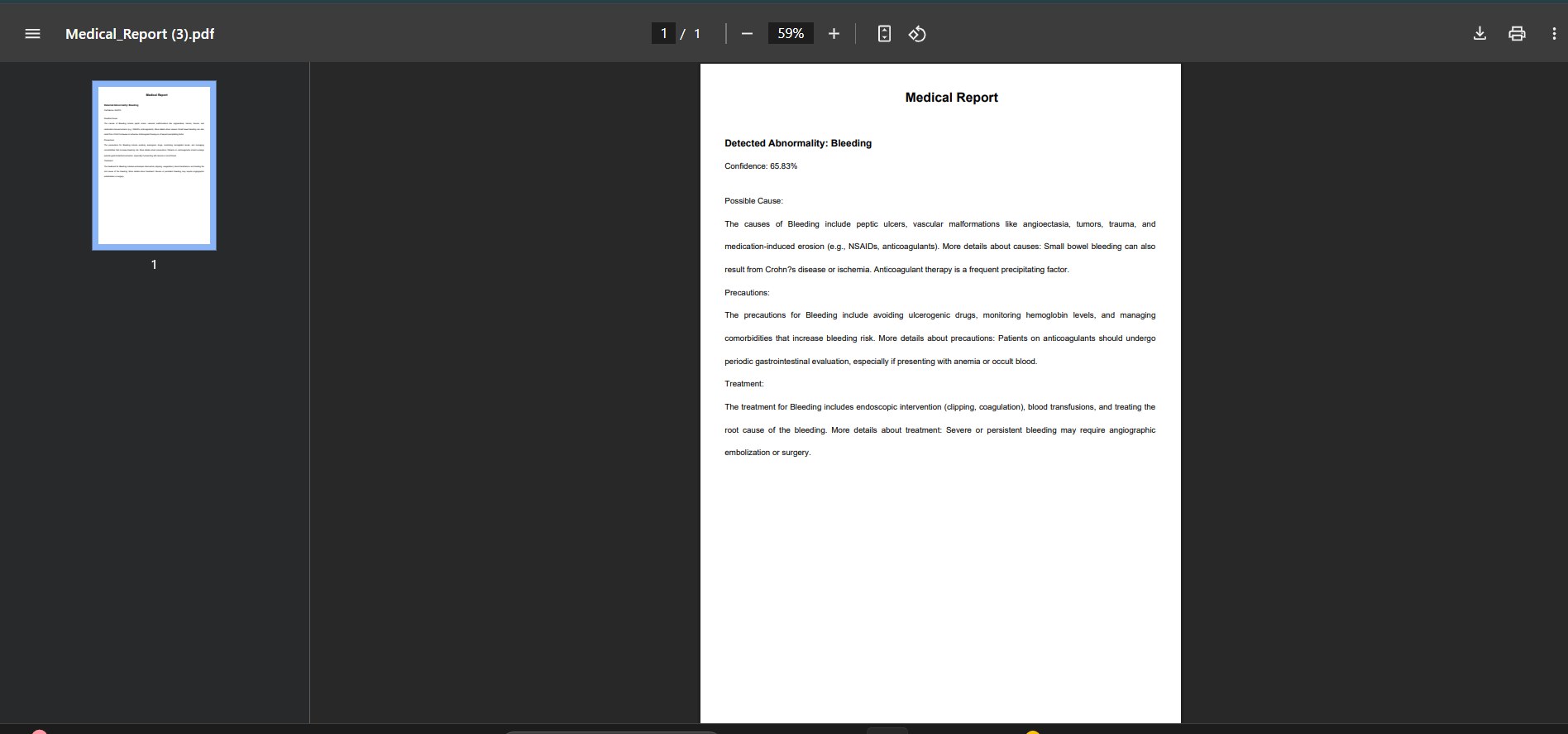
The application allows users to upload endoscopic images, which are analyzed by a deep learning model trained to classify various gastrointestinal conditions. It provides a detailed report containing the detected abnormality, confidence score, possible causes, precautions, and recommended treatments. The system also offers a streamlined interface for easy accessibility and generates professional medical reports in PDF format.
The project is built using a convolutional neural network (CNN) model trained on endoscopic images. The interface is developed with Streamlit for user-friendly interaction, while OpenCV and PIL handle image preprocessing. Disease-related data is stored in structured files (CSV, Word documents) and retrieved dynamically. Report generation is done using FPDF, ensuring comprehensive and well-structured medical documentation.
One of the biggest challenges was obtaining high-quality, annotated medical images for training the model. Encoding issues while handling text data in different file formats also posed difficulties. Additionally, optimizing model performance to ensure real-time predictions without compromising accuracy required significant fine-tuning.
We successfully developed an AI-powered diagnostic tool capable of assisting medical professionals in detecting gastrointestinal conditions more efficiently. The integration of automated report generation enhances usability, and the model’s high accuracy in classification demonstrates the effectiveness of AI in medical imaging.
This project deepened our understanding of medical imaging, deep learning, and the challenges of real-world AI implementation in healthcare. We also gained experience in data preprocessing, model optimization, and overcoming encoding and deployment issues to ensure a smooth user experience.
Future developments include expanding the model to analyze real-time VCE video streams, integrating electronic health record (EHR) systems, and improving disease classification accuracy with larger datasets. We aim to make AI-powered diagnostics more accessible, especially for remote and under-resourced healthcare facilities.
Built With
- fpdf
- keras
- matplotlib
- numpy
- opencv-python
- pandas
- pillow
- python-docx
- requests
- scikit-learn
- seaborn
- streamlit
- tensorflow


Log in or sign up for Devpost to join the conversation.