Inspiration
Vida+: A Smarter Future for Chronic Disease Care What Inspired Us In sub-Saharan Africa, millions silently live with chronic diseases like hypertension, diabetes, and HIV. Clinics often rely on paper records, limited follow-up, and reactive care. Complications such as strokes, kidney failure, and amputations happen not because we lack medicine, but because we lack timely data and proactive systems.
As a doctor and health innovator in Mozambique, I’ve witnessed this firsthand. That’s why we built Vida+: to bring predictive, preventive, and people-centered care to those who need it most.
What it does
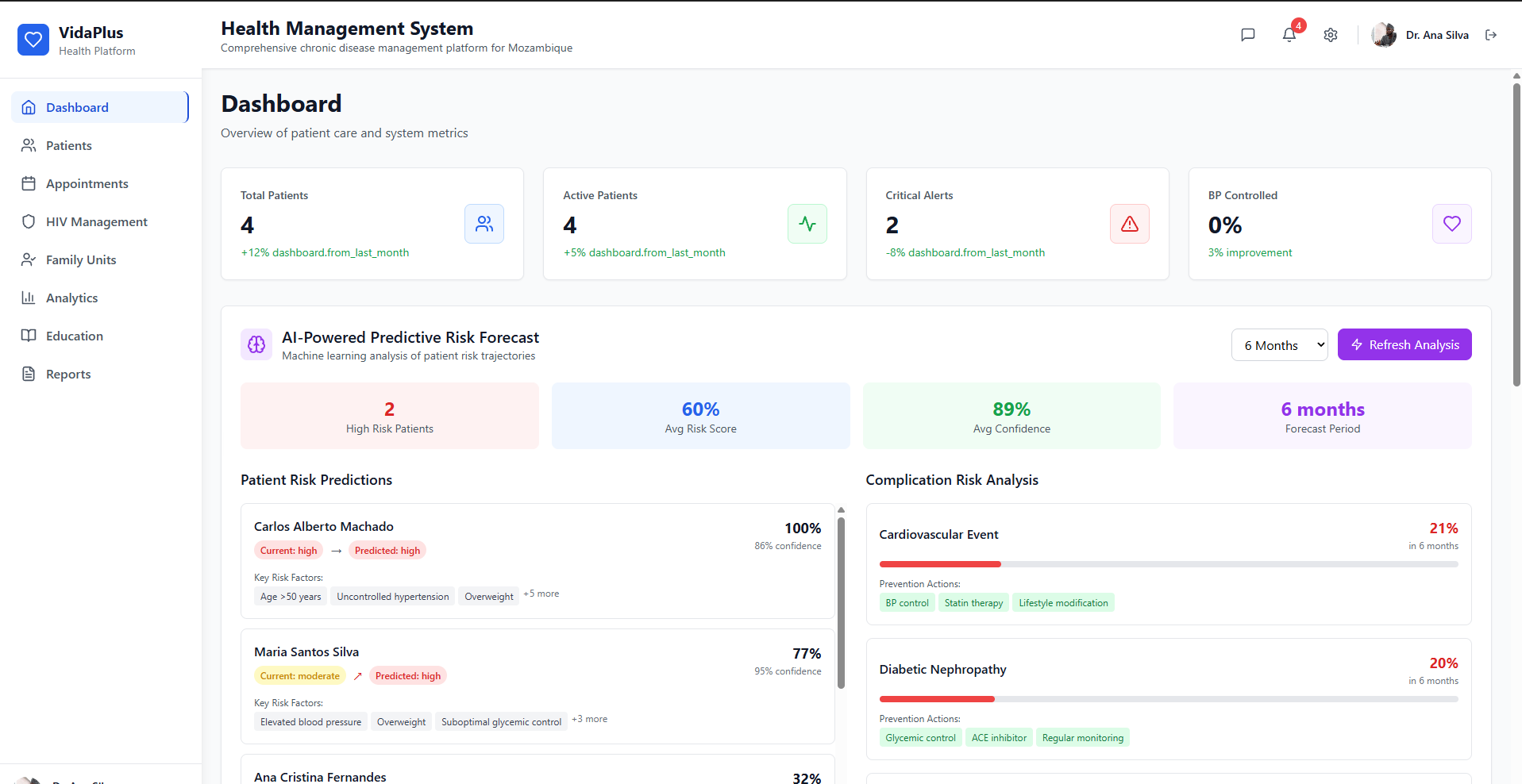
Vida+ is a digital health platform that empowers clinics to predict, prevent, and manage chronic diseases more effectively.
It allows healthcare providers to:
Track patients with hypertension, diabetes, and HIV over time
Log clinical data including vitals, labs, medications, comorbidities, and complications
Generate longitudinal trends and evolution charts (e.g. BP, HbA1c, BMI)
Identify shared risk factors and complications in family units
Receive AI-assisted clinical suggestions via a built-in decision support system
Flag high-risk patients and recommend timely interventions
Monitor adherence, appointment history, and follow-up gaps
Educate patients with personalized educational content
Produce dashboards and public health reports for districts and clinics
Export data for research, referral summaries, and ministry-level reporting
Whether in a rural clinic or an urban hospital, Vida+ helps health workers move from reactive care to data-driven, proactive chronic disease management, saving lives and improving outcomes.
How we built it
We built Vida+ as a modular, full-stack web application, combining medical expertise with AI-assisted development using Bolt.
Our core stack includes:
Backend: PHP with CodeIgniter 4 (REST-ready, modular MVC)
Database: MySQL with relational tables for vitals, complications, medications, risk factors, etc.
Frontend: Bootstrap 5 for clean UI, Chart.js for visualizations, and Blade-style components
Bolt AI: Used extensively to generate scaffolding, wireframes, helper scripts, UI layouts, and backend logic for faster iteration
Clinical logic: Based on WHO/ADA/National guidelines, converted into structured rules for decision support
Analytics engine: Designed to track population-level KPIs (e.g. control rates, complication rates, follow-up gaps)
Role-based access: Admin, clinical staff, data manager levels with RBAC enforcement
With Bolt, we went from idea to production-grade MVP in days instead of months, generating dynamic components, database models, and context-aware code blocks faster than a traditional team could manually.
The system is designed for scalability, supporting:
AI-based forecasting (planned)
Mobile/offline-first extensions
Integration with public health reporting
Localization (Portuguese + English)
Challenges we ran into
Balancing clinical depth with usability Capturing complex clinical data (e.g., comorbidities, risk scores, complications, family history) without overwhelming the interface was a major challenge. We had to find the right balance between structure and simplicity, especially for users with limited digital training.
Encoding real clinical logic Medical decision-making involves nuance. Translating national and global treatment guidelines into machine-readable logic for the decision support system (CDSS), while keeping it safe and interpretable, took several iterations.
Building for real-world constraints Our target users are often in resource-limited settings with poor connectivity and few devices. We had to make sure the platform was lightweight, offline-ready (future), and responsive, while maintaining full functionality.
Adapting Bolt to our domain While Bolt accelerated development immensely, customizing AI-generated scaffolding for a highly clinical, data-sensitive environment required close attention, especially in database design, form validation, and user access control.
Designing for modular growth We wanted Vida+ to be scalable and adaptable for other diseases and contexts (e.g., HIV, TB, maternal care). Building a flexible modular architecture was complex, but essential to avoid “hard-coding” clinical assumptions.
Privacy and ethical safeguards Storing health data, especially sensitive, longitudinal family-linked records meant we had to prioritize consent tracking, access control, and future integration of encryption/audit logging protocols.
These challenges helped us build a smarter, safer, and more scalable system, and we’re just getting started.
Accomplishments that we're proud of
We turned a clinical vision into a working digital solution From a simple idea on paper, we built a fully functional, modular platform that can help clinicians manage patients more proactively, track outcomes, and prevent complications.
We built a structured, longitudinal patient model Unlike basic health apps, Vida+ captures data over time including vitals, labs, medications, family history, and complications enabling real trend analysis and intelligent risk prediction.
We implemented an early Clinical Decision Support System (CDSS) Our platform now provides real-time clinical suggestions based on patient data, bringing AI-assisted thinking to even the most remote clinics.
We designed for real-world Africa Vida+ was built with constraints in mind: limited infrastructure, low digital literacy, and multilingual communities. Our design is lightweight, scalable, and practical for real deployment.
We accelerated everything using Bolt With Bolt, we were able to build in days what would normally take weeks or months. We used it to scaffold our backend, generate interfaces, design workflows, and explore edge cases.
We created a population-level analytics dashboard We don’t just help one patient, we help entire clinics and public health teams understand who needs help, where, and why.
We made something that matters Vida+ is more than software. It’s a tool to prevent strokes. To avoid amputations. To bring order to chaos. It has the potential to save lives and that’s what we’re most proud of.
What we learned
Healthcare is complex and deeply human It’s not just about forms and databases. Every data point is a person. Designing a system that respects both clinical structure and human dignity taught us to think beyond just features.
Prevention is not just clinical it’s systemic We realized that preventing complications requires more than alerts. It demands coordination, education, and tools that empower both providers and patients across time, families, and communities.
Simplicity is powerful We learned that the best system is not the one with the most buttons but the one that helps the nurse in a rural clinic do exactly what they need, quickly and confidently.
AI is not a replacement it’s a partner Using Bolt and building our CDSS taught us that AI can accelerate development and amplify clinical reasoning, but it still needs human wisdom, ethical design, and local knowledge.
Modularity unlocks growth Designing Vida+ in modular layers patient core, HIV, analytics, CDSS taught us how to build systems that can adapt, scale, and evolve without breaking.
Privacy and ethics are not optional We learned that working with real patient data means carrying real responsibility. We started designing privacy from day one and we’ll continue to strengthen it.
You don’t need to be in Silicon Valley to build something world-class With a clear mission, the right tools, and a deep connection to the problem, innovation can come from anywhere. Including here.
What's next for Vida+ Predictive, Preventive Digital Health for Chronic Care
Real-world deployment in public clinics We are preparing to launch pilot programs in public health facilities across Mozambique, starting with chronic disease units. These deployments will help validate clinical impact, usability, and long-term outcomes in resource-limited settings.
Offline-ready mobile companion We're building a lightweight, tablet-friendly mobile app to support community health workers and rural clinics. It will include offline data capture, syncing, and AI-powered prioritization for home visits.
Advanced AI-driven risk prediction We plan to integrate a predictive model that estimates individual risk for:
Stroke, nephropathy, amputation (in 5–10 year horizons)
Based on vitals, labs, trends, and comorbidities
Using interpretable machine learning models
- Expansion to HIV, TB, and maternal care modules Vida+ will grow beyond hypertension and diabetes. We're actively adding modules for:
HIV/SIDA management (with CD4, VL, ART tracking)
TB co-infection
PMTCT and maternal risk monitoring
Open public health dashboards and research integration We’ll offer real-time dashboards for ministries of health and NGOs, and provide anonymized, exportable data for epidemiological research and cohort studies.
Crowdfunding + global partnerships We plan to launch on platforms like GoFundMe and seek global partnerships with universities, NGOs, and funders to sustain the platform and scale it across the continent.
Our mission remains clear: Prevent what can be prevented. Predict what can be predicted. Empower those who care. Protect those who are most vulnerable.
Built With
- ai
- bolt
- bootstrap
- chart.js
- codeigniter
- fastapi
- mysql
- php
- python
- typescript

Log in or sign up for Devpost to join the conversation.