-
-
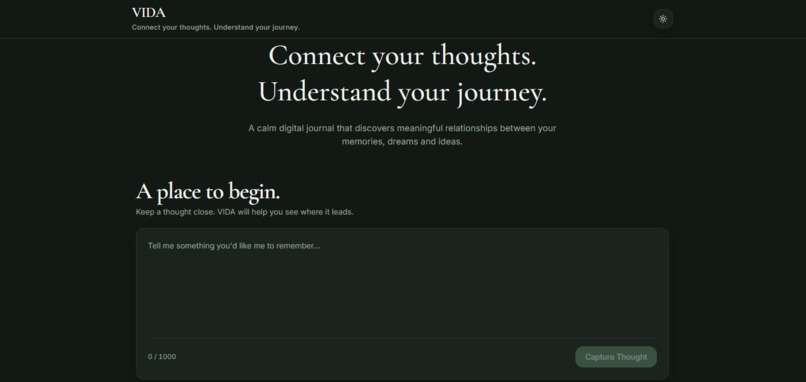
DARK MODE
-
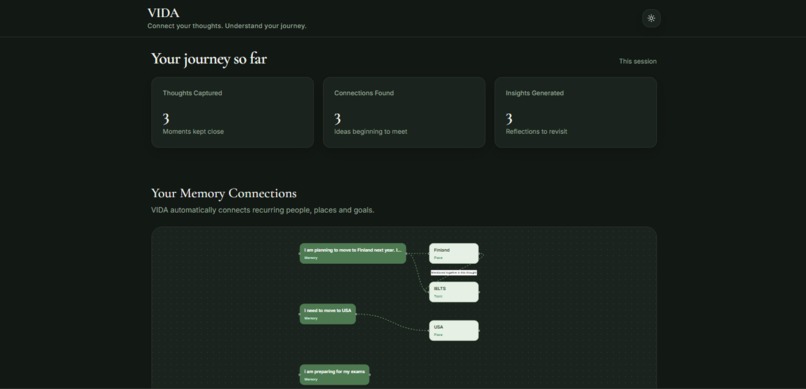
DARK MODE
-
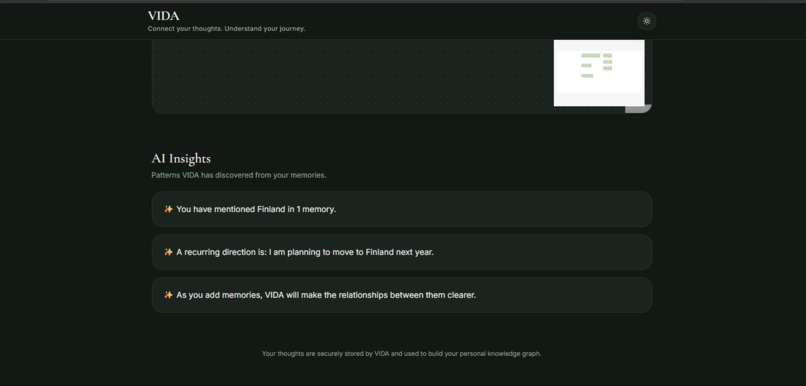
DARK MODE
-

LIGHT MODE
-
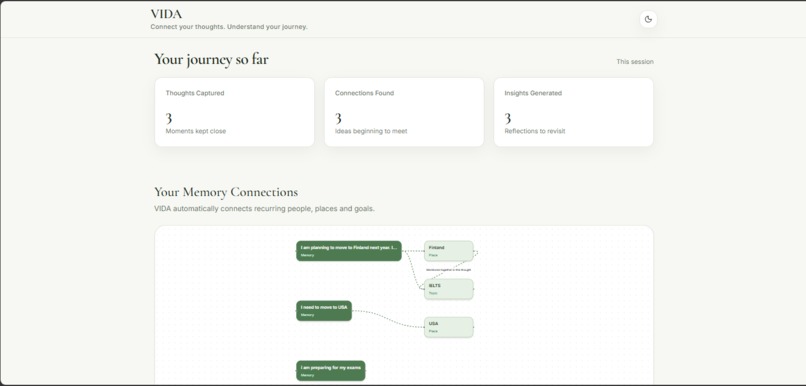
LIGHT MODE


VIDA
Inspiration
We often capture ideas, goals, and memories across different notes, journals, and apps, but these thoughts remain disconnected. Over time, it becomes difficult to identify recurring patterns or understand how our experiences relate to one another.
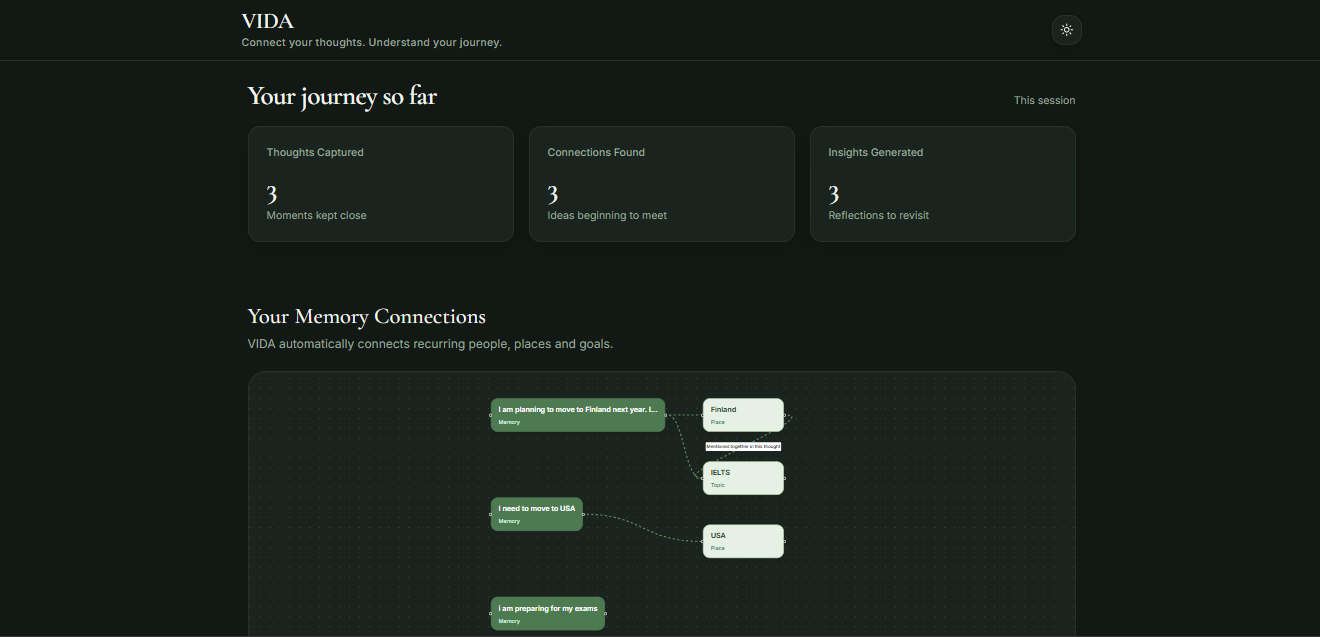
VIDA was inspired by the idea of creating a personal memory companion that does more than store information. Instead of acting like a traditional note-taking application, VIDA uses AI to organize memories, identify meaningful entities and relationships, and present them as an interactive knowledge graph that helps users better understand their personal journey.
What it does
VIDA enables users to capture personal memories, reflections, and goals through a simple interface.
When a memory is saved, AI analyzes the text to:
- Generate a concise summary
- Extract important entities such as people, places, and topics
- Identify personal goals mentioned in the memory
- Detect meaningful relationships between entities
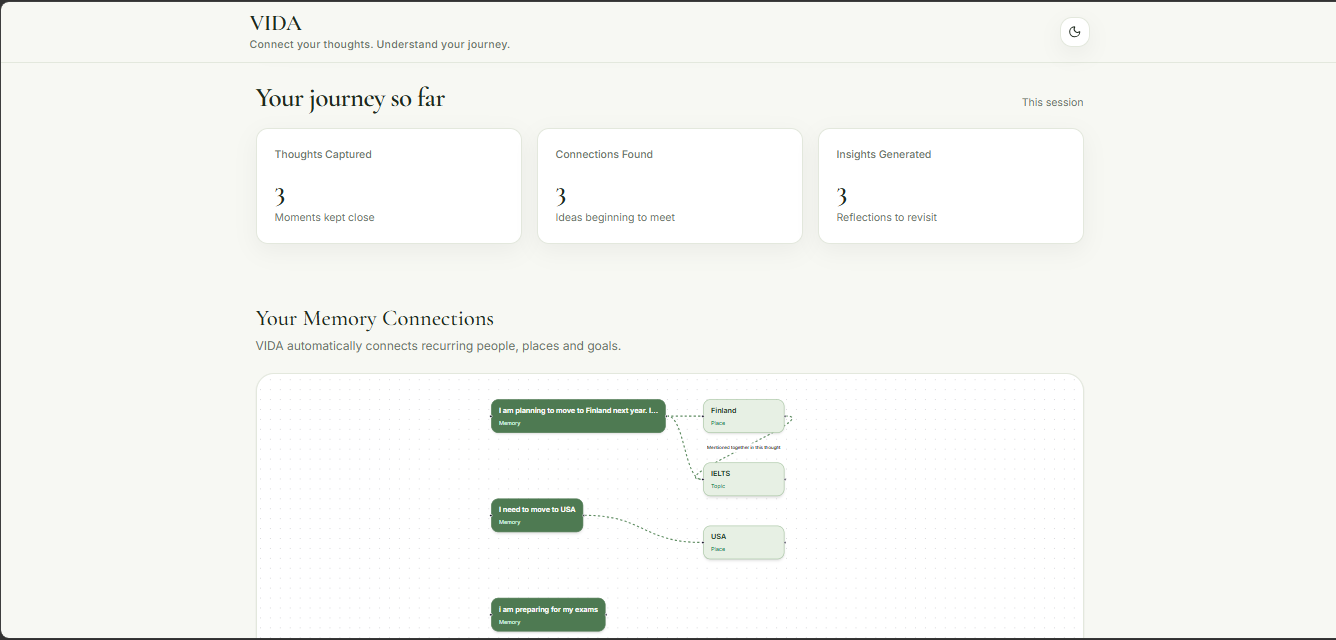
The processed information is then visualized as an interactive Knowledge Graph, allowing users to explore how different memories connect over time.
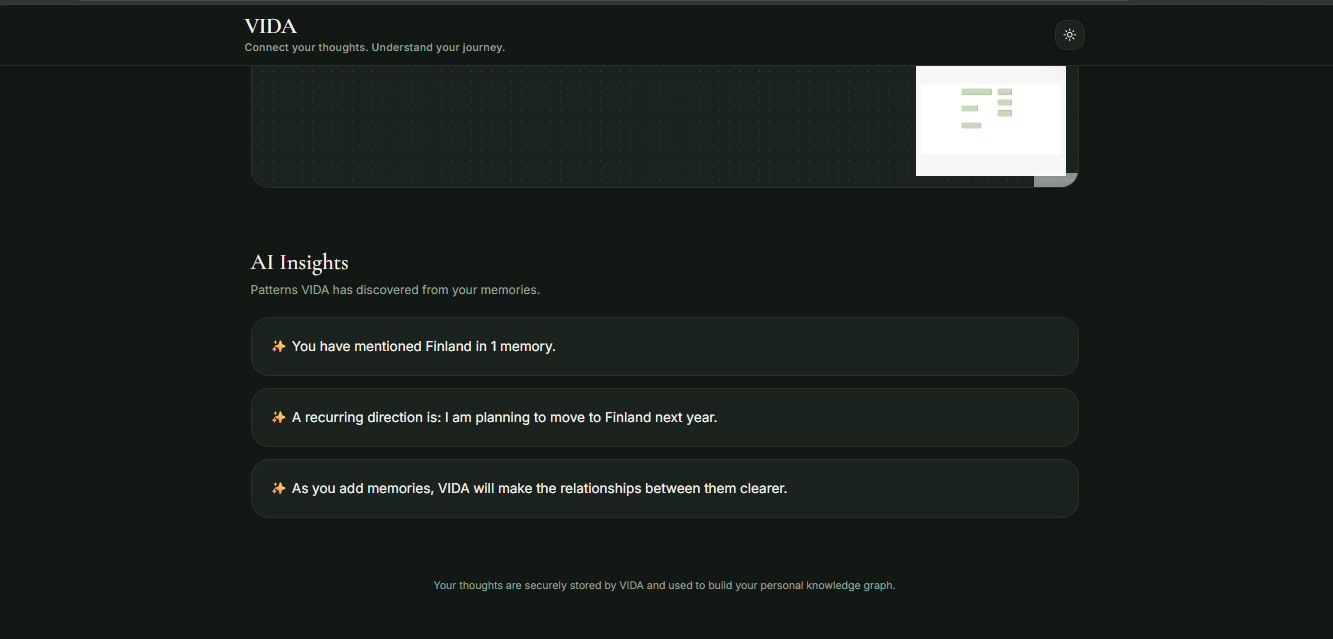
VIDA also generates AI-powered insights by identifying recurring themes and patterns across all stored memories, giving users a new perspective on their thoughts and experiences.
How I built it
The application was built as a full-stack web application.
Frontend
- React
- TypeScript
- Tailwind CSS
- React Flow (Knowledge Graph visualization)
- Vite
Backend
- Node.js
- Express.js
- TypeScript
AI
- OpenAI Responses API
- Structured JSON Schema outputs for reliable extraction
- Automatic entity and relationship detection
The backend exposes REST APIs for memories, insights, statistics, and graph generation. Each submitted memory is analyzed by the AI service, stored locally, and used to continuously build the user's personal knowledge graph.
Challenges I ran into
One of the biggest challenges was designing a system that could consistently transform unstructured text into structured knowledge without introducing incorrect relationships.
Building the knowledge graph required careful handling of duplicate entities, relationship generation, and graph visualization so that the information remained meaningful and easy to explore.
Another challenge was integrating the frontend and backend while ensuring that AI-generated insights, statistics, and graph updates remained synchronized after each new memory.
Accomplishments that I' m proud of
- Built a complete AI-powered full-stack application from scratch.
- Successfully transformed free-form memories into structured knowledge.
- Developed an interactive knowledge graph for visual exploration.
- Generated contextual AI insights based on recurring memories.
- Designed a clean, responsive interface focused on simplicity and usability.
What I learned
This project strengthened our understanding of:
- Building AI-powered web applications
- Working with the OpenAI Responses API
- Structured AI outputs using JSON Schema
- Designing knowledge graph data structures
- React state management
- Backend API development with Express
- Full-stack application architecture
What's next for VIDA
We envision VIDA evolving into a complete personal knowledge companion.
Future improvements include:
- Secure user authentication
- Cloud database and cross-device synchronization
- Semantic memory search
- Voice and image memories
- Memory timeline visualization
- Personalized AI assistant for memory retrieval
- Calendar integration
- Mobile application support
Our long-term vision is to help users not only remember their experiences but also understand the meaningful connections between them.
Built With
- api
- css
- css3
- express.js
- flow
- git
- html5
- javascript
- node.js
- openai
- react
- rest
- tailwind
- typescript
- vite

Log in or sign up for Devpost to join the conversation.