-
-
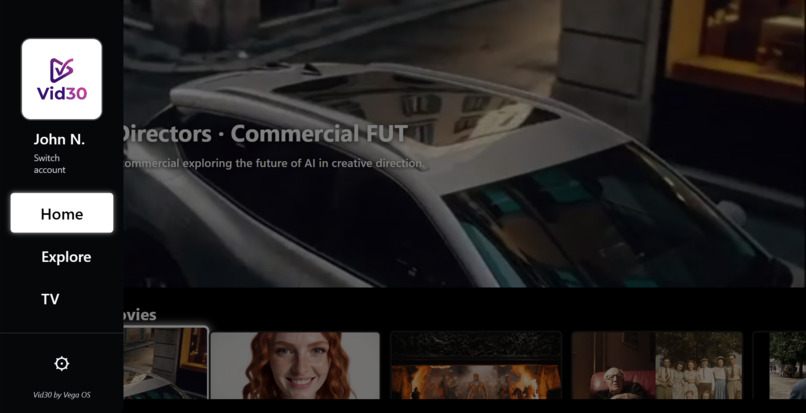
Streaming platform
-
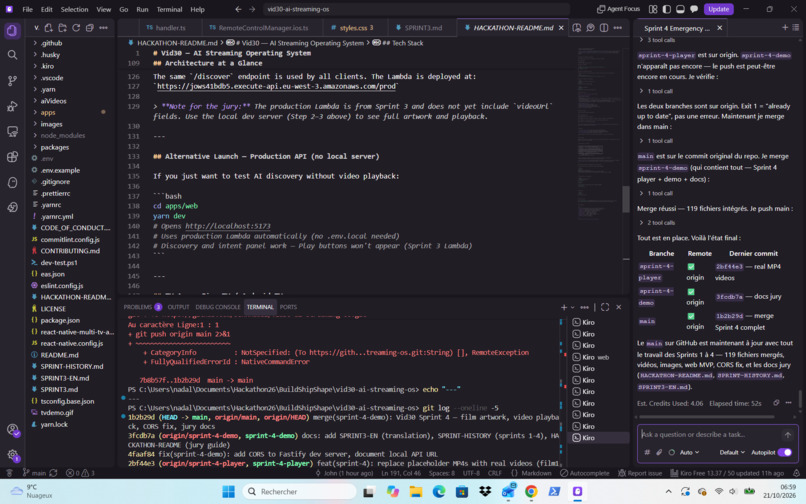
Kiro
-
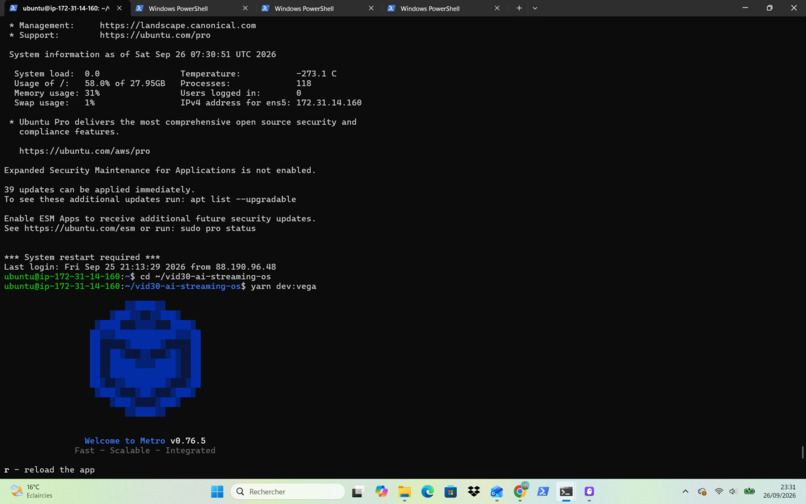
Trying Vega OS
-
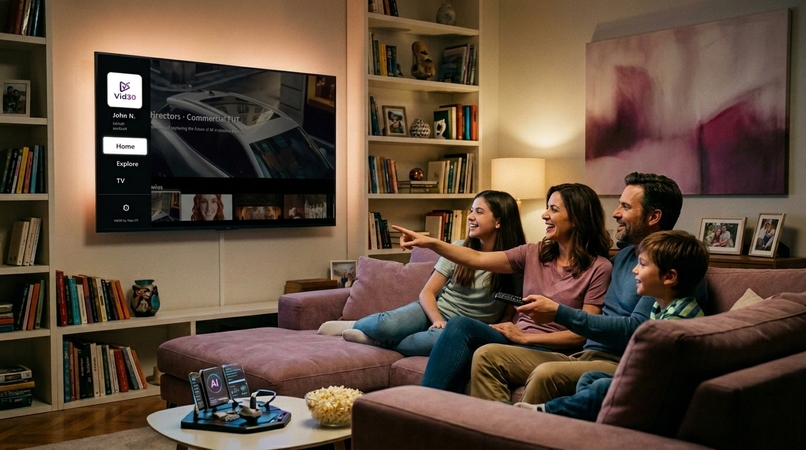
Vid30 Hero
""Inspiration I approach Vid30 with two perspectives: as a builder exploring AI and Smart TV technology, and as a startup-minded founder thinking about strategy, distribution, and sustainable business models.
One pattern caught my attention in the emerging AI filmmaking community. I call it the “Prompter Loop.”
People invest in generative AI courses, learn new tools, refine their prompting skills, create impressive demos and films, and then often teach others, enter competitions, or share their work on professional social networks. This cycle helps people learn and pushes the community forward. But creating something is not the same as building an audience for it, and sharing a film does not automatically create a sustainable way to earn revenue from that creative work.
Courses, consulting, and competitions can create opportunities, of course. My question is different: what happens to the film itself after it has been created? Where can it be discovered, watched, and appreciated by an audience beyond the creator’s existing network?
Social platforms are useful for visibility, but I saw an opportunity to explore another destination: the television screen, where watching films can become a more focused, cinematic experience.
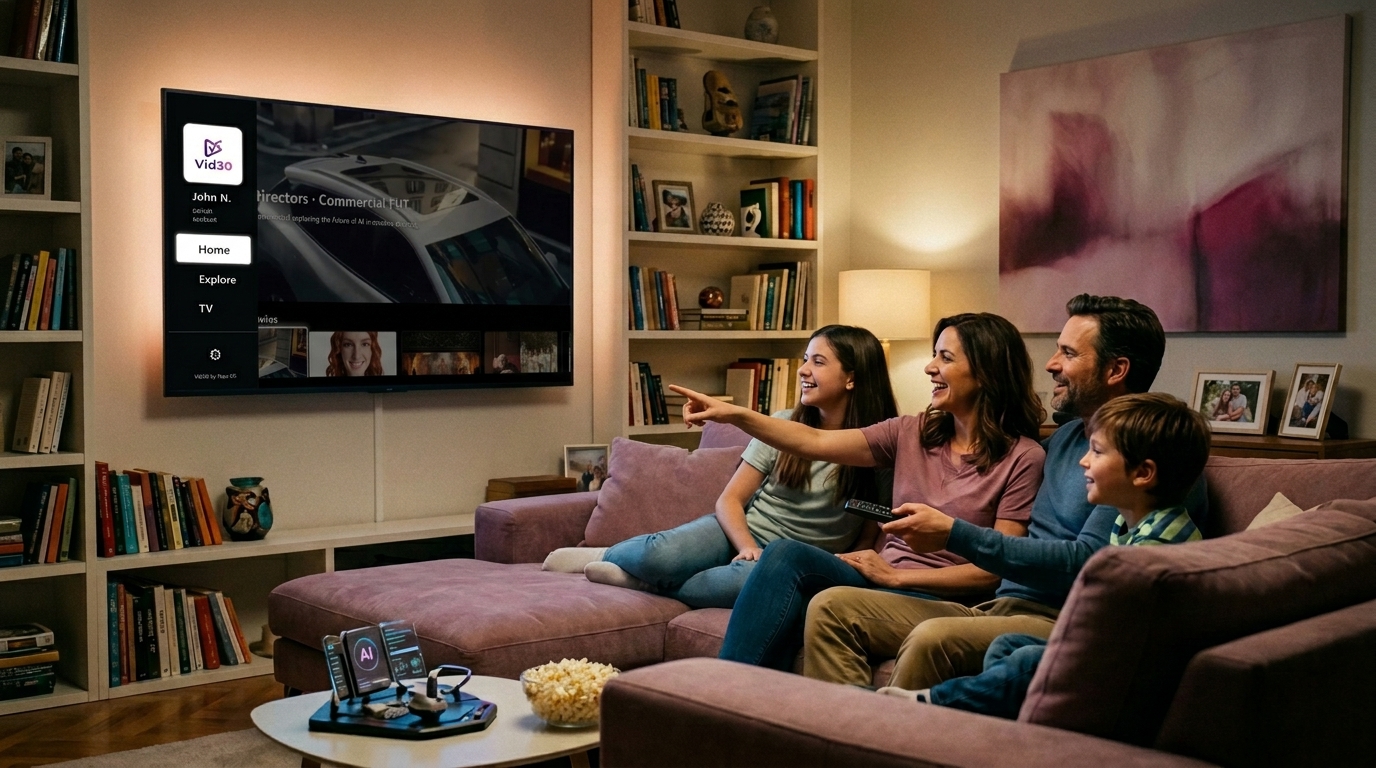
That is why I started building Vid30 the AI Streaming OS for Smart TVs: a project exploring how AI-created films could reach audiences through intelligent discovery on Fire TV and Vega OS.
For me, this is both a technology challenge and a startup question: can we build a better bridge between AI creation, audience discovery, and eventually sustainable monetization?
What it does
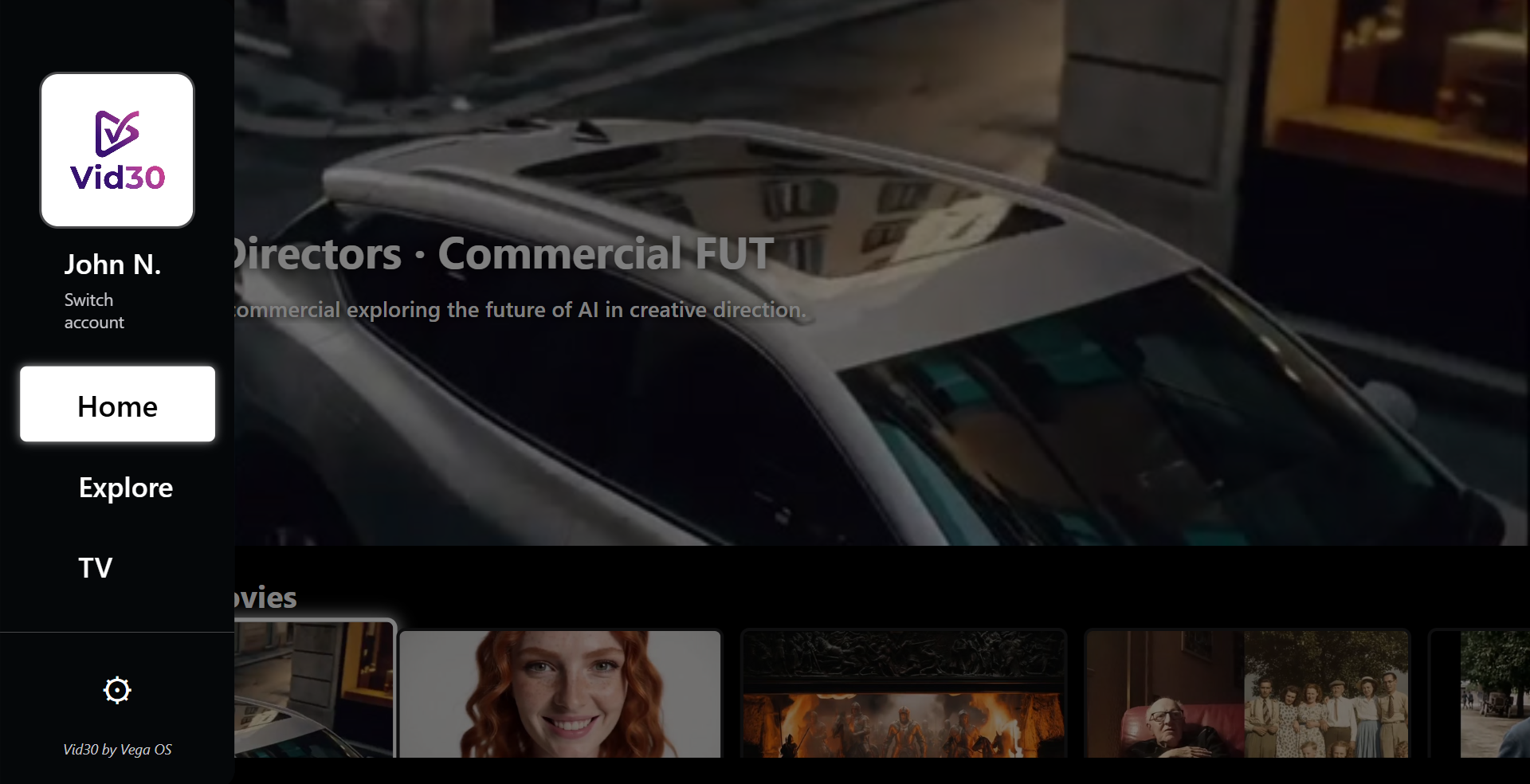
Vid30 explores a new streaming experience designed around AI-created films and the people who make them.
The current prototype includes:
- AI-powered discovery: Users can describe what they want to watch and receive relevant film recommendations. - Context-aware recommendations: The discovery service uses the user’s request and viewing context to help match films to their intent. - Family Mode: A family-aware discovery option filters content based on safety-related metadata. - A growing film catalog: The prototype includes 41 catalog entries, including 14 Vid30 Originals. - A Smart TV-oriented experience: The project builds on a React Native TV application foundation targeting Fire TV and Vega OS, alongside a web MVP for demonstrating and testing the discovery experience. The current focus is making AI-created films easier to discover. Reliable end-to-end video playback and validation on the target TV runtime remain important next steps.
How we built it
I built Vid30 around a practical principle: the TV application should request recommendations from a backend service rather than calling the AI model directly.
The AI discovery flow uses:
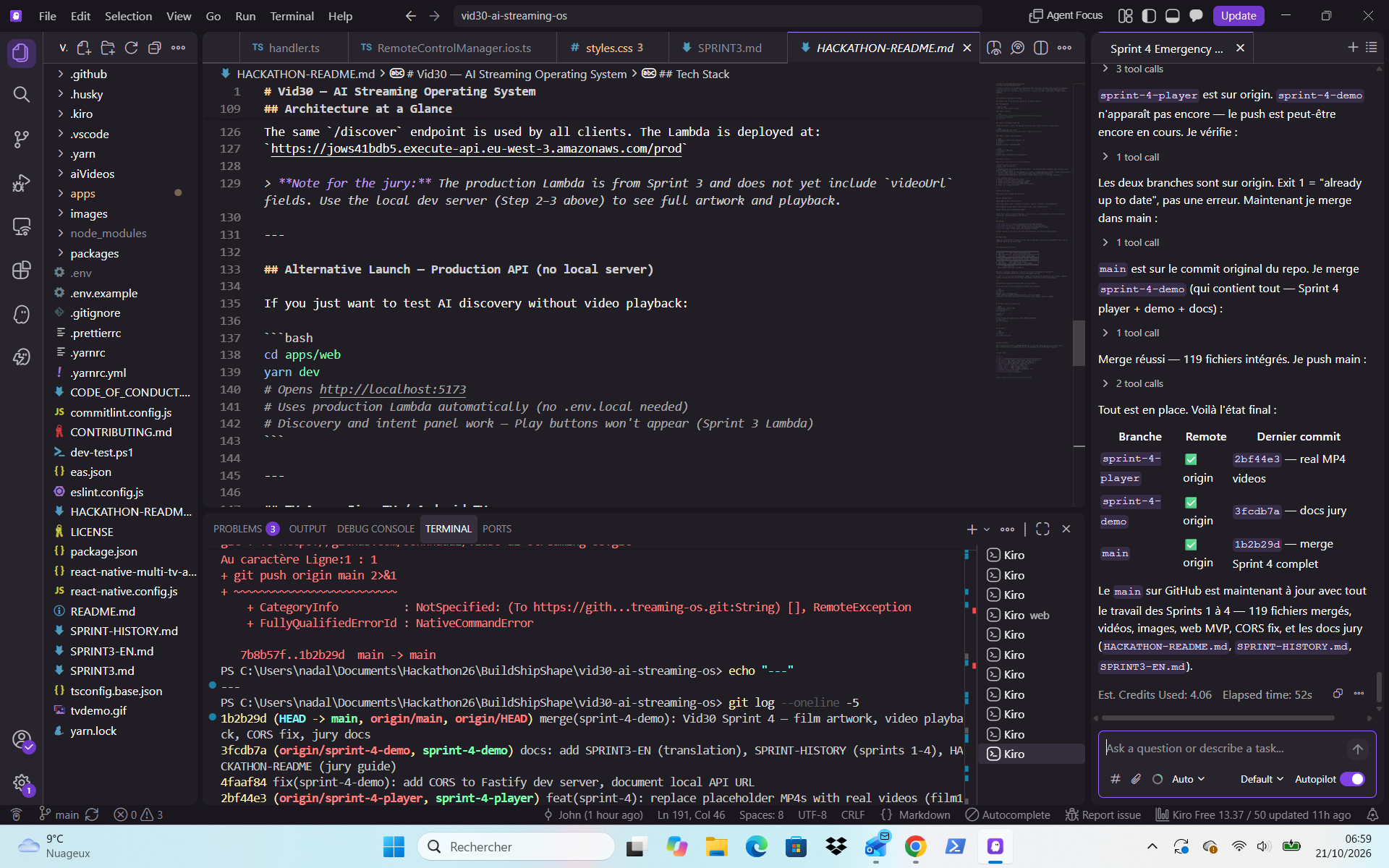
- Amazon API Gateway to expose the backend API. - AWS Lambda to run the discovery service. - Amazon Bedrock with Amazon Nova Lite to support AI-assisted discovery. - Provider abstractions to separate AI and catalog logic, making the service easier to test and evolve. - React Native and TypeScript for the Smart TV application foundation. - React and Vite for the web MVP. - Vitest for automated testing. - Kiro as an AI-assisted development tool for codebase analysis, implementation, and iteration. This architecture lets the application send a discovery request to the backend and receive catalog results without coupling the client directly to a particular AI provider.
I also used a mock catalog to develop and test the discovery flow without making every test dependent on live AWS services.
Challenges we ran into
One of the biggest challenges was the difference between building for Vega OS and validating an application at runtime.
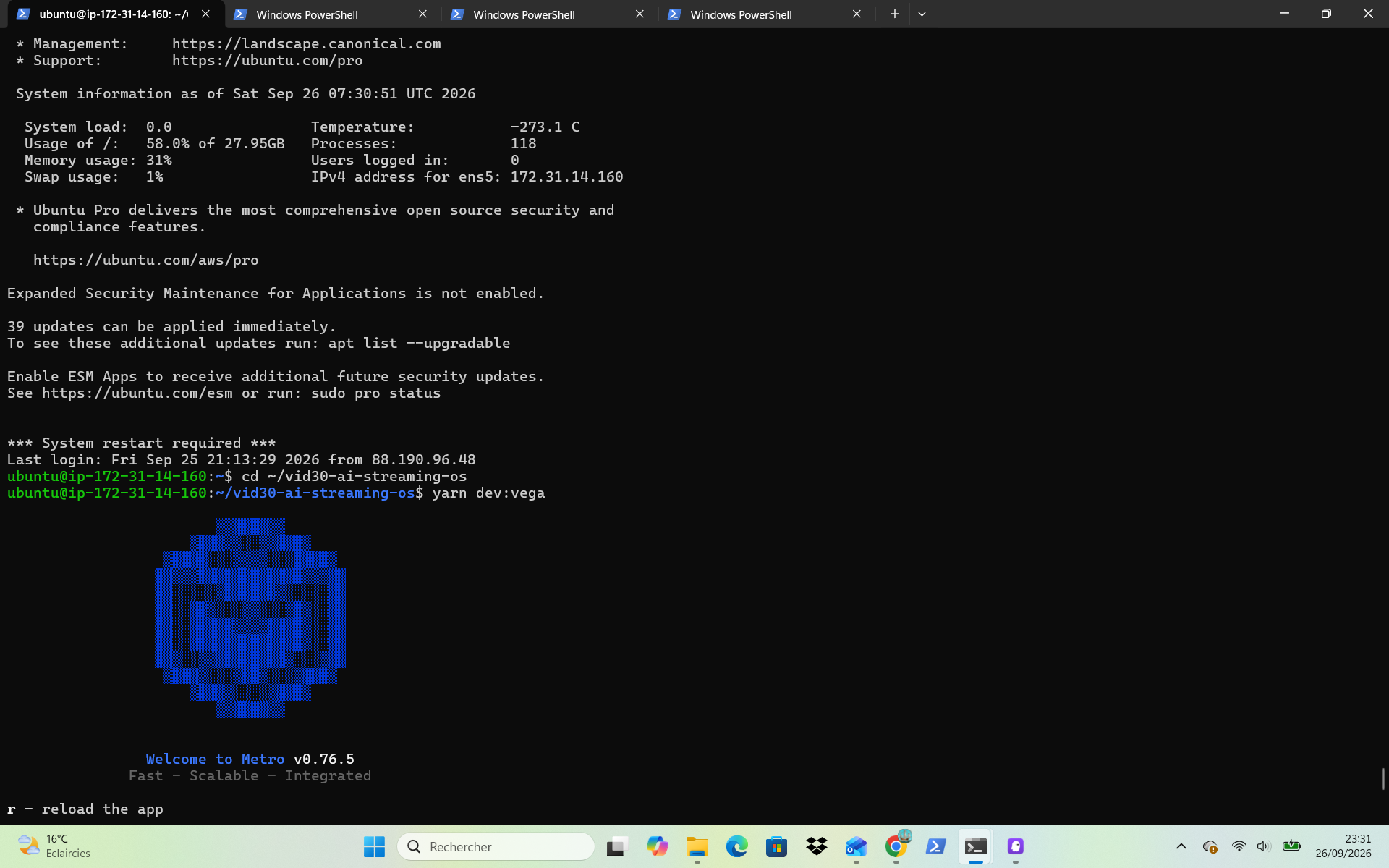
The Vega development workflow required additional environment investigation. I moved build work to an Ubuntu environment on AWS EC2 and succeeded in generating a Vega package, but a successful build is not proof that the application runs correctly on a device or simulator. End-to-end runtime validation remains an important milestone.
Another challenge was turning the Family Mode concept into a consistent implementation. It required aligning catalog metadata, content-safety information, discovery logic, and the user interface.
Finally, I had to make difficult scope decisions under a tight hackathon deadline. AI discovery, catalog integration, and the web MVP were achievable priorities. Complete video playback and full Smart TV runtime validation require further work.
These challenges reinforced an important lesson: a promising architecture and a successful build are useful milestones, but the user experience must ultimately be demonstrated working end to end.
Accomplishments that we’re proud of
- Built an AWS-backed AI discovery service integrating Amazon Bedrock, AWS Lambda, and API Gateway.
- Developed a provider-based architecture that separates discovery, AI, and catalog responsibilities.
- Expanded the prototype catalog to 41 entries, including 14 Vid30 Originals.
- Implemented context-aware recommendation logic and Family Mode.
- Built a web MVP to demonstrate the discovery flow while continuing development of the Smart TV application foundation.
- Added automated tests and TypeScript checks to improve reliability.
- Turned a broad product vision into a more concrete technical prototype while identifying the next steps required for a complete TV experience. Beyond the technical milestones, I am proud that Vid30 starts with a question about value creation, not just technology: how can AI filmmakers get their work discovered after they create it?
What we learned
This project strengthened my understanding of how to connect a generative AI service to a real application architecture, with clear boundaries between the client, backend, model provider, and content catalog.
It also reinforced the importance of testing business assumptions alongside technical assumptions. Intelligent recommendations can help people find relevant films, but recommendations alone do not prove audience demand, creator adoption, or a sustainable business model.
From the Smart TV side, I learned to distinguish packaging from runtime validation and to treat the target-device experience as a core requirement rather than a final detail.
Most importantly, I learned to approach AI filmmaking not only as a creation problem, but also as a question of discovery, distribution, and value for creators.
What’s next for Vid30
The next step is to complete and validate the viewing experience, including reliable video playback and testing on the intended Smart TV platform.
From there, I want to explore three areas:
- Creator distribution: Make it easier to bring AI-created films into the catalog and present them with appropriate artwork, metadata, and context. - Audience discovery: Improve recommendations so viewers can find films that match their interests, mood, and viewing context. - Sustainable monetization: Investigate potential models, including carefully designed contextual advertising, that could support the platform while creating value for creators and audiences. The “Prompter Loop” is the observation that inspired this direction, not a claim that every AI filmmaker faces the same problem. My next challenge is to validate the idea with real creators and viewers.
My long-term vision is for Vid30 to become a destination where AI-created films are not only made and shared, but also discovered and watched.
Vid30 aims to connect the next generation of AI filmmaking with the next generation of Smart TV streaming.
Built With
- ai
- amazon-api-gateway
- amazon-bedrock
- amazon-lambda
- amazon-nova-lite
- amazon-web-services
- fire-tv
- generative-ai
- javascript
- kiro
- node.js
- react
- react-native
- recommendation-systems
- typescript
- vega-os
- vite
- vitest


Log in or sign up for Devpost to join the conversation.