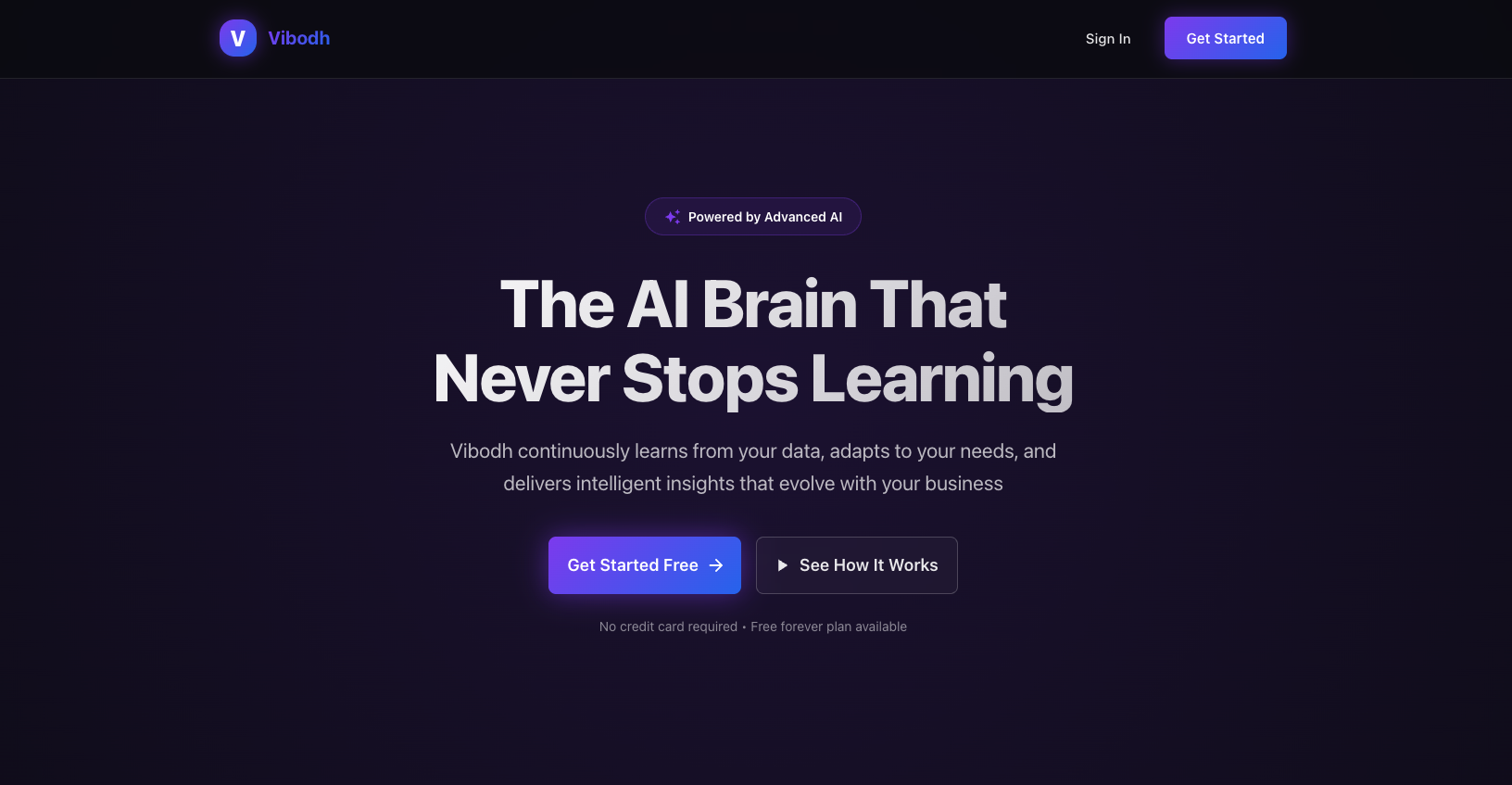
🧠 Vibodh AI – Knowledge that Evolves with Your Organization
Inspiration
Modern organizations rely on multiple tools—Slack, ClickUp, Google Ads, Meta Ads, CRMs (Hubspot, Salesforce, etc.) but none of them truly understand how the company operates. This leads to data silos, inefficiencies, and disconnected insights.
We wanted to create a system that acts as an organizational brain, learning continuously from every workflow, conversation, and decision to provide meaningful, connected intelligence.
What it does
Vibodh AI is a self-evolving organizational intelligence platform that unifies company data across systems, builds adaptive knowledge graphs, and continuously improves through meta-learning and adaptive reasoning.
It:
- Connects to Slack, ClickUp, Google Ads, Meta Ads, and CRMs.
- Builds an organizational knowledge graph that maps relationships between people, tasks, KPIs, and processes.
- Uses RAG (Retrieval-Augmented Generation) for context-aware responses.
- Employs multi-agent systems (Marketing & Communication agents) for insights, task automation, and recommendations.
- Learns over time using implicit feedback loops and performance-based reinforcement.
How we built it
We structured Vibodh as a three-tiered system:
- Backend (FastAPI + Supabase + Groq) – Handles ingestion, embeddings (pgvector), and LLM reasoning.
- Frontend (Next.js + Material-UI + React Force Graph) – Displays dashboards, AI insights, and knowledge graph visualizations.
- Admin Layer – For data monitoring, analytics, and feedback optimization.
Tech Stack:
- Backend: FastAPI, Supabase (PostgreSQL + pgvector), Groq (Llama 3.3 70B), OpenAI Embeddings, APScheduler
- Frontend: Next.js 15.5.5, Material-UI v7, TypeScript, Recharts, React Force Graph
- Integrations: Slack SDK, ClickUp API, Google Ads API, Meta Ads API
Challenges we ran into
- Designing an ingestion framework capable of unifying structured (CRM, Ads) and unstructured (Slack, Docs) data.
- Implementing meta-learning and adaptive reasoning while keeping inference costs low.
- Visualizing a dynamic, large-scale knowledge graph in real time.
- Ensuring security and multi-tenancy with Row-Level Security (RLS) and org-level isolation.
Accomplishments that we're proud of
- Built a working self-evolving AI system that integrates multiple enterprise tools.
- Implemented a RAG + Knowledge Graph hybrid reasoning engine.
- Deployed a multi-agent orchestration system with Communication and Marketing agents.
- Created a visually interactive organizational knowledge graph to explain how data connects.
- Established a foundation for enterprise-grade scalability using modular FastAPI services.
What we learned
- AI reasoning is only as good as the data ingestion and knowledge structure behind it.
- Combining RAG with graph-based reasoning drastically improves contextual accuracy.
- Continuous learning loops are essential for building trust and long-term adaptability.
- Building modular, containerized architectures early ensures future scalability.
What's next for Vibodh AI – Knowledge that Evolves with Your Organization
- Integrate Finance, HR, and Operations agents for full organizational visibility.
- Deploy containerized multi-tenant architecture using Docker + Kubernetes.
- Expand adaptive reasoning through reinforcement learning and feedback analytics.
- Add voice-based and Slack-native conversational interfaces.
- Launch beta testing with real organizations to measure ROI improvements.
Built With
- api
- clickup-api
- fastapi
- google-ads-api
- groq-llm
- material-ui
- meta-ads-api
- next.js
- open-ai
- open-ai-text-embedding
- python
- slack-sdk
- supabase
- typescript


Log in or sign up for Devpost to join the conversation.