Inspiration
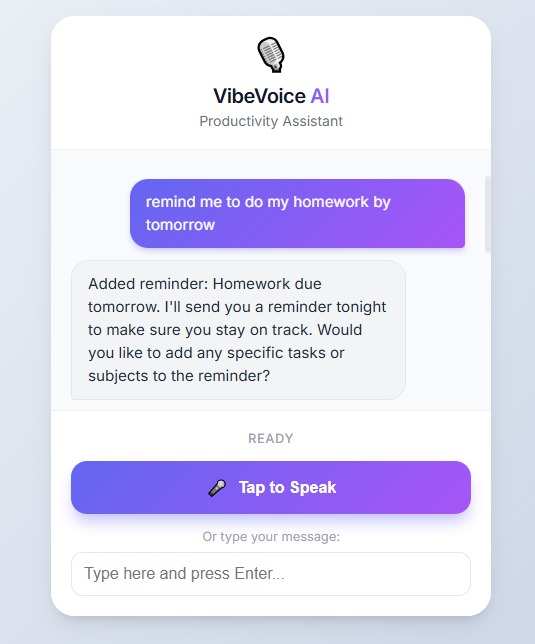
As a developer in Nairobi juggling multiple responsibilities—coding projects, family reminders, and daily tasks—I often found myself frustrated with traditional productivity apps. Typing tasks on a phone while on the move feels clunky, especially in a bustling city where voice feels more natural. The AI Vibe Coding Hackathon theme of "vibe coding" inspired me to build something intuitive: a simple web app where you speak naturally to manage tasks, set reminders, and get help, and it responds with a lifelike voice.
What it does
I wanted to create a tool that feels magical—like chatting with a real assistant—while being accessible for everyone, including low-literacy users in Kenya who might prefer voice (hence Swahili phrase support). The idea: combine browser speech recognition, fast AI reasoning, and premium text-to-speech to make productivity effortless.
How we built it
I vibe-coded the entire app in Node.js over the 72-hour weekend: Started with a basic Express server and frontend. Used Groq's Llama-3.3-70B (free tier, lightning-fast) as the brain—system prompt makes it a friendly task manager that handles English + Swahili phrases. Browser Web Speech API for speech-to-text (with text fallback for reliability). ElevenLabs for premium streaming TTS (Rachel voice—sounds incredibly natural). Polished the UI with modern CSS (gradients, animations) via AI prompts in Cursor. Added robust error handling: browser TTS fallback if ElevenLabs hits limits, clear status messages.
Challenges we ran into
API quotas: Hit OpenAI limits early → switched to Groq (free & faster). Model deprecation: Llama3-70B got decommissioned mid-hackathon → updated to Llama-3.3-70B. Speech recognition quirks: Network/permission errors on some browsers → added text input fallback and detailed guidance. TTS reliability: Free ElevenLabs credits ran low during testing → debugged voice IDs and added browser fallback.
Despite the hurdles, vibe coding let me ship a polished, functional app in days instead of weeks.
Accomplishments that we're proud of
Building a working app in hours through the power of vibe coding.
What we learned
Vibe coding is powerful: I built ~90% of this project by prompting AI tools (Cursor, Bolt.new, and even Groq itself) instead of writing every line manually. It taught me how to iterate fast through natural language. Voice UX matters: Getting real-time streaming audio to feel instant required careful error handling and fallbacks. Free-tier constraints: Navigating API quotas and deprecations (OpenAI → Groq, model changes) showed me how to pivot quickly without spending money.
What's next for VibeVoice Assistant
Add attachments eg. docs and pdfs. The app should read the attachments (notes). The app should remember the context and answer correctly based on the attachments.
Built With
- api
- cursor
- elevenlabs
- express.js
- fallback
- groq
- html/css/javascript
- llama-3.3-70b
- model)
- node.js
- recognition
- speech
- streaming)
- synthesis)
- text-to-speech
- web


Log in or sign up for Devpost to join the conversation.