💡 The Inspiration
The idea for VibeSync was born from a frustrating reality of travel and relocation: when you ask a standard AI, "Recommend a place for me to hang out," it calculates a statistical average. It sends you to the pristine, generic 5-star tourist trap. But when you travel to a new city, or when you are missing home, you don't want the highest-rated spot, you want a place that shares your cultural DNA. You want the right vibe.
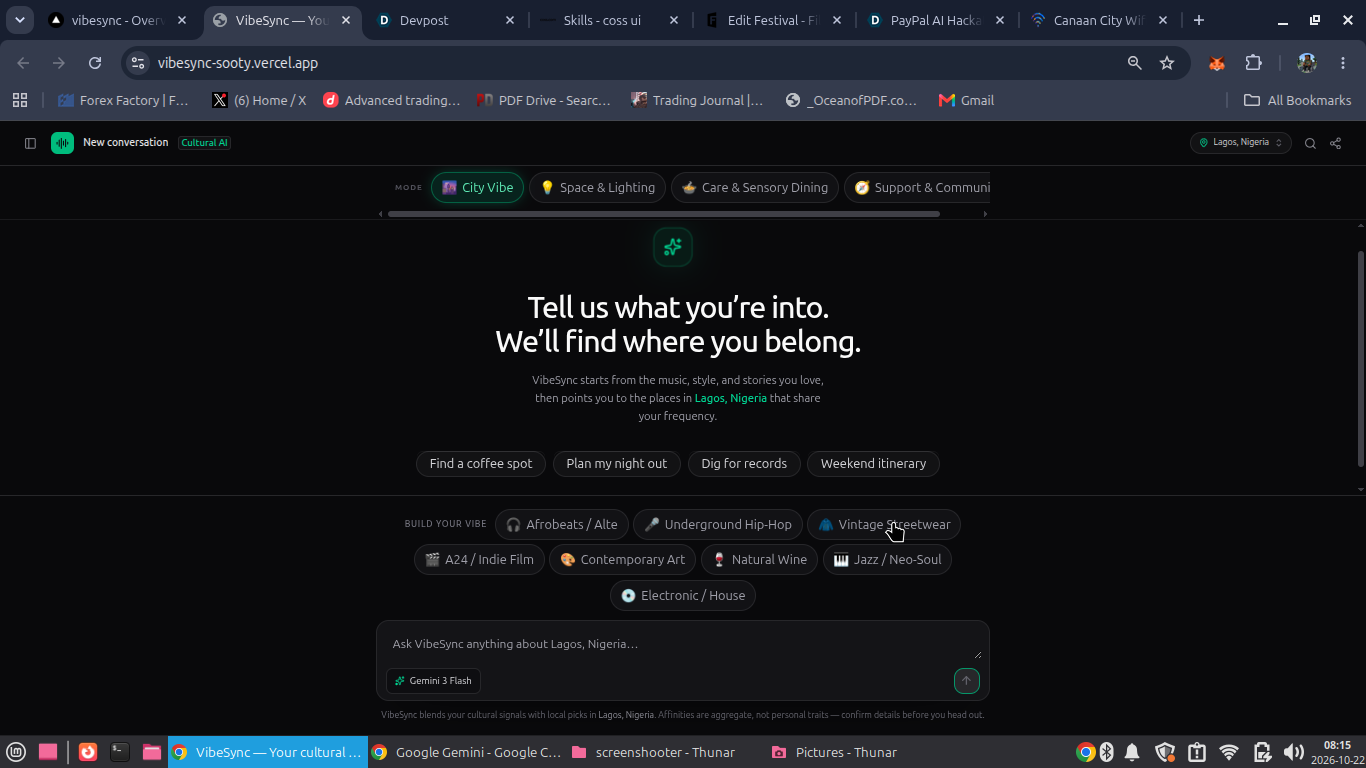
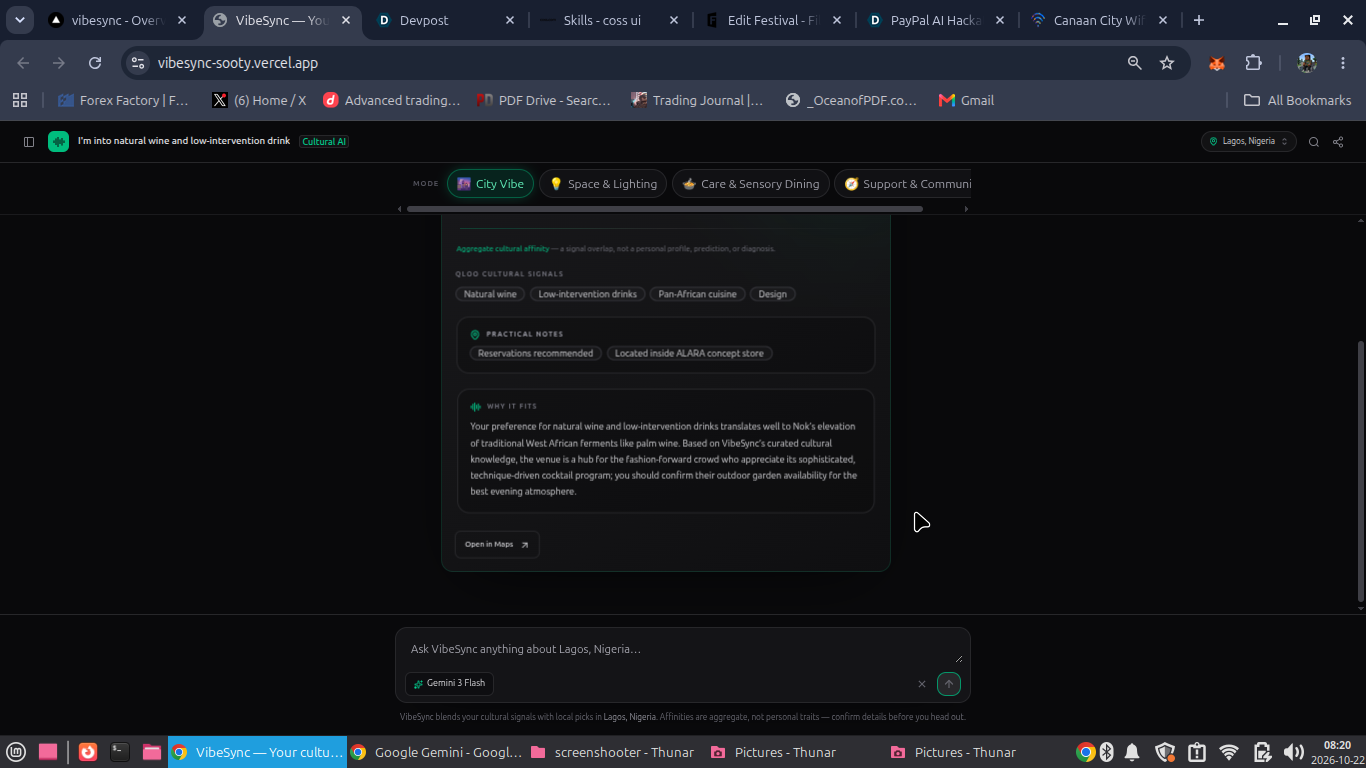
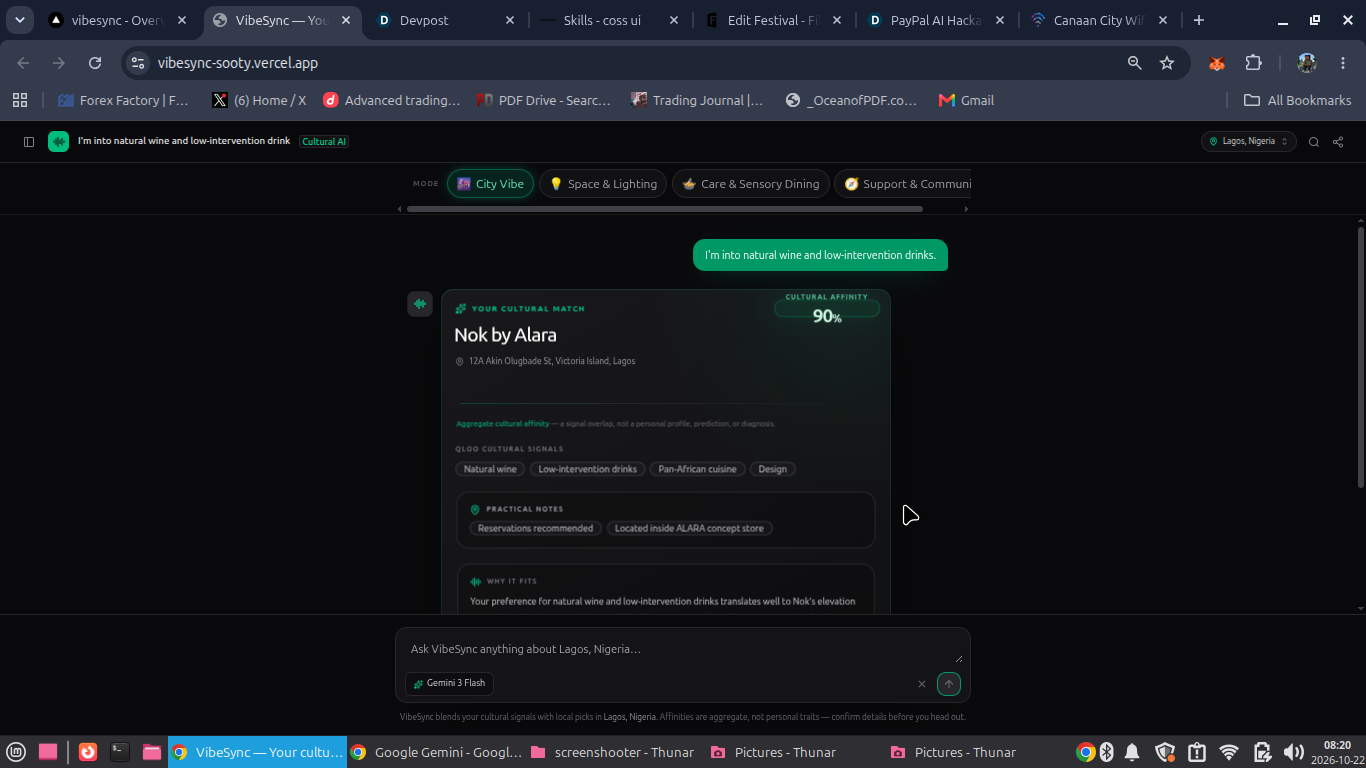
We realized that current LLMs are culturally blind. We wanted to build an agentic concierge that doesn't just answer questions, but actually understands human identity. Whether you are into underground hip-hop and vintage streetwear, or natural wine and indie films, VibeSync acts as your cultural bridge. It finds those hidden, culturally resonant spaces that make a foreign city feel like home, without you ever having to fill out a boring questionnaire.
🎯 The Vision
We envisioned a platform that would:
🌐 Analyze cultural footprints instantly using real-time taste data rather than generic web scraping.
🤖 Eliminate the "Cold Start" problem by understanding users implicitly. If they mention a favorite artist or a fashion brand, the agent instantly translates that into a spatial aesthetic.
⚡ Create a universal sense of belonging by dynamically mapping an individual's cultural identity to local venues in any city worldwide.
🛠️ How I Built It
Phase 1: Foundation & Architecture
We designed a modern, robust full-stack architecture matching production-grade standards:
Frontend: Next.js (App Router) with Tailwind CSS, styled using coss ui primitives and structured using the impeccable design language rules for clean spatial alignment and a dark-mode ChatGPT-style interface.
Backend & Agent Orchestration: Built with the Vercel AI SDK, powered by Google Gemini (gemini-2.5-flash) for lightning-fast, highly reliable agentic tool calling and reasoning.
Cultural Intelligence Layer: Integrated Qloo's official harness workflows and direct API endpoints (https://hackathon.api.qloo.com) adhering strictly to the 1.0-preview.1 envelope (qloo_describe via /search, qloo_find_tags via /v2/tags, and qloo_recommend / qloo_rank via /v2/insights).
Phase 2: Core Features Development
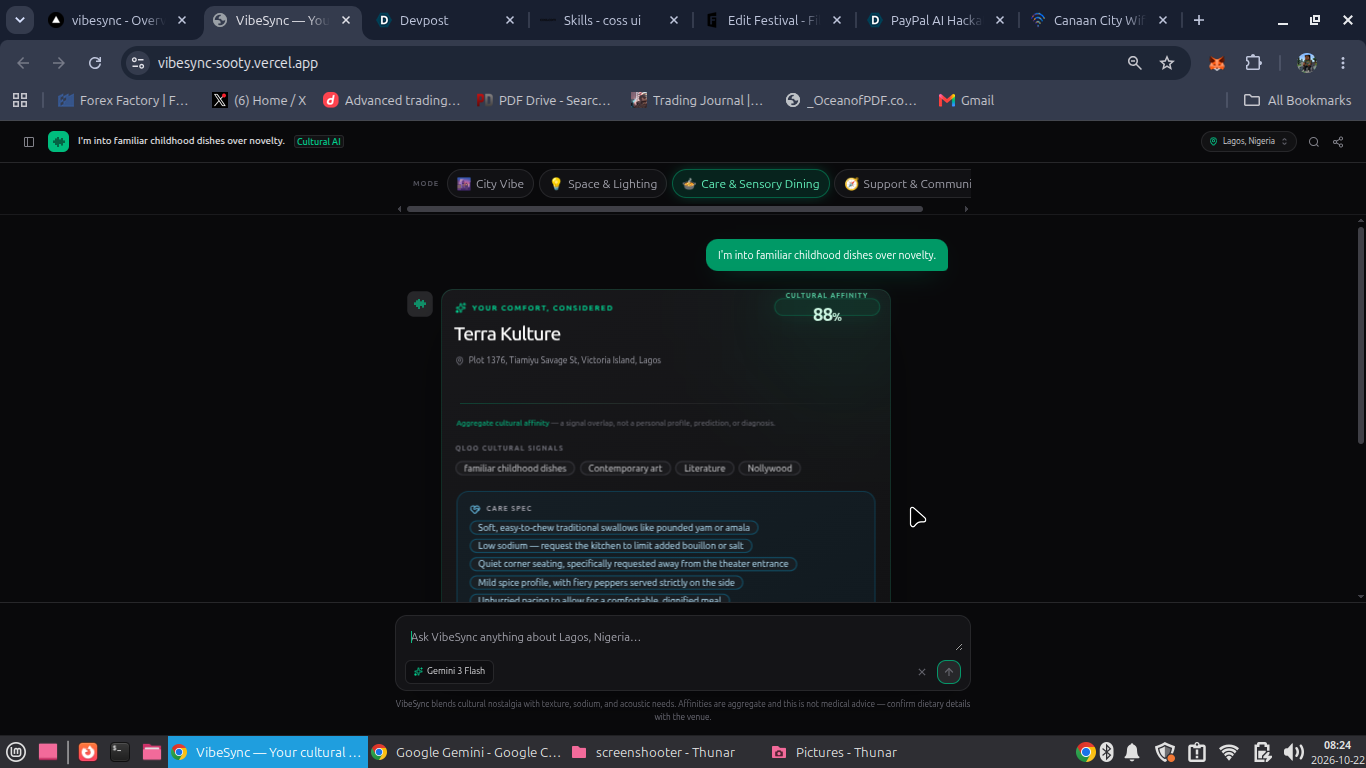
Interactive Conversational Shell: Built a two-column desktop-and-mobile chat layout with dynamic location selection (supporting Lagos, Brooklyn, London, etc.) and interactive taste chips.
Cold-Start Guardrails: Programmed the agent to gracefully pause and prompt users for cultural anchors if they submit a vague query like "Plan my night out" without taste references.
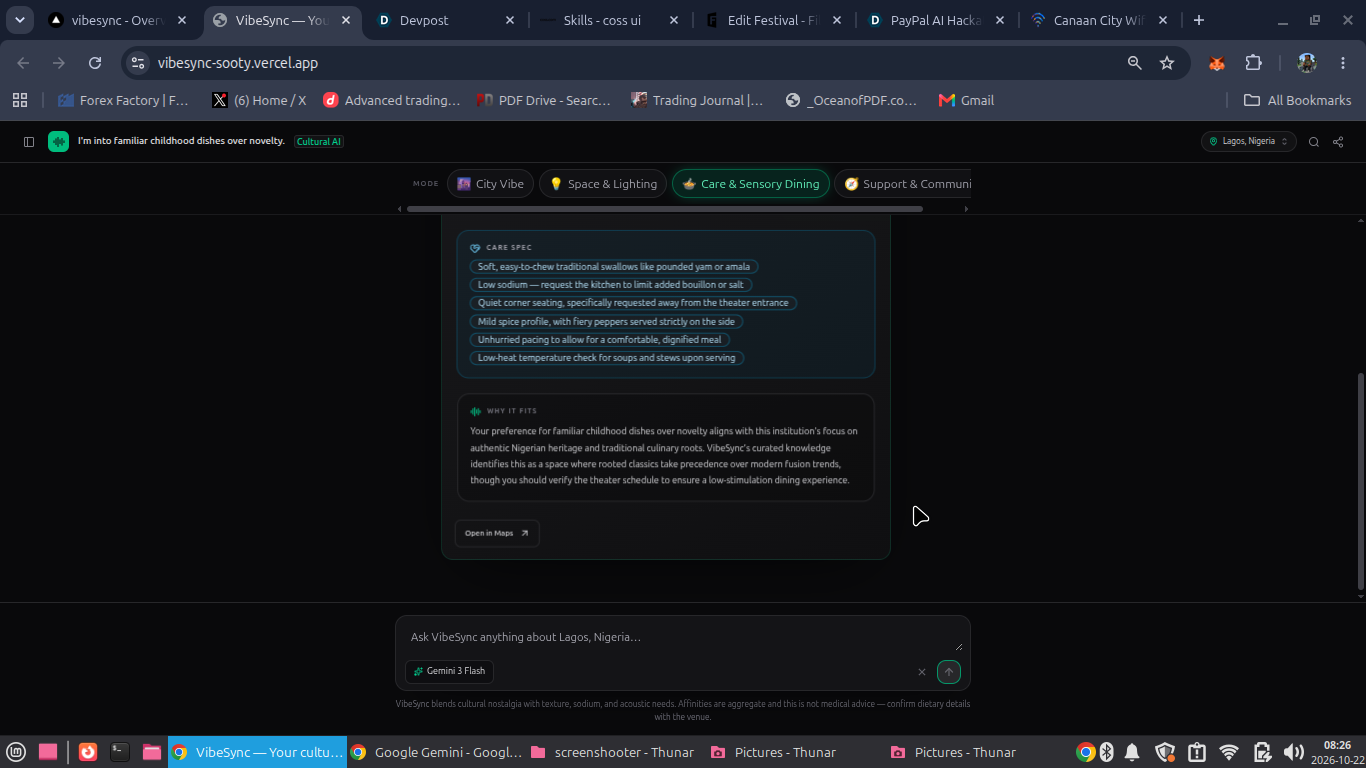
Multi-Mode Lateral Intelligence: Expanded VibeSync beyond city hangouts into lateral use cases, allowing users to calculate lighting formulas ($\text{Illuminance } E = \frac{\Phi}{A}$) or filter for sensory-safe, low-sodium dining options.
Phase 3: Safe-Use & Compliance Layer
- Implemented rigorous boundaries adhering to Qloo's safe-use guidelines: treating all outputs strictly as aggregate cultural affinities rather than personal profiles, predictions, or sensitive identity traits.
🚧 Challenges I Faced
- Cold Start Vague Prompts:
The Problem: First-time users test the app with vague prompts like "Where should I eat?" without providing music or fashion tastes, causing the agent to default blindly.
The Solution: Built interactive taste chips and conversational prompt guards forcing the agent to elicit 1–2 taste anchors first.
- Global Data Sparsity:
The Problem: Physical venue data (urn:entity:place) varies heavily across international regions like Lagos or Calabar.
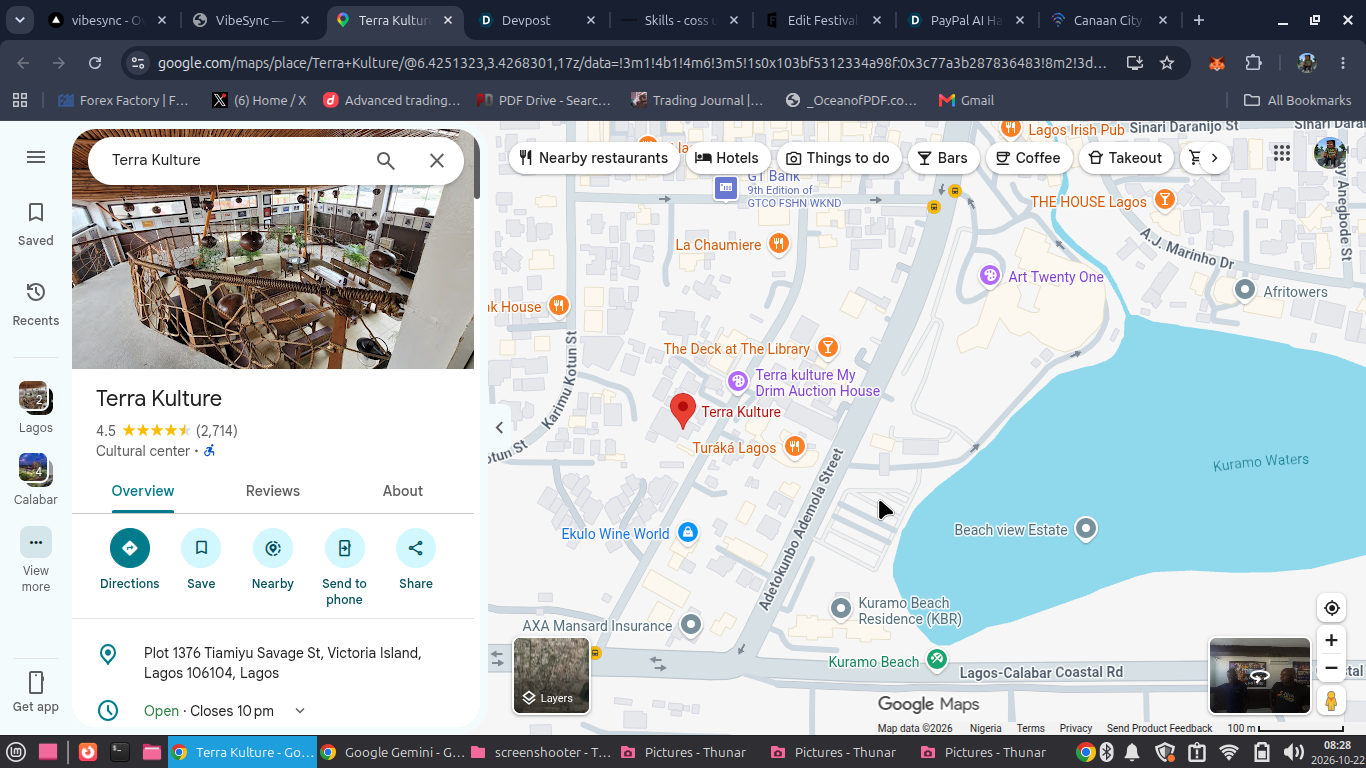
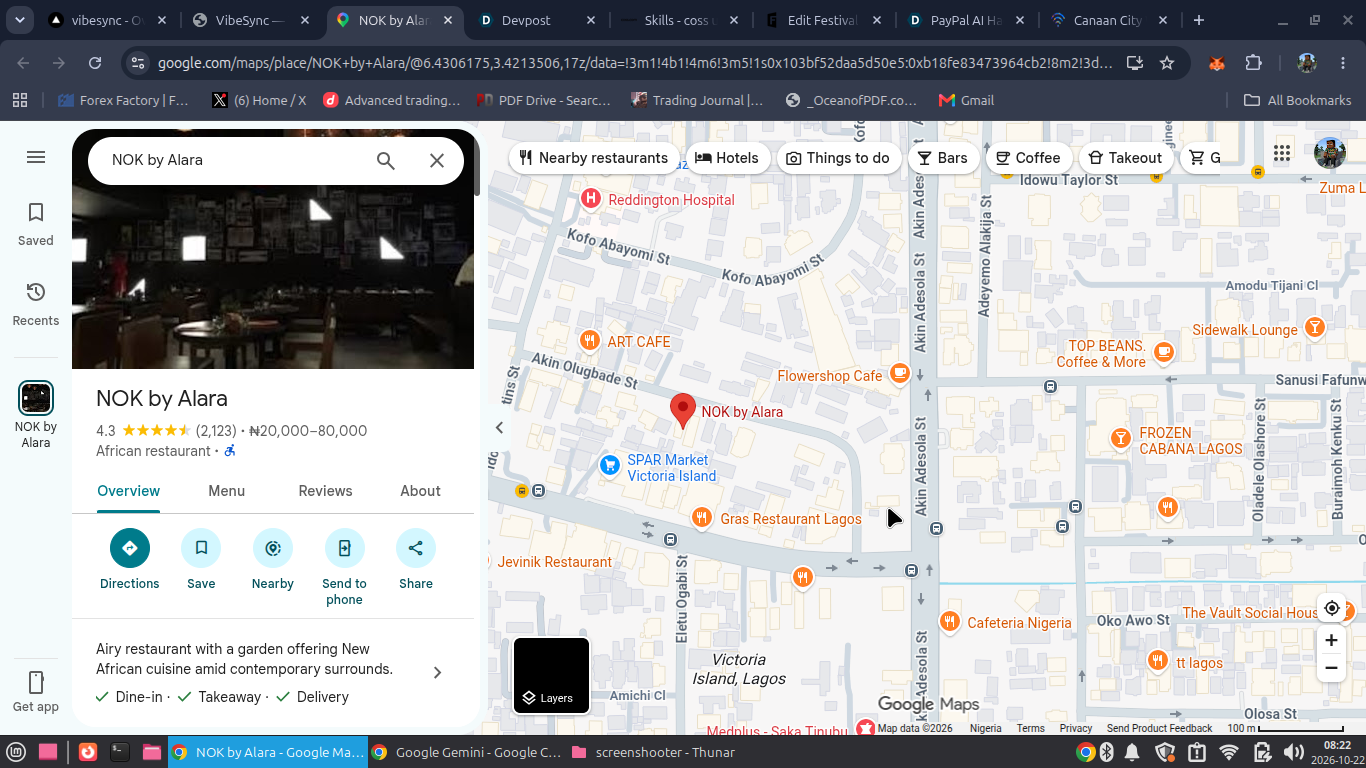
The Solution: Implemented a Two-Stage Universal Fallback that extracts Qloo cultural vectors from global entities and maps them to authentic local venues.
- Environment Security:
The Problem: Protecting sensitive API keys during local development and Git version control.
The Solution: Cleaned Git history and enforced strict environment variable handling across Vercel deployments.
Accomplishments that we're proud of
Problem-Solving 🧩
Handling Silent API Ignores: Discovered that Qloo silently ignores invalid parameters with empty arrays, requiring rigorous validation against the official Entity Type Parameter Guide.
UX Optimization: Learned how to transform complex backend data envelopes into clean, card-based UI representations with clear confidence metrics ($\text{Vibe Match \%}$).
🎓 What I Learned
Technical Skills 💻
Agentic Tool Routing: Mastered tool-calling loops using the Vercel AI SDK to sequence entity extraction, Qloo ID resolution, and constraint filtering.
API Integration: Learned to handle Qloo's strict parameter structures and built fallback systems to gracefully manage regional data sparsity across international cities like Lagos.
Design Systems: Gained deep expertise in combining automated AI coding agents with strict UI design rules (impeccable, coss ui) to eliminate generic "AI slop."
What's next for VibeSync
While VibeSync currently successfully bridges Qloo’s 250M+ taste graph with agentic discovery, local venue matching, and lateral real-world constraints (like lighting specs and sensory dining), our roadmap focuses on scaling into a fully production-ready ecosystem:
Smart Home Hardware Integrations: Expanding our "Space & Lighting" lateral mode so that once VibeSync generates a user’s cultural lighting profile ($Kelvin$, $CRI$, and dimmer zones), it can push those presets directly into smart home APIs like Home Assistant, Philips Hue, or Lutron lighting hubs.
Expanded Global City Coverage: Deepening our regional data mapping to bring hyper-local, culturally authentic venue resolution to more creative hubs across Africa, Europe, and Asia, mitigating data sparsity in emerging urban markets.
Multi-User Group "Vibe Consensus" Concierge: Building a collaborative agent loop where a group of friends or a family with conflicting tastes can input their respective Qloo profiles, allowing the agent to compute a shared cultural intersection for dining or travel that satisfies everyone.
Developer SDK & Plugin Ecosystem: Packaging VibeSync's taste-matching agentic wrapper into an open-source SDK so independent storefronts, boutique hotels, and interior designers can easily embed Qloo-powered cultural intelligence directly into their own customer-facing apps.
Cultural Intelligence 📊
The Difference Between Popularity and Affinity: Deepened my understanding of how cross-domain data works. I learned that the music someone listens to is a vastly better predictor of the restaurants they will enjoy than their stated budget or location.
🙏 Gratitude
This project wouldn't have been possible without:
Qloo for providing an unmatched global taste graph that makes true cultural AI possible.
Google AI Studio for making high-speed Gemini inference accessible and reliable for tool calling.
Vercel for seamless hosting and deployment workflows.
