-
-
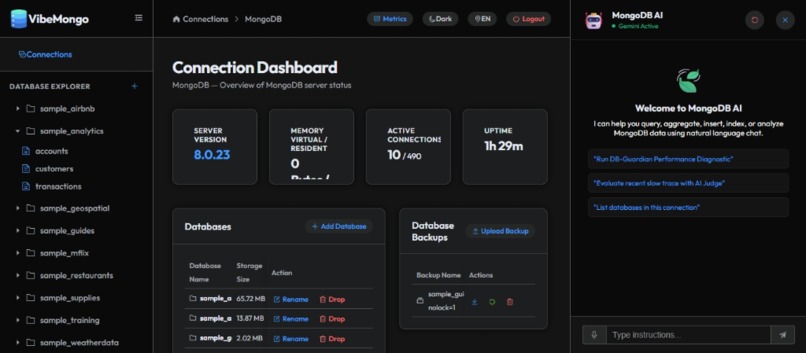
Agent Welcome
-
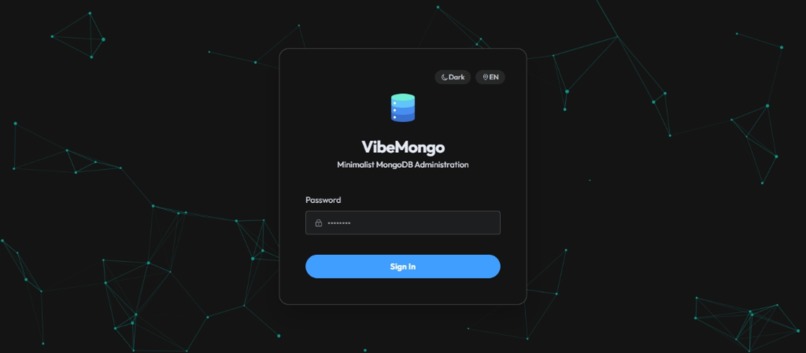
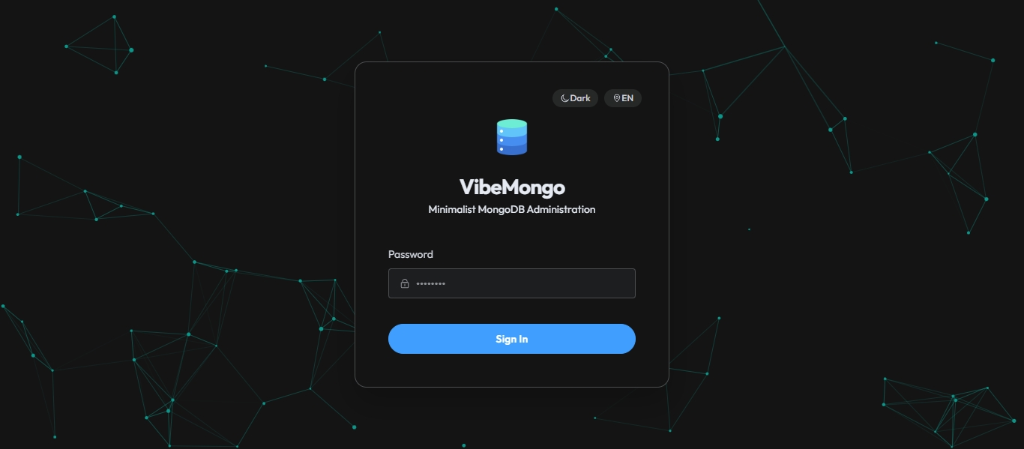
Login
-
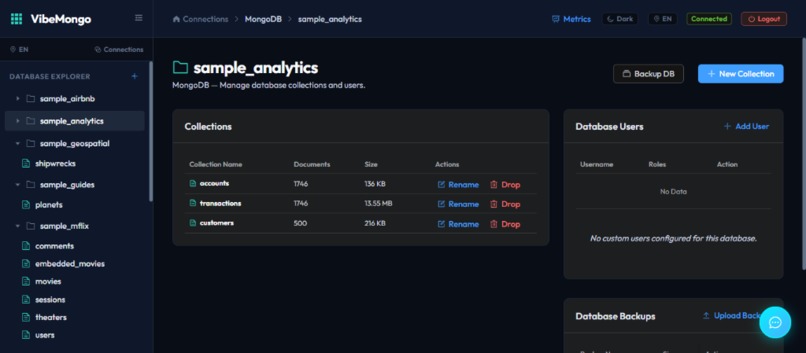
Connections
-
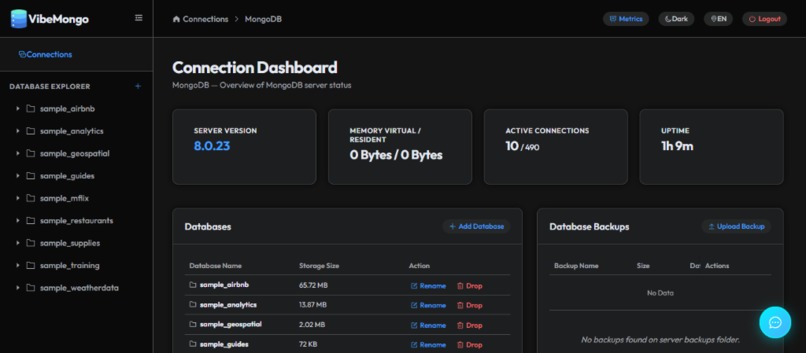
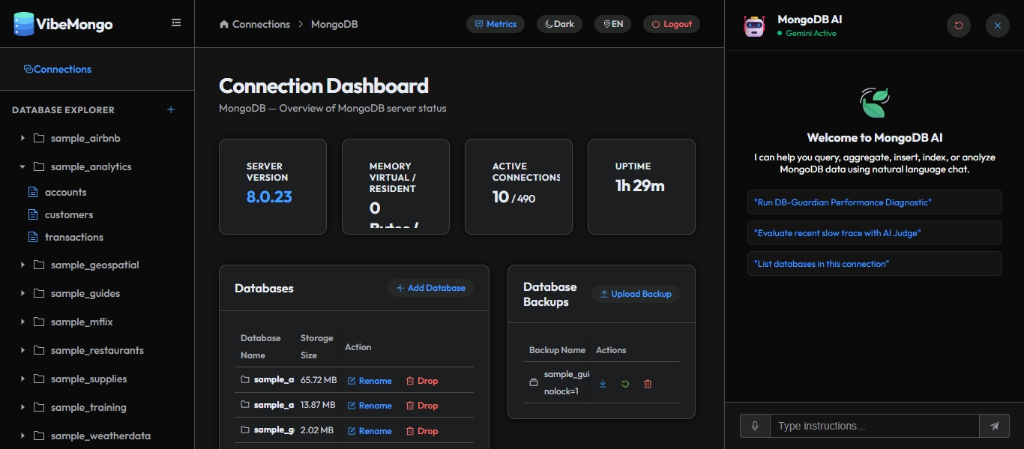
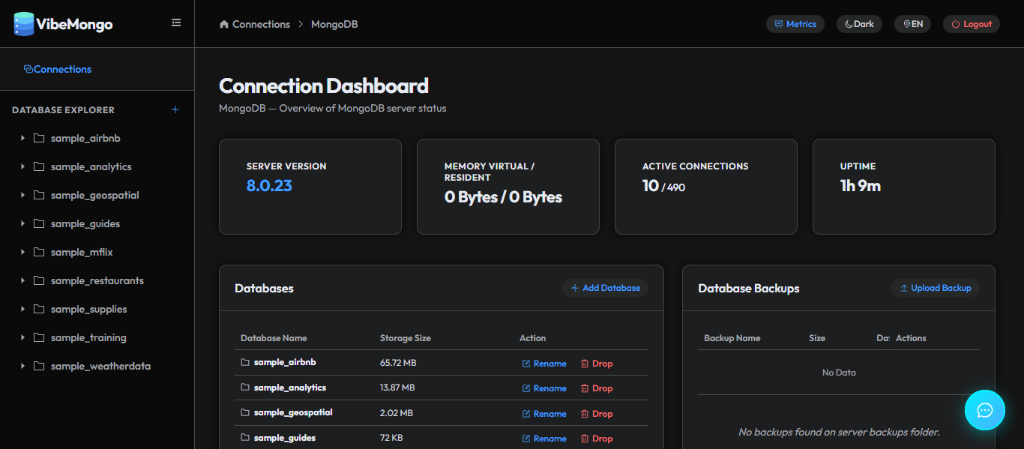
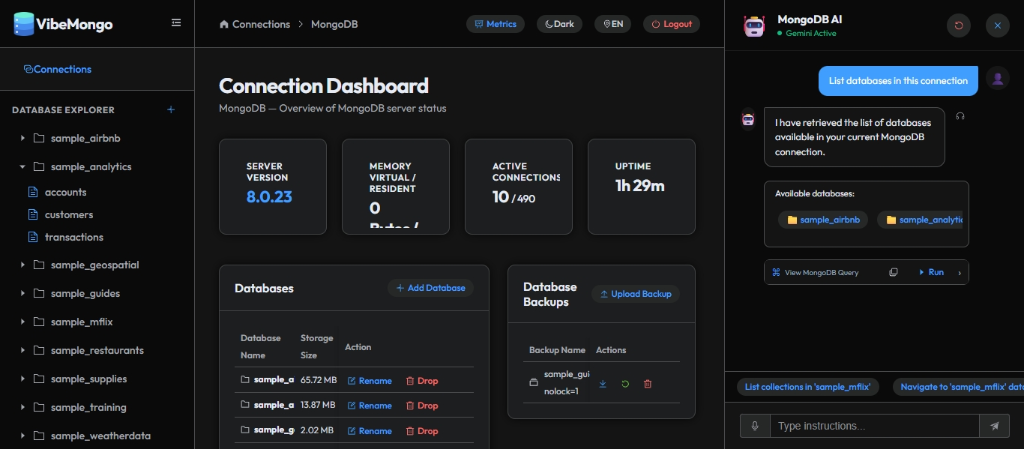
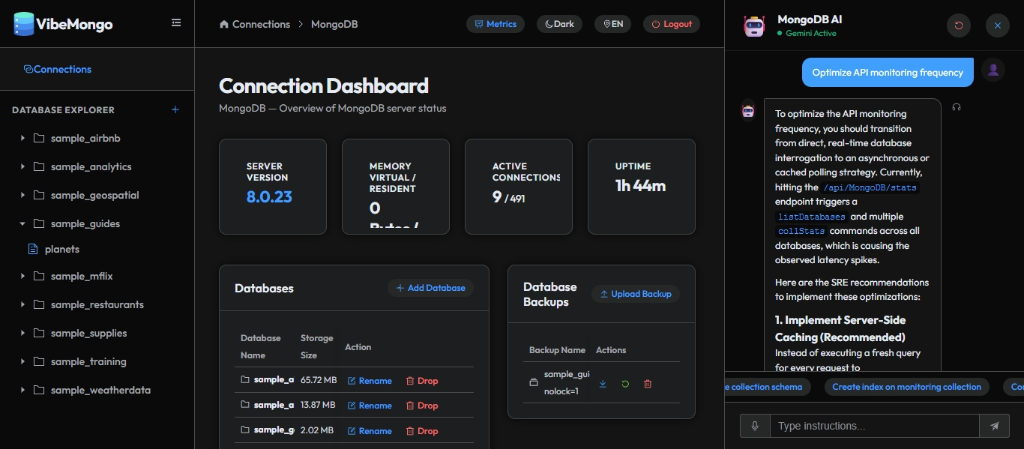
Connection Dashboard
-
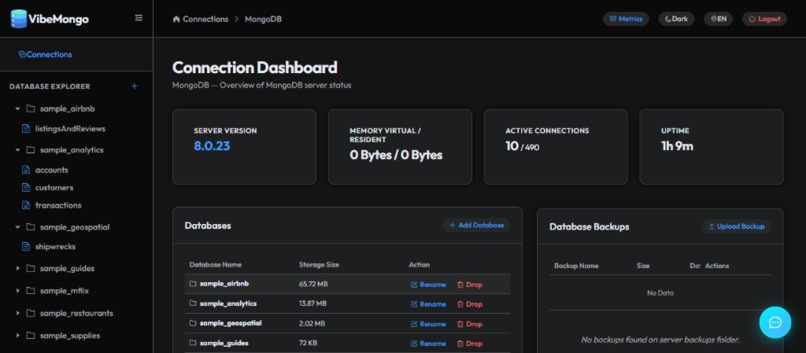
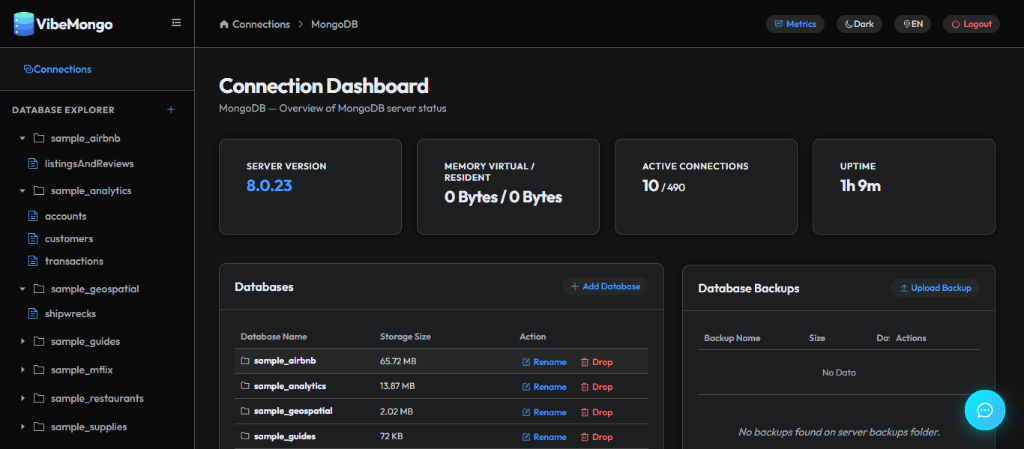
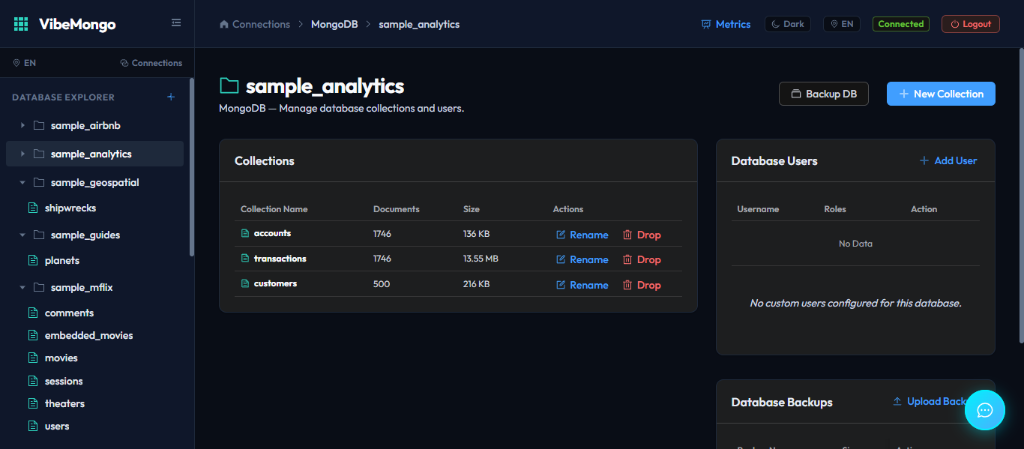
Database Explorer
-
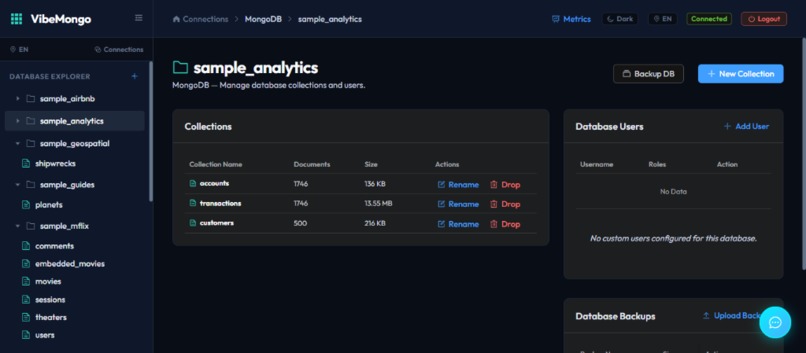
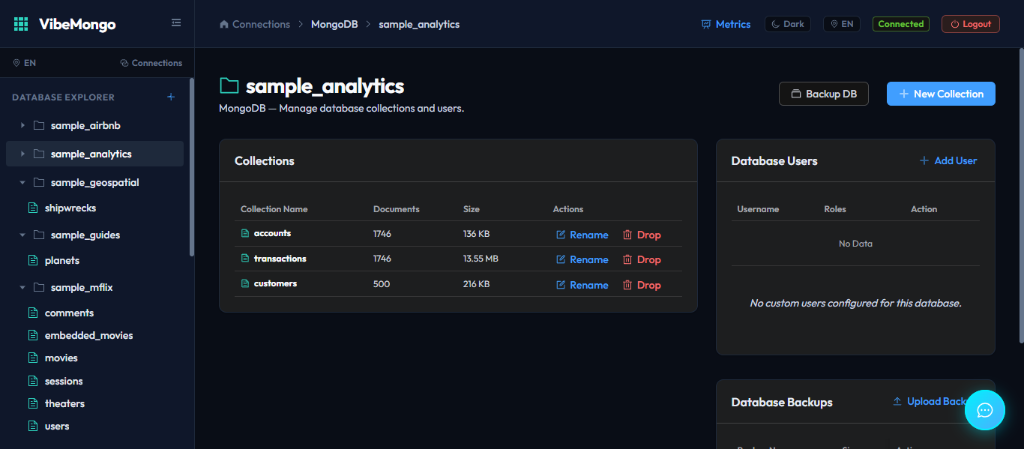
Collections View
-
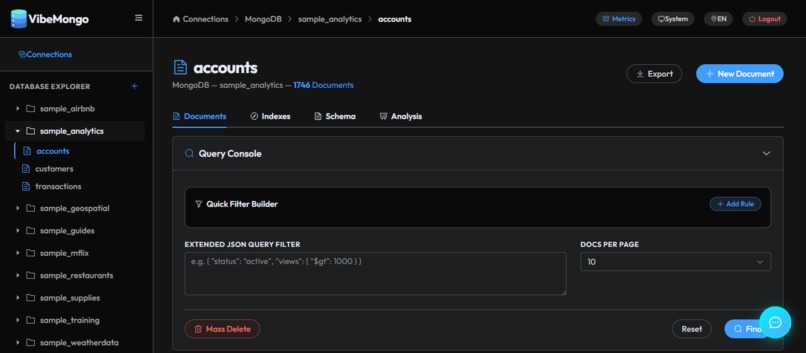
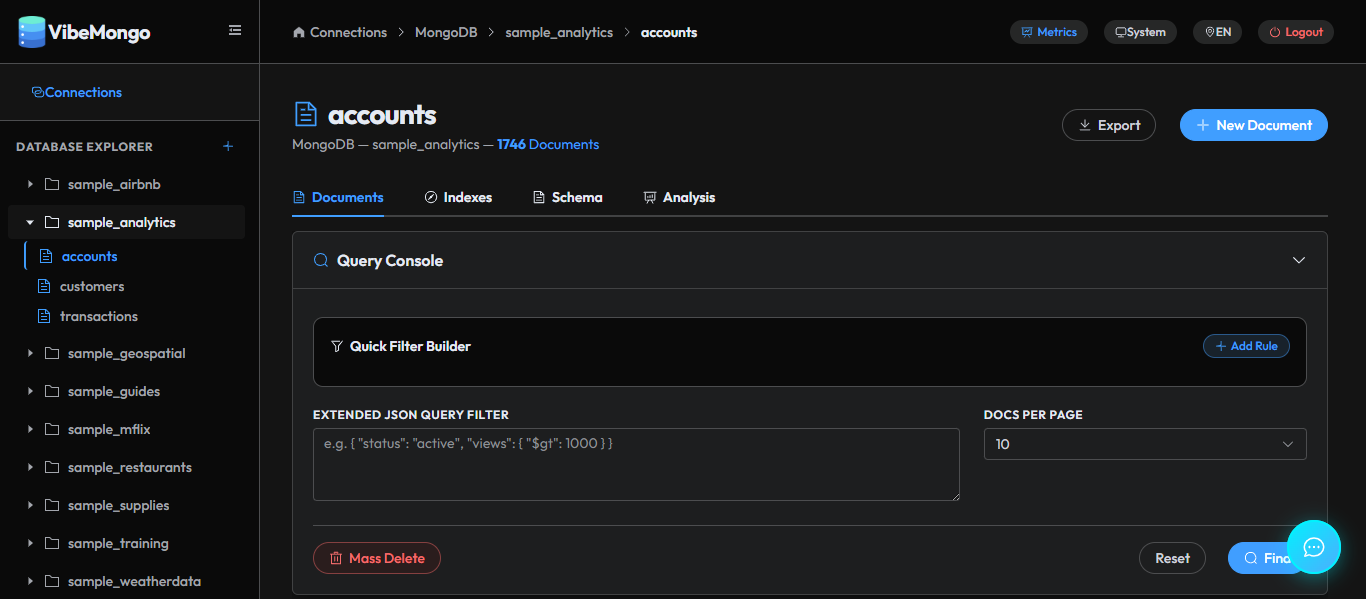
Collection Query
-
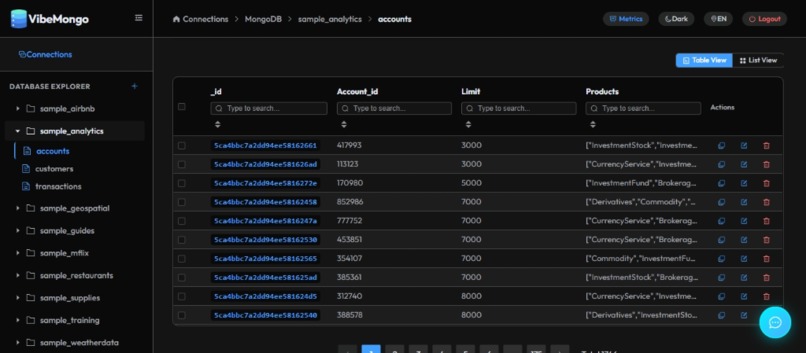
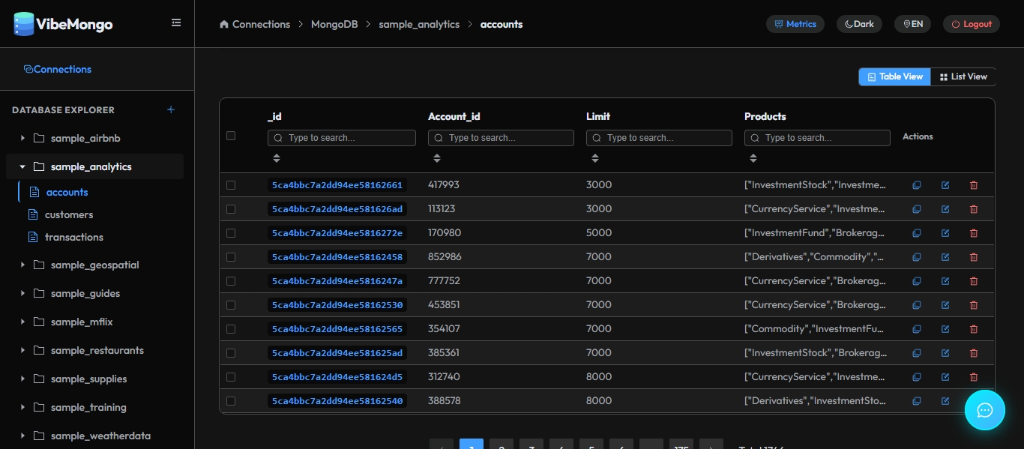
Documents View
-
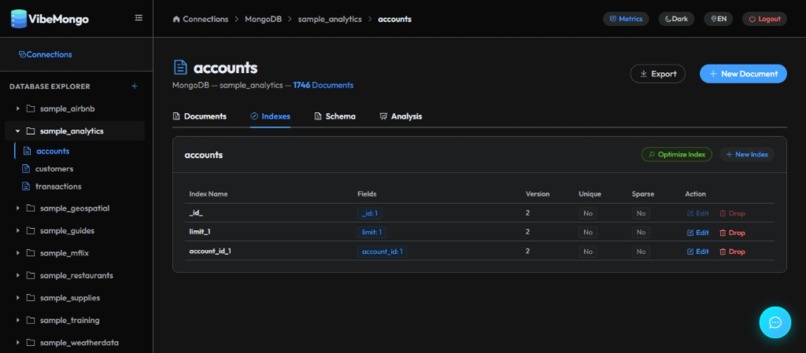
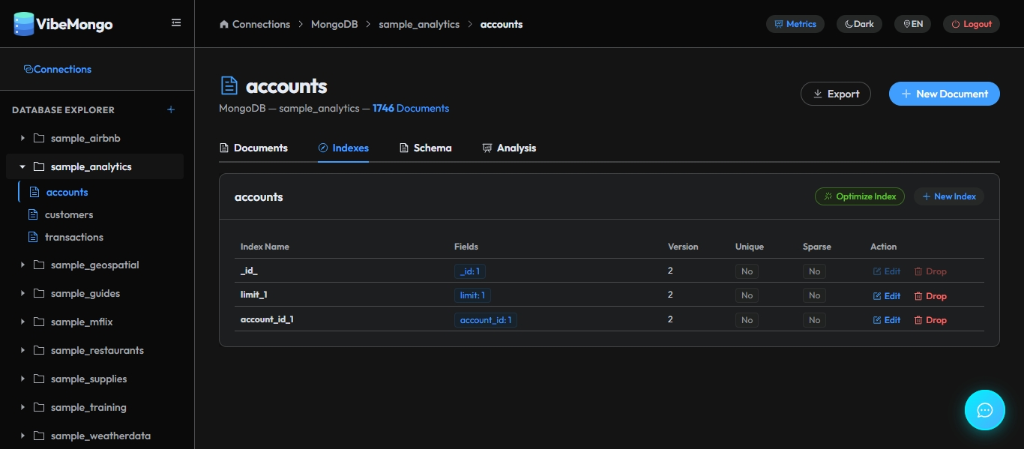
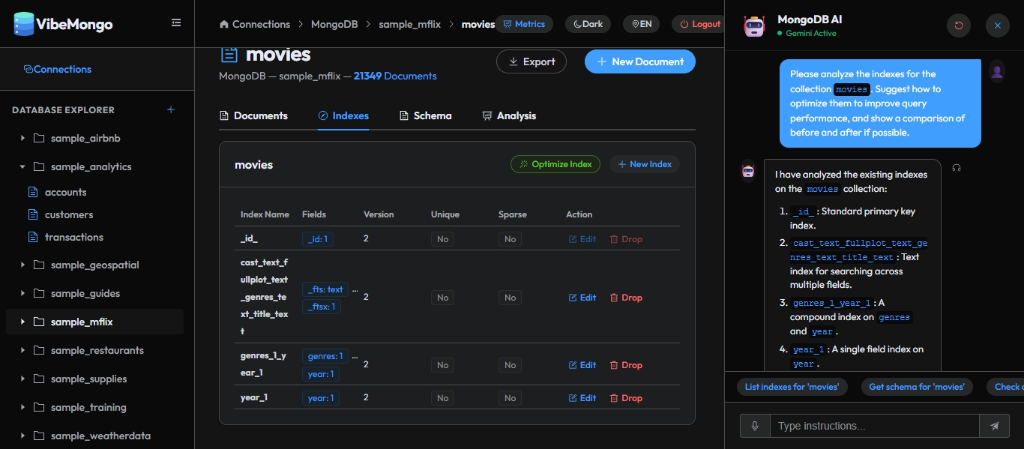
Collection Index
-
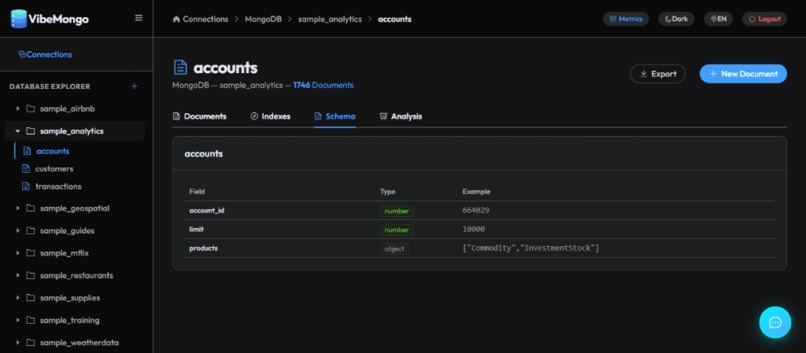
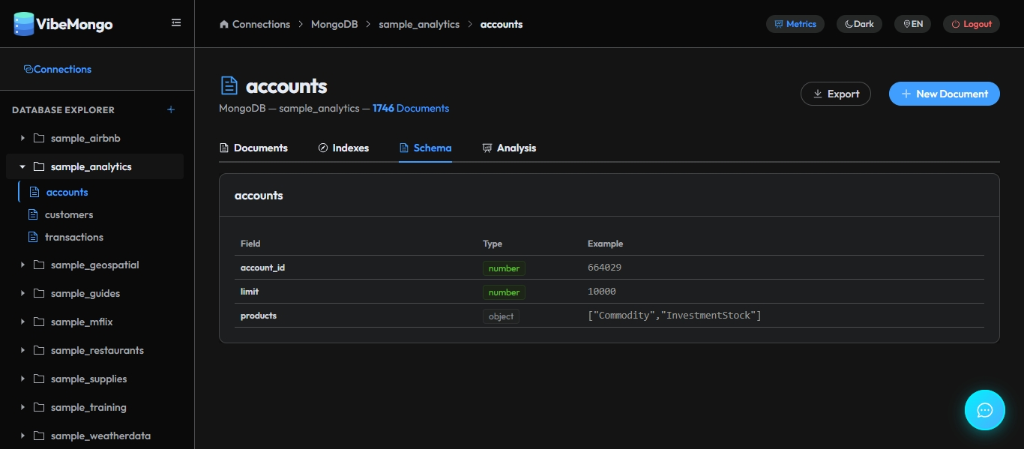
Collection Schema
-
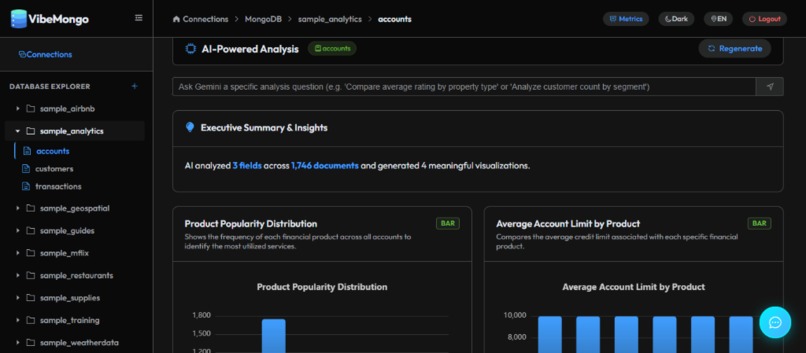
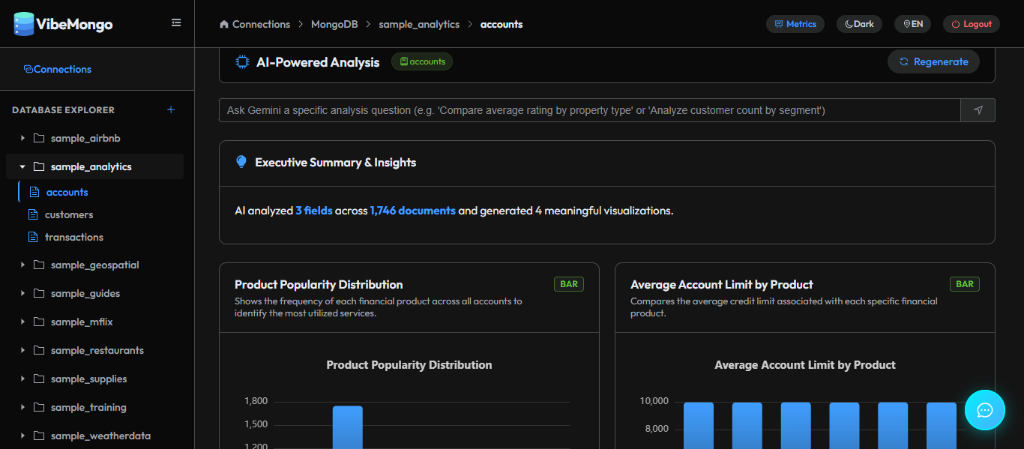
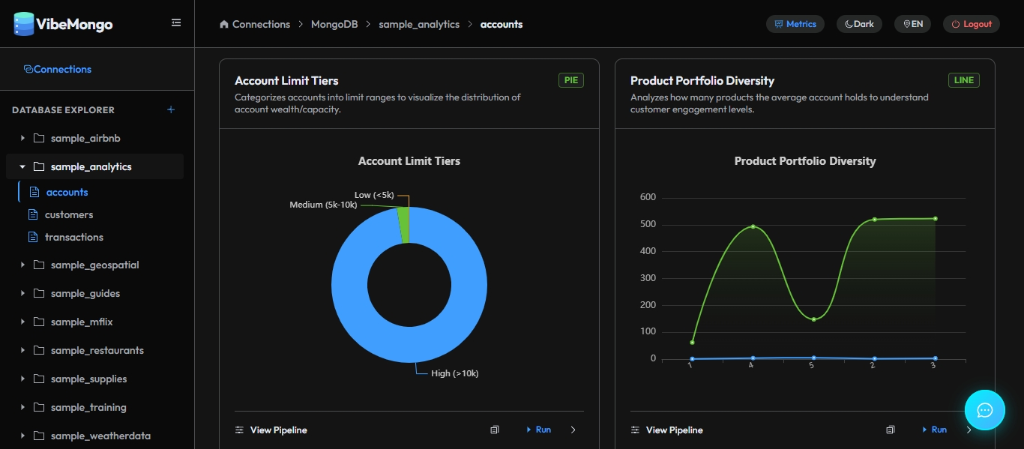
Collection Analysis
-
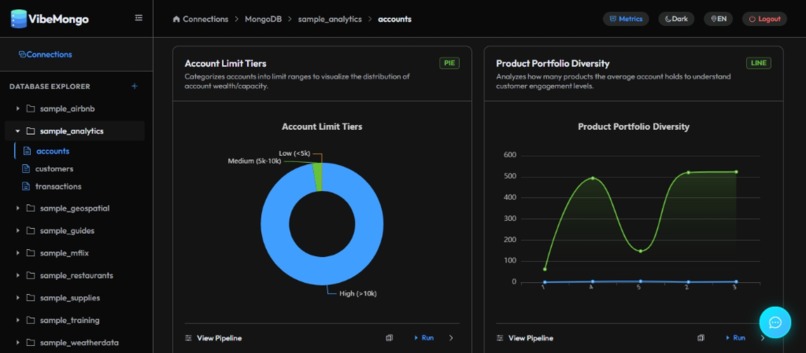
Smart Collection Analysis
-
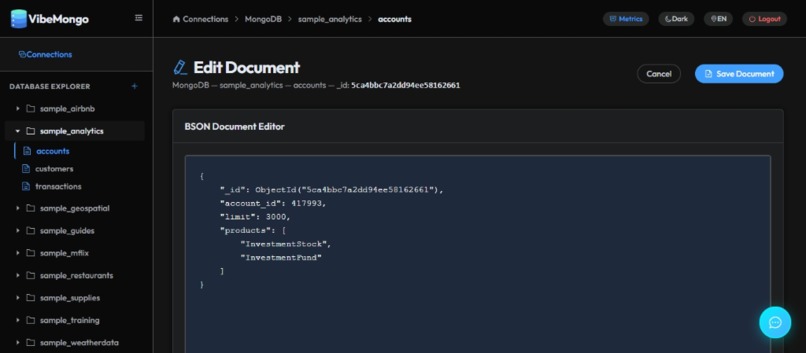
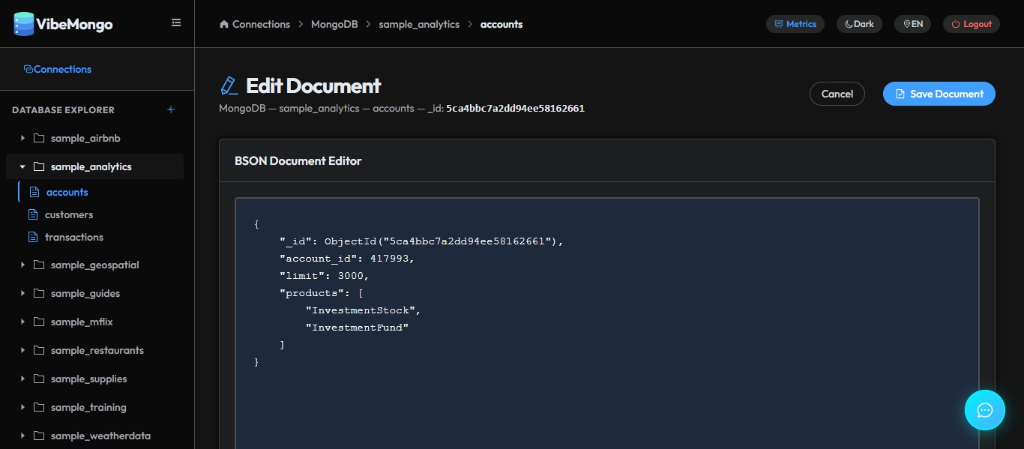
Document Editor & Create
-
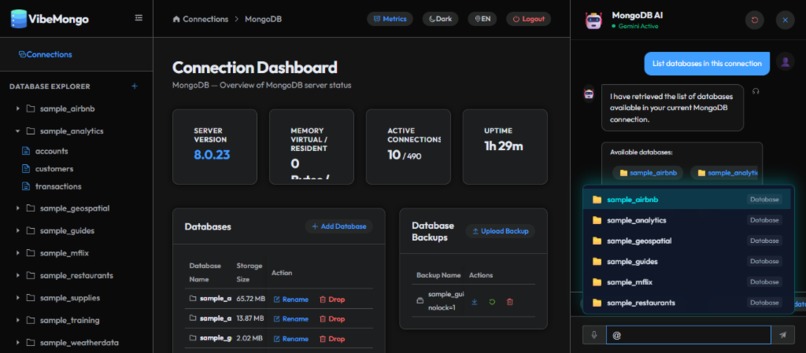
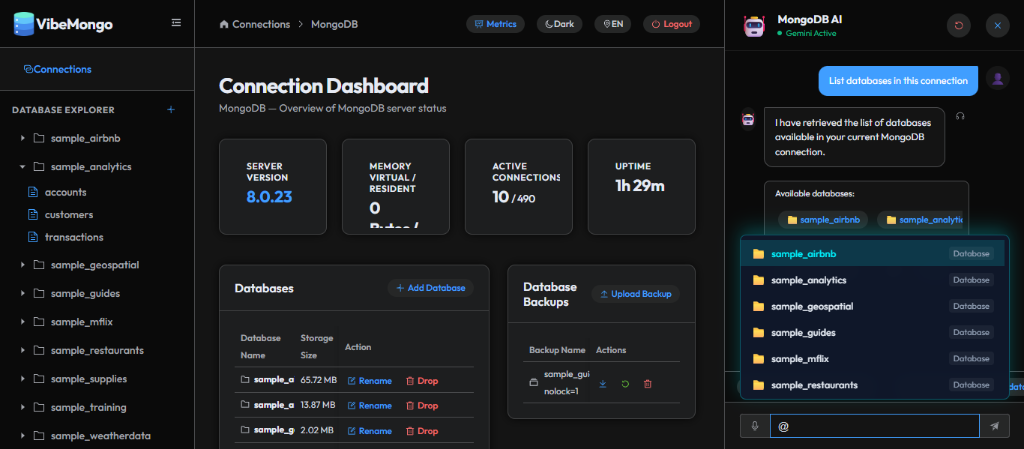
Agent Suggestion and Autocomplete
-
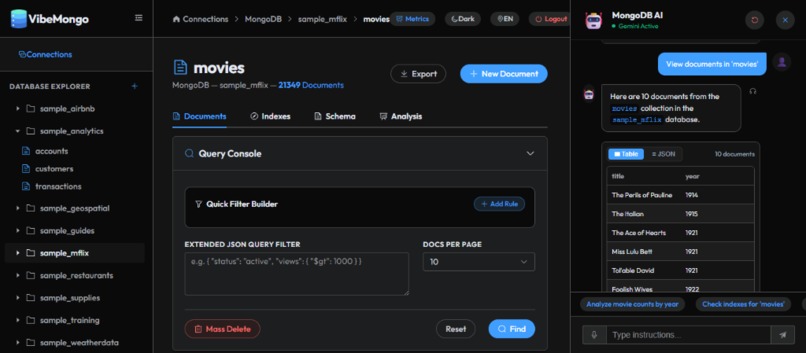
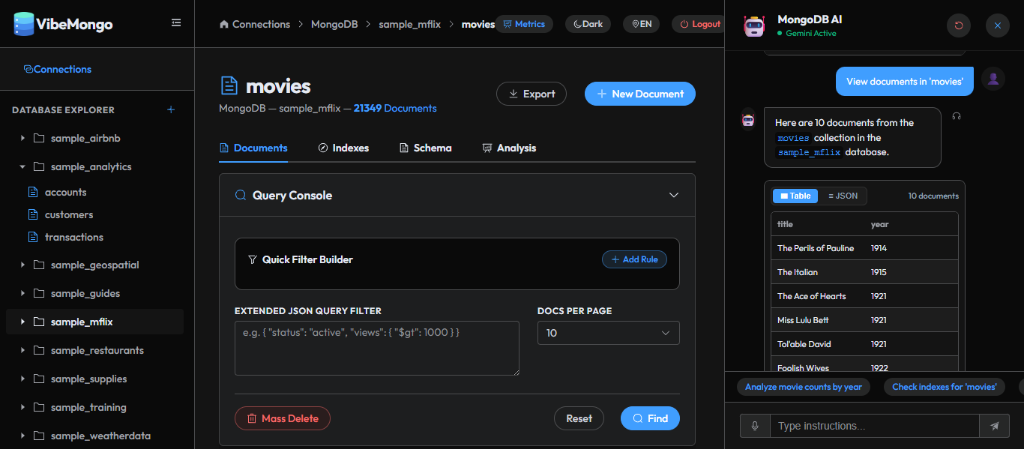
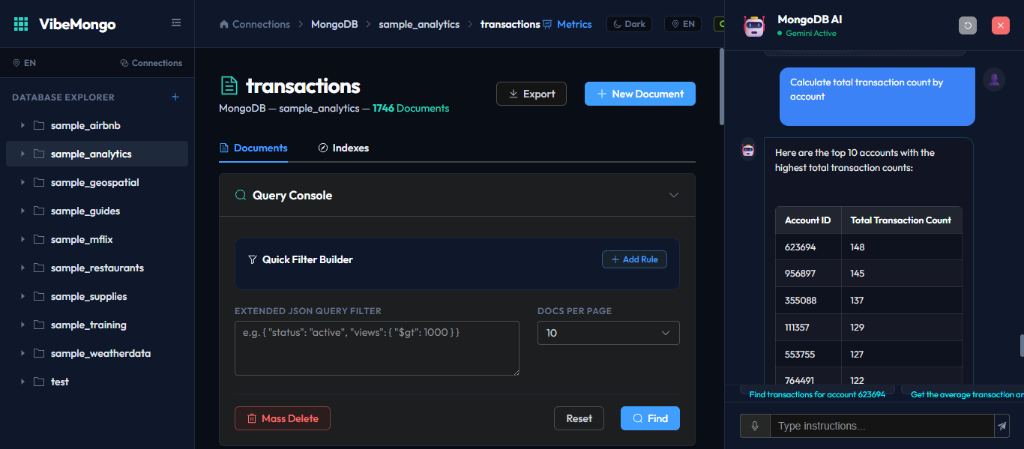
Agent Table View
-
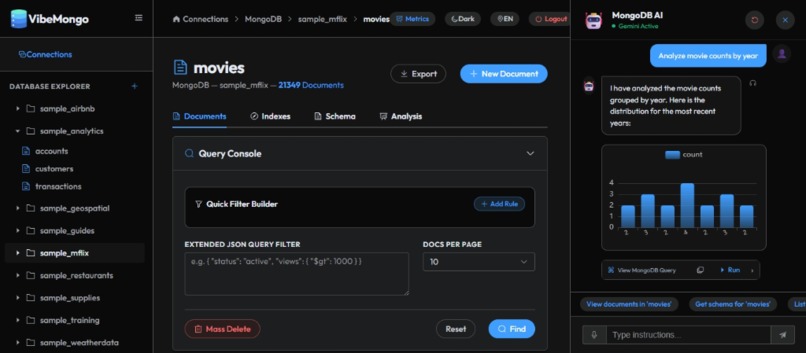
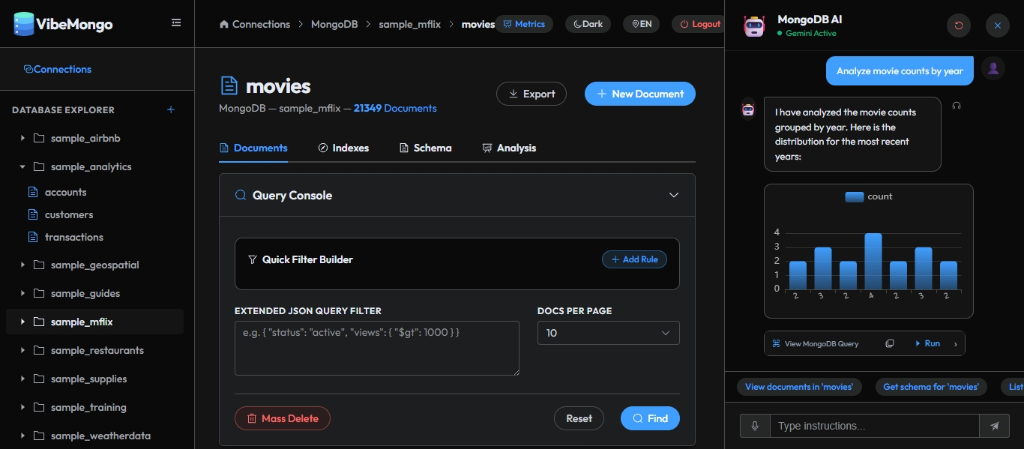
Agent Bar Chart View
-
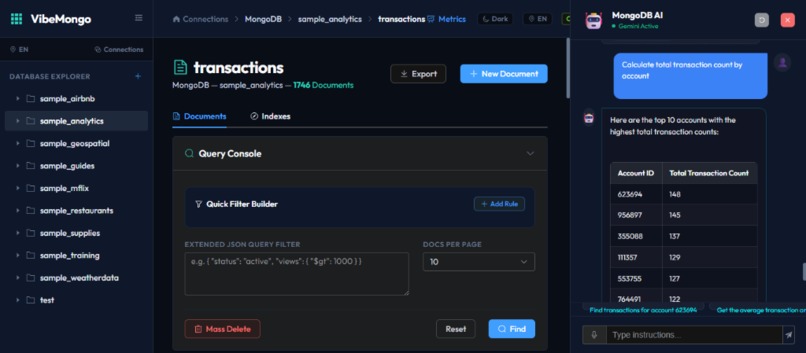
Agent Collection Schema
-
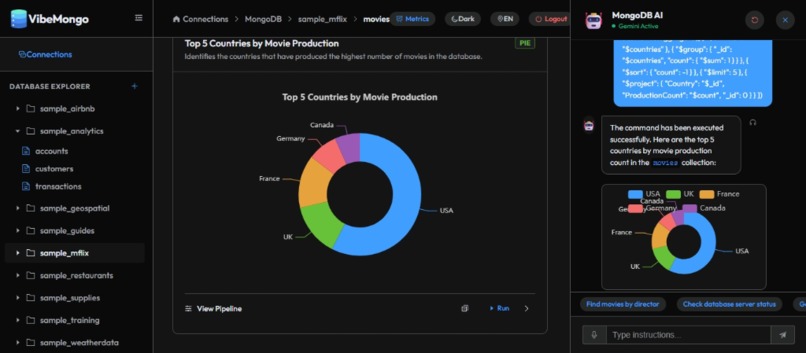
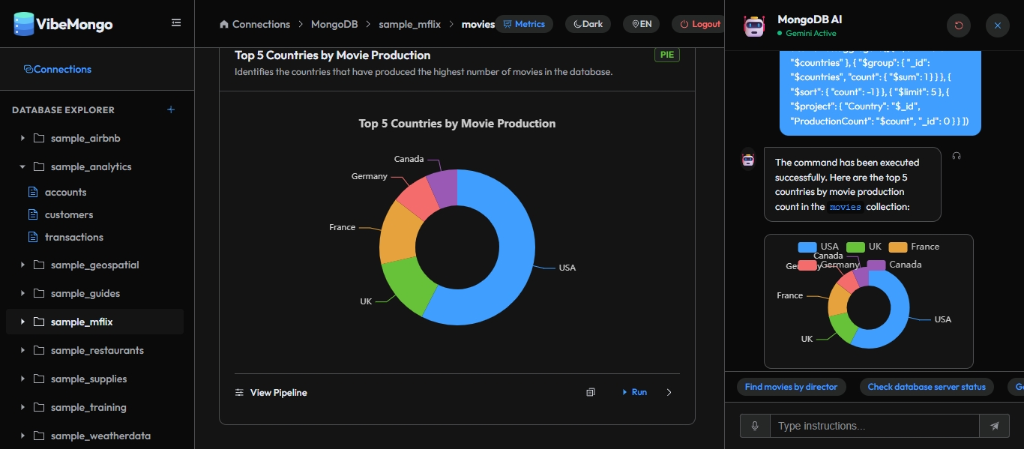
Agent Pie Chart View
-
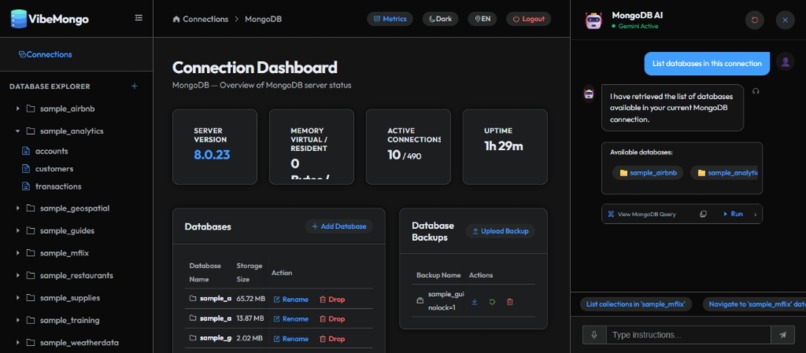
Agent Query Suggestion
-
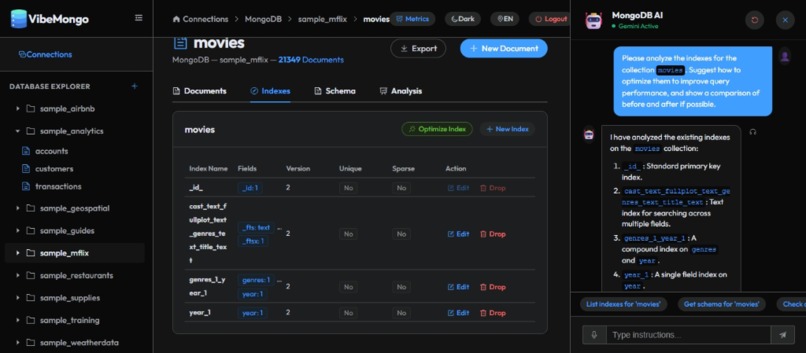
Agent Collection Index
-
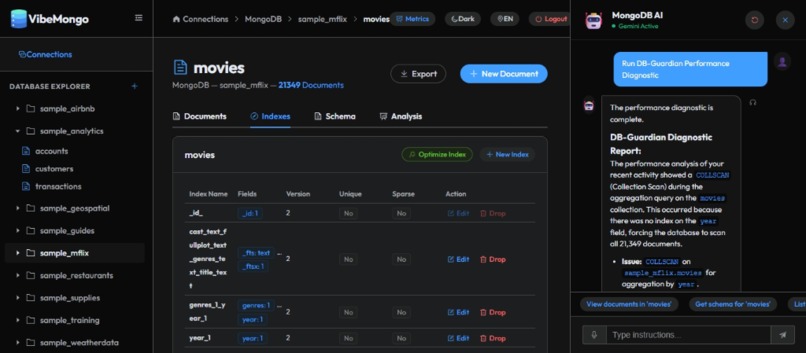
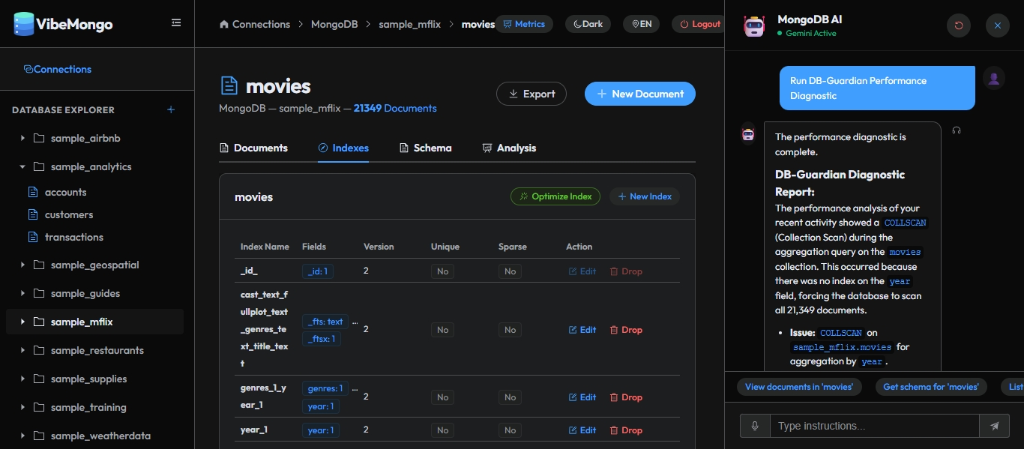
Agent DB Guardian Diagnostic
-
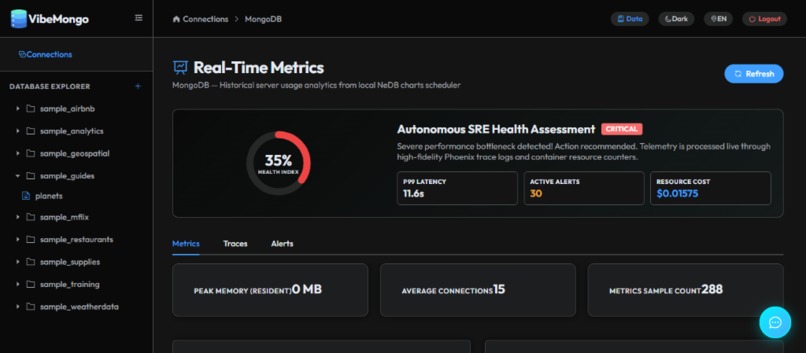
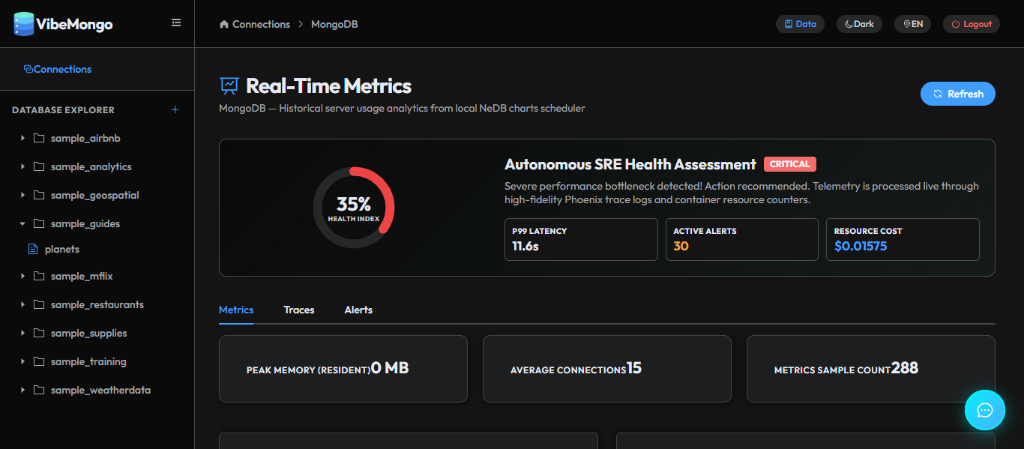
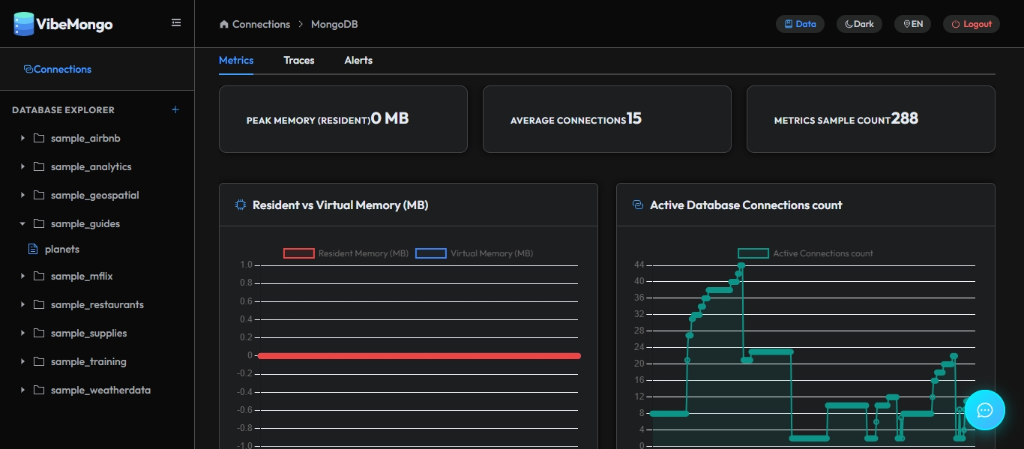
DB Monitoring
-
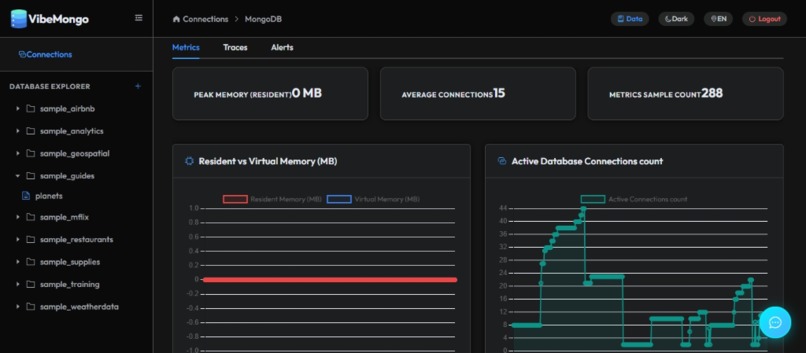
Realtime Metrics
-
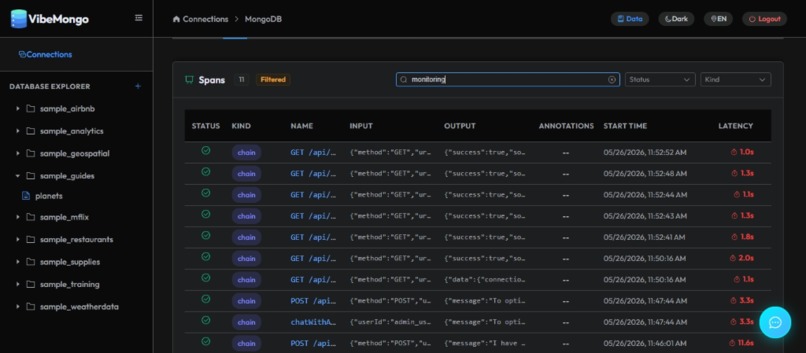
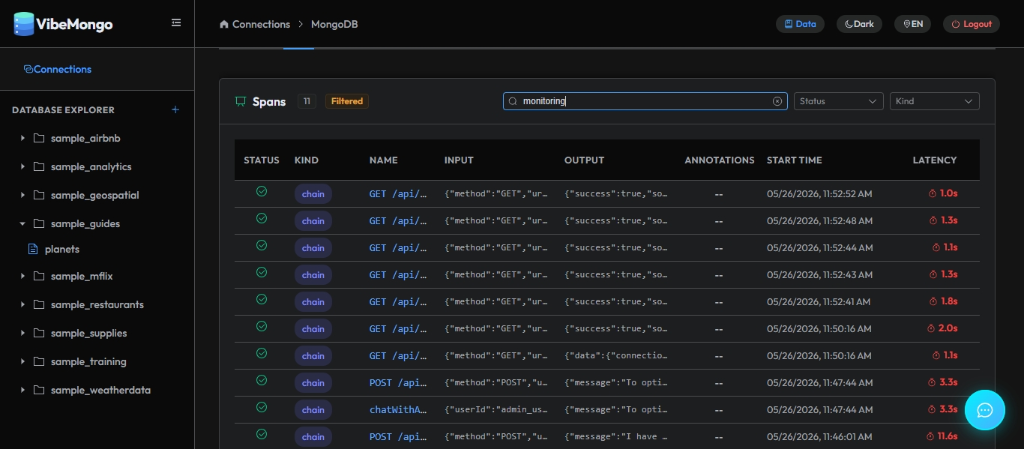
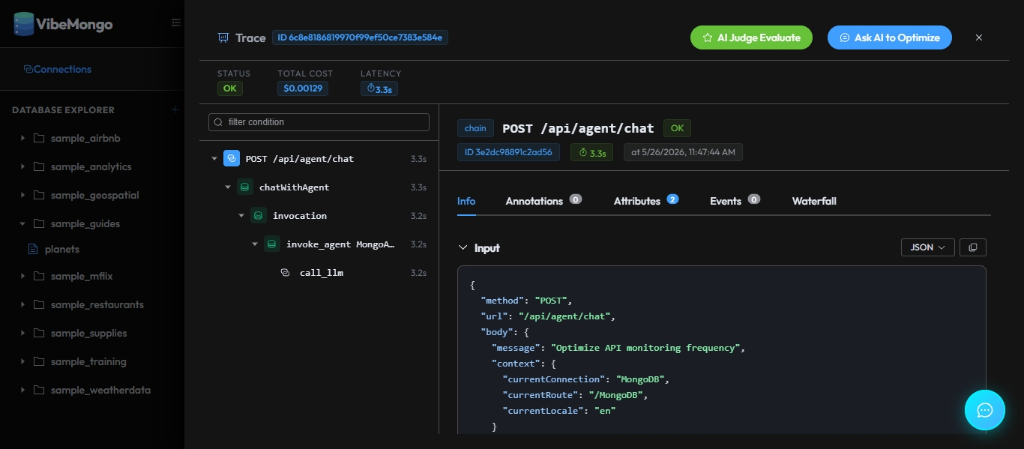
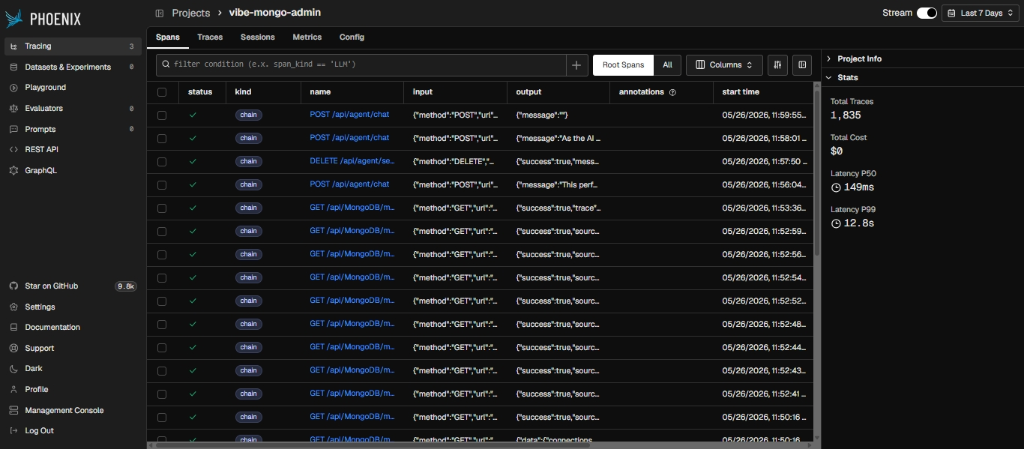
Phoenix Traces
-
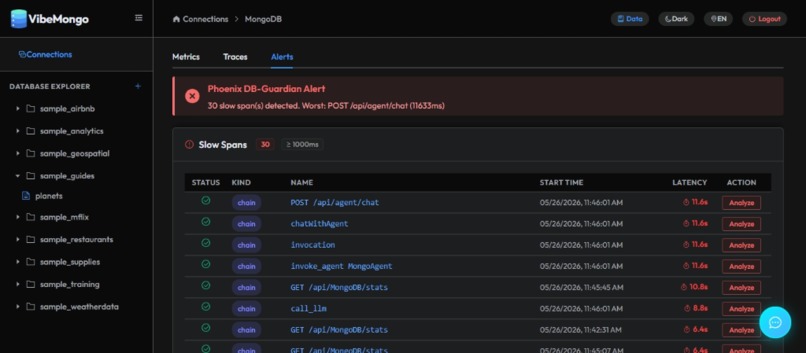
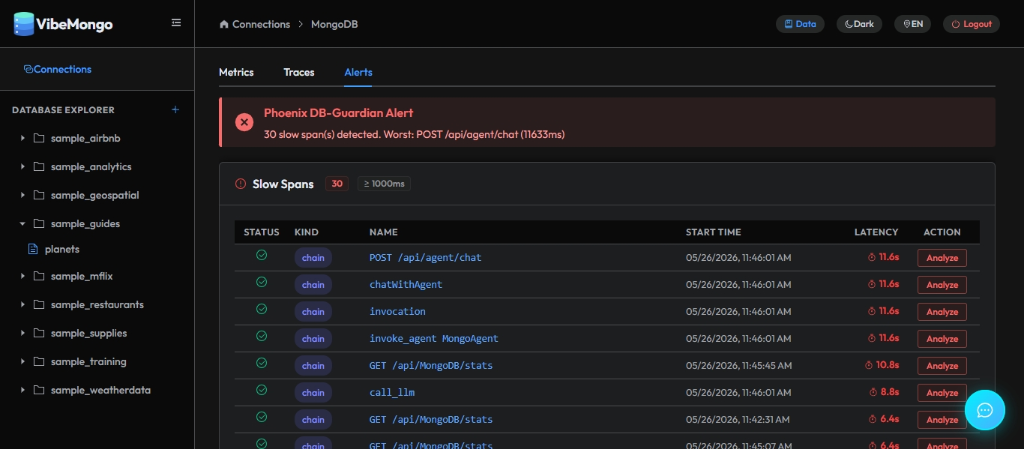
Phoenix Alerts
-
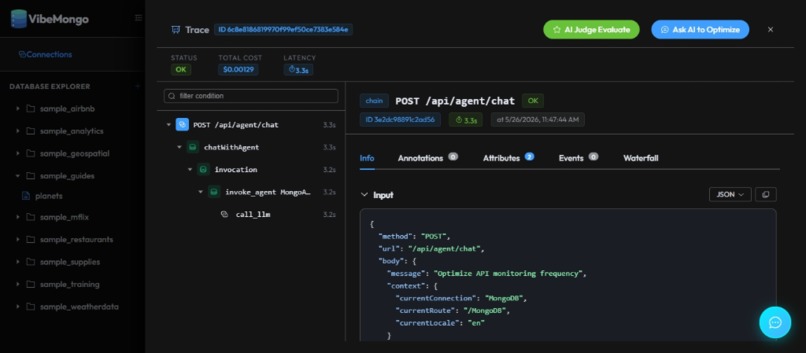
Trace Detailed Information
-
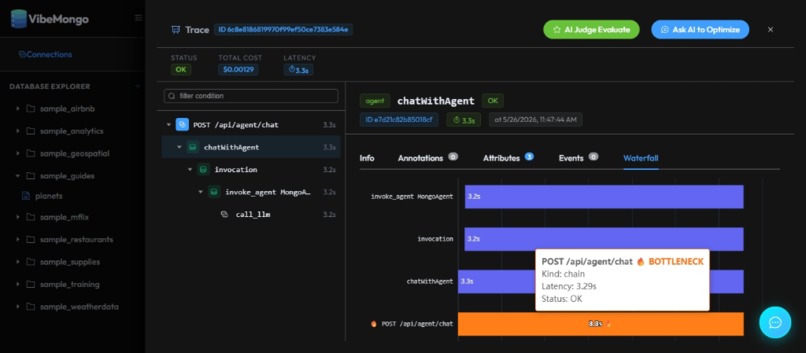
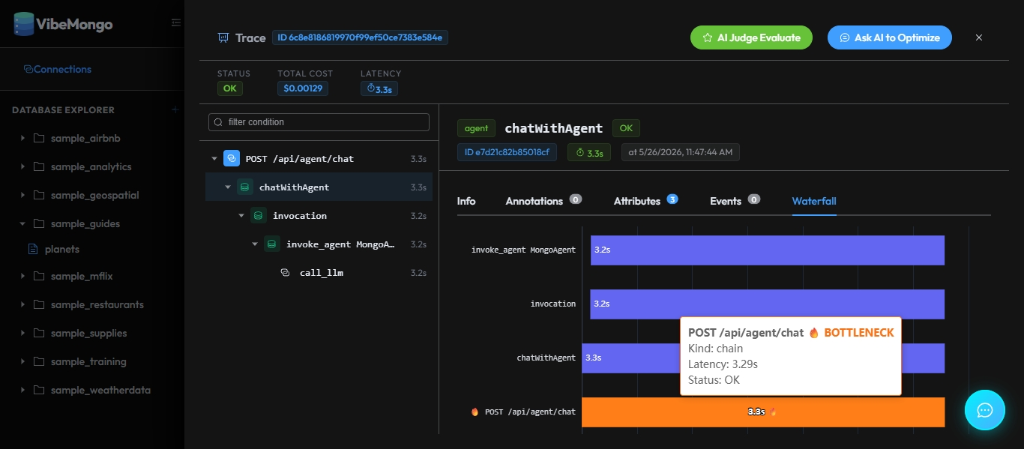
Trace Waterfall
-
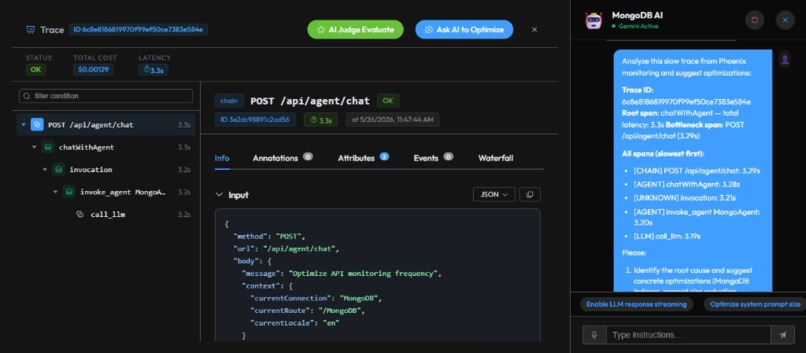
Trace with AI Evaluation
-
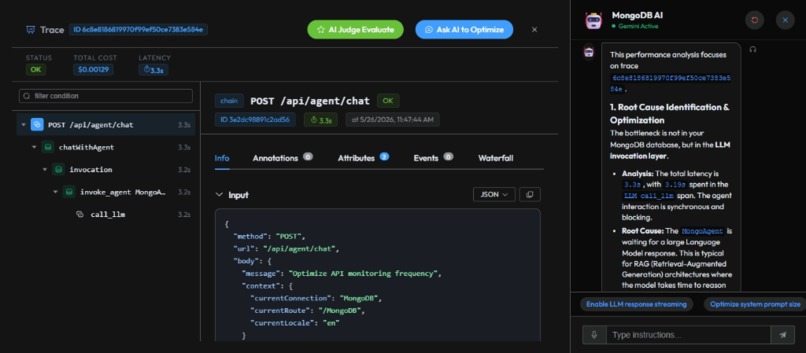
Trace with AI Prediction
-
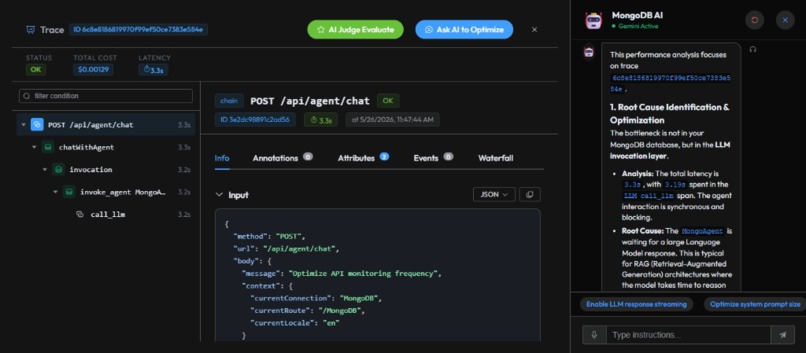
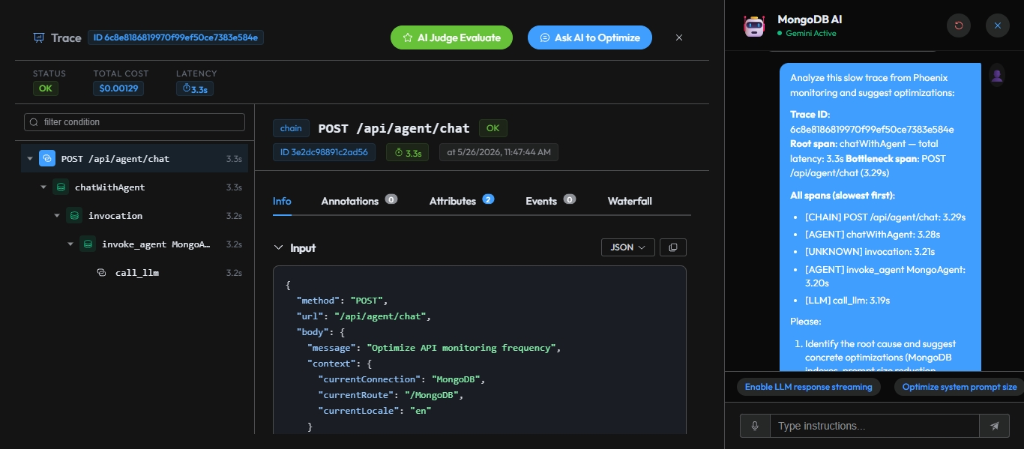
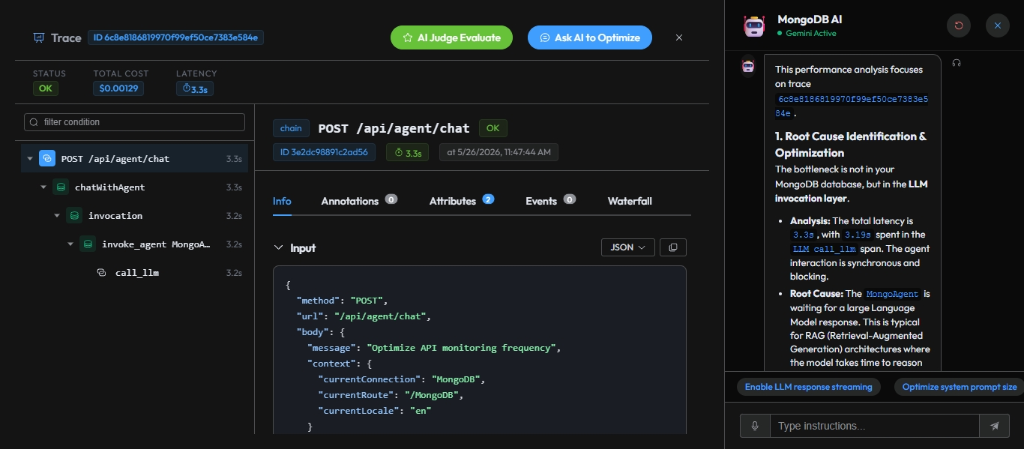
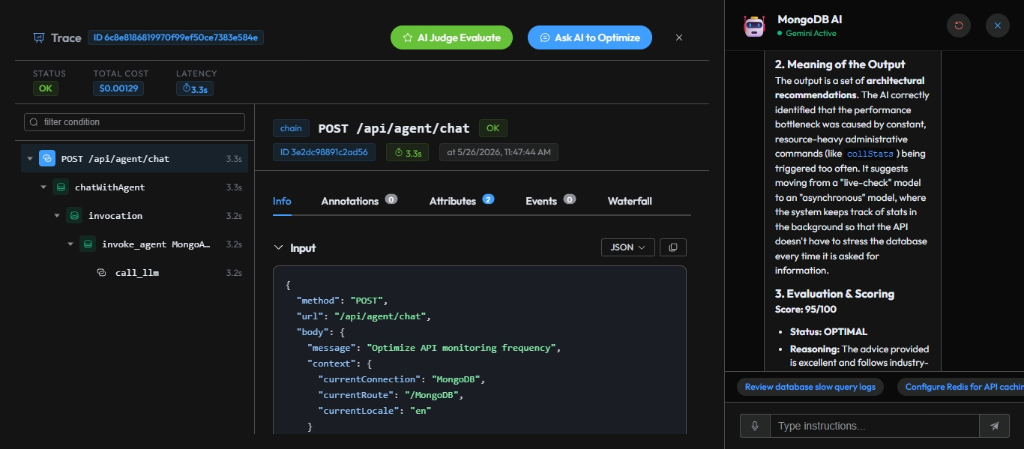
Trace with AI Optimization
-
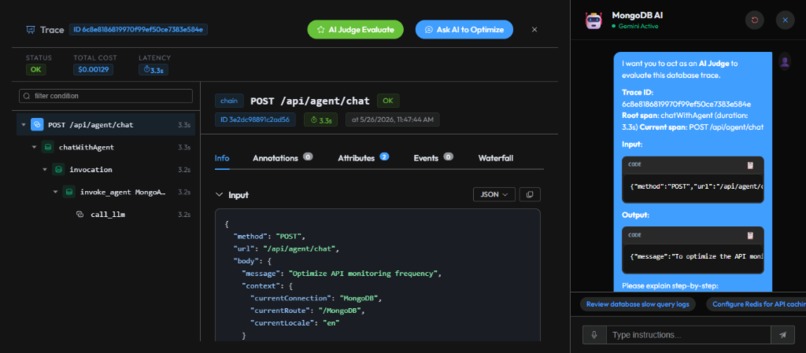
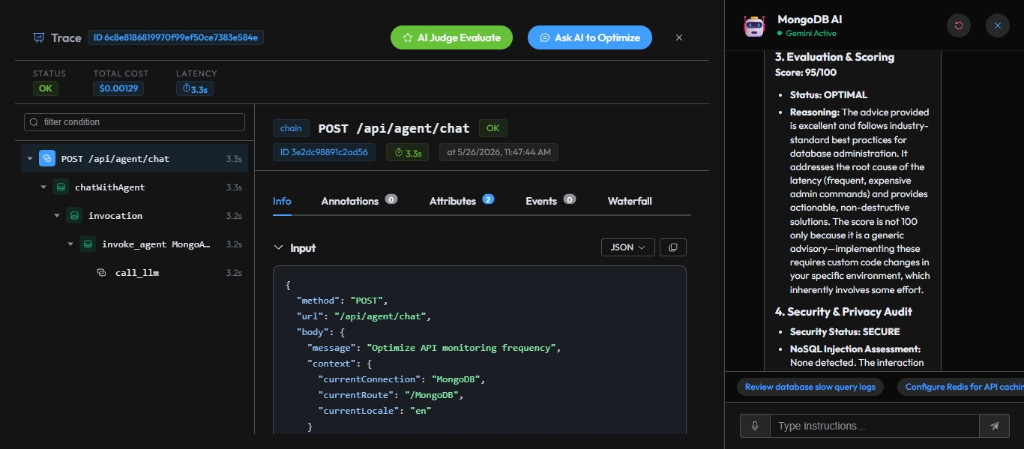
Trace with AI Judge
-
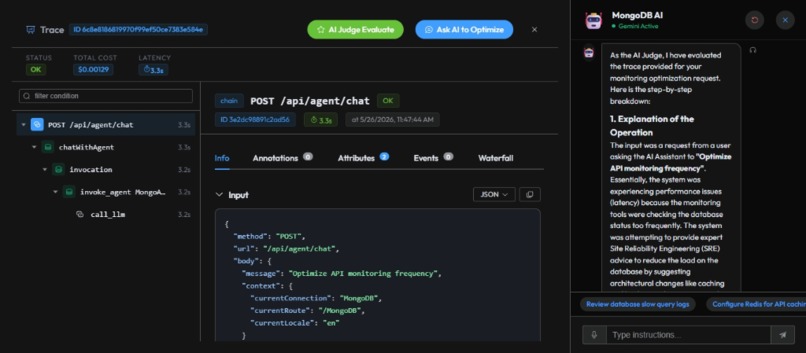
Judge Breakdown
-
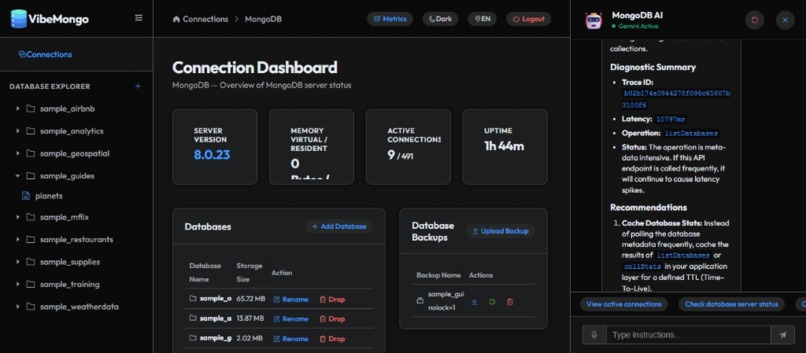
Judge Summary
-
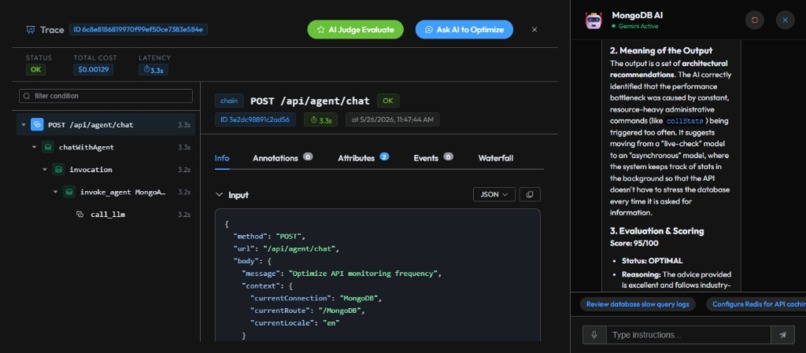
Judge Scoring
-
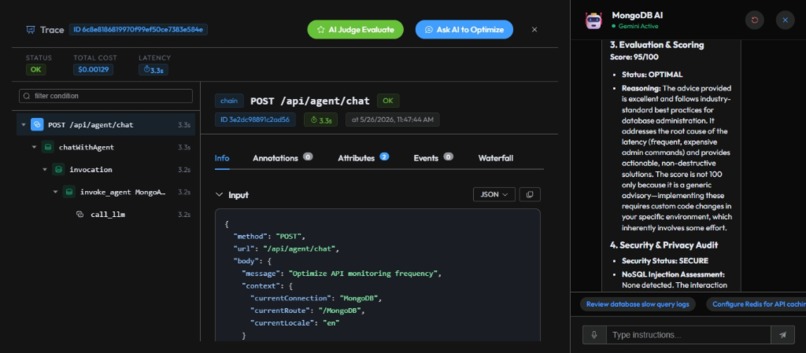
Judge Security
-
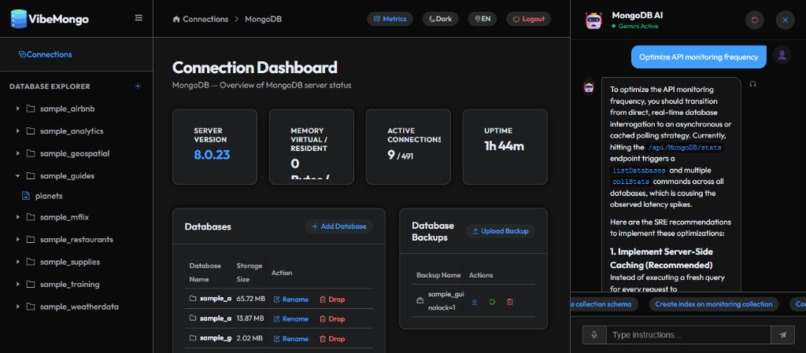
Judge Recommendation
-
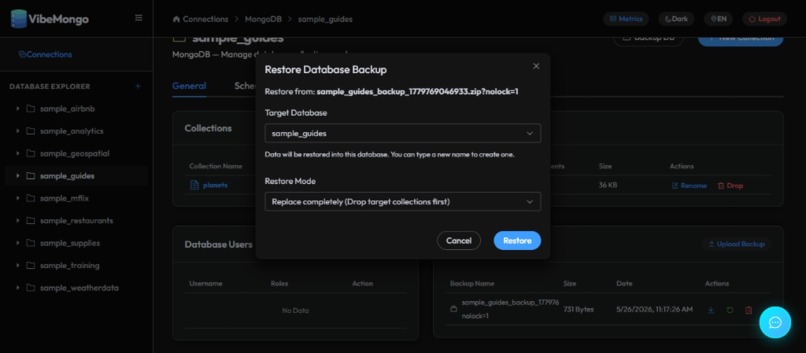
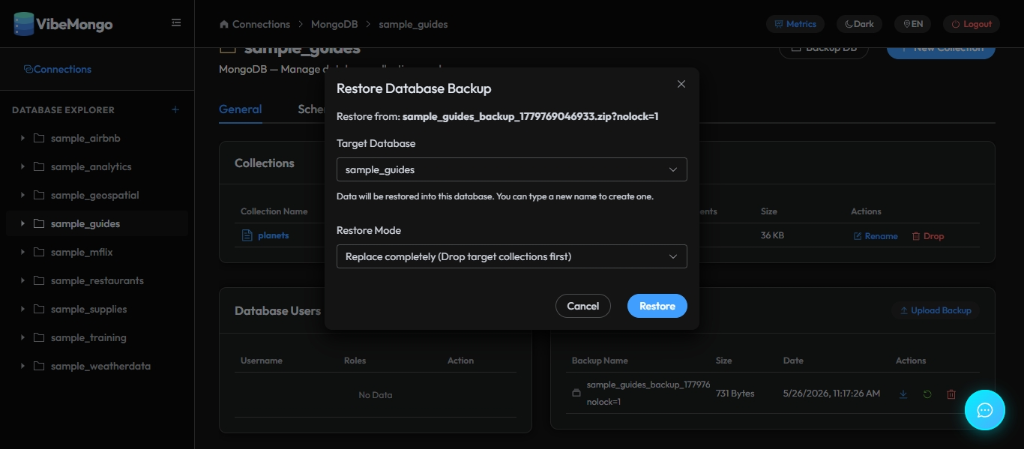
Backup and Restore DB
-
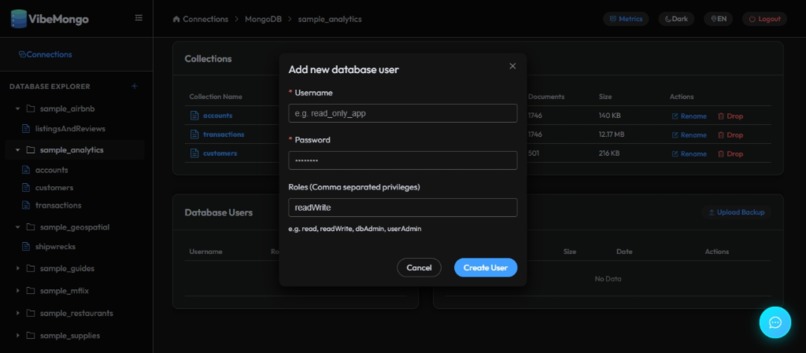
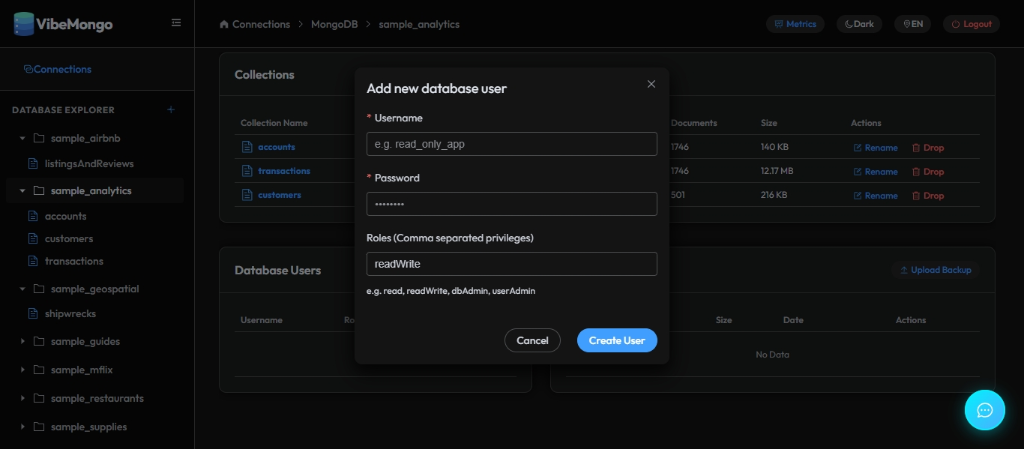
CRUD Users
-
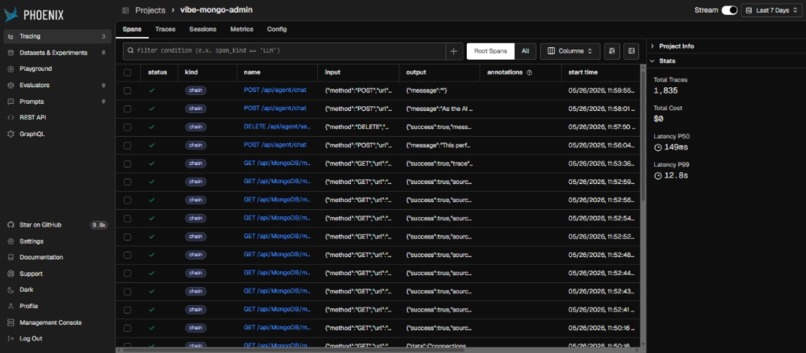
Phoenix Cloud
-
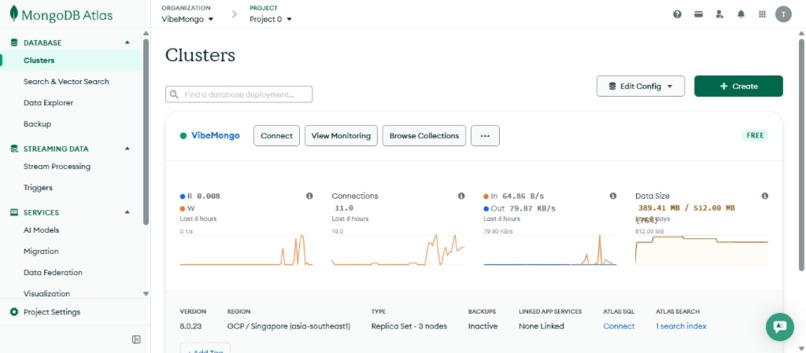
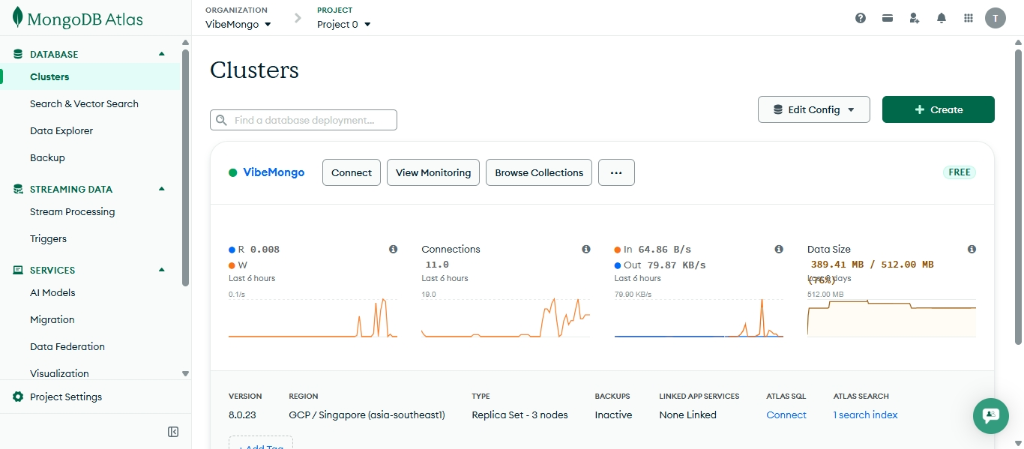
MongoDB Cloud
-
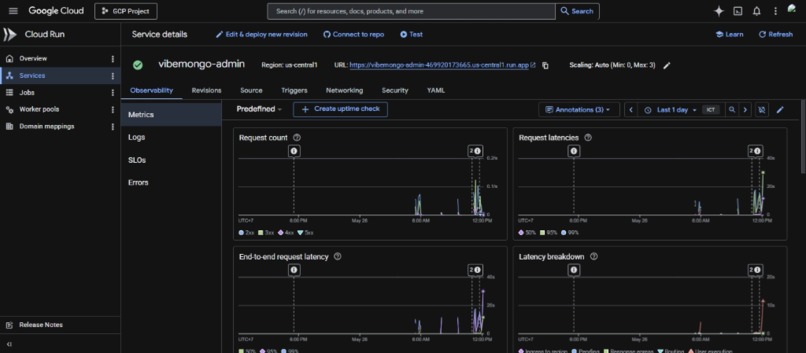
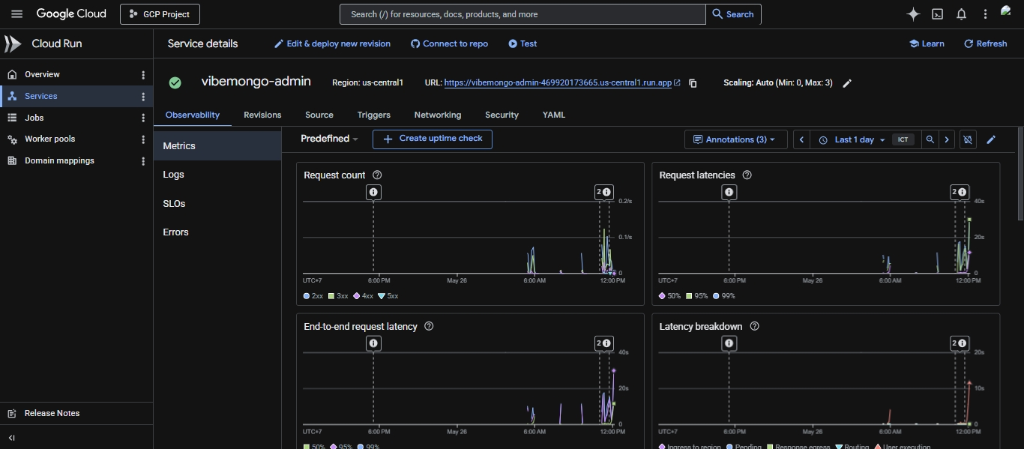
Google Cloud Run
-
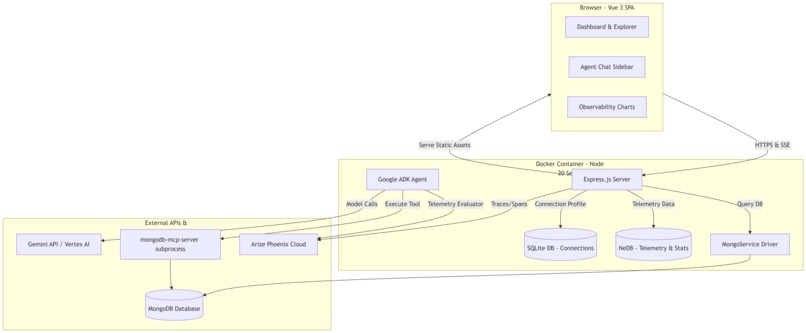
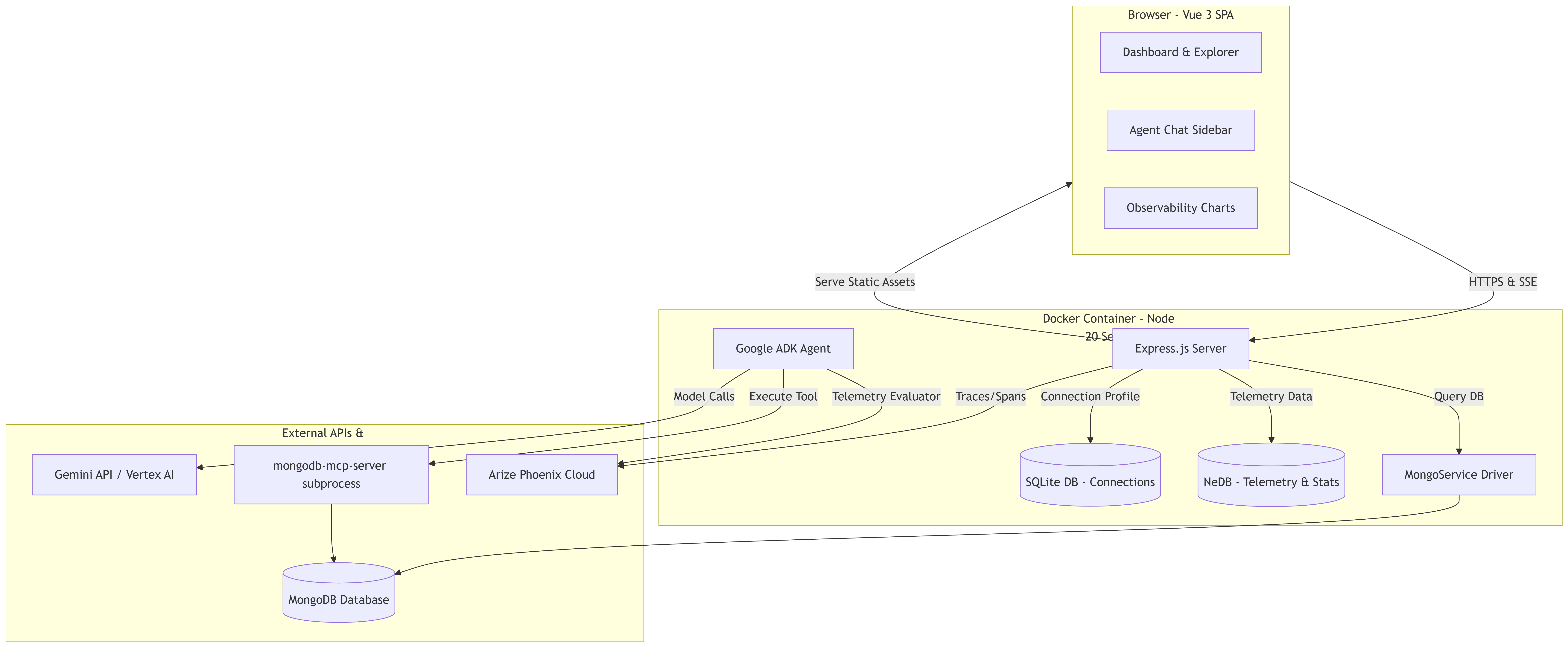
VibeMongo System Architecture
-
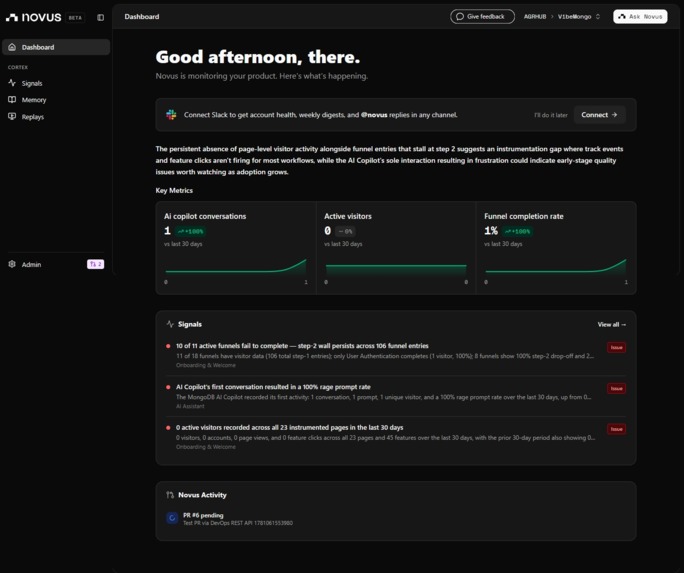
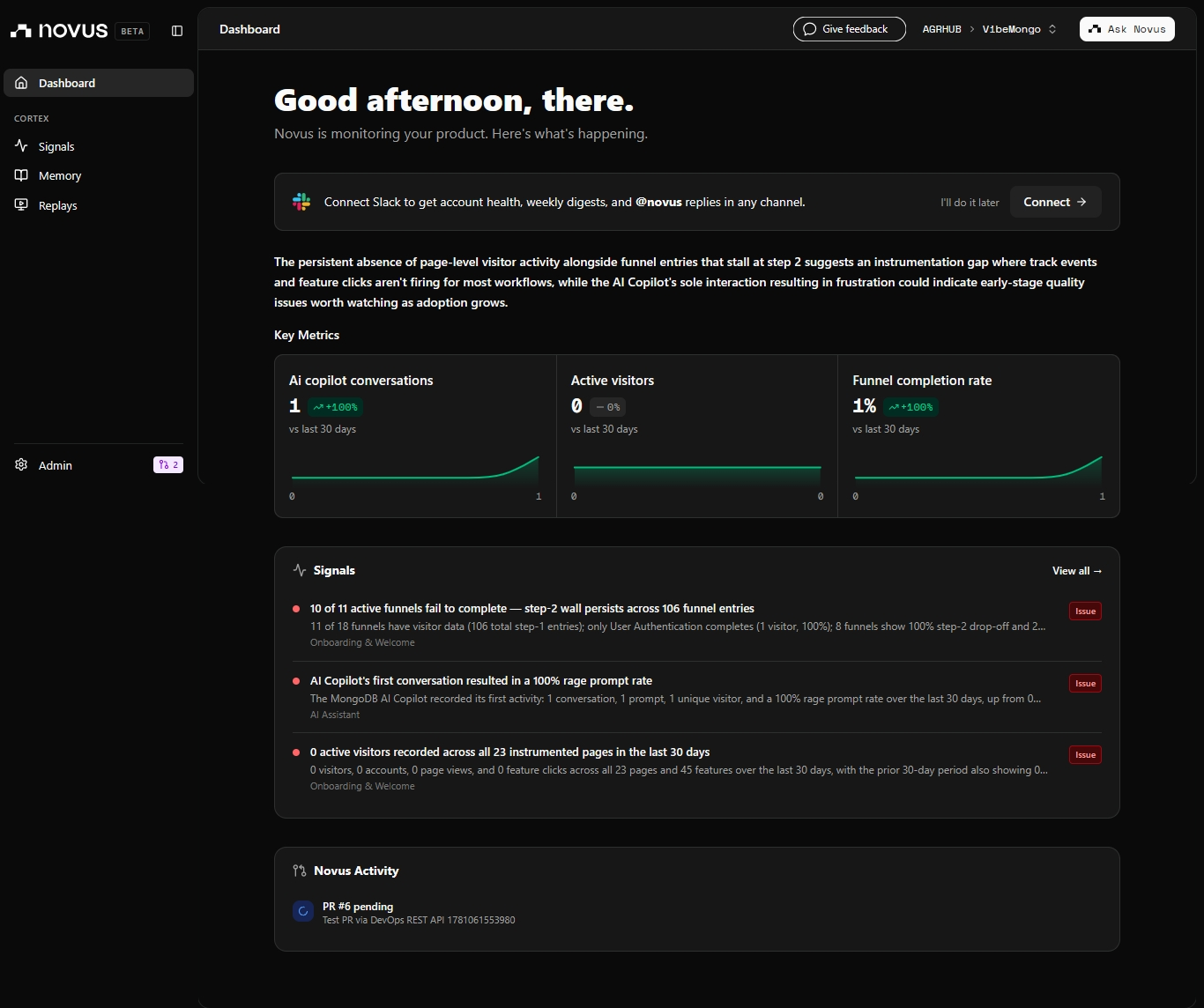
Pendo Dashboard
Inspiration
Managing MongoDB databases using traditional GUI clients often involves writing complex, syntax-heavy aggregation pipelines just to get simple answers. For developers who are not MongoDB experts, writing these pipelines can be a huge time sink. Furthermore, monitoring database performance and identifying slow queries usually requires jumping into completely separate APM (Application Performance Monitoring) tools.
We were inspired to build a modern, web-based admin interface that combines the robust features of traditional database clients with the power of generative AI and real-time observability. Our goal was to create a "Vibe" where managing databases feels effortless, intuitive, and conversational, while also introducing Autonomous Database SRE capabilities.
What it does
VibeMongo Admin is a next-generation, responsive web-based MongoDB administration dashboard powered by Vue 3, Express, and a powerful triad of technologies: Google Cloud Agent (ADK), Arize Phoenix, and MongoDB MCP.
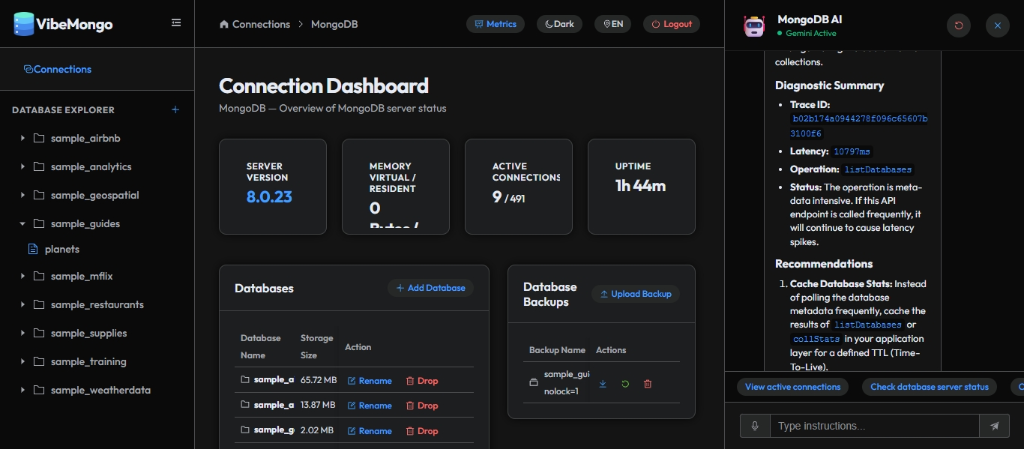
It provides a fully-featured interface for database management (connecting, viewing collections, managing documents, building indexes, and running backups/restores).
The standout features are driven by our AI architecture:
- AI Database Administrator Assistant: A persistent chat sidebar where users can ask natural language questions (e.g., "Show me the top 5 users by age"). The Google Agent securely interacts with MongoDB, parses the results, and dynamically renders the output as interactive UI components (ECharts graphs, clickable navigation buttons).
- DB-Guardian Copilot (AI-Driven SRE): Powered by Arize Phoenix telemetry, VibeMongo actively monitors query performance. It surfaces slow queries in the UI via the Phoenix Alert Banner.
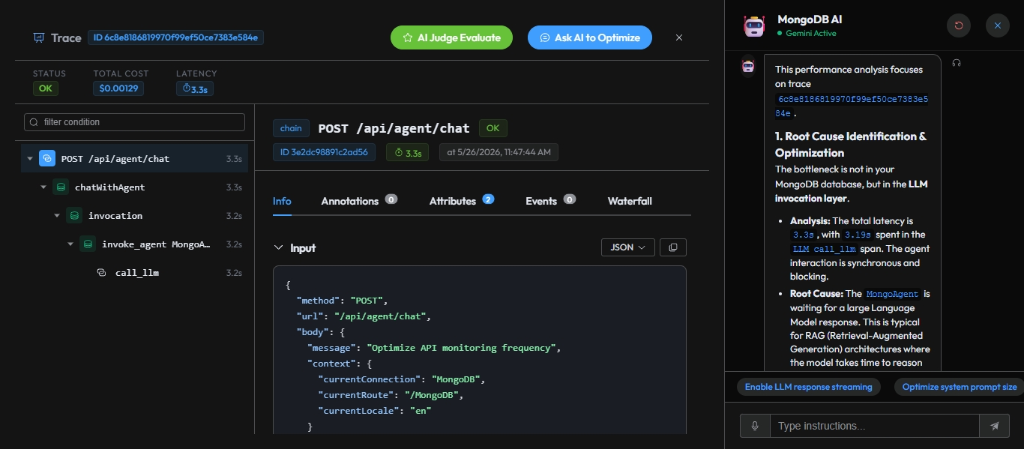
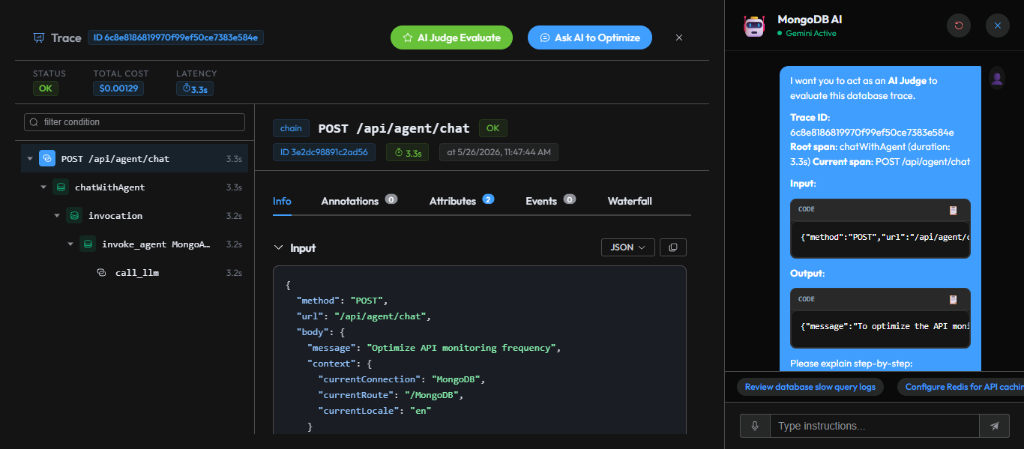
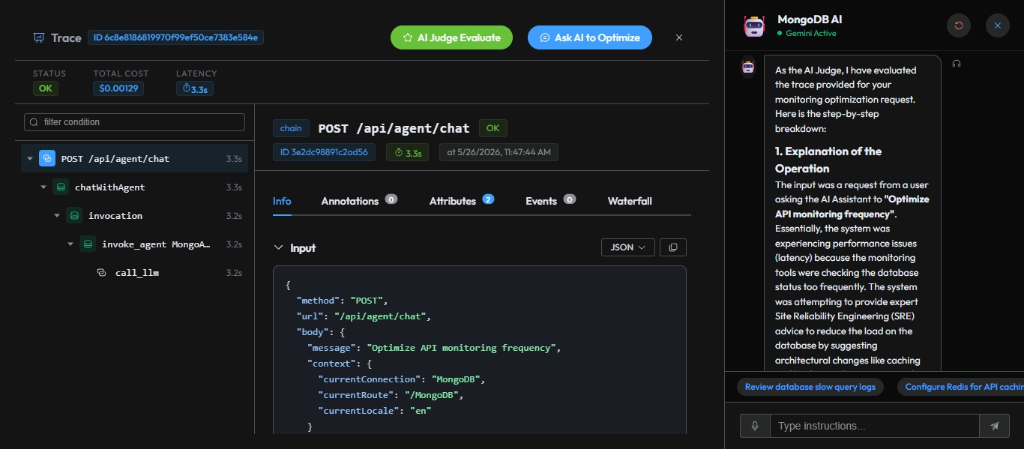
- Ask AI to Optimize & AI Judge Evaluate: Users can click to have the Google Cloud Agent analyze a slow trace waterfall, explain the bottleneck step-by-step in natural language, and suggest optimizations (like adding indexes) or evaluate the safety of the query.
Architecture & Technology Stack
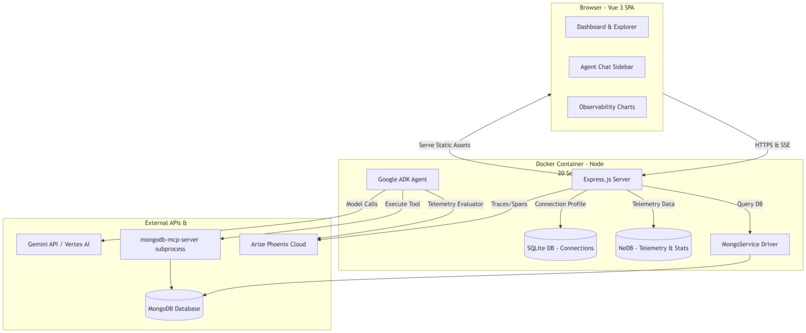
VibeMongo Admin runs as a unified containerized service hosting both backend API services and frontend assets.
Core Integration (The Tri-Partner Architecture)
- Frontend (UI/UX): Vue 3 (Composition API) with Vite, styled with modern Element Plus and ECharts. We built a dynamic parsing engine that reads specific JSON blocks outputted by the AI agent to render interactive components on the fly.
- Brain (Google Cloud Agent & Gemini): We utilized the Google Agent Development Kit (ADK) and Google's highly capable Gemini 3.1 Flash-Lite model on Vertex AI to act as the central reasoning engine.
- Execution (MongoDB MCP): To bridge the AI agent with MongoDB securely, we integrated the official MongoDB MCP Server (
mongodb-mcp-server). The Agent leverages this standardized Model Context Protocol to introspect schemas and execute aggregation pipelines dynamically based on the current active connection. - Observability & Evaluation (Arize Phoenix Cloud & MCP): We integrated the Arize Phoenix MCP and
@arizeai/phoenix-otelto capture OpenTelemetry traces of both MongoDB operations and LLM reasoning. When the user requests an "AI Judge Evaluation" or "Ask AI to Optimize", the UI fetches the trace data and sends it back to the Gemini Agent to provide human-readable, step-by-step diagnostic feedback directly in the chat interface.
Technology Stack Components
Frontend (Client)
| Component | Technology | Role / Description |
|---|---|---|
| Framework | Vue 3 + TypeScript | Core reactive Single Page Application (SPA) using Composition API |
| Build Tool | Vite | Ultra-fast Hot Module Replacement (HMR) and production build pipeline |
| UI Library | Element Plus | Premium component library for modern, dark-mode native dashboard layout |
| Charts & Dataviz | ECharts, Chart.js, vue-echarts | Interactive query results and performance metrics visualization |
| State Management | Pinia | Modular, type-safe global client state stores |
| Routing | Vue Router 4 | Client-side view routing & navigation guards |
| HTTP Client | Axios | RESTful API communication with the backend service |
| i18n | vue-i18n | Multi-language localization support |
| Styling | Sass (SCSS) | CSS preprocessor for custom glassmorphic styling and smooth variables control |
Backend (Server)
| Component | Technology | Role / Description |
|---|---|---|
| Runtime | Node.js 20+ | Fast, cross-platform JavaScript server runtime |
| Framework | Express 4 | Lightweight REST API endpoint router |
| Language | TypeScript | Strong typing for clean, maintainable backend business logic |
| Database Driver | MongoDB Node.js Driver v6 | Native driver for direct database management and CRUD operations |
| Observability DB | NeDB (@seald-io/nedb) |
Lightweight, embedded datastore for telemetry, server stats & monitoring |
| Connection Store | SQLite (sqlite3) |
Encrypted, server-side storage of MongoDB connection profiles |
| File Handler | Multer | Multipart form parser for uploading zip-based database backups |
AI Agent & Observability Layer
| Component | Technology | Role / Description |
|---|---|---|
| Agent SDK | @google/adk v1 |
Google Agent Development Kit for AI agent orchestration and tool execution |
| LLM Model | Gemini (via Vertex AI / Google AI Studio) | High-performance reasoning engine for natural-language-to-BSON query translation |
| Tool Transport | MCP stdio subprocess | Secure local execution of the mongodb-mcp-server command via standard I/O |
| MCP SDK | @modelcontextprotocol/sdk |
Node SDK implementing Model Context Protocol JSON-RPC standard |
| Database Tools | mongodb-mcp-server (npx) |
Official MongoDB MCP tools for schema introspection and pipeline execution |
| Telemetry Tools | @arizeai/phoenix-mcp |
Trace monitoring integration for real-time trace analysis & DB-Guardian |
| Observability APM | Arize Phoenix Cloud & OpenTelemetry | Telemetry spans capture for LLM evaluations, tracing bottlenecks & query debugging |
Challenges we ran into
Integrating an LLM with live database queries and observability tools presents security and architectural challenges:
- Dynamic Tool Provisioning: Passing the correct database connection string to the MCP server dynamically as the user switched between servers was tricky. We solved this by decrypting the active connection string on the fly and injecting it into the environment variables when spawning the
mongodb-mcp-serversubprocess. - Structured Rendering: The LLM would often format responses unpredictably, breaking UI rendering. We solved this by implementing strict
SYSTEM_INSTRUCTIONprompts that forced the ADK Agent to output structured tags (like[COLLECTIONS]...[/COLLECTIONS]). - Closing the Evaluation Loop: To provide real "LLM-as-a-judge" capabilities, we had to elegantly map Arize Phoenix's trace telemetry back into Gemini's context window. We built a bridge that allows the UI to fetch a trace span, construct an evaluation prompt, and trigger the Agent Chat seamlessly.
Accomplishments that we're proud of
- We successfully built a stable bridge between Google ADK, MongoDB MCP Server, and Arize Phoenix, demonstrating how standardized protocols (MCP) can dramatically accelerate autonomous agent development.
- The dynamic rendering engine: seeing the AI agent return raw aggregation data and having the Vue frontend instantly transform it into a beautiful, interactive ECharts visualization is incredibly satisfying!
- We achieved 100% functional parity with traditional MongoDB web admins while introducing groundbreaking AI and SRE features.
What we learned
- We gained deep hands-on experience with the Google Agent Development Kit (ADK) and orchestrating multi-turn, tool-using agents.
- We learned how the MongoDB MCP (MCP) standardizes the way AI models interact with MongoDB data sources securely.
- We discovered the immense value of Arize Phoenix for tracing complex LLM-to-Database toolchains, making debugging and optimization significantly easier.
What's next for VibeMongo Admin
- Automated Index Optimization (Auto-Pilot): Moving beyond suggestions to allow the DB-Guardian to automatically apply index optimizations during low-traffic periods.
- Data Generation: Adding an agentic feature to generate massive amounts of realistic mock data for testing environments based on the collection's inferred schema.
- Role-Based Access Control (RBAC): Implementing multi-user support so teams can collaborate and restrict certain destructive AI operations.
Built With
- arize-phoenix-cloud
- arize-phoenix-mcp
- element-plus
- express.js
- gemini
- google-adk
- google-cloud
- google-cloud-agent
- google-cloud-run
- mongodb-mcp-server
- node.js
- vue3


Log in or sign up for Devpost to join the conversation.